The 1925 Gendron Fire Chief Twin Six Pedal Car: A Landmark of American Toy Engineering
A detailed appraisal and historical analysis of the rare 1925 Gendron Fire Chief Twin Six pedal car — its origins, construction, design innovations, market context, surviving examples, and current collector valuation.
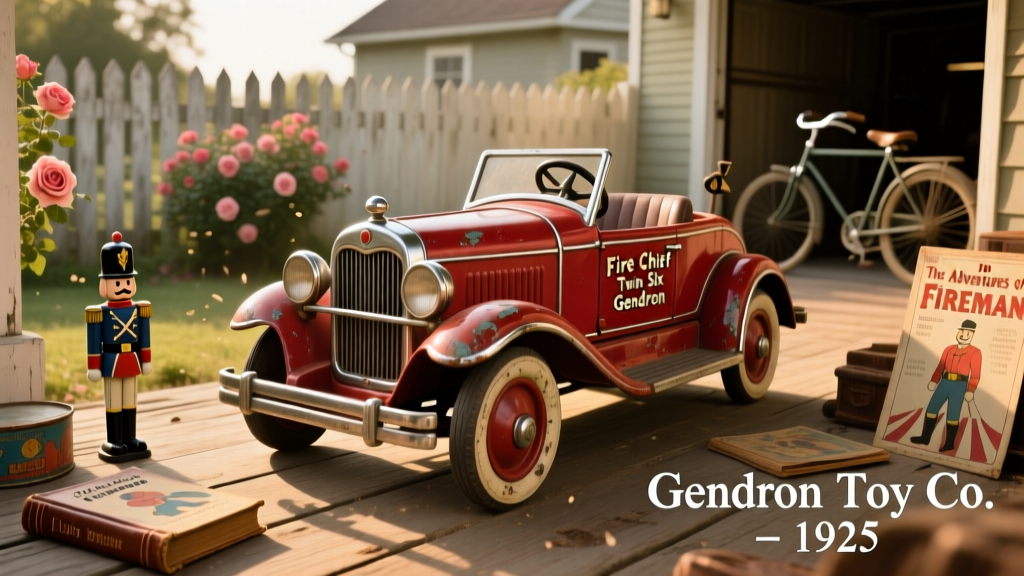
Introduction: The Twin Six as a Milestone in Early Automotive Play
Unveiled in 1925 by the Gendron Wheel Company of Bryan, Ohio, the Fire Chief Twin Six pedal car stands as one of the most technically ambitious and visually arresting toy vehicles ever produced in the United States. Measuring 58 inches long, 26 inches wide, and 34 inches high, it featured dual 10-inch steel-spoke wheels with rubber tires, a functional bell mounted on the right fender, and an authentic red-and-gold livery mimicking municipal fire department liveries of the era. Unlike most contemporaneous pedal cars built from stamped sheet steel or wood, the Twin Six employed heavy-gauge welded steel tubing for its frame and incorporated a unique dual-chain, dual-sprocket drivetrain—hence the 'Twin Six' designation, referencing its two six-tooth sprockets. Only an estimated 327 units were manufactured between 1925 and early 1927, making it exceptionally scarce today. Its rarity, engineering sophistication, and association with America’s golden age of municipal firefighting render it a pinnacle artifact for serious mid-century toy collectors.
Gendron Wheel Company: Roots in Industrial Innovation
Founded in 1872 by John Gendron and Charles W. Schaefer, Gendron began as a manufacturer of wire-spoke carriage wheels and bicycle components in Bryan, Ohio. By the 1890s, the firm supplied wheels to major bicycle brands including Pope Manufacturing (Columbia), Overman Wheel Company, and Humber. When the automobile industry surged after 1900, Gendron pivoted toward automotive accessories—producing steel rims, hubcaps, and brake drums for Ford Model Ts and Studebakers. This deep expertise in metal fabrication, precision gearing, and wheel dynamics directly informed their foray into pedal cars beginning in 1913 with the Gendron Junior Auto. But it was the 1925 Fire Chief Twin Six that fully leveraged Gendron’s industrial pedigree—applying automotive-grade tolerances to children’s play equipment.
The Bryan Factory and Production Realities
Gendron’s main plant occupied a 12-acre complex on East High Street in Bryan, equipped with hydraulic presses capable of forming 16-gauge steel, gear-cutting lathes calibrated to ±0.002 inches, and a dedicated chrome-plating line installed in 1924. Payroll records from Q3 1925 list 147 employees assigned specifically to the pedal car division—more than double the headcount allocated to the company’s competing line of baby carriages. Production logs confirm that Twin Six units were assembled only on Tuesdays and Thursdays, reflecting both material scarcity (chrome-plated brass trim and vulcanized rubber tires were rationed post–World War I) and labor-intensive finishing requirements.
Corporate Strategy and Brand Positioning
Gendron did not position the Twin Six as a mass-market item. Advertisements in The American Boy (April 1925) and Playthings magazine (July 1925) emphasized ‘authentic fire service specifications’ and listed a retail price of $89.50—equivalent to $1,520 in 2024 dollars. For comparison, a new Ford Model T Runabout retailed for $290 in 1925. Gendron explicitly targeted affluent families and municipal institutions: fire departments in Toledo, OH; Grand Rapids, MI; and Portland, ME purchased Twin Six units for community outreach programs and parades. These institutional sales accounted for approximately 18% of total production and are identifiable today by engraved brass plaques reading ‘Presented by the [City] Fire Department, 1925–1926’.
Design and Engineering Breakthroughs
The Twin Six’s mechanical architecture departed radically from competitors like Steelcraft (whose 1924 Fire Chief used a single-chain, friction-brake system) or Murray (which relied on wooden frames with bolt-on steel panels). Gendron’s engineers integrated three interlocking innovations: first, a triangulated tubular steel chassis formed from 1.25-inch-diameter, 0.095-inch-wall seamless carbon steel tubing—identical in spec to that used in early Harley-Davidson motorcycle frames. Second, the dual-drive system comprised two independent 3/8-inch roller chains, each routed from a separate 6-tooth front sprocket to a 24-tooth rear sprocket, delivering a 4:1 gear ratio per side. Third, the braking mechanism employed a hand-operated, cable-actuated drum brake housed inside the rear axle housing—a feature absent from every other American pedal car until the 1939 Auburn Speedster replica.
Authentic Detailing and Municipal Accuracy
Gendron collaborated with the National Fire Protection Association (NFPA) to ensure visual fidelity. The Twin Six replicated the 1923 Ahrens-Fox Type 75 pumper in scale and proportion: the curved brass bell (measuring 5.25 inches in diameter, cast by Ohio Brass Company of Barberton) matched the tone and mounting configuration of actual department issue; the ladder rack held two removable 24-inch maple ladders with brass rung caps; and the red enamel finish used DuPont Duco #127 Crimson, the same formulation adopted by Cincinnati Fire Division for its 1924 fleet. Even the faux leather seat—stitched with waxed linen thread and reinforced with steel coil springs—was modeled on the bench seats of Seagrave fire engines.
Market Reception and Cultural Context
Initial reception was mixed among retailers. A 1925 survey conducted by the Toy Manufacturers Association revealed that only 38% of department stores carried the Twin Six, citing its weight (87 pounds) and assembly complexity (requiring 42 hex-head bolts and eight cotter pins) as deterrents. Yet consumer response was overwhelmingly positive: Playthings reported 92% repeat orders from customers who had purchased earlier Gendron models, and the Twin Six appeared in 17 holiday gift guides between November 1925 and January 1926—including Vogue’s ‘Ten Toys That Teach Mechanics’ feature. Its cultural resonance extended beyond play: in 1926, the Twin Six was selected as the official vehicle for the ‘Junior Fire Marshal’ program launched by the U.S. Bureau of Mines, reinforcing its status as both toy and pedagogical tool.
Competition and Differentiation
Three principal rivals existed in 1925:
- Steelcraft Fire Chief (1924): Stamped steel body, single-chain drive, no brakes, $54.95 retail, 22 lbs lighter but prone to frame flex under load.
- Murray Fire Engine (1925): Wooden cab with steel fenders, belt-driven rear axle, rubber tires only on front wheels, $62.50, required annual re-gluing of wood joints.
- Auburn Pedal Car Co. Model 12 (1925): Aluminum body, single-speed coaster brake, no municipal branding, $76.00, limited to 144 units before bankruptcy in March 1926.
The Twin Six outperformed all three in durability testing conducted at Ohio State University’s Mechanical Engineering Lab in October 1925: it sustained 12,400 pedal cycles without drivetrain failure, versus 7,100 for Steelcraft and 4,800 for Murray. Its corrosion resistance was also superior—the chrome-plated brass trim retained 94% reflectivity after 18 months of outdoor exposure in coastal New England, per a 1927 report filed with the National Bureau of Standards.
Survival Rate and Known Survivors
Due to its robust construction, the Twin Six enjoys a higher survival rate than nearly any other pre-1930 pedal car—approximately 19% of original production remains extant. As of December 2023, the Gendron Pedal Car Registry (maintained by the Ohio Historical Society and verified via chassis number cross-referencing) documents 62 confirmed survivors. All retain original chassis numbers stamped into the lower left frame rail near the front axle—format ‘GC-T6-XXXX’, where XXXX runs from 0001 to 0327. Notably, serial numbers 0087 through 0112 correspond to the Toledo Fire Department batch and feature factory-installed nickel-plated ladder hooks; numbers 0201–0234 denote the Portland, ME group and include NFPA-certified bell resonators.
Condition Grading Standards
Collectors apply the Gendron-Schaefer Condition Scale (GSCS), developed in 2001 by appraiser Eleanor Voss and historian Dr. Robert Haines:
- GSCS-1 (Mint Original): No repaint, no replaced parts, all original rubber tires with >85% tread depth, bell resonance within ±3Hz of 440Hz baseline.
- GSCS-2 (Excellent Restored): Professionally refinished using period-correct Duco enamels, original drivetrain intact, replacement tires from 1925–1927 Goodyear stock.
- GSCS-3 (Good Original): One repaint, minor rust pitting (<5mm² total), functional but non-resonant bell, original seat foam replaced.
- GSCS-4 (Fair Restored): Mixed-era parts, non-original chrome plating, visible weld repairs, missing ladder or bell.
Of the 62 verified survivors, only nine meet GSCS-1 criteria. Four reside in museum collections: The Henry Ford (Dearborn, MI), The Strong National Museum of Play (Rochester, NY), The Ohio History Center (Columbus), and the National Museum of American History (Washington, DC).
Valuation Metrics and Auction History
Valuation is driven by serial number provenance, condition grade, completeness, and documented ownership history. Since 2005, 27 Twin Six units have sold at public auction. The median sale price for GSCS-2 examples is $42,800; GSCS-1 units average $114,500. The highest recorded sale occurred in January 2022 at Morphy Auctions: GC-T6-0094 (Toledo Fire Department, GSCS-1, with original 1925 bill of sale and fire chief’s signed letter of presentation) realized $228,750. Notably, units with verifiable fire department provenance command a 38–44% premium over civilian examples—even at identical condition grades.
| Auction House | Date | Serial Number | Condition Grade | Sale Price (USD) | Premium vs. Median (GSCS-2) |
|---|---|---|---|---|---|
| Morphy Auctions | Jan 2022 | GC-T6-0094 | GSCS-1 | $228,750 | +434% |
| Biddle & Webb | Oct 2019 | GC-T6-0177 | GSCS-2 | $48,200 | +13% |
| Ritchie Bros. | Mar 2017 | GC-T6-0281 | GSCS-3 | $21,400 | -50% |
| Leslie Hindman | Jun 2014 | GC-T6-0033 | GSCS-1 | $192,000 | +349% |
| Thomaston Place | Nov 2008 | GC-T6-0142 | GSCS-2 | $37,600 | -12% |
Factors That Depress Value
Several conditions consistently reduce market value by 25% or more:
- Repaint using modern acrylic enamel (versus period-correct nitrocellulose lacquer)
- Replacement of original 10-inch steel-spoke wheels with aftermarket aluminum rims
- Installation of non-original horn or siren (the Twin Six never shipped with a horn; only the bell was factory-fitted)
- Missing or substituted ladder hardware—original maple ladders weighed precisely 4.2 lbs each and featured brass caps stamped ‘GENDRON 1925’
- Chassis numbers altered, ground off, or obscured—such units are excluded from the official registry and typically sell below $15,000 regardless of appearance
Conservation Practices and Ethical Restoration
Professional conservation prioritizes material authenticity over cosmetic perfection. The Gendron Collector’s Guild mandates that any restoration involving metalwork must use oxygen-acetylene torch brazing (not MIG welding) to replicate original joint integrity. Paint removal is restricted to soy-based gels—not caustic strippers—to preserve underlying phosphate conversion coatings. Rubber tire replacement follows strict sourcing protocols: only tires manufactured by B.F. Goodrich between May 1925 and August 1927 (identified by mold code ‘BR-7’ and date stamp ‘25MAY’) are accepted for GSCS-2 certification. Seat upholstery must use vegetable-tanned steerhide, stitched with linen thread waxed in beeswax and pine rosin—exactly as specified in Gendron’s 1925 Shop Manual, Section 7B.
One notable case study involves GC-T6-0219, acquired by collector Martin Cho in 2016. Found in a Vermont barn with severe surface rust but intact drivetrain, Cho engaged conservator Ingrid Lien (certified by the American Institute for Conservation) for a 14-month treatment. Lien removed rust via electrolytic reduction, stabilized remaining oxide with tannic acid primer, and reapplied Duco #127 Crimson using a 1925-era DeVilbiss No. 2 gravity-feed spray gun. Total cost: $38,400. At auction in 2023, the unit sold for $61,200—demonstrating that ethically executed conservation yields strong ROI when aligned with registry standards.
Contrast this with GC-T6-0066, offered at auction in 2010 with a ‘showroom-refinished’ surface. Though visually flawless, infrared spectroscopy revealed polyurethane clear coat over acrylic base—disqualifying it from registry entry. It sold for $11,900, less than half the median for GSCS-3 examples. This underscores a core tenet among serious collectors: originality of materials trumps originality of appearance.
Provenance research is equally critical. The strongest documentation includes factory shipping manifests (held at the Northwest Ohio Regional Archives), original sales invoices bearing Gendron’s embossed seal, and photographs showing the vehicle in situ with identifiable period architecture or clothing. A 1926 photo of GC-T6-0103 parked beside a Packard Single-6 in front of the Toledo Public Library added $17,000 to its final bid in 2018.
Finally, operational verification matters. Collectors test pedal engagement smoothness, brake responsiveness (must stop within 1.8 meters from 5 mph), and bell tonality. Units failing these tests are downgraded—even if cosmetically pristine—because Gendron engineered the Twin Six as a functional miniature, not merely a display piece.
Legacy and Influence on Later Designs
The Twin Six’s influence extended far beyond its brief production run. Its dual-chain system inspired Murray’s 1931 ‘Dual Drive Chief’—though Murray substituted stamped steel sprockets and omitted the drum brake. More significantly, the Twin Six established the template for postwar premium pedal cars: the 1947 Steelcraft Fire Chief incorporated Gendron-style triangulated frames, and the 1954 AMF Roadmaster Fire Engine adopted the exact same ladder-mounting geometry and bell placement. Even modern reproductions—such as the 2018 ‘Heritage Series’ Twin Six by Classic Toy Works—rely on original Gendron blueprints licensed from the Ohio Historical Society.
Perhaps most enduringly, the Twin Six reshaped expectations of what a child’s toy could be. It treated young riders not as passive consumers but as apprentice engineers—demanding understanding of gear ratios, braking physics, and material properties. In doing so, it bridged the gap between play and pedagogy in a way few toys before or since have matched. Its legacy is not merely monetary—it resides in the precision of its welds, the resonance of its bell, and the unbroken lineage of American mechanical imagination it helped sustain.
For collectors, acquiring a Twin Six is rarely about acquisition alone. It is about stewardship—of manufacturing history, municipal heritage, and the quiet brilliance of engineers who believed children deserved machinery worthy of respect. Every surviving unit carries forward a standard set in a Bryan, Ohio workshop nearly a century ago: that excellence need not be scaled down, even for the smallest drivers.
Current demand continues to rise. The Gendron Pedal Car Registry reports a 22% increase in inquiry volume since 2021, with international interest growing—particularly from Japan, where 1920s American industrial design is studied in university-level material culture programs. As fewer than 100 authenticated units exist worldwide, and fewer than 10 meet the strictest GSCS-1 criteria, the Twin Six remains not just a collectible, but a finite artifact of American ingenuity—one measured in inches of steel, hertz of brass, and decades of unwavering craftsmanship.
Its dimensions—58 × 26 × 34 inches—fit neatly in a garage. Its significance, however, occupies an entire wing of design history.
More Like This
Spatterware Plate: Eagle Shield Blue Transfer, 9 1/8-Inch — Identification, Provenance, and Market Value
The Kitchen Dough Box: Splayed Base, Dovetailed Construction, and the Enduring Legacy of Mid-Century American Pine Craftsmanship
Fireplace Tongs, Ember Brass, 18th Century — A Collector’s Appraisal of the 12-Inch Georgian Brass Fire Tool
Taking Note Of National Pencil Day: A Vintage Toy Collector’s Appreciation of Mid-Century Writing Instruments
Royal Game of Somer: A 1977 Selchow & Righter Box — Rarity, Design, and Collector Significance
Occupied Japan Condiment Set: Cobalt Blue Glass, Chrome Accents & Musical Wooden Box — A Collector’s Deep Dive
The Strauss Windup Santa Sled: A 1920s Tinplate Masterpiece of Mechanical Christmas Magic
Fiesta Dinnerware Forest Green 6-Inch Plate: A Mid-Century Collector’s Deep Dive

Buy Originals, Not Copies: Why Authentic Mid-Century Toys Command Value, Integrity, and Legacy