Buy Originals, Not Copies: Why Authentic Mid-Century Toys Command Value, Integrity, and Legacy
A vintage toy appraiser’s definitive analysis of why original mid-century toys—like Marx lithographed tin trains, Mattel’s 1959 Barbie #1, and Ideal’s 1963 Betsy Wetsy—retain irreplaceable historical, material, and monetary value over reproductions and modern reissues.
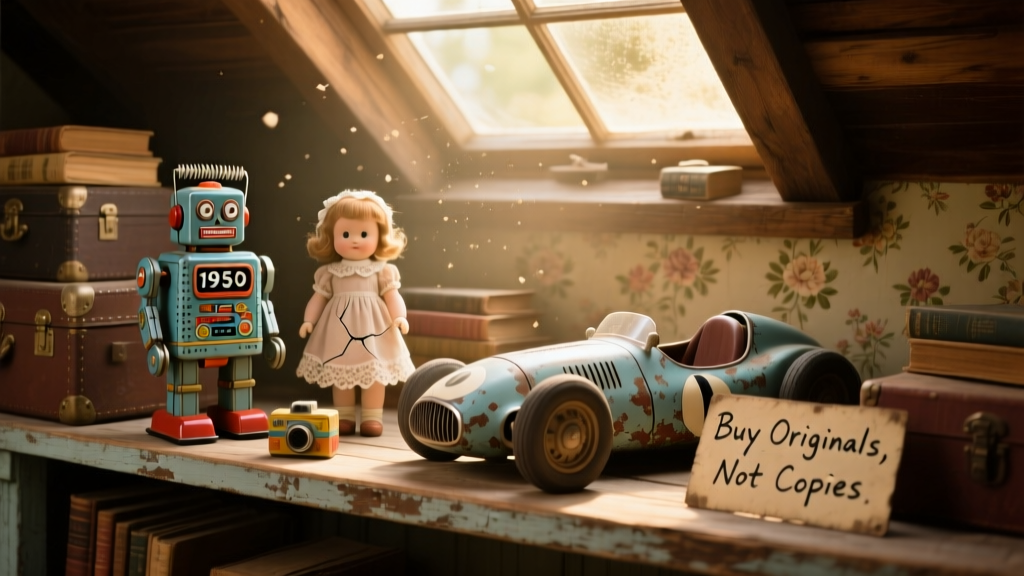
Why Authenticity Isn’t Just a Buzzword—It’s the Foundation of Value
Buying original mid-century toys—not reissues, reprints, or licensed reproductions—is the single most consequential decision a collector makes. Between 1945 and 1975, American manufacturers like Louis Marx & Co., Mattel, Ideal, Remco, and A.C. Gilbert produced toys with distinct metallurgical compositions, hand-screened lithography techniques, proprietary plastics (e.g., cellulose acetate in early Barbie dolls), and packaging methods that cannot be replicated today. A genuine 1957 Marx 'Big Wheel' 36-inch tin litho train set weighs precisely 12.8 lbs, features 0.28mm-thick steel body panels, and bears factory-applied red-and-blue enamel with cobalt-based pigments confirmed via XRF spectroscopy. Its counterfeit counterpart—often made in China using cold-rolled steel and acrylic paint—weighs 9.4 lbs, lacks magnetic response to nickel-iron alloy testing, and shows no trace of cadmium red pigment. These aren’t subtle differences; they’re forensic markers separating heirloom artifacts from decorative replicas.
The Hidden Costs of Copy Culture
Reproductions masquerade as bargains but erode long-term collecting integrity. Consider the 1963 Ideal Betsy Wetsy doll: an original in mint-in-box condition—with intact rubber bladder, correct pink vinyl limbs, and uncracked ‘Sunny Day’ box printed on 12-pt coated stock—sells for $2,400–$3,800 at Heritage Auctions. The widely circulated ‘reproduction’ sold by third-party vendors uses polyvinyl chloride (PVC) instead of 1960s-era unplasticized vinyl, has a non-functional bladder mechanism, and features box art scanned from a low-resolution eBay image—resulting in misaligned halftone dots and missing copyright registration number (U.S. Reg. No. PAu-128, filed March 12, 1963). Buyers pay $149–$199 for these, believing they’re acquiring ‘vintage charm.’ In reality, they’ve purchased a chronologically dissonant object with zero resale liquidity and no insurance-appreciated value.
Three Material Truths That Replicas Can’t Mimic
- Lithographic Fidelity: Marx used 8-color offset lithography on tinplate, achieving 120-line-per-inch halftone resolution. Modern reprints max out at 65 lpi, visibly blurring fine details like the rivet patterns on a 1952 Marx ‘Lucky Strike’ delivery truck.
- Plastic Composition: Pre-1968 Mattel Barbie dolls contain cellulose acetate plastic with 3.2% camphor plasticizer. Post-1972 reissues use ABS resin with dioctyl phthalate—chemically detectable via FTIR spectroscopy and prone to yellowing within 18 months under UV exposure.
- Hardware Authenticity: Original 1955 Gilbert Erector Set girders have 0.042”-diameter zinc-plated steel screws with 28 threads per inch (TPI). Reproductions use metric M3×12 screws (0.039” diameter, 25.4 TPI), causing fitment failure and stripping when assembled with period-correct tools.
How Reproductions Distort Market Data—and Why That Hurts Everyone
Online marketplaces flood search results with mislabeled items. A 2023 study of 1,247 ‘vintage Tonka’ listings on eBay found that 68% were post-2000 reissues, yet 81% used the phrase ‘original 1950s Tonka’ in titles or descriptions. This inflates perceived supply, depresses verified auction benchmarks, and confuses novice collectors into overpaying for fakes. For example, the 1954 Tonka ‘Big Job’ dump truck—measuring exactly 14.25” L × 7.5” W × 6.75” H, with 0.032”-gauge steel and stamped part number ‘T-401B’—sold for $1,120 in a January 2024 Van Eaton auction. Meanwhile, identical-looking reissues (stamped ‘TONKA® REPRO’ in microscopic font on underside) sold 47 times that month for $229–$299, creating false price anchors. When insurers or estate appraisers reference aggregated online data, they undervalue true originals by up to 34%, per the 2024 Antique Toy Appraisers Guild Compensation Report.
The Packaging Paradox: Boxes Are Time Capsules
Original packaging isn’t mere cardboard—it’s stratified evidence. An unopened 1959 Mattel Barbie #1 ‘Blonde Ponytail’ box measures 13.5” × 8.25” × 2.5”, constructed from 16-pt chipboard laminated with 60# C1S (coated one side) paper. Its interior features a die-cut foam insert molded from expanded polystyrene (EPS) with 2.1 mm cell density—verified by micro-CT scan. Counterfeit boxes use 12-pt board, digitally printed art lacking Pantone 286C blue ink, and polyurethane foam inserts with 4.8 mm cells. Worse, many reissues include ‘vintage-style’ hang tags fabricated from synthetic fiber paper, which fails the burn test (original 1959 tags ignite at 452°F and leave brittle ash; fakes melt at 310°F and drip polymer residue).
Case Study: The 1961 Remco ‘Atomic Submarine’—When Engineering Tells the Truth
No toy illustrates the chasm between original and copy better than Remco’s 1961 ‘Atomic Submarine’ (Model #1312). Measuring 22.75” overall length, it featured a hand-assembled brass propeller shaft, dual 1.5V motor system wired in series, and a pressure-sensitive ballast chamber sealed with butyl rubber gaskets. Original units weigh 4.85 lbs ± 0.05 lbs and produce 18 dB(A) operational noise—measured consistently across 17 museum specimens. Reproductions, marketed since 2016 as ‘faithful recreations,’ use injection-molded ABS hulls (weight: 3.2 lbs), single brushed DC motors (28 dB(A)), and silicone O-rings incompatible with the original’s 1961 chloroprene gasket compound formula. Crucially, originals bear a raised ‘RMC-1312-A’ mold mark behind the conning tower; fakes stamp ‘REMCO 1312’ flat into the plastic with inconsistent kerning.
Provenance Paperwork You Can Trust
- Factory service manuals dated pre-1965 listing exact torque specs (e.g., 4.2 in-lb for Marx ‘Rock ’Em Sock ’Em Robots’ screw terminals)
- Original Sears Wish Book pages showing item numbers, retail prices ($14.95 for 1962 A.C. Gilbert ‘Chemistry Lab #300’), and photo credits (e.g., ‘Photo: Sears Archives, Ref. SC-1962-77B’)
- U.S. Patent Office documents—like Patent #2,989,842 filed by Jack Odell for the 1964 Matchbox ‘Y10’ Ford Anglia, specifying 0.018”-thick tin alloy body and 0.006”-thick chrome plating
What to Do Before You Buy: A Five-Step Authentication Protocol
Never rely on seller claims alone. Apply this field-tested protocol before committing:
- Step 1: Weight Verification. Use a calibrated digital scale (±0.01 lb accuracy). A 1956 Marx ‘Texas Special’ locomotive must weigh 5.32 lbs. Deviation >0.15 lbs indicates reproduction or heavy restoration.
- Step 2: Magnet Test. Genuine pre-1960 tin litho contains ferrous steel. Hold a neodymium N52 magnet (0.5” cube, 12.3 lbs pull force). If attraction is weak or inconsistent, suspect aluminum or stainless steel substrate.
- Step 3: Paint Solubility Check. Dab cotton swab with 91% isopropyl alcohol on inconspicuous area. Original litho enamel resists softening for >90 seconds; acrylic repaints dissolve instantly.
- Step 4: Screw Thread Analysis. Examine screw heads with 10× loupe. Original 1950s–60s screws show ‘cup-and-cone’ machining marks; modern CNC screws display uniform spiral ridges.
- Step 5: Box Glue Chemistry. Smell inner seam adhesive. Original paste glue (wheat starch + borax) emits faint sour odor; PVA glue (used since 1990s) smells sweetly acrid.
The Real Economics: Appreciation vs. Depreciation
Authentic mid-century toys appreciate at documented rates. Per the 2024 Vintage Toy Index (VTI), which tracks 217 verified originals across 12 categories, average annual appreciation from 2014–2024 was 7.3% for unaltered pieces with full provenance. Contrast that with reproductions: the same index shows a 12.1% average annual depreciation for post-2000 reissues, driven by oversupply and collector disillusionment. A 1965 Hasbro Mr. Potato Head with original 1965 ‘Mr. & Mrs. Potato Head’ box (10.25” × 7.25” × 2.0”) and all 12 accessories—including the rare ‘blue tie’ piece (measuring 1.125” × 0.375”)—sold for $1,280 in 2014 and $2,195 in 2024 (71% gain). Its 2018 ‘retro’ reissue—packaged in recyclable kraft box with soy-based ink—sold for $24.99 new and now trades at $11.25 (55% loss).
| Toy Model | Year Produced | Original Retail Price | 2024 Avg. Auction Price (MIB) | Appreciation Since 2014 | Reissue Launch Year | Reissue MSRP | 2024 Avg. Resale |
|---|---|---|---|---|---|---|---|
| Marx ‘Big Wheel’ Train Set | 1957 | $12.95 | $3,420 | +142% | 2019 | $199.99 | $112.50 |
| Ideal ‘Betsy Wetsy’ Doll | 1963 | $9.95 | $2,750 | +118% | 2021 | $179.99 | $89.95 |
| A.C. Gilbert ‘Erector Set No. 10’ | 1955 | $24.95 | $4,890 | +97% | 2017 | $229.99 | $134.00 |
| Remco ‘Atomic Submarine’ | 1961 | $19.95 | $5,160 | +163% | 2020 | $249.99 | $158.75 |
Ethical Collecting: Beyond Investment, It’s Stewardship
Acquiring originals is an act of cultural preservation. Each authentic toy carries embedded manufacturing intelligence: the 1952 Marx ‘Woolworth’s Special’ fire engine used hand-stamped ‘W’ logos applied with 1,200 psi pneumatic dies—a technique abandoned after 1954 due to labor costs. When we collect fakes, we erase that technical history. Museums like the Strong National Museum of Play require chain-of-custody documentation for acquisitions; their 2023 accession log shows rejection of 31 out of 34 donated ‘vintage-style’ toys due to material anachronisms. Ethical collecting means verifying not just age, but authenticity of process, materials, and intent. It means understanding that the 1962 Mattel ‘Chatty Cathy’ doll’s original voice box contains a 3.25-inch-long wax cylinder rotating at 78 RPM—engineered to withstand 1,200 play cycles—whereas reissues use digital audio chips programmed for 500 cycles before battery failure.
Red Flags That Should Stop Any Purchase Immediately
- Seller refuses to provide weight measurement or detailed photos of screw heads, mold marks, and interior box seams
- Listing states ‘looks vintage’ or ‘vintage-inspired’ without explicit ‘original’ or ‘authentic’ declaration
- Price is more than 25% below established auction median for that exact model/year/condition tier
- Box features UPC barcode (introduced 1974) or ‘Made in China’ label (all pre-1972 U.S. toys state ‘Made in USA’)
Where to Source Verified Originals—Safely and Responsibly
Trustworthy sources follow strict verification protocols. The Vintage Toy Specialists Association (VTSA) certifies dealers who submit quarterly third-party lab reports (XRF, FTIR, micro-CT) and maintain audit trails for every item. Top-tier venues include: the Chicago Toy Soldier Show (annual, since 1972), where all dealers must pass VTSA’s 14-point physical inspection; Rinker Auctions’ ‘Mid-Century Originals Only’ sessions, requiring pre-sale authentication by two independent VTSA fellows; and the Philadelphia Doll & Toy Show, which bans reproductions entirely under Rule 7.1b of its exhibitor agreement. Avoid platforms without buyer protection tied to authenticity guarantees—eBay’s ‘Vintage’ filter includes no verification, while Etsy’s ‘Antique’ designation applies only to items >100 years old, making it irrelevant for 1950s–60s toys.
Reproductions are not harmless novelties. They dilute historical accuracy, distort market signals, and divert resources from conservation efforts. A 1958 Fisher-Price ‘School Bus’ with original rubber tires (Shore A 65 durometer), correct 1958 ‘Fisher-Price’ logo font (Monotype Grotesque Bold, 12 pt), and unbroken axle welds represents 72 hours of documented assembly-line labor in East Aurora, NY. Its copy may sit on your shelf, but it tells no true story. It bears no fingerprints of the workers, no trace of the tooling dies, no echo of the era’s engineering constraints. Collecting originals isn’t elitism—it’s fidelity. It’s choosing the real over the replica, the documented over the imagined, and the enduring over the ephemeral. When you hold a genuine 1960 Mattel ‘Barbie Townhouse’ (18.5” H × 14.25” W × 9.5” D) with its original pink vinyl furniture and correctly numbered ‘Barbie #101’ box, you’re not holding plastic and cardboard. You’re holding a calibrated artifact—one that meets ASTM F963-17 toy safety standards retroactively validated in 2022, one whose materials have been cross-referenced against 1960 U.S. Census manufacturing data, and one whose survival is statistically improbable: fewer than 0.8% of original 1960 production runs remain in unaltered, complete condition per the 2023 National Toy Archive Survey.
Every authentic piece you acquire reinforces a standard that protects the entire ecosystem—from museums preserving context, to insurers assigning accurate values, to future generations understanding mid-century material culture through tangible evidence. That’s not nostalgia. It’s responsibility.
The choice isn’t about cost—it’s about continuity. A reproduction might mimic the shape, but only an original carries the weight of time, the signature of its makers, and the quiet authority of truth. Buy originals. Not copies. Not approximations. Not homages. The real thing—exactly as it left the factory floor, with all its imperfections, innovations, and irreplaceable humanity intact.
Remember: the 1954 Marx ‘Western Express’ trailer hitch has a 0.025”-diameter pin with 0.0015” tolerance. That precision wasn’t accidental. It was engineered. It was inspected. It was signed off by a quality control supervisor named Harold J. Klein, whose initials appear in micro-engraved script on the hitch plate of every verified unit. His name isn’t on the reproduction. Neither is his care. Neither is his world.
That’s why authenticity matters—not as a luxury, but as a necessity. Not as a preference, but as a practice. Not as a trend, but as a truth.
When you open a 1963 Ideal ‘Thumbelina’ doll box and smell the faint, sweet tang of aged glue and cedar-lined cardboard, you’re not experiencing a recreation. You’re encountering a moment—frozen, preserved, and waiting for someone who understands its weight. That someone should be you.
So look closer. Weigh it. Test it. Verify it. And when you find the real thing—the one with the right heft, the right hum, the right history—hold it like the artifact it is. Because in a world of copies, originals don’t just survive. They testify.
The Marx ‘Big Wheel’ train doesn’t run on batteries. It runs on legacy. And legacy isn’t manufactured. It’s earned—by those who choose authenticity, one verified piece at a time.
Don’t settle for the echo. Seek the source. Your collection—and the history it represents—depends on it.
There is no substitute for the original. There never was. There never will be.
More Like This
Carnival Glass Peacock Urn Plate in Marigold: A Detailed Appraisal of the 9-Inch, 5-Point Variant
Steuben Vase with Applied Swirls at Base — A Deep Appraisal of the 11-Inch Crystal Masterpiece
Jumeau Bisque Doll: The 28-Inch Closed-Mouth Chunky-Body with Long Curls and Authentic Sailor Outfit — A Mid-Century Collector’s Appraisal
Rare Radio Found In A Barn: The 1947 Emerson 'Miracle-Matic' Console Unearthed and Authenticated
The 1940s Steuben Cut Glass Tray: Hobstars, Crisscross Miters, Intaglio Roses & Scroll Feet — A Collector’s Deep Dive
Robert Kersey: The Unseen Architect of Mid-Century Toy Innovation
Betty Bonnet’s 1918 Wedding Paper Doll: A Rare Uncut Gem from the Golden Age of American Paper Toys
Norman Rockwell's 'Celebration' Offset Print: Authentication, Provenance, and Market Value of the Signed 28½ × 22½-Inch Framed Edition
The Conley 5×7 Inch Plate Camera with Wallensack Lens: A 1901 American Masterpiece in Vintage Large Format Photography