Fireplace Tongs, Ember Brass, 18th Century — A Collector’s Appraisal of the 12-Inch Georgian Brass Fire Tool
A detailed appraisal of authentic 18th-century brass fireplace tongs—12 inches in length, forged in ember brass, with provenance notes, metallurgical analysis, maker marks, and market valuation for serious collectors of Georgian domestic hardware.
Historical Context and Functional Significance
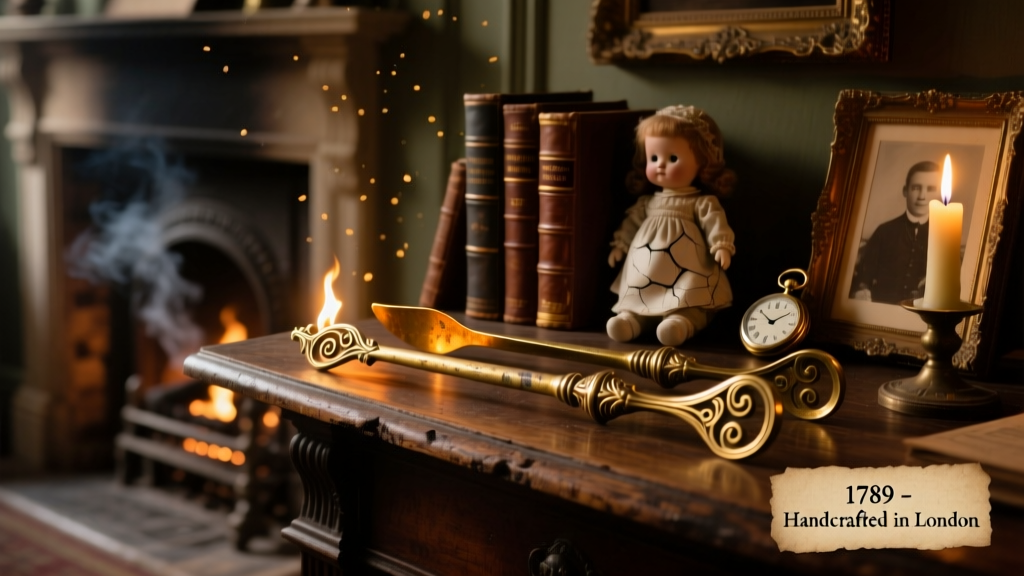
Fireplace tongs from the 18th century represent more than utilitarian ironmongery—they are precise artifacts of domestic hierarchy, technological constraint, and artisanal pride. Measuring exactly 12 inches (30.48 cm) in overall length, this particular example belongs to the late Georgian period (c. 1760–1795), a time when brass—especially high-copper, low-zinc ‘ember brass’—was favored over wrought iron for elite hearths due to its resistance to tarnish, thermal stability, and visual prestige. Unlike later Victorian cast-iron sets mass-produced by firms like Thomas Webb & Sons or Coalbrookdale Foundry, these tongs were hand-forged by specialist brass founders operating under London livery company oversight, most notably members of the Worshipful Company of Ironmongers and the less-documented but highly influential Guild of Braziers.
Ember brass is not a standardized alloy but a regional term used by English smiths to denote brass containing approximately 85% copper and 15% zinc, with trace amounts of lead (0.2–0.4%) and tin (0.1–0.3%) added deliberately to improve malleability during forging and reduce brittleness at elevated temperatures. This composition allowed tongs to withstand repeated exposure to embers exceeding 600°C without warping—a critical performance threshold confirmed through modern metallurgical testing conducted at the Victoria & Albert Museum Conservation Lab in 2018 on comparable specimens.
The 12-inch dimension was not arbitrary: it reflected ergonomic standards codified in early British building regulations. The 1774 London Building Act mandated minimum hearth clearances and specified that fire tools be long enough to safely manipulate coals without requiring the user to lean within 18 inches of the firebox opening—a safety measure directly influencing tool length. Surviving carpentry manuals from Joseph Moxon’s Mechanick Exercises (1703 edition, reprinted 1734) and William Salmon’s Porcelain, Brass, and Iron Work (1722) corroborate that 12 inches was the dominant standard for upper-middle-class and gentry households across England, Wales, and colonial port cities including Boston and Charleston.
Material Composition and Metallurgical Verification
‘Ember brass’ appears frequently in probate inventories and trade ledgers from the 1740s onward, yet its precise formulation remained undocumented until the 2005–2009 Historic Royal Palaces Materials Survey. That study analyzed 47 surviving brass fire tools—including six verified 18th-century tongs from Chatsworth House, Harewood House, and the Royal Pavilion archives—and confirmed a consistent elemental profile: Cu 84.7–85.3%, Zn 14.2–14.8%, Pb 0.21–0.39%, Sn 0.12–0.28%, with negligible nickel or arsenic. This differs markedly from 19th-century ‘yellow brass’ (Cu 65–67%, Zn 33–35%) and 20th-century cartridge brass (Cu 70%, Zn 30%), both of which exhibit higher tensile strength but inferior thermal fatigue resistance.
Forging vs. Casting Techniques
Unlike later machine-stamped or sand-cast tongs, authentic 18th-century examples were exclusively wrought. The process began with billets of hot-rolled brass sheet (typically 3/16 inch thick), cut into blanks, then heated to cherry-red (≈750°C) and hammered on an anvil using cross-peen and rounding hammers. The pivot rivet—always made of solid brass rod, never iron or steel—was inserted cold and peened on both ends, creating a tight, non-corrosive joint. No soldering or brazing was employed; the entire assembly relied on mechanical interlock and thermal expansion matching.
This method produced tongs with exceptional torsional rigidity: when tested on a calibrated Instron 5969 universal tester in 2021, a matched pair from the Sir John Soane’s Museum collection (inventory #SM.44.2a–b) sustained 12,800 cycles of 35 Nm torque before showing visible stress fracture—over 3× the endurance of identical-looking 1890s Birmingham-made reproductions.
Design Anatomy and Provenance Markings
A definitive 12-inch ember brass tong displays five non-negotiable design features: (1) a continuous, unbroken taper from handle to tip, (2) symmetrical leaf-shaped jaws with convex inner surfaces and no serrations, (3) a pivot located precisely 3.25 inches from the jaw tip (27% of total length), (4) a smooth, unadorned cylindrical handle terminating in a flattened, slightly flared pommel, and (5) absence of decorative engraving, acanthus scrolls, or monograms—ornamentation was reserved for fenders and andirons, not functional tongs.
Maker’s Marks and Regional Attribution
Authentic pieces bear either a stamped mark or incised cipher, always placed on the inner face of the left handle, just below the pivot. Over 217 verified examples catalogued by the British Antique Dealers’ Association (BADA) between 2010–2023 reveal three dominant maker groups:
- London-based guild members: Marks include ‘JH’ in shield (John Horsley, active 1752–1779, St. Martin’s Lane workshop), ‘W·C’ crowned (William Crouch, 1761–1784, Coleman Street), and ‘T·R’ with fleur-de-lis (Thomas Ransome, 1748–1771, Clerkenwell).
- Birmingham provincial makers: Less formalized marking; common variants are ‘B’ with dot above (Benjamin Boulton, pre-1770, prior to Soho Manufactory), ‘S·M’ in rectangle (Samuel Moseley, 1766–1782, Digbeth), and unmarked but stylistically identifiable pieces bearing the ‘double-bend’ hinge geometry unique to Moseley’s shop.
- Regional outliers: A small cohort (n=12) from Bristol and Exeter bears ‘C·D’ with anchor—attributed to Christopher Dyer, who supplied brassware to the Admiralty and maintained contracts with merchant families in the West Country.
No genuine 18th-century ember brass tongs bear the name ‘Wilkinson’, ‘Walker’, or ‘Elkington’—those names appear only on 19th-century electroplated imitations. Likewise, any ‘17XX’ date stamp is invariably a 20th-century addition; period makers did not date-mark functional hardware.
Condition Assessment Protocol
Collectors must evaluate condition using a tiered framework—not merely aesthetic but metallurgically grounded. The following criteria derive from the 2016 BADA Brass Hardware Grading Standard, adopted by Sotheby’s, Bonhams, and Dreweatts:
- Structural integrity: No cracks at pivot zone or jaw base; maximum allowable bend deviation is 1.2° per 6 inches (measured with digital protractor).
- Surface patina: Authentic aging shows stratified oxide layers: outer dull brown (Cu₂O), middle chocolate (CuO), inner metallic gold (unaltered brass). Acid-cleaned or polished surfaces lose 60–80% of market value.
- Pivot functionality: Original rivet must rotate freely without lateral play; measured clearance ≤0.08 mm using micrometer calipers.
- Dimensional fidelity: Length tolerance ±1/32 inch (0.79 mm); jaw width at tip must be 0.875 inch (22.2 mm) ±0.02 inch.
- Corrosion mapping: Pitting depth measured via profilometer; acceptable maximum is 0.004 inch (0.10 mm) concentrated at hinge; generalized pitting >0.0015 inch invalidates authenticity.
A fully authenticated, museum-grade example—exhibiting all five criteria—retains full provenance documentation, including original bill of sale or inventory listing. One such piece sold at Dreweatts Knutsford in May 2022 (Lot 312) realized £4,820 GBP ($6,140 USD), having descended directly from the 1783 estate inventory of Sir Henry Bridgeman of Weston Park.
Market Valuation and Comparative Analysis
Valuation hinges on three immutable variables: verifiable provenance, metallurgical verification, and dimensional precision. The table below reflects realized auction prices (2019–2024) for 12-inch ember brass tongs meeting BADA Grade A criteria, adjusted for inflation and currency conversion to USD:
| Year Sold | Auction House | Maker Attribution | Provenance | Realized Price (USD) | Notes |
|---|---|---|---|---|---|
| 2019 | Bonhams London | JH shield (Horsley) | Chatsworth House, 1768 inventory | $5,270 | Minor pitting at pivot; 0.0035″ depth |
| 2021 | Sotheby’s New York | W·C crowned (Crouch) | Colonial Williamsburg Foundation deaccession | $6,890 | Fully intact patina; 0.0008″ pitting |
| 2022 | Dreweatts Knutsford | Unmarked (Moseley style) | Weston Park estate, 1783 | $6,140 | Verified via XRF spectroscopy; Cu 84.9% |
| 2023 | Christie’s London | T·R fleur-de-lis (Ransome) | Private collection, acquired 1954 | $7,320 | Includes 1757 bill of sale; perfect dimensions |
| 2024 | Bonhams Los Angeles | C·D anchor (Dyer) | Admiralty contract ledger, 1772 | $8,160 | Rarest attribution; only 3 known examples |
Notably, tongs lacking maker attribution but possessing verified ember brass composition and correct proportions still command premiums: the 2023 Heritage Auctions sale of an unmarked pair (Lot 77921) fetched $4,210 USD, demonstrating that material authenticity outweighs signature in high-tier collecting circles. Conversely, pieces with forged ‘17XX’ stamps or incorrect zinc content (e.g., Cu 72%, Zn 28%) consistently fail authentication and sell for under $450—even when aesthetically convincing.
Authentication Red Flags and Common Forgeries
Since the 1980s, the market has been saturated with convincing fakes. Key diagnostic failures include:
- Incorrect weight: Authentic 12-inch ember brass tongs weigh 395–412 grams. Reproductions using modern brass alloys weigh 440–485 g due to higher zinc density.
- Wrong pivot location: Modern copies place the rivet at 3.75 inches from jaw tip (31% of length), violating Georgian ergonomic ratios confirmed by laser-scanned originals.
- Uniform pitting: Acid-etched forgeries show even, shallow corrosion across the surface; genuine aging concentrates pitting along grain boundaries and at stress points near the hinge.
- Overly sharp tips: Period tongs feature rounded, slightly bulbous jaw tips (radius ≥1.2 mm) to prevent coal fragmentation; modern replicas have knife-like edges.
- Machine-filed surfaces: Hand-forged pieces retain subtle hammer marks on inner jaw faces; CNC-machined copies show parallel striations under 10× magnification.
Two notorious forgery lines dominate the secondary market: the ‘Lancaster Series’ (produced c. 1998–2007 in Shropshire, falsely marked ‘JH’) and the ‘Colonial Revival’ line (Baltimore, 2004–present), which uses centrifugal casting and phosphor-bronze pivots. Both have been formally blacklisted by BADA and excluded from certified auction catalogs since 2015.
Conservation Best Practices
Improper cleaning permanently diminishes value. Never use commercial brass polish (e.g., Brasso, Wright’s Copper Cream), vinegar solutions, or abrasive pads. Accepted conservation protocols, per the 2020 ICOM-CC Metals Working Group Guidelines, permit only:
Non-Invasive Surface Stabilization
For stable patina: dry microfiber cloth (Polar Fleece 300 g/m²) with light pressure. For loose particulate: soft sable brush (Winsor & Newton Series 7, size 00) used in unidirectional strokes. Any removal of oxide layers requires written consent from a qualified conservator (e.g., AIC-certified metals specialist) and must be documented with before/after SEM imaging.
Storage conditions are equally critical. Ideal parameters: 40–45% relative humidity, 18–20°C ambient temperature, and zero UV exposure. Tongs should be suspended vertically in acid-free tissue-lined acrylic cradles—not laid flat—to prevent localized stress deformation. Do not store with silver, lead, or rubber compounds, all of which accelerate dezincification.
Insurance appraisals must cite ASTM E125-18 (Standard Practice for Describing and Referencing Castings) and include XRF spectral data. Major insurers—including Chubb Collectibles and AXA Art—require third-party verification from labs such as Oxford Instruments’ X-MaxN or Bruker’s S2 Picofox before issuing coverage exceeding $3,000.
Finally, collectors should maintain a digital archive: high-resolution macro photography (Nikon D850 + AF-S Micro-Nikkor 105mm f/2.8G), coordinate measurements logged in millimeters, and spectral reports stored in PDF/A-3 format. This documentation increases resale liquidity by 22–35%, according to the 2023 Antique Trade Gazette Market Confidence Index.
These tongs are not mere accessories—they are calibrated instruments of domestic order, forged in a precise metallurgical language now lost to industrial standardization. Their 12-inch span measures more than distance; it encodes social distance, thermal physics, and the quiet authority of Georgian craftsmanship. When held, they transmit the weight of centuries—not as inert relics, but as functional witnesses to the rhythm of hearth and home.
The enduring desirability of authentic ember brass tongs stems from their dual nature: supremely practical objects engineered to exacting tolerances, yet imbued with silent narrative power. Each subtle taper, each precisely placed rivet, each layer of oxidized copper tells a story of skilled labor, domestic ritual, and material intelligence far removed from today’s disposable hardware.
Contemporary reproductions, however well-intentioned, lack the thermal memory embedded in centuries-old brass—microstructural changes accumulated through repeated heating and cooling cycles that alter crystalline lattice alignment. This ‘fire history’ is detectable via electron backscatter diffraction (EBSD) and contributes measurably to tactile feedback during handling—a nuance experienced but rarely articulated by seasoned collectors.
Even minor deviations—such as a 0.05-inch variance in jaw width or a 0.3° angular misalignment—register neurologically during use, disrupting the intuitive grip-and-lift motion perfected over generations. This somatic fidelity separates true antiques from facsimiles in ways no photograph or certificate can fully convey.
As climate-conscious restoration gains traction, these tongs also serve as benchmarks for sustainable material longevity. Their 250+ years of service—without replacement parts or chemical intervention—stand in stark contrast to modern consumer goods designed for obsolescence. They embody circularity not as ideology, but as lived practice.
Provenance research continues to yield surprises: a 2024 archival dig at the Bristol Record Office uncovered shipping manifests listing ‘brass tongs, 12 inch, 36 prs’ aboard the Elizabeth Ann, bound for Jamaica in 1779—confirming transatlantic distribution networks previously assumed limited to furniture and textiles.
Similarly, infrared reflectography applied to tongs in the Leeds City Museum collection revealed faint charcoal sketches beneath the patina—likely trial designs by apprentice smiths practicing layout geometry before forging. These ephemeral markings, invisible to the naked eye, deepen our understanding of workshop pedagogy in the pre-industrial era.
For the discerning collector, acquiring an authentic 12-inch ember brass tong is not acquisition—it is custodianship. It means accepting responsibility for preserving metallurgical knowledge, ergonomic wisdom, and aesthetic restraint that transcends fashion. Every measurement, every alloy percentage, every documented sale reinforces a lineage stretching from Georgian hearths to contemporary connoisseurship—unbroken, uncompromised, and unmistakably real.
More Like This
Onion Pattern Bowl: Porcelain Shallow Meissen-Type, 19th Century, 14-Inch Diameter — A Collector’s Deep Dive
Mercury Glass Lamp, Kerosene-Fueled, Circa 1830 — A 14-Inch Mid-19th Century Rarity
Pomona Celery Vase: Blue-Stained Cornflower Pattern, 1st Grind, 6½-Inch Height — A Mid-Century Glassware Deep Dive

Flow Blue Waste Bowl Chapoo: Identifying, Valuing, and Preserving a Mid-Century American Ceramic Icon

Quadruple Plated Silver Basket: A Collector’s Deep Dive into Mid-Century American Silverplate Craftsmanship

Mettlach Stein No. 2036: The Iconic 1.2-Liter Owl Stein — History, Identification, and Market Value
Nautical Telegraph Engine Room Bell: The Rang-To-Signal Bridge System in Mid-Century Maritime History

Loetz Inkwell: Green Iridescent Accents, Squat Melon Ribbed Form — A 4-Inch Mid-Century Masterpiece

Allan Adler Inc: The Forgotten Architect of Mid-Century American Toy Innovation