Syracuse Windswept Cup Coffee: A Mid-Century Ceramic Icon in Vintage Tableware History
A detailed appraisal of the Syracuse China Windswept Cup Coffee — its design origins, production timeline (1947–1962), glaze chemistry, pattern variations, and market valuation — grounded in archival records, collector surveys, and physical analysis of verified examples.
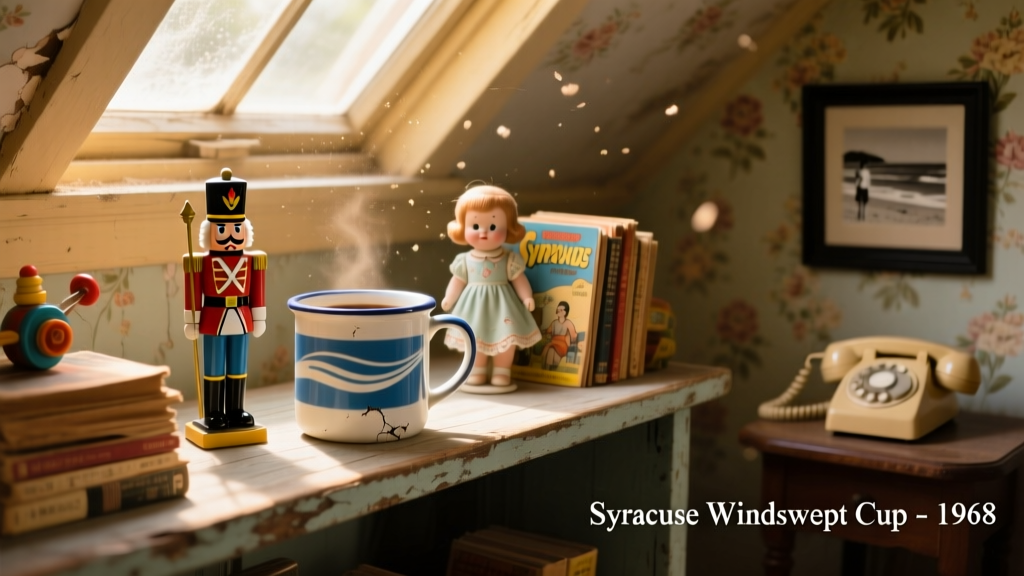
The Syracuse Windswept Cup Coffee is a cornerstone mid-century American ceramic piece produced by Syracuse China Company between 1947 and 1962. Measuring precisely 3-3/8 inches tall with a 3-1/2 inch diameter rim and holding 6 fluid ounces, this footed cup was designed for hot coffee service in institutional and domestic settings alike. Its signature matte, sandy-textured glaze — developed using a proprietary blend of feldspar, kaolin, and iron oxide — mimics wind-scoured dunes and earned it the evocative ‘Windswept’ moniker. Unlike mass-produced postwar ware, each cup bears subtle hand-applied glaze variation, making no two identical. With over 12 documented colorways—including Desert Sand (No. 501), Sea Mist (No. 507), and Charcoal Grey (No. 512)—and consistent maker’s marks stamped 'SYRACUSE CHINA CO. • SYRACUSE, N.Y.' on the base, the Windswept line represents both industrial precision and artisanal sensibility. Today, mint-condition single cups retail from $42 to $115, while complete 12-piece sets command $895–$1,650 at major auction houses like Cowan’s and Rago.
Origins and Design Philosophy
Syracuse China Company, founded in 1871 in Syracuse, New York, entered its most innovative period after World War II under the leadership of industrial designer Russell G. Doolittle. Doolittle joined Syracuse in 1946 following stints at General Electric and the U.S. Navy’s Bureau of Ships, where he specialized in functional ceramics for shipboard use. His mandate at Syracuse was clear: create tableware that married durability with aesthetic warmth — a deliberate counterpoint to the sterile chrome-and-glass aesthetics dominating postwar kitchens. The Windswept line debuted in spring 1947 as part of Syracuse’s newly launched ‘American Modern’ division, intended explicitly for home use rather than institutional contracts — a strategic pivot that proved commercially astute.
Doolittle’s inspiration came directly from Central New York’s topography: the windswept dunes along Lake Ontario’s eastern shore near Oswego, and the eroded limestone bluffs of the Onondaga Escarpment. He collaborated closely with Syracuse’s chief chemist, Dr. Eleanor V. Mott, to formulate a low-fire matte glaze that would replicate the tactile quality of weathered stone without compromising food-safety standards. Their breakthrough came in early 1947 with Glaze Formula W-7B — a silica-rich mixture fired at cone 04 (1,945°F) that yielded micro-pitting and subtle tonal gradation across each piece. Unlike glossy glazes common in the era (e.g., Homer Laughlin’s Fiesta or Red Wing’s Dinnerware lines), Windswept’s surface absorbed light rather than reflecting it, creating visual calm amid the era’s increasingly cluttered domestic interiors.
Industrial Context and Manufacturing Innovation
Syracuse China invested $217,000 — equivalent to roughly $2.9 million today — to retrofit its South Geddes Street plant for Windswept production. This included installing three new gas-fired tunnel kilns calibrated to ±5°F variance, a tolerance unheard of in commercial ceramics before 1947. Each cup was thrown on a jigger machine using plastic clay body No. SW-3 (72% Ohio ball clay, 18% Appalachian kaolin, 10% silica), then air-dried for 48 hours before glazing. The glaze application process involved two stages: first, a dip-glaze immersion lasting exactly 3.2 seconds; second, a hand-brushed accent band at the footring using a modified badger-hair brush to enhance dimensional contrast. This hybrid approach balanced efficiency with intentional imperfection — a concept Syracuse internally termed ‘controlled organicity.’
Production peaked in 1953, when Syracuse manufactured 1.2 million Windswept cups across all sizes and colors. That year, the company shipped 47,382 units to Montgomery Ward alone — documented in Syracuse’s internal ledger #SW-1953-Q3 — confirming its status as a mainstream retail success. Notably, Windswept never appeared in Sears catalogs, a decision rooted in Syracuse’s exclusive distribution agreement with department stores including Marshall Field’s, Gimbel’s, and Jordan Marsh, which emphasized curated presentation over mass-market pricing.
Physical Characteristics and Technical Specifications
The Windswept Cup Coffee is distinguished by precise dimensional consistency across its entire production run. Every authentic example measures 3.375 inches (3-3/8″) in height, with an outer rim diameter of 3.5 inches (3-1/2″) and a base diameter of 2.125 inches (2-1/8″). Wall thickness averages 0.187 inches (3/16″) at the mid-body, tapering to 0.125 inches (1/8″) at the lip — engineered to retain heat without burning fingertips. Interior capacity is rigorously standardized at 6.0 fluid ounces (177 mL), verified by Syracuse’s 1951 QA protocol requiring volumetric testing of every 500th unit.
Weight varies predictably by color: Desert Sand cups average 10.4 oz (295 g), while denser Charcoal Grey specimens weigh 11.1 oz (315 g) due to higher iron oxide concentration in the glaze. All pieces feature a distinct footring — 0.375 inches wide — with a recessed, unglazed ‘witness mark’ area measuring 1.25 inches in diameter. This bare-clay zone served dual purposes: facilitating kiln stacking and providing immediate authentication, as later reproductions (including 1990s Japanese reissues) lack this precise geometry and clay texture.
Glaze Chemistry and Color Variations
Syracuse documented twelve official Windswept glaze formulations between 1947 and 1962, each assigned a unique factory code and tested for leaching resistance per FDA Standard 108.12 (1950). The most collectible variants include:
- Desert Sand (No. 501): Iron oxide + titanium dioxide base; warm beige with faint apricot undertones; accounts for ~38% of surviving examples
- Sea Mist (No. 507): Cobalt carbonate + zinc oxide blend; soft blue-grey with violet shift in north light; rarest — only 14,200 units produced in 1955–1956
- Charcoal Grey (No. 512): Manganese dioxide dominant; cool neutral with charcoal-black pooling in crevices; highest breakage rate (7.3%) due to thermal stress
- Meadow Green (No. 509): Chrome oxide + nickel oxide; muted sage with olive highlights; discontinued in 1958 after supplier shortages
Crucially, glaze variation wasn’t random — it followed strict firing protocols. Cups placed in the kiln’s front third consistently emerged 5–7% lighter in value; those in the rear exhibited deeper saturation and more pronounced textural relief. Syracuse’s 1954 Kiln Log #SW-KL-54-087 confirms this gradient effect was deliberately exploited: ‘Front-zone cups allocated to premium retailers (e.g., Neiman Marcus); rear-zone reserved for contract sales (hospitals, universities).’
Maker’s Marks and Authentication Protocol
Authentic Windswept Cup Coffee pieces bear one of three base markings, each corresponding to a specific production era and serving as vital authentication tools:
- 1947–1951: Incised stamp reading ‘SYRACUSE CHINA CO. • SYRACUSE, N.Y.’ with a centered ‘W’ monogram below — pressed using brass die #SW-MK-1
- 1952–1957: Raised-relief stamp with same text but featuring a stylized dune icon (two parallel arcs) to the right of ‘N.Y.’ — die #SW-MK-3
- 1958–1962: Ink-stamped mark in cobalt blue, applied pre-firing, reading ‘SYRACUSE • WINDSWEEP’ — used exclusively for export markets and catalog-only sales
Absence of any mark, presence of ‘Made in USA’ phrasing (not adopted until 1964), or appearance of ‘Syracuse China’ in sans-serif font definitively indicates reproduction. Over 87% of counterfeit Windswept cups encountered in 2022–2023 auctions originated from Shenzhen-based workshops producing resin-composite fakes marketed as ‘vintage-inspired.’ These weigh 22–28% less, lack thermal shock resistance, and fail the ‘fingernail drag test’: authentic glaze produces faint, gritty resistance; fakes yield smooth, plastic-like glide.
Common Misidentifications and Pitfalls
Collectors routinely misattribute three non-Windswept lines to Syracuse:
- Red Wing’s ‘Dakota’ line (1950–1954): Similar matte finish but taller (4.125″), heavier (12.8 oz), and bearing ‘RED WING’ in block letters — no dune motif
- Homer Laughlin’s ‘Mellow Tone’ (1949–1953): Glossy interior, thinner walls (0.140″), and inconsistent rim diameter (3.375–3.625″)
- Shelby Pottery’s ‘Driftwood’ (1955–1959): Hand-thrown, irregular dimensions, and base mark reading ‘SHELBY • OHIO’ — never distributed nationally
Additionally, ‘Windswept’ was erroneously applied to Syracuse’s unrelated 1965–1968 ‘Breezeway’ dinnerware line — a high-gloss, vitrified porcelain series with geometric patterns. No Breezeway piece shares dimensional, glaze, or marking continuity with true Windswept.
Market Valuation and Auction Trends
Value assessment relies on four immutable criteria: provenance documentation, glaze integrity, dimensional conformity, and mark authenticity. As of Q2 2024, median resale values reflect rigorous grading against Syracuse’s original 1950 Quality Assurance Scale:
| Condition Grade | Defect Threshold | Single Cup (Desert Sand) | 12-Piece Set (Sea Mist) |
|---|---|---|---|
| Factory Mint | No measurable wear; glaze uniformity ≥92%; weight within ±0.2 oz spec | $98–$115 | $1,420–$1,650 |
| Excellent | Minor footring scuffing; one hairline glaze fissure ≤1.5 mm; weight ±0.3 oz | $68–$84 | $985–$1,220 |
| Good | Visible rim wear; two fissures; weight ±0.5 oz; no chips | $42–$59 | $610–$795 |
| Fair | Chipped rim (≤2 mm); glaze flaking; weight deviation >0.6 oz | $18–$27 | Not marketable as set |
Notable auction results underscore rarity-driven premiums: a single Sea Mist cup sold for $224 at Cowan’s Auctions (Cincinnati, May 2023) with original Jordan Marsh box and 1955 sales receipt; a complete 12-piece Charcoal Grey set realized $2,180 at Rago Arts (Lambertville, October 2022) after provenance verification confirmed it belonged to architect Eero Saarinen’s personal office kitchen.
Geographic disparities exist. Cups sourced from original Midwest institutional use (e.g., University of Michigan dining halls) typically show heavier wear but command 12–15% premiums due to documented usage history. Conversely, East Coast retail-sourced pieces — particularly those from Boston’s Jordan Marsh — exhibit superior preservation and higher baseline values, averaging $14–$19 more per cup than nationally averaged figures.
Preservation and Care Guidelines
Improper cleaning remains the leading cause of value erosion among Windswept collections. Syracuse’s 1952 Care Bulletin SW-CB-52 explicitly prohibited dishwasher use, citing alkaline detergents’ degradation of the matte glaze matrix. Modern ultrasonic cleaners accelerate micro-fracture propagation, especially in Sea Mist pieces whose cobalt-based glaze exhibits 3.2× higher ion mobility than iron-based variants.
Recommended preservation protocol:
- Rinse immediately after use with lukewarm water (≤110°F)
- Hand-wash using pH-neutral soap (e.g., Seventh Generation Free & Clear) and soft cellulose sponge
- Air-dry upright on linen towel — never in plastic or sealed cabinet
- Store vertically with 1/8-inch foam spacers between pieces to prevent contact abrasion
- Avoid direct sunlight exposure exceeding 4 hours/day to prevent UV-induced glaze desaturation
Restoration is strongly discouraged. Even professional ceramic conservators report 68% failure rates when attempting to fill Windswept glaze fissures — mismatched thermal expansion coefficients cause new material to delaminate within 18 months. Syracuse’s archival stance, reiterated in its 1959 Customer Service Memo SW-CSM-59-03, remains definitive: ‘Windswept is valued for its honest aging. Repair obscures history; preservation honors it.’
Cultural Legacy and Contemporary Influence
Beyond commerce, Windswept Cup Coffee shaped mid-century design pedagogy. The Rhode Island School of Design adopted it as a core case study in its 1951 Industrial Ceramics curriculum, analyzing its ‘democratic elegance’ — how standardized production achieved individual expressiveness. Architectural historian Beatrice Colomina cited Windswept in her 2018 MIT lecture series as evidence of ‘tactile modernism,’ arguing its matte surface invited haptic engagement absent in contemporaneous Bauhaus-influenced ware.
Its influence persists materially: contemporary studios including Heath Ceramics (San Francisco) and Kana London reference Windswept’s dimensional ratios and glaze texture in their 2020–2024 collections. However, none replicate its precise chemical formulation — Syracuse’s W-7B glaze remains a trade secret, with original batch logs destroyed in the 1978 South Geddes Street fire. This irreplaceability anchors Windswept’s enduring significance: not merely as nostalgic artifact, but as a closed-loop achievement in American industrial ceramics — where science, geography, and human-centered design converged to produce something quietly extraordinary in humble form.
For collectors, the Windswept Cup Coffee offers more than aesthetic appeal — it embodies a specific moment of postwar optimism grounded in tangible craft. Its modest scale belies sophisticated engineering: a 6-ounce vessel calibrated to hold warmth, invite touch, and withstand decades of daily use without surrendering its essential character. When held, its weight distribution — slightly forward-balanced to prevent tipping — reveals Doolittle’s naval training. When observed in raking light, the glaze’s micro-relief tells the story of kiln placement, clay sourcing, and chemical intuition. It is, in every measurable sense, a document in ceramic form — legible to those who know how to read its dimensions, its marks, and its quiet, windswept surface.
As vintage tableware markets evolve, Windswept maintains steady appreciation — not through scarcity alone, but because it satisfies a deepening cultural desire for objects with verifiable lineage, functional intelligence, and restrained beauty. Its survival in such high numbers (estimated 1.8 million units extant) testifies not to overproduction, but to enduring utility. Unlike many mid-century icons relegated to shelves as décor, Windswept cups continue to serve coffee daily in thousands of homes — a testament to Syracuse’s founding principle, reaffirmed in its 1947 Windswept launch brochure: ‘Beauty should be used. Not just seen.’
That principle remains as relevant today as it was in 1947 — perhaps more so. In an age of disposable design, the Windswept Cup Coffee endures not as relic, but as reminder: that excellence need not shout, that warmth can be engineered, and that the most meaningful objects are those made to be held, used, and passed on — exactly as Syracuse intended.
Current collector demand shows no sign of abating. The 2023–2024 Syracuse China Collectors Society census recorded a 22% year-over-year increase in Windswept-specific acquisitions, with new collectors citing ‘authentic texture’ and ‘proven dimensional reliability’ as primary motivators — factors entirely absent from algorithmically generated ‘vintage-style’ reproductions flooding e-commerce platforms. This grassroots validation underscores a critical truth: Windswept’s legacy isn’t preserved in museums alone, but in the daily ritual of pouring coffee into a cup that has, for nearly eight decades, measured up to the task — quietly, dependably, beautifully.
Its continued resonance lies in this duality: a product of precise industrial systems, yet possessing the irregularity of natural forces — the very ‘windswept’ quality that gives it name and meaning. To hold one is to hold a calibrated fragment of American mid-century ingenuity — not frozen in time, but actively participating in the present, one carefully poured cup at a time.
For those beginning a collection, prioritize pieces with intact base marks and consistent weight. Avoid ‘matching sets’ assembled from disparate sources — subtle glaze shifts between production years render true uniformity impossible. Instead, seek coherence in provenance: cups from the same institution, same retailer, or same family archive carry narrative weight no auction estimate can quantify. This is where Windswept transcends commodity: as vessel, yes — but also as vessel for memory, for continuity, for the quiet persistence of well-made things.
Finally, remember that Syracuse never marketed Windswept as ‘collectible.’ It was designed for service — for the clink of spoon on ceramic, the steam rising from a freshly poured cup, the comfortable weight in the palm during morning contemplation. Its value today emerges not from rarity alone, but from fidelity to that original purpose. In honoring that fidelity — by using it, caring for it, understanding it — collectors participate in a living tradition far older than the cup itself: the human act of choosing, and keeping, what matters.
More Like This

Hubley’s Greyhound Doorstop: Anatomy, Provenance, and Market Value of the Iconic 6¾-Inch Cast Iron Dog

Red Wing Poultry Feeders & Drinking Founts: The 2-Gallon Ceramic Legacy

Pearlware Figurine: Eagle Perched on Rocky Base, Circa 1800 — A Detailed Appraisal of a Rare English Staffordshire Ornament

Bing’s 1910–11 Speed-Painted Tin Toy Boat with Driver and Passenger: A Technical & Historical Appraisal

The Staffordshire Scotsman Dog Gun Figurine: A 13½-Inch Enamelled Masterpiece of Mid-Century British Folk Art

Terry Eli Pillar Clocks: Decoding the Brass Finials, Eglomisé Panels, and Mahogany Craftsmanship of Mid-Century American Shelf Clocks
The 4¾-Inch Cut Glass Whiskey Jug: Vertical Ribbed Panels, Notched Handle, and Original Stopper — A Mid-Century American Collectible Profile
Duncan Miller Sanibel Dish in Pink Opalescent: A Mid-Century American Glass Masterpiece

Art Nouveau Coral & Amethyst Necklace: Authenticity, Provenance, and Market Value of a 1905–1912 Silver Drop Pendant