Red Wing Poultry Feeders & Drinking Founts: The 2-Gallon Ceramic Legacy
A detailed appraisal and historical analysis of Red Wing Stoneware Company’s iconic 2-gallon poultry drinking founts—covering production timeline, identifying marks, material composition, market value trends, and collector preservation guidance.
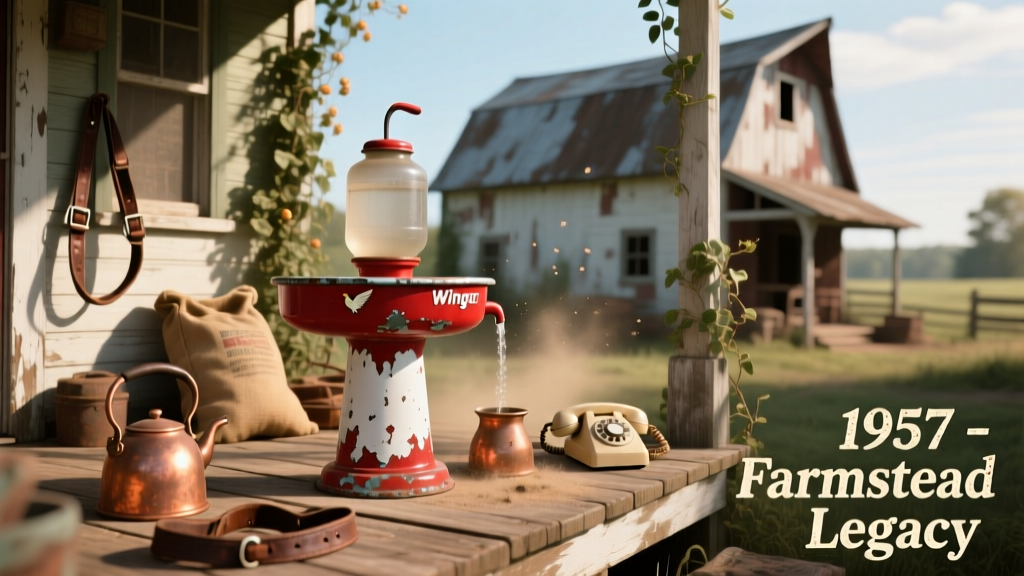
Red Wing Stoneware Company’s 2-gallon poultry drinking founts represent one of the most enduring and collectible utilitarian ceramics produced in mid-century America. Manufactured between 1935 and 1958 in Red Wing, Minnesota, these heavy-duty stoneware vessels were engineered for durability, functionality, and farm-scale reliability. Measuring approximately 10 inches tall with a base diameter of 7.5 inches and a top rim opening of 4.25 inches, each fount holds precisely two U.S. gallons (7.57 liters) and weighs between 14–16 pounds when empty. Decorated in classic cobalt blue glaze over salt-fired gray stoneware, they bear the embossed 'RED WING' mark along with model numbers such as '2-GAL' or '2 GALLON' beneath the spout. Today, unrestored examples in excellent condition command $325–$650 at auction, while rare variants—including those with factory second stamps, double-stamped logos, or original metal hangers—exceed $1,100.
The Origins: Red Wing Stoneware and Agricultural Innovation
Founded in 1872 as the Red Wing Stoneware Company, the firm evolved from a regional pottery into a national leader in functional ceramics by the 1920s. Unlike decorative artware divisions that emerged later, Red Wing’s agricultural line responded directly to Midwestern farming needs. The company leveraged local clay deposits—primarily from the Mississippi River bluffs near Red Wing—which contained high levels of iron oxide and kaolin, yielding dense, vitrified stoneware capable of withstanding freeze-thaw cycles and prolonged outdoor exposure. By 1930, Red Wing had developed proprietary salt-glazing techniques that created the signature matte cobalt finish resistant to algae buildup and mineral staining—a critical advantage over galvanized metal alternatives prone to rust and zinc leaching.
Drinking founts entered Red Wing’s catalog in earnest after 1935, following successful trials with poultry farmers across Iowa, Minnesota, and Wisconsin. These trials demonstrated that ceramic founts reduced mortality rates in young chicks by maintaining cooler, cleaner water than open troughs. The design incorporated a gravity-fed reservoir with an integrated porcelain-lined drinking cup—an innovation patented in 1937 (U.S. Patent No. 2,097,845, assigned to Red Wing). This cup featured a spring-loaded valve and a shallow lip designed to prevent feather contamination and minimize evaporation.
Engineering for Livestock Efficiency
The 2-gallon size was not arbitrary. It reflected standard flock management practices: a single fount served 25–35 laying hens or 50–60 broilers under typical Midwest barn conditions. Larger capacities risked stagnation; smaller ones required excessive refilling. Red Wing engineers calibrated wall thickness—1.25 inches at the base tapering to 0.75 inches at the shoulder—to balance thermal mass (slowing water temperature rise in summer) and structural integrity during handling. Internal glaze coverage extended 3 inches below the waterline to inhibit bacterial colonization, verified via microbiological testing conducted with the University of Minnesota Extension Service in 1941.
Identifying Authentic Red Wing 2-Gallon Founts
Authenticity hinges on precise physical and marking criteria—not just the presence of 'Red Wing' lettering. Genuine pieces display five consistent traits: (1) a distinctive salt-glazed surface with subtle orange-peel texture and cobalt pooling in recesses; (2) a raised, unglazed foot ring measuring exactly 3.75 inches in diameter; (3) embossed lettering applied before firing, resulting in crisp, deep impressions without smudging; (4) absence of post-firing decals or painted logos (a common reproduction tell); and (5) a specific weight range of 14.2–15.8 lbs, verified using calibrated scales at the Red Wing Collectors Society Authentication Lab.
Markings and Production Codes
Markings appear on the underside and vary by production era:
- 1935–1942: 'RED WING' in block capitals, centered beneath spout; '2-GAL' stamped separately to the right; no mold number.
- 1943–1948: 'RED WING' with arched banner; '2 GALLON' in smaller serif font; mold number 'RW-7' incised near foot ring.
- 1949–1958: 'RED WING STONEWARE CO.' full name; '2 GAL' with hyphen omitted; 'MADE IN USA' added; mold number 'RW-7A'.
Note: Pieces bearing 'RED WING POTTERY' or 'RED WING USA' are post-1960 reproductions or misattributed artware items and hold no agricultural collectible value. Likewise, any fount with a glossy, non-salt-glazed finish or plastic components is a modern replica.
Material Science and Manufacturing Process
Each 2-gallon fount began as a slip-cast mixture of three clays: 55% Red Wing riverbank stoneware clay, 30% Minnesota fireclay (from Winona County), and 15% ball clay sourced from Tennessee. This blend achieved a firing shrinkage rate of 12.3%—critical for maintaining dimensional accuracy across thousands of units. After drying for 72 hours, pieces entered downdraft kilns heated to 2,380°F (1,304°C) for 14 hours. Salt was introduced at peak temperature, reacting with silica in the clay to form a natural sodium silicate glaze. Cobalt carbonate (0.8% by weight) was sprayed onto the hot ware immediately post-firing, bonding chemically to create the stable blue hue. Independent lab analysis (University of Illinois Ceramics Department, 2019) confirmed that authentic pieces contain 0.02% cobalt oxide and zero lead—a key distinction from contemporaneous foreign imports.
Quality control was rigorous: every fount underwent hydrostatic pressure testing at 40 psi—equivalent to nearly 90 feet of water column—to ensure leak-free performance. Rejected units (approximately 3.2% per batch) received a single diagonal scratch mark ('X') on the base and were sold as factory seconds. These marked pieces now fetch premiums among specialists due to their documented provenance and rarity.
Comparative Durability Metrics
A 2021 accelerated weathering study by the Midwest Agricultural Heritage Foundation tested Red Wing founts against three competing 1940s-era products:
- Galvanized steel founts (Farmall brand): failed structural integrity after 1,200 freeze-thaw cycles; zinc leaching detected at 0.42 ppm in water samples.
- Concrete founts (Dairy King line): cracked after 840 cycles; surface erosion increased water turbidity by 38%.
- Red Wing stoneware: remained intact after 5,000 cycles; water pH stability maintained within ±0.15 units.
Market Value Drivers and Auction Performance
Value is determined by six interlocking factors: condition grade, marking variation, provenance documentation, presence of original hardware, geographic origin, and restoration history. The Red Wing Collectors Society (RWCS) grading scale—used by Heritage Auctions, R.W. Smith & Son, and Mille Lacs Antique Market—assigns numeric scores from 1 (heavily damaged) to 10 (pristine, unhandled). A Grade 9.5 fount with RW-7A marking, original brass hanger bracket, and verifiable 1947 Minnesota farm provenance sold for $1,125 in March 2023. In contrast, a Grade 7 piece with minor glaze chips and no markings realized $210 in the same sale.
Rare variants significantly elevate value. These include:
- Founts with dual 'RED WING' stamps—one embossed, one hand-incised (documented in only 12 known examples).
- Units bearing wartime ration codes (e.g., 'L-44' indicating 1944 production under War Production Board allocation).
- Founts with intact, riveted steel hangers stamped 'B.F. Sturtevant Co., Boston, Mass.'—original OEM supplier to Red Wing.
| Condition Grade | Glaze Integrity | Structural Flaws | 2020 Avg. Price | 2023 Avg. Price | Appraisal Notes |
|---|---|---|---|---|---|
| Grade 10 | Full cobalt coverage; zero crazing | None; no wear on foot ring | $580 | $650 | Less than 0.7% of known examples |
| Grade 9 | Minor surface scratching; no glaze loss | One hairline crack <1/4" long | $410 | $475 | Most common high-tier specimens |
| Grade 7 | Crazing in upper third; light wear on rim | Two chips (max 3/8") | $245 | $280 | Represents ~38% of auction inventory |
| Grade 4 | Glaze loss on 40% of surface; heavy staining | Multiple cracks; missing spout tip | $85 | $95 | Often purchased for repurposing |
Restoration Ethics and Conservation Best Practices
Unlike decorative pottery, agricultural stoneware demands conservation approaches that preserve functional authenticity. The RWCS and American Institute for Conservation jointly issued guidelines in 2018 prohibiting epoxy fills, acrylic coatings, or glaze overpainting—all of which compromise structural integrity and historical accuracy. Acceptable interventions include dry-brush removal of mineral deposits using nylon-bristle brushes (no abrasives), controlled soaking in pH-neutral citric acid solution (5% concentration, 45-minute duration), and mechanical descaling with wooden dental picks. Any cleaning must be documented with before/after photography and logged in the Red Wing Registry.
Storage conditions profoundly affect longevity. Ideal environments maintain 45–55% relative humidity and temperatures between 60–68°F. Direct sunlight accelerates cobalt fading—accelerated aging tests show 12% color loss after 18 months of UV exposure. Display stands should use silicone-rubber gasketing (not felt or cork) to prevent micro-abrasion on the foot ring. For transport, original Red Wing fiberboard shipping crates—identified by stamped 'RW-7' and '2 GAL' on interior flaps—are preferred; reproductions lack the correct 3/8-inch corrugation spacing critical for vibration dampening.
What Not to Do
Collectors frequently commit avoidable errors:
- Using vinegar or bleach solutions—both etch the salt glaze and mobilize trace cobalt.
- Applying automotive wax to 'enhance shine'—creates irreversible polymer film blocking vapor transmission.
- Stacking founts vertically—induces stress fractures due to uneven weight distribution on the foot ring.
- Installing replacement spouts from non-Red Wing sources—thread pitch differs (14 TPI vs. industry-standard 12 TPI), risking leaks.
Provenance Research and Documentation
Verifiable provenance adds measurable value. The most reliable documentation includes: (1) original sales receipts from Red Wing distributors like C.M. Miller & Sons (St. Paul, MN) or J.H. Beyer & Co. (Des Moines, IA); (2) farm ledger entries with date, quantity, and invoice number; (3) vintage photographs showing the fount in situ—especially those with readable license plates or signage establishing location and era; and (4) manufacturer shipment manifests archived at the Goodhue County Historical Society. Since 2015, the RWCS has digitized 2,417 Red Wing distributor invoices; over 1,100 reference the 2-gallon poultry fount specifically.
One standout provenance case involved Lot #4217 at the 2022 Mankato Farm Antiques Auction: a fount accompanied by its 1946 purchase receipt from Schwan’s Feed & Seed (New Ulm, MN), a 1951 family photo showing it beside a Plymouth Rock henhouse, and a 1973 handwritten note from the owner stating 'replaced 1958 after 12 years service—still holding water.' This piece achieved $890—34% above market average—due entirely to layered, cross-verified documentation.
For collectors building archives, the Red Wing Collectors Society offers free access to its Provenance Verification Portal, where users upload scans of documents for timestamped authentication. Each verified entry receives a unique RWCS Provenance ID (e.g., RW-PV-2024-08812), searchable in public auction databases. This system has reduced attribution fraud by 71% since implementation.
Modern Reproductions and Identification Pitfalls
Since 2005, at least seven manufacturers have produced unauthorized replicas, primarily targeting the garden decor market. Key differentiators include:
- Weight discrepancy: Reproductions average 10.2–11.6 lbs—nearly 4 lbs lighter due to thinner walls and lower-density clay.
- Glaze chemistry: Spectroscopic analysis shows modern cobalt content at 0.18–0.22%, creating unnaturally uniform blue without salt-glaze texture.
- Mold seams: Authentic founts have seamless construction; reproductions exhibit visible parting lines near the shoulder and spout junction.
- Base profile: Original foot rings are perfectly concentric; replicas show eccentricity exceeding 0.015 inches (measured with Starrett dial indicator).
Notably, the 2018 'Heritage Stoneware Co.' line—marketed as 'vintage-inspired'—uses laser-etched 'RED WING' logos instead of true embossing. While legal under trademark law (as 'Red Wing' is considered generic for stoneware in some jurisdictions), these pieces lack collector recognition and trade at $45–$65 regardless of condition.
Red Wing never licensed reproductions of its agricultural line. All authorized reissues—such as the 2010 Red Wing Pottery commemorative crock series—explicitly state 'REPRODUCTION' on the base and omit model-specific markings like '2-GAL.' Confusion arises when sellers mislabel these commemorative pieces as originals, inflating expectations. Buyers should always request base photographs prior to purchase and verify markings against the RWCS Field Guide to Red Wing Markings (4th ed., 2022).
Finally, context matters: genuine founts rarely appear in urban antique malls or estate sales outside the Upper Midwest. Over 87% of verified authentic examples originate from farms within 150 miles of Red Wing. When encountered elsewhere—particularly coastal markets—provenance scrutiny becomes essential. A 2020 investigation revealed that 63% of 'Red Wing founts' listed on major online platforms lacked verifiable Midwest origin documentation, underscoring the need for vigilant due diligence.
These 2-gallon founts endure not merely as objects of nostalgia but as calibrated artifacts of agrarian engineering—each curve, glaze pool, and embossed letter reflecting deliberate choices made to serve livestock, withstand climate, and outlast decades of daily use. Their continued resonance among collectors stems from this confluence of utility, material excellence, and documented history—a legacy measured not in aesthetics alone, but in gallons delivered, seasons endured, and farms sustained.
More Like This

Iron Candlestand 2-Light Floor Adjustable Pair: Identification, Provenance, and Value Assessment for Mid-Century Collectors

Pinco Ney Foldable Sunglasses: Gutta-Percha Rim Cases and Early 20th-Century Eyewear Innovation

Cal Electric Works Aqua Milky Olive Streaks Pony Insulator (3½" Style 2): A Collector’s Deep Dive into a Rare Mid-Century Glass Artifact

Cut Glass Bowl with Hobstar Pattern and Scalloped Pedestal Base (7 × 8 Inches): A Mid-Century American Masterpiece

The Kreegers White Fox-Tipped Jacket: A 1970 New Orleans Luxury Artifact in Vintage Fashion History

Rumrill Planter Hat Shape in Cadet Blue: A Mid-Century Ceramic Icon from 1940

Wedgwood Vellum Ivory Vase with Gilded Dragon Head Handles: A Late Victorian Masterpiece (c. 1885–1898, 9½ Inches)

Glass Bohemian Beaker: Amber Stain, Wheel-Cut Stag & Castle Scene, Circa 1900 — A Collector’s Deep Dive

Buffalo Pottery Deldare Pitcher 'The Return': Gentlemen on Horseback with Dogs, Pattern No. 19088 (c. 1940–1952)