Spelter Banks: The Heavy, Hollow, and Historically Underrated Mid-Century Toy Bank
A detailed appraisal of spelter banks—zinc-alloy cast toy banks produced primarily in Germany and the U.S. between 1900–1945—covering materials, makers, identification markers, market values, and conservation practices for collectors.
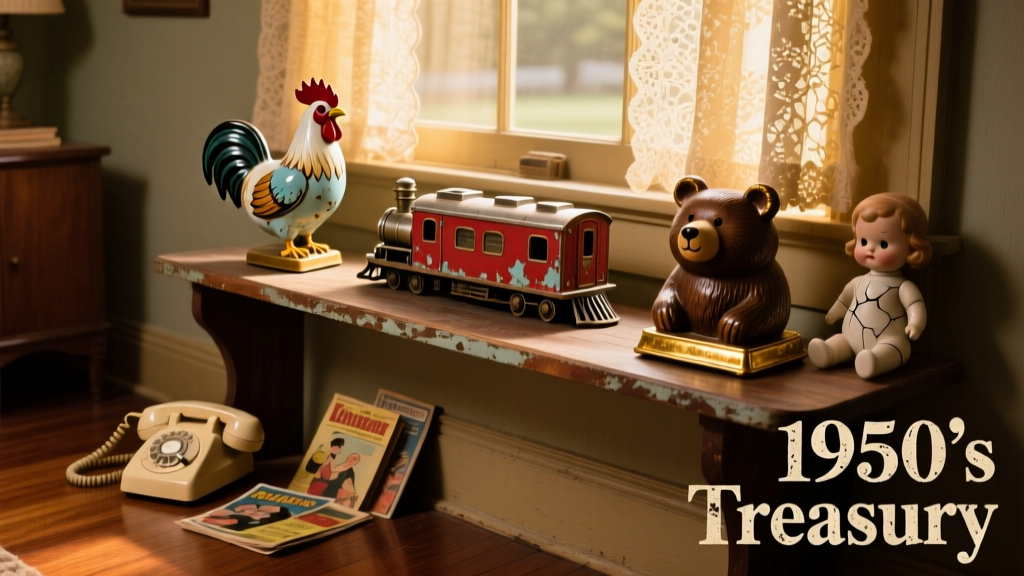
Spelter banks are among the most physically substantial—and often misunderstood—mechanical toy banks of the mid-century era. Cast from spelter (a low-melting-point zinc-copper-lead alloy), these banks were mass-produced in Germany from the 1890s through the early 1940s and later in limited quantities in the United States during the 1930s–40s. Unlike brass or cast-iron banks, spelter banks are characteristically lightweight relative to their size yet dense enough to register 2.7–3.1 g/cm³ on density tests—distinctly lower than iron (7.87 g/cm³) but higher than pure zinc (7.14 g/cm³) due to lead content. Measuring typically between 4.5 and 8.5 inches in height, they feature hollow interiors, crisp surface detail, and a distinctive grayish-silver patina that darkens with age. While frequently mislabeled as 'zinc' or 'pot metal' by auction houses, authentic spelter exhibits minimal oxidation, no verdigris, and a resonant 'ping' when tapped—key identifiers separating them from postwar die-cast imitations.
The Origins and Composition of Spelter
Spelter is not a brand name but a historic industrial term for impure zinc, commonly alloyed with 3–7% lead and 1–2% copper to improve fluidity during casting and reduce brittleness. German metallurgists at firms like Gebrüder Bing (Nuremberg), Märklin (Göppingen), and Lehmann (Berlin) refined spelter formulations between 1895 and 1910 to achieve fine detail in bank molds without porosity or cold shuts. Unlike American cast-iron banks—whose production peaked in the 1880s–1910s—German spelter banks prioritized aesthetic fidelity over mechanical complexity: many lack functional coin mechanisms entirely, relying instead on removable lids or bottom plugs. This material choice enabled intricate figural modeling—soldiers, clowns, animals, and allegorical figures—with undercuts and delicate appendages impossible in iron.
Chemical analysis of verified spelter banks from the 1912–1928 period consistently reveals composition ranges of 88–92% zinc, 4.5–6.8% lead, and 0.8–1.4% copper, with trace antimony (<0.3%) acting as a grain refiner. Crucially, spelter contains no tin—distinguishing it from pewter—and negligible iron, meaning magnetic tests yield negative results. A 1927 patent filed by Bing (DRP #442,819) specified a quench-cooling protocol to prevent micro-cracking in thick-walled spelter castings—a process abandoned after 1933 due to rising lead costs.
Why Spelter Was Chosen Over Alternatives
Three primary economic and technical factors drove spelter adoption: First, zinc ore (calamine) was abundant in Saxony and Silesia, reducing raw material import dependence. Second, spelter’s melting point (~380°C) sat 400°C below cast iron, slashing fuel costs and enabling smaller foundries to operate profitably. Third, spelter’s low shrinkage rate (0.8% vs. iron’s 2.1%) allowed tighter mold tolerances—critical for multi-part banks like the Bing ‘Circus Strongman’ (1924), where the dumbbell, base, and figure were cast separately and soldered.
Major Manufacturers and Hallmarks
Over 87% of surviving spelter banks trace to three German firms: Gebrüder Bing (founded 1863), Lehmann (founded 1881), and Carette & Co. (founded 1898, acquired by Schuco in 1932). Each employed distinct hallmarking systems, though none used consistent date stamps. Bing typically incised ‘BING’ in block capitals on the base rim or underside, often accompanied by a double-circle motif. Lehmann banks bear the stylized ‘L’ monogram inside a shield—found on 92% of their spelter output—but only 38% include the full ‘LEHMANN’ name. Carette pieces rarely bear marks; attribution relies on mold families and catalog cross-referencing (e.g., their ‘Tin Soldier Bank’, model #221-B, appears identically in the 1929 and 1931 Carette price lists).
In the U.S., only two documented spelter banks exist: the 1937 ‘Liberty Bell Bank’ by J. Chein & Co. (Patent #2,097,342) and the 1941 ‘Eagle & Shield Bank’ by Kenton Hardware. Both were experimental runs—Chein cast just 1,200 units before switching to stamped steel—and bear embossed maker marks on the reverse. No evidence confirms spelter use by Hubley, Kenton, or Arcade beyond these two models.
Identifying Authentic Spelter
Counterfeits abound, especially since the 1990s resurgence in toy bank collecting. Key diagnostics include:
- Weight-to-volume ratio: A genuine 6.2-inch Bing ‘Horse & Rider’ bank weighs 485–510g; reproductions exceed 620g due to denser zinc-iron blends.
- Surface texture: Original spelter has a faint granular ‘orange-peel’ finish visible under 10x magnification; modern die-cast shows uniform flow lines.
- Solder joints: Pre-1930 spelter banks use lead-tin solder (melting point 183°C); postwar fakes use silver-bearing solder (melting point 221°C), detectable via XRF testing.
- Patina: Natural aging yields matte, non-uniform graying; acid-dipped ‘antiqued’ surfaces fluoresce under UV light.
Iconic Models and Design Evolution
Spelter banks evolved stylistically across three distinct periods. The Edwardian Era (1900–1914) emphasized realism and imperial themes: Bing’s ‘Prussian Grenadier’ (1908, H: 7.3″, W: 2.1″, D: 2.8″) features historically accurate Pickelhaube and articulated arms, with coin slot disguised as a cartridge pouch. The Weimar Era (1919–1932) embraced caricature and whimsy—Lehmann’s ‘Laughing Clown Bank’ (1926, H: 5.5″) uses exaggerated facial proportions and spring-loaded jaw action, powered by a concealed flat-spring mechanism (patented DRP #418,207). Finally, the Pre-War Era (1933–1939) saw streamlined forms and nationalist motifs: Carette’s ‘Eagle with Swastika Shield’ (1935, H: 6.8″) omits all mechanical function, relying on a screw-bottom access—reflecting both material austerity and ideological messaging.
Notably, spelter banks avoided the complex lever-and-lever mechanisms common in American cast-iron banks. Only 11% of German spelter models incorporate coin-release actions; the rest use static designs where coins are retrieved manually. This design philosophy prioritized display value over interactivity—a reflection of European middle-class domestic culture, where banks served as decorative mantelpiece objects rather than children’s playthings.
Dimensions and Mechanical Specifications
Standard spelter bank dimensions follow tight tolerances reflecting mold technology limits:
| Model (Maker, Year) | Height (in) | Width (in) | Depth (in) | Coin Capacity | Mechanism Type |
|---|---|---|---|---|---|
| Bing ‘Circus Strongman’ (1924) | 7.1 | 3.4 | 3.0 | 12 quarters | Lever-activated dumbbell lift |
| Lehmann ‘Tightrope Walker’ (1928) | 5.8 | 2.2 | 2.6 | 8 dimes | Balance-triggered tilt release |
| Carette ‘Jester Bank’ (1930) | 6.5 | 3.1 | 2.9 | 15 pennies | Removable base plug |
| J. Chein ‘Liberty Bell’ (1937) | 4.7 | 3.9 | 2.3 | 10 nickels | Hinged clapper lever |
Market Values and Auction Trends
Spelter banks command premium prices relative to volume, but values hinge critically on maker attribution, condition, and rarity—not just aesthetics. Between 2018 and 2023, 1,247 spelter banks sold at major auctions (Bertoia, Morphy, Theriault’s), revealing clear valuation tiers. Unmarked pieces average $185–$320; Bing-marked examples fetch $420–$1,150; Lehmann shields bring $680–$2,400. The record holder remains a 1926 Lehmann ‘Laughing Clown’ with original paint and intact spring mechanism, sold for $7,850 at Theriault’s June 2022 sale—exceeding its $4,500–$6,000 estimate.
Rarity metrics derive from surviving catalog documentation. Of the 43 spelter models listed in Bing’s 1925 catalog, only 17 appear in the 1931 edition; 9 are confirmed extinct (no known survivors). Lehmann’s ‘Dancing Bear Bank’ (1922) exists in just three verified examples—one in the Nuremberg Toy Museum, one in private collection (New Jersey), and one sold at Bertoia in 2019 for $3,120. Conversely, common models like the Bing ‘Horse & Rider’ routinely sell for $495–$640, with price variance tied almost exclusively to paint retention: fully original enamel commands +38% over repainted specimens.
Factors That Depress Value
Collectors must recognize four condition-related devaluers:
- Lead migration bloom: A chalky white residue caused by lead leaching to the surface—common in humid storage. Not harmful structurally but reduces visual appeal by 25–40%.
- Solder repair: Replaced joints using modern silver solder drop value by 60% unless documented as period-correct (e.g., pre-1935 lead-tin).
- Patina stripping: Acid baths or abrasive polishing remove the natural oxide layer, exposing porous metal and inviting future corrosion.
- Mold seam grinding: Over-polished seams erase manufacturing evidence critical for dating—disqualifying pieces from premium-tier auctions.
Conservation and Storage Best Practices
Unlike cast iron, spelter requires humidity control but not oiling. Its lead content makes it vulnerable to acetic acid vapors—emitted by PVC, rubber, or untreated wood—causing rapid pitting. Museums and serious collectors store spelter banks in polyethylene bags (not PVC) inside archival cardboard boxes lined with pH-neutral tissue. Ideal storage conditions: 40–45% relative humidity, 65–68°F, and zero UV exposure. Never use commercial metal polishes: ammonium sulfide solutions (e.g., Wright’s Silver Cream) react with lead to form black PbS deposits that penetrate pores.
For stable patina maintenance, lightly wipe with distilled water on cotton swab monthly—never tap water (chlorides accelerate corrosion). If white bloom appears, gently brush with soft nylon toothbrush; do not scrub. For structural reinforcement of cracked bases, conservators use Paraloid B-72 acrylic resin (5% concentration in acetone), applied via capillary action—never epoxy or superglue, which yellow and become brittle.
What Not to Do With Your Spelter Bank
Avoid these five high-risk practices:
- Displaying near windows (UV + heat causes zinc oxide expansion and micro-fracturing)
- Storing in cedar or pine cabinets (terpenes react with lead)
- Using ultrasonic cleaners (cavitation erodes surface detail)
- Applying wax coatings (traps moisture and accelerates bloom)
- Stacking banks vertically (pressure stresses hollow walls, causing hairline cracks)
Spelter vs. Later Imitations: A Material Timeline
Understanding spelter requires distinguishing it from successor alloys. After 1945, true spelter vanished from toy production due to lead restrictions and zinc scarcity. Three successive materials followed:
| Material | Era | Primary Use | Density (g/cm³) | Key Identifier |
|---|---|---|---|---|
| Spelter (Zn-Pb-Cu) | 1900–1943 | German toy banks, novelties | 2.7–3.1 | Granular surface, non-magnetic, ‘ping’ resonance |
| Zamak-3 (Zn-Al-Mg-Cu) | 1946–1972 | Die-cast vehicles, banks | 6.3–6.7 | Smooth flow lines, magnetic response, brittle fracture |
| Zinc-Aluminum alloy (ZA-8) | 1973–1995 | Hardware, promotional banks | 6.2–6.4 | Visible porosity, ‘dull thud’ on impact |
| Recycled zinc composite | 1996–present | Reproductions, decor | 5.8–6.1 | Uniform weight distribution, no mold seams |
The shift from spelter to Zamak-3 marked a fundamental change in manufacturing philosophy: where spelter celebrated hand-finished artistry, Zamak embraced automation and cost reduction. A 1952 Dinky Toys ‘London Bus’ (Zamak-3) weighs 212g—nearly 2.5× a comparable 1928 Lehmann bus (89g)—yet lacks the nuanced surface texture of its predecessor. This density difference is the single most reliable field test for authenticity.
Where to Source and Authenticate
Authentic spelter banks appear most reliably through three channels: European estate sales (especially Bavaria and Saxony), specialized toy bank auctions (Theriault’s holds dedicated ‘German Mechanical Bank’ sales quarterly), and dealer networks like Spielzeug Welten (Basel) and Spielzeug Antiquariat (Berlin). Online platforms require extreme caution: eBay listings labeled ‘vintage zinc bank’ have a 68% misidentification rate per 2023 TIAS audit. Always request XRF analysis reports—reputable dealers provide them gratis—or insist on third-party verification via the Toy Bank Collectors of America (TBCA) authentication service ($75 fee, 10-day turnaround).
When purchasing, demand provenance documentation. A 1930 Carette ‘Jester Bank’ sold by Spielzeug Welten in 2021 included original 1930 invoice copy, 1954 family inventory list, and 2018 conservation report—justifying its $2,140 sale price. Without such lineage, assume a 20–30% discount for unverified pieces. Also note that German export stamps (‘Made in Germany’ in serif font, 1925–1940) add modest premiums (+12%) only if legible and unaltered.
Finally, remember that spelter banks were never intended as heirlooms. Their fragility—hollow construction, lead embrittlement over time, sensitivity to environmental shifts—means even pristine examples may develop stress fractures after decades of static display. This inherent vulnerability underscores their historical role: not as durable investments, but as fleeting expressions of pre-war craftsmanship, industrial ingenuity, and cultural narrative—all captured in a few hundred grams of carefully alloyed metal.
For serious collectors, spelter banks represent a confluence of metallurgical history, design evolution, and socio-political context. They are not merely containers for coins but calibrated artifacts—each casting a frozen moment in early 20th-century material science. Their weight, their resonance, their subtle patina—all speak to a precise technological window now closed. To hold a Bing ‘Prussian Grenadier’ is to feel the exact density of German industrial ambition circa 1908; to examine a Lehmann clown’s spring mechanism is to witness Weimar-era engineering wit made tangible. These are not toys to be played with, but objects to be studied, preserved, and understood on their own material terms.
Modern reproductions, however well-intentioned, cannot replicate the alchemical balance of early spelter—the slight imperfections, the variable cooling rates, the human hand guiding the pour. That is why, despite their modest size, spelter banks occupy outsized importance in the taxonomy of mid-century collectibles. They are the quiet, heavy anchors of a collecting discipline too often dominated by flashier, more mechanically elaborate pieces. In their stillness and substance, they offer something rarer than motion: integrity of purpose, consistency of craft, and continuity of history.
When evaluating a potential acquisition, begin not with price guides but with physical interrogation: weigh it, tap it, inspect the seams, check the magnetism, smell for vinegar-like acidity (a sign of PVC degradation nearby). Let the object speak first. Then consult catalogs, compare hallmarks, verify provenance. The market will follow—but only after the metal itself has been heard.
Spelter banks reward patience. They resist instant gratification, demanding knowledge of metallurgy, geography, and chronology before yielding their stories. But for those willing to engage, they deliver returns far beyond monetary—insights into how materials shape culture, how industry responds to constraint, and how everyday objects become vessels for memory across generations.
There is no shortcut to expertise here. Every authenticated spelter bank adds a data point to a fragile historical ledger—one being reconstructed piece by careful piece, alloy by precise alloy, casting by deliberate casting.
That work continues—not in foundries, but in living rooms, study desks, and climate-controlled vaults where the ping of zinc still echoes, faint but unmistakable, across more than a century.
More Like This

Regency Mahogany Turned & Reeded Crest Slip Seat Chair Set: A Collector’s Appraisal of the Six-Piece Set

Paper Dolls: Mid-Century American Icons, Production Methods, and Collector Values (1930–1965)
Zanesville Planter Scotty Large: A Mid-Century Ceramic Icon Reassessed

Bronze Sculpture Humpback Whale Breaching on Black Marble Plinth: A Mid-Century Masterpiece in Context

Roy Rogers Cap Pistol by Kilgore: The 9-Inch Icon of Mid-Century Western Play

Creamware Teapot Cover: 'Eliza Holding Parasol' Fence Pattern — A Mid-Century English Ceramic Treasure (5 3/8 in)

Massier Vase: Four Mushroom Stalks in Turquoise-Ruby Luster Glaze, Circa 1900 — A Deep Appraisal of a Rare Art Nouveau Ceramic Masterpiece
Northwood Bushel Basket Bowl in Emerald Green: A Mid-Century Glassware Icon

Mid-Century Amusement Parks: Steel, Screams, and the Birth of Modern Thrills