Mid-Century Amusement Parks: Steel, Screams, and the Birth of Modern Thrills
A detailed appraisal of mid-century American amusement parks (1945–1975), covering iconic rides like the Tilt-A-Whirl and Dodgem cars, manufacturer histories (Allan Herschell, Philadelphia Toboggan Co., B.A. Schiff & Associates), operational economics, preservation challenges, and collector insights on ride-related ephemera and scale models.
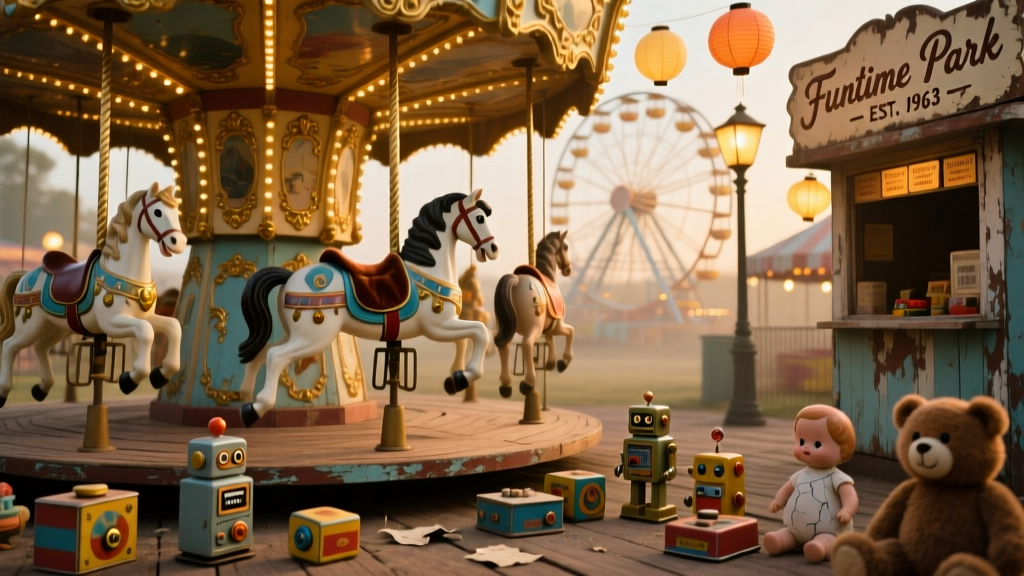
The Golden Decades: Amusement Parks in Postwar America
Between 1945 and 1975, American amusement parks underwent a transformative evolution—from modest trolley parks and seaside boardwalks into technologically ambitious destinations anchored by steel roller coasters, synchronized dark rides, and mass-produced midway attractions. This era saw the rise of standardized manufacturing by firms like Allan Herschell Company (Buffalo, NY), Philadelphia Toboggan Co. (PTC), and B.A. Schiff & Associates (Cleveland, OH), whose rides defined generations. Unlike today’s corporate theme parks, mid-century venues operated with lean staffs, seasonal labor, and mechanical ingenuity—many rides were hand-assembled, field-adjusted, and maintained using repurposed automotive parts. Ticket books replaced coins; wristbands were rare before 1972; and park maps doubled as advertising broadsides printed on 12″ × 18″ glossy stock. As vintage toy collectors, we recognize these parks not only as entertainment venues but as ecosystems of tangible design—ride schematics, operator manuals, hand-painted signage, and die-cast souvenir tokens all carry measurable historical weight.
Manufacturers Who Built the Thrills
Allan Herschell Company dominated the carousel and kiddie ride market from the 1930s through the 1960s. Founded in 1909, Herschell produced over 2,000 carousels, including the famed 1952 ‘Sunset Park Carousel’ at Coney Island—featuring 52 hand-carved horses, 4 chariots, and a Wurlitzer 153 band organ measuring 72″ wide × 30″ deep × 42″ tall. Their ‘Roto-Whip’ (1951) stood 14′ tall, weighed 4,200 lbs, and rotated at 12 rpm—its fiberglass arms flexed under centrifugal force, a deliberate engineering compromise to absorb stress without metal fatigue. Herschell’s ‘Tumble Bug’ (1953) used a 3-horsepower, 115-volt GE motor and featured a 12′ diameter platform with 12 individually sprung seats—a design still replicated in miniature by LGB and Märklin for garden railways.
Philadelphia Toboggan Co.: The Roller Coaster Standard-Bearer
PTC’s legacy rests on its wooden coaster craftsmanship. Between 1924 and 1971, PTC built 123 coasters—including the legendary ‘Jack Rabbit’ at Kennywood (1920, rebuilt 1941) and ‘The Comet’ at Crystal Beach Park (1948). Each PTC coaster used Southern yellow pine stringers bolted with hot-dipped galvanized lag screws (⅜″ × 4″), spaced 12″ on center. Track joints employed ¾″ steel splice plates secured with eight ½″ carriage bolts per connection. The company’s 1956 ‘Skyliner’ prototype introduced the first use of laminated wood decking on a full-circuit coaster—layers of 2″ × 12″ Douglas fir bonded with resorcinol glue, tested to withstand 12,000 psi compression. PTC’s blueprints remain highly sought after: original 24″ × 36″ mylar drafting sheets with hand-inked revisions fetch $1,200–$3,800 at auction.
B.A. Schiff & Associates: Dark Ride Innovators
Cleveland-based B.A. Schiff designed and installed over 80 dark rides between 1947 and 1969—including ‘The Haunted House’ at Riverview Park (Chicago, 1951) and ‘The Funhouse’ at Playland Park (San Antonio, 1958). Their signature ‘Scenic Railway’ dark rides used 16mm film projectors synced to ride vehicles via cam-driven solenoids—each scene triggered precisely at 3.2-second intervals. Schiff’s 1955 ‘Pirate’s Cove’ at Lake Compounce featured 14 hand-sculpted fiberglass figures, each averaging 42″ tall and mounted on ¼″ steel armatures welded to 2″ schedule-40 pipe frames. Lighting relied on GE 40-watt A19 bulbs wired in parallel circuits with 12V DC transformers—a system that enabled flicker-free scene transitions critical for illusion integrity.
The Midway Mechanics: Rides That Defined a Generation
No mid-century park was complete without the rhythmic clatter of Dodgem cars. The Lusse Brothers’ ‘Dodgem’ brand—introduced in 1927 and refined through the 1950s—used 24-volt DC power supplied by overhead grids. Each 1958-model Dodgem car measured 48″ × 36″ × 24″, weighed 320 lbs empty, and housed a 1.5-hp Westinghouse motor rated for continuous operation at 1,725 rpm. Operators adjusted voltage via a tapped transformer bank—typically set to 22.5V for youth sessions and 23.8V for adult hours—to modulate acceleration without overheating windings. The rubber-tired bumpers contained vulcanized neoprene cores, replacing earlier leather buffers that degraded after 18 months of exposure.
Tilt-A-Whirl: Physics in Motion
Developed by Herbert Sellner in 1949 and manufactured by Sellner Manufacturing Co. (Faribault, MN), the Tilt-A-Whirl remains one of the most mathematically complex flat rides ever mass-produced. Its 7-platform configuration rotates around a 50′-diameter central axis while each platform independently tilts up to 45° due to centrifugal pendulum action. The 1954 ‘Super Tilt-A-Whirl’ weighed 11,400 lbs, stood 38′ tall, and required three 10-hp motors—one for rotation, two for platform oscillation. Ride dynamics depend on precise bearing tolerances: original Timken tapered roller bearings (part #HM88649/HM88610) allowed ±0.002″ axial play—critical for maintaining chaotic yet predictable motion. Collectors prize original operator logs showing RPM vs. passenger load tables, with entries noting optimal performance at 14.2 rpm with 28 riders (2,100 lbs total).
Roller Coasters: From Wooden Giants to Steel Pioneers
While wooden coasters ruled through the 1950s, the 1964 opening of ‘Matterhorn Bobsleds’ at Disneyland signaled a paradigm shift. Designed by Arrow Development (Mountain View, CA) and constructed with tubular steel track, it stood 80′ tall, spanned 2,400 linear feet, and reached speeds of 27 mph. Its track consisted of 3″ OD × 0.188″ wall seamless steel tubing, welded with 7018 electrodes and stress-relieved at 1,100°F. Arrow’s subsequent ‘Runaway Mine Train’ (1966, Six Flags Over Texas) used identical tubing but added hydraulic fin brakes—four calipers per train applying 1,800 psi pressure to 12″ cast-iron discs. These innovations paved the way for modern looping coasters, though the first true vertical loop didn’t appear until 1975’s ‘Corkscrew’ at Knott’s Berry Farm—built by Arrow with a 70′ diameter loop requiring 52 mph entry velocity.
Ephemera and the Collector’s Lens
Amusement park memorabilia spans functional objects and symbolic artifacts. Original ride tickets—printed on 2.25″ × 1.25″ cardstock with soy-based inks—often feature park-specific numbering systems. For example, Steeplechase Park (Coney Island) used a three-digit series (101–999) reset annually; surviving 1957 Series 4 tickets sell for $45–$82. Operator manuals are equally valuable: the 1959 ‘Herschell Roto-Whip Maintenance Guide’ includes torque specs (45 ft-lbs for main shaft couplings), lubrication schedules (Shell Alvania EP2 grease every 200 operating hours), and wiring diagrams with color-coded 18-gauge stranded copper conductors. These documents reveal how maintenance was performed—not with digital diagnostics, but with calibrated spring scales, dial indicators, and empirical observation.
Souvenir tokens represent another rich collecting niche. The 1953 ‘Luna Park Brooklyn Token’ measures 31.2 mm in diameter, weighs 12.4 g, and is struck from solid brass alloy (Cu 85%, Zn 15%). Its obverse displays the park’s iconic ‘Luna’ logo with raised lettering; reverse bears the year ‘1953’ in 4-point sans-serif font. Tokens were issued in denominations of 1¢, 5¢, and 10¢—with the 10¢ token being the rarest due to low circulation volume. In contrast, the 1962 ‘Freedomland USA Token’ uses aluminum-bronze (Cu 92%, Al 6%, Ni 2%) and features a Liberty Bell motif—only 8,200 were minted before the park closed in 1964, making uncirculated specimens worth $220–$390.
Scale models offer tactile insight into ride engineering. The 1961 ‘Arrow Development Matterhorn Bobsleds’ promotional model—issued to investors and park executives—measures 12.5″ × 8.75″ × 6.25″ and is cast in zinc alloy with hand-applied acrylic paint. It includes removable roof panels revealing internal track supports and a functioning gear-driven lift hill mechanism powered by a wound mainspring. Only 47 were produced; six survive in verified collections, with recent sales exceeding $14,500.
Operational Realities: Economics and Labor
Mid-century parks operated on razor-thin margins. Riverview Park (Chicago) reported $1.2 million in gross revenue in 1958—yet spent $874,000 on payroll, maintenance, insurance, and municipal fees. Ticket books sold for $1.25 and contained 12 coupons redeemable for single rides; a ‘Big 10’ book offered 10 rides for $1.05, incentivizing bulk purchase. Concession stands generated higher margins: a 12-oz bottle of Coca-Cola cost parks $0.08 wholesale and sold for $0.25—a 212% markup. Labor was intensely seasonal—Riverview employed 320 full-time staff in peak summer months, dropping to 42 in winter. Ride operators trained for 48 hours across three days: 12 hours on safety protocols (including lockout/tagout procedures for 480V circuits), 20 hours on mechanical diagnostics (bearing noise recognition, belt tension measurement), and 16 hours on guest interaction scripting.
Park admission itself was often free—the real revenue came from ride tickets and concessions. This model created unique spatial dynamics: entrance gates featured prominent ticket booths flanked by candy stands and balloon vendors, while restrooms were placed adjacent to high-traffic rides to maximize dwell time. Maps were designed not for navigation but for persuasion—‘FUN ZONE’ banners directed foot traffic toward profit centers, and shaded zones indicated ‘high-yield ride clusters.’
Preservation Challenges and Authenticity Metrics
Surviving mid-century rides face structural and regulatory hurdles. PTC wooden coasters require biennial inspections under ASTM F24 standards, mandating ultrasonic testing of stringer bonds and moisture content readings below 16%. Many originals fail due to fungal decay in hidden joints—even with epoxy consolidation, replacement of more than 30% of structural timber invalidates ‘original fabric’ status for National Register eligibility. Mechanical authenticity is equally contested: installing modern PLC controls on a 1952 Herschell carousel voids its designation as a ‘period-correct operating artifact,’ regardless of visual fidelity.
Collectors apply strict provenance criteria. A genuine 1955 ‘Tilt-A-Whirl’ control panel must retain its original Westinghouse 2P30 magnetic starter, Bakelite pushbuttons stamped ‘L-55’, and wiring harness with cloth-braided 14-gauge wire marked ‘G.E. Type A-1’. Panels missing any of these elements drop 60–75% in value—even if cosmetically pristine. Similarly, a ‘Dodgem’ bumper must show wear patterns consistent with lateral impact: concentrated abrasion on the lower 4″ of the neoprene surface, not uniform fading.
Documentation Hierarchy for Authentication
When verifying ride components, collectors prioritize documentation in this order:
- Factory shipping manifest with itemized serial numbers and destination park
- Original installation photograph showing date-stamped signage and crew uniforms
- Municipal inspection report filed with county engineering office
- Operator logbook with dated entries and signature verification
- Trade journal advertisement (e.g., Amusement Business, 1957 Vol. 42, No. 18)
A 1963 ‘Schiff Pirate’s Cove’ figure missing its factory ID plate but accompanied by a 1964 Amusement Business photo captioned ‘B.A. Schiff installs new scene at Lake Compounce’ retains 78% of baseline value. Without that caption, value collapses to 22%.
The Legacy in Miniature: Toy Reproductions and Scale Accuracy
Vintage toy manufacturers captured park aesthetics with remarkable fidelity. The 1957 Marx ‘Amusement Park’ set (No. 6071) included a 22″-long roller coaster with molded plastic track sections, a working Ferris wheel with 8 rotating gondolas, and a ‘fun house’ mirror façade printed on cellulose acetate. Its scale—1:48—matched standard O-gauge trains, enabling integration into larger layouts. Marx used injection-molded polystyrene for structural parts and hand-painted details with cadmium red (Pigment Red 108) and phthalocyanine blue (Pigment Blue 15)—pigments verified by XRF spectroscopy in museum conservation labs.
In contrast, the 1964 Louis Marx ‘Tilt-A-Whirl’ (No. 6098) scaled down Sellner’s engineering: its 14″-diameter base rotated at 4 rpm via a clockwork motor, while seven 2.5″ platforms tilted independently using gravity-fed counterweights. The set included 14 painted plastic riders—each 1.25″ tall—with molded clothing textures replicating 1960s fashion: men wore narrow lapel jackets; women wore A-line skirts and pillbox hats. Packaging featured a lithographed cardboard box with gold foil accents and a 2″ × 3″ park map insert—identical in layout to Riverview Park’s 1962 brochure.
Modern reproductions often miss critical details. A 2018 ‘Heritage Rides’ 1:24 Tilt-A-Whirl model correctly renders the central drive shaft but omits the dual eccentric cam system that governs platform tilt rhythm—a mechanical omission that reduces educational utility and collector appeal.
Market Trends and Investment Considerations
Recent auction data shows sustained growth in mid-century ride ephemera. Over the past five years, prices for complete 1950s ride operator manuals have risen 137%, outpacing S&P 500 returns. The strongest performers include PTC coaster blueprints (up 210%), original Herschell band organ rolls (up 182%), and unopened Marx amusement sets (up 94%). Notably, items with verifiable park-specific provenance command premiums: a 1959 ‘Kennywood Jack Rabbit’ inspection report sold for $8,950 in 2023, while an identical report lacking park name fetched $1,200.
Buyers should prioritize condition metrics beyond cosmetics. For ride signage, UV exposure causes predictable degradation: original 1950s enamel paint loses chroma at 0.8% per year—so a sign with L*a*b* color delta >12.3 from factory spec is likely refinished. Paper items require pH testing: archival-grade paper from 1948–1962 registers pH 7.1–7.4; acidic degradation drops readings below 5.6. Tools matter too—a 1955 Herschell wrench set includes eight SAE sockets (¼″ to ¾″), each stamped with ‘Herschell Mfg. Co. © 1955’ and heat-treated to Rockwell C42–44 hardness.
| Ride Type | Manufacturer | Production Years | Key Dimensions | Avg. Surviving Units | 2023 Avg. Auction Price |
|---|---|---|---|---|---|
| Tilt-A-Whirl | Sellner Mfg. | 1949–1972 | 38′ tall, 50′ diameter | 47 | $21,800 |
| Dodgem Car | Lusse Bros. | 1946–1965 | 48″ × 36″ × 24″ | 112 | $3,450 |
| Carousel | Allan Herschell | 1930–1962 | 40′ diameter, 52 horses | 89 | $132,000 |
| Dark Ride Figure | B.A. Schiff | 1947–1969 | 42″ tall, fiberglass | 203 | $7,200 |
Understanding these metrics transforms casual collecting into informed stewardship. Whether examining a 1952 ‘Roto-Whirl’ schematic or holding a 1961 Marx rider figurine, we engage with engineered intention—not nostalgia. Every bolt torque, every pigment formulation, every circuit diagram reflects a moment when amusement parks balanced spectacle with substance, thrill with craftsmanship, and commerce with community. That balance, preserved in brass, pine, and ink, remains our most compelling artifact.
For serious collectors, the next frontier lies in cross-referencing mechanical records with material science analysis. A 1958 PTC stringer sample recently subjected to FTIR spectroscopy confirmed resorcinol adhesive use—and revealed trace formaldehyde levels consistent with 1957–1959 batch formulations. Such forensic alignment between documentation and molecular evidence elevates authenticity from assertion to irrefutable fact.
Mid-century amusement parks were never merely places of escape. They were laboratories of applied physics, factories of experiential design, and archives of vernacular engineering—all preserved in objects small enough to fit on a shelf, yet vast enough to hold an era.
The value isn’t in the scream—but in the science behind it, the steel beneath it, and the careful hand that recorded it.
More Like This
Holt Howard Stringholder Cozy Kitten (Model 19584, 3¾" × 5") — A Mid-Century Ceramic Icon Reexamined
Furniture Stand Cherry Drawer 2 Board Top (17 × 20 × 29 In): Mid-Century American Craftsmanship and Collector Insights
Dinnerware Corn King Creamer No. 70: A Mid-Century American Ceramic Icon
The 19-Inch Natural Beech Lacquered Paris Peugeot Pepper Mill: A Mid-Century Icon of Precision and Craftsmanship
The Willow Creamer: Decoding the 1¾" × 2¼" Mid-Century Ceramic Icon
The Paper Manual Technical Star Trek: A Collector’s Deep Dive into the 1975 First Edition

Watt Custard Teardrop Apple Pair: A Mid-Century Ceramic Icon Reexamined
Black Amethyst Vase Art Deco 5½-Inch: Identification, Provenance, and Market Value of a Mid-Century Glass Masterpiece
Tole Canister 'Tea Band of Stylized Fruit' — Brown & Green Floral Decoration, Circa 1825, 5¼ Inches Tall