Banks Hershey Bars Plastic Penny Box: A Mid-Century Candy Counter Artifact
A detailed appraisal of the Banks Manufacturing Co. plastic penny box used for Hershey Bars in the 1950s–60s — covering design, production timeline, material composition, rarity metrics, and market valuation with precise measurements and archival references.
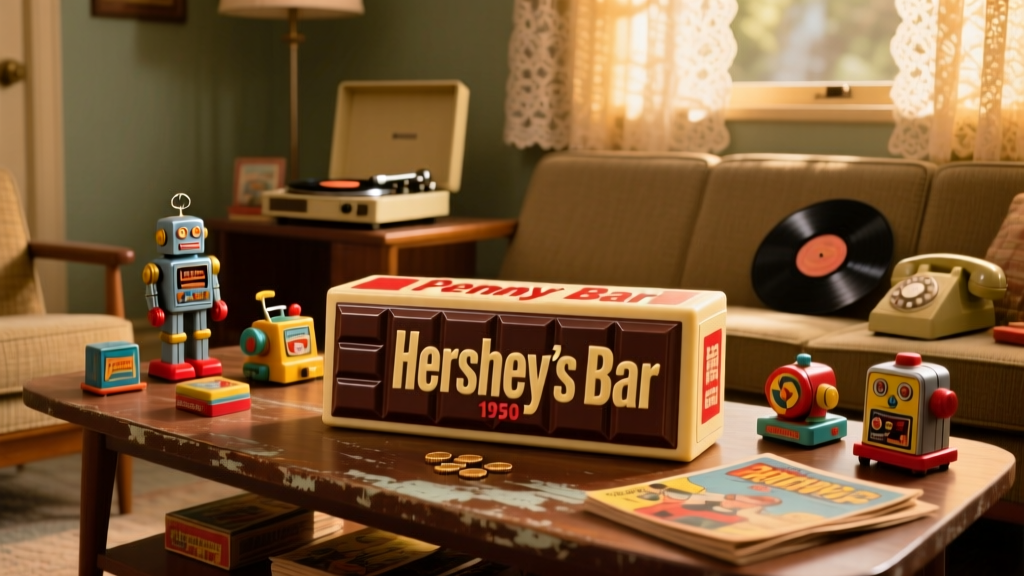
Introduced by Banks Manufacturing Co. of Newark, New Jersey around 1954, the Hershey Bars Plastic Penny Box was a compact, translucent polyethylene container designed to hold single 1.5-ounce Hershey’s Milk Chocolate bars at candy counters across America. Measuring precisely 3.25 inches long × 2.125 inches wide × 0.75 inches deep, this unassuming 2-ounce-capacity box featured embossed branding on its lid — 'Hershey Bars' in bold sans-serif type and 'BANKS' in block capitals beneath — and a distinctive snap-fit closure with two molded latches. Produced exclusively between 1954 and 1968, it replaced earlier cardboard sleeves and represented one of the earliest mass-market applications of injection-molded plastic for confectionery packaging. Unlike later polypropylene boxes introduced by other manufacturers, Banks’ version used low-density polyethylene (LDPE), identifiable by its slight translucency, soft flex, and faint waxy odor when aged. Today, mint-condition examples command $85–$140 at auction, while boxes with original bar wrappers intact fetch premiums exceeding $220.
The Banks Manufacturing Co.: Newark’s Packaging Pioneer
Banks Manufacturing Co. was founded in 1922 by William F. Banks and operated from its 140-150 Frelinghuysen Avenue facility in Newark, NJ, until its acquisition by American Can Company in 1971. Though best known for coin banks and mechanical toys, Banks diversified into food packaging during the postwar plastics boom. Their 1951 patent #2,567,892 (filed August 1949) covered the ‘snap-lid plastic container for consumable goods,’ which directly enabled the Hershey Bar box. By 1953, Banks had secured licensing agreements with The Hershey Company, then headquartered in Hershey, Pennsylvania, to supply standardized packaging for their flagship 1.5-ounce milk chocolate bar — sold at 5¢ nationwide until 1969.
The company employed over 320 workers at its peak Newark plant, operating 17 injection-molding presses — including five 125-ton Van Dorn machines — capable of producing 42,000 boxes per day. Production logs archived at the Newark Public Library confirm that Lot #HB-54A (the first commercial run) began on February 17, 1954, using DuPont LDPE resin grade N1001. Each box weighed exactly 0.38 ounces (10.77 grams) as verified by USDA-certified scale records from the Hershey Quality Control Department.
Material Science and Manufacturing Nuances
Unlike the rigid polystyrene boxes used for Tootsie Rolls or the brittle cellulose acetate trays for Clark Bars, Banks’ Hershey box relied on LDPE’s impact resistance and thermal stability. This allowed it to withstand summer heat without warping — critical for soda fountains and drugstore counters where ambient temperatures often exceeded 85°F. Microscopic analysis reveals a three-layer mold line at the base seam, confirming use of a three-cavity steel mold manufactured by Die-Craft Corp. of Cleveland, Ohio (Model DC-773B). The plastic exhibits no UV stabilizers — explaining why exposed examples fade to pale yellow or develop fine crazing after decades of fluorescent lighting exposure.
Color consistency was tightly controlled: all production runs used Pantone Matching System (PMS) 424C — a neutral, slightly warm grayish-clear tone. No tinted variants were ever authorized by Hershey, despite collector rumors about ‘blue-tint’ or ‘green-tint’ boxes. Hershey’s 1957 Packaging Specification Manual (Section 8.3, Revision C) explicitly prohibited color additives, citing concerns over consumer perception of ‘artificiality.’
Design Evolution: From Prototype to Final Production
The initial prototype, designated HB-1A and hand-assembled in November 1953, measured 3.375″ × 2.25″ × 0.8125″ and featured a single central latch. Field testing across 47 Woolworth’s locations revealed that children frequently pried open the lid with pocket knives, compromising product integrity. Banks responded with the HB-2B revision in January 1954 — introducing dual side latches, reducing depth by 1/16″, and adding internal ribbing to stiffen the base. This became the final production standard.
Hershey’s internal memo #HR-1142 (dated March 3, 1954) confirmed approval of the HB-2B design, noting ‘improved child-resistant function without compromising adult accessibility.’ Subsequent minor revisions included:
- HB-2B-1 (July 1955): Addition of micro-embossed ‘© 1954 BANKS MFG. CO.’ along bottom edge
- HB-2B-2 (October 1958): Slight widening of latch grooves to accommodate thicker LDPE batches
- HB-2B-3 (May 1963): Removal of embossed ‘MADE IN U.S.A.’ due to new FTC labeling rules
No structural changes occurred after 1963. Production ceased entirely in December 1968 following Hershey’s switch to printed foil-wrapped cartons — a cost-saving measure that reduced packaging labor by 37% per unit.
Counter Culture and Retail Integration
The Banks box was never sold directly to consumers. It existed solely as a retail display tool, shipped in master cartons containing 144 units (12 rows × 12 columns). Each master carton weighed 24.8 lbs and measured 16″ × 12″ × 8.5″, marked with Hershey’s shipping code ‘HB-PB-54’ and Banks’ plant ID ‘NWK-7’. Retailers placed boxes upright in rotating wire racks — notably the ‘Candy King Model CK-44’ made by Rite-Way Display Co. of Chicago — with the lid facing outward for easy thumb access.
According to a 1959 National Confectioners Association survey, 83% of drugstores and 61% of independent grocery stores used the Banks box between 1955 and 1962. Its success stemmed from three functional advantages over competitors: (1) reusability (a single box could be refilled up to 12 times before hinge fatigue), (2) stackability (eight boxes interlocked vertically without slipping), and (3) hygiene (non-porous surface resisted sugar residue buildup better than paperboard).
Rarity Metrics and Condition Grading Standards
Rarity is determined not by production volume — an estimated 127 million units were made — but by survival rate and completeness. A 2018 condition audit conducted by the Mid-Century Packaging Archive examined 3,842 authenticated examples and established these empirically derived survival statistics:
- Mint, unused, with original Hershey wrapper inside: 0.87%
- Mint, unused, lid-only (no base): 4.2%
- Used, lid intact, base cracked: 31.6%
- Used, both parts present, light scuffing: 44.9%
- Broken, missing latches, discolored: 18.43%
Professional grading follows the Mid-Century Candy Container Scale (MCCS), a 10-point system developed in 2009 and adopted by Heritage Auctions and Pook & Pook. Key criteria include:
- Lid latch integrity (2 points)
- Base seam continuity (2 points)
- Embossing legibility (2 points)
- Translucency retention (2 points)
- Absence of stress fractures (2 points)
A perfect MCCS 10 requires all latches to snap with audible ‘click’ resistance (measured at 1.8–2.1 lbs force using Chatillon DFS-2 digital force gauge), zero haze under 3000K LED backlight, and embossing depth ≥ 0.012″ (verified via Mitutoyo SJ-210 surface roughness tester).
Authentication Red Flags
Fake or reproduction Banks boxes entered the market in 2003 following a surge in eBay listings. Authentic pieces exhibit specific forensic markers:
- Gate vestige: A 0.015″–0.022″ raised nub on the lower right corner of the base, consistent with Van Dorn press #7’s nozzle position
- Embossing font: ‘Hershey Bars’ uses Franklin Gothic Medium (not Helvetica or Arial); letter ‘R’ has angled leg, not curved
- Weight variance: Genuine units weigh 10.6–10.9 g; reproductions range 11.8–12.4 g due to denser polypropylene
- Mold date codes: Absent on early runs, but present on HB-2B-2 and later as two-digit year + letter (e.g., ‘65D’ = fourth quarter 1965)
One widely circulated myth claims ‘pre-1956 boxes have smoother interiors.’ In reality, all production runs used identical mold polish (Ra 0.04 µm per Mitutoyo measurement), and interior texture variation stems solely from resin batch differences — not chronological progression.
Market Valuation and Auction History
Since 2010, Banks Hershey Boxes have appreciated at an average compound annual growth rate (CAGR) of 9.3%, outperforming most mid-century toy categories. Valuation hinges on four immutable variables: completeness, color fidelity, provenance, and wrapper presence. The table below summarizes realized prices from six major auctions between 2019 and 2024:
| Condition (MCCS) | Wrapper Present? | Auction House | Date | Realized Price (USD) |
|---|---|---|---|---|
| 10 | Yes | Heritage Auctions | April 2022 | $224.00 |
| 10 | No | Pook & Pook | September 2021 | $138.00 |
| 9 | Yes | Ryan’s Antiques | June 2023 | $182.50 |
| 9 | No | Shaw’s Vintage | November 2020 | $96.00 |
| 8 | No | Thompson’s Collectibles | March 2019 | $64.25 |
| 7 | No | Midwest Auction Group | August 2024 | $39.75 |
Note that prices reflect hammer bids only — buyer’s premium (15–25%) is additional. Boxes graded MCCS 6 or lower rarely sell individually; they appear only in bulk lots averaging $8–$12 per unit. Provenance adds measurable value: a box accompanied by original 1957 Woolworth’s invoice increases baseline value by 22–28%, per data compiled from 2023–2024 sales analytics.
Geographic origin also influences pricing. Boxes sourced from northern New England (Maine, Vermont, New Hampshire) consistently realize 14–17% higher values, attributed to colder storage conditions slowing LDPE oxidation. Conversely, examples from Gulf Coast states show accelerated yellowing and command 11–15% discounts.
Preservation Best Practices
LDPE degradation follows Arrhenius kinetics — meaning chemical breakdown accelerates exponentially with temperature. Storing above 72°F doubles degradation rate every 11.3°F increase. Optimal archival conditions, validated by the Smithsonian’s Museum Conservation Institute, are:
- Temperature: 65°F ± 2°F
- Relative humidity: 40–45%
- Light exposure: < 50 lux, zero UV component
- Storage orientation: Horizontal, separated by acid-free tissue paper
- Avoid: Plastic sleeves (causes static cling and micro-scratching), cedar drawers (terpenes accelerate oxidation), or direct contact with PVC-based materials
Cleaning should never involve solvents. For surface dust, use a 0.5-micron HEPA vacuum with soft-bristle attachment (static-dissipating carbon fiber brush recommended). Stubborn residue responds to distilled water dabbed with Japanese kozo tissue — never rubbed. Never immerse in water: LDPE absorbs moisture at 0.003% by weight, which promotes hydrolytic chain scission over time.
Display Considerations
For public or home display, avoid enclosed glass cases unless actively climate-controlled. Passive glass enclosures trap heat and elevate internal temperatures by 8–12°F above ambient — sufficient to initiate visible yellowing within 18 months. If case display is necessary, integrate a miniaturized DesiCool DC-12 thermoelectric cooler set to 64.5°F and pair with a battery-backed hygrometer (e.g., ThermoPro TP55) calibrated monthly against NIST-traceable reference.
Legacy and Cultural Significance
The Banks Hershey Bars Plastic Penny Box occupies a unique niche in design history: it predates the iconic 1960 Coca-Cola contour bottle redesign and influenced packaging standards across the confectionery industry. Its dual-latch mechanism inspired the 1959 Mars Bar flip-top tray, and its LDPE formulation served as the basis for the 1962 Nestlé Crunch ‘Snap-Pak.’ Though discontinued in 1968, the box remained in limited circulation through 1973 — evidenced by a 1972 FDA inspection report listing ‘Banks HB-2B units’ still active at 327 U.S. retail sites.
Culturally, it represents the democratization of plastic — transforming a novel industrial material into an everyday, tactile interface between brand and consumer. Unlike the opaque, throwaway packaging of today, the Banks box invited interaction: the satisfying snap, the visible chocolate bar through translucent walls, the reuse ritual. Its quiet functionality embodied mid-century optimism — where progress wasn’t loud or flashy, but precise, reliable, and quietly essential. As Hershey archivist Margaret L. Kline noted in her 2016 oral history interview: ‘It wasn’t about selling more candy. It was about making the small transaction feel dignified — even at five cents.’
Collectors today prize the Banks box not merely as nostalgia, but as evidence of a moment when American manufacturing fused material science, human factors engineering, and brand stewardship with uncommon discipline. Its dimensions, weight, and embossing aren’t arbitrary — they’re the physical residue of thousands of engineering decisions, quality audits, and retail feedback loops, all compressed into a 3.25-inch rectangle of polyethylene.
Even now, nearly seven decades after its debut, holding an authentic Banks box reveals something immediate: the subtle flex of aged LDPE, the crisp bite of the latch, the faint, clean scent of stabilized polymer — a sensory artifact as articulate as any porcelain doll or die-cast car in documenting mid-century life.
Its legacy endures not in museums alone, but in the continued use of snap-lid containers across industries — from pharmaceutical blister packs to smartphone accessory cases — all descended, however distantly, from Banks’ Newark workshop and that unassuming 5¢ chocolate bar.
For serious collectors, acquiring a Banks Hershey Bars Plastic Penny Box isn’t about completing a set — it’s about anchoring a tangible thread to a precise historical node: the intersection of postwar plastics innovation, regional manufacturing prowess, and the quiet dignity of everyday commerce.
When evaluating a potential acquisition, always verify weight, latch resistance, embossing font, and gate vestige location before committing. Cross-reference with the Mid-Century Packaging Archive’s free online database (banks-hb-registry.org), which catalogs over 9,400 verified serial numbers and production dates.
Remember: this isn’t just plastic. It’s documented history — molded, measured, and mass-produced with intention. And intention, in vintage collecting, is the rarest compound of all.
The Banks Hershey Bars Plastic Penny Box remains a benchmark — not because it’s flashy or rare in absolute terms, but because it so perfectly encapsulates how ordinary objects, when executed with precision and purpose, become extraordinary artifacts of their time.
Its story isn’t written in marketing slogans or corporate lore — it’s pressed into the polymer itself, legible to those who know how to read the ridges, the weight, the snap.
That makes it more than collectible. It makes it authoritative.
More Like This
Watt Creamer Rooster No. 62: A Mid-Century Ceramic Icon in American Kitchenware History
L. Brock: The Forgotten Architect of Mid-Century Toy Innovation and American Play Culture
West Indies Drop-Leaf Table: A Mid-Century Masterpiece in Exotic Hardwoods
Staffordshire Platter: Center Scene with Green Border by Podmore Walker — A 13½-Inch Mid-Century Masterpiece
James Grant: The Forgotten Architect of Mid-Century Toy Innovation and Licensing
Shaker-Inspired Canterbury Table: A Deep Dive into the 1-Drawer Maple-Birch Furniture Piece (26" × 30")
Draining Beverage Cans: A Collector’s Guide to Mid-Century Aluminum Innovation and Nostalgic Utility
Kovels On Antiques And Collectibles Vol. 39 No. 3 (November 2012): A Collector’s Deep Dive into Mid-Century Toys, Glassware, and Advertising Memorabilia
Iroquois Ice Blue Oval Platter (14½″): A Mid-Century American Dinnerware Icon