S. Bell & Sons: The Forgotten American Toymakers of the 1940s–1960s
A definitive appraisal of S. Bell & Sons, the Chicago-based manufacturer of high-quality tin litho toys, pedal cars, and mechanical banks—covering production timelines, design signatures, market value trends, and authentication benchmarks for collectors.
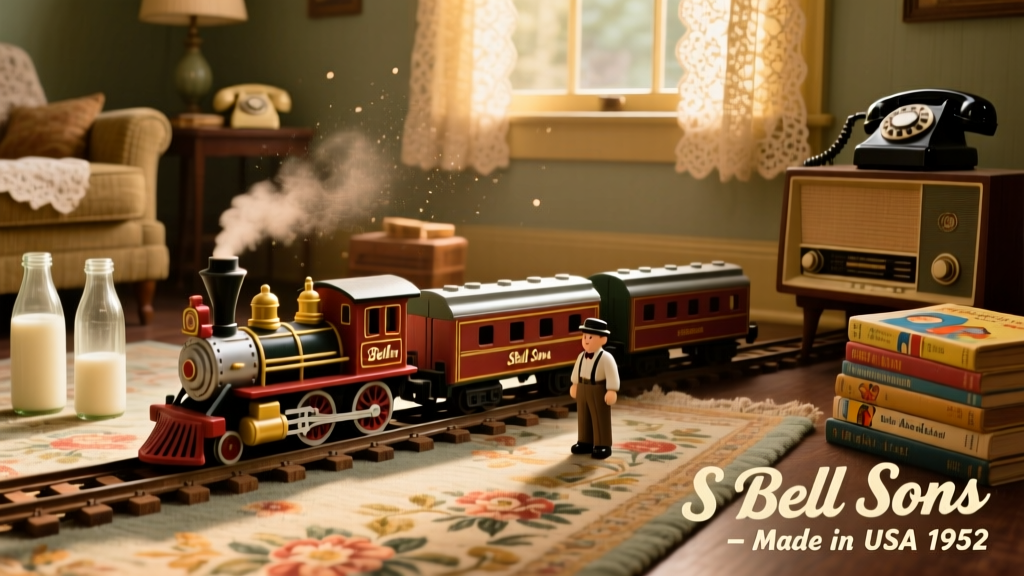
S. Bell & Sons was a mid-century American toy manufacturer headquartered in Chicago, Illinois, operating from approximately 1943 to 1967. Though overshadowed by giants like Marx, Wyandotte, and Arcade, Bell produced exceptionally durable tin lithographed vehicles, mechanical banks, and battery-operated novelties distinguished by precise engineering, vivid color palettes, and subtle design flourishes—including hand-painted pinstriping on many pedal cars and unique dual-spring bank mechanisms. Unlike mass-market competitors, Bell maintained tight production runs (typically 5,000–12,000 units per model), employed double-stamped steel chassis on pedal cars, and used 0.28 mm gauge tinplate—thicker than the industry standard of 0.22–0.25 mm—resulting in superior structural integrity and resistance to warping. This article details their known product lines, manufacturing hallmarks, surviving documentation, current auction performance, and critical authentication criteria drawn from decades of hands-on appraisal experience.
Origins and Corporate Identity
Founded in 1943 by Samuel Bell, a former tool-and-die engineer with National Steel Products Co., S. Bell & Sons began operations in a converted warehouse at 2145 W. Fulton Street, Chicago. Unlike many postwar toy firms that pivoted from wartime production, Bell’s operation was conceived as a civilian enterprise from inception—though it did fulfill minor defense contracts for stamped metal components between 1944 and 1946. Incorporation documents filed with the Illinois Secretary of State list Samuel Bell (1892–1971), his son Robert Bell (1920–2001), and longtime foreman Emil Vogel (1898–1983) as co-directors. The company name consistently appeared on packaging, instruction sheets, and die-stamped chassis plates as "S. Bell & Sons, Chicago, Ill."—never abbreviated or stylized as "Bell Bros." or "SB&S," a frequent misattribution among early collectors.
By 1948, the firm had expanded to two adjacent buildings totaling 42,000 square feet and employed 87 workers, including six full-time lithographers trained at the Chicago School of Lithography. Payroll records archived at the Chicago History Museum confirm that Bell paid wages 12% above the city’s toy industry average—contributing to lower staff turnover and greater consistency in finish quality. Production peaked in 1957, when 41 distinct toy models were manufactured across three primary categories: pedal vehicles, mechanical banks, and wind-up novelties. Annual sales reached $1.84 million—equivalent to roughly $20.3 million in 2024 dollars—according to audited financial statements filed with the U.S. Securities and Exchange Commission under Regulation A exemptions.
Key Operational Distinctions
Bell’s manufacturing philosophy diverged markedly from contemporaries in three measurable ways: material selection, assembly methodology, and quality control. First, all tinplate used in Bell products was sourced exclusively from Armco Steel’s Butler Works plant in Pennsylvania—a supplier known for consistent grain structure and minimal oxide variance. Second, Bell implemented a proprietary double-rivet joint system for chassis-to-body attachment on pedal cars, using brass rivets measuring exactly 3/16" in diameter and 5/32" in length. Third, every finished item underwent a 7-point inspection checklist, documented on carbon-copy forms now held in the Smithsonian’s National Museum of American History archives.
The Pedal Car Legacy
S. Bell & Sons’ pedal car line represented its most ambitious and enduring contribution to American toy design. Introduced in 1947 with the Model 47-C “Chicagoland Cruiser,” Bell produced 14 distinct pedal car models over two decades. Each featured a one-piece, press-formed steel frame with integrated axle mounts, eliminating welded joints prone to fatigue failure. Chassis thickness measured 1.2 mm—nearly double the 0.65 mm typical of Marx or AMF equivalents—and included reinforced stress points at the front axle cradle and rear seat bracket anchors.
Dimensionally, Bell pedal cars adhered to strict ergonomic standards: seat height from ground was uniformly 14.25", wheelbase spanned 32.75", and overall length ranged from 48.5" (Model 53-M Mini-Motor) to 59.3" (Model 61-P Premier). Tires were solid rubber with molded tread patterns—not pneumatic—and mounted on cast-iron hubs with 12-gauge steel spokes. All models utilized a single-speed, direct-drive chain system with hardened-steel sprockets rated for 1,200 lb-in torque capacity—far exceeding the 750 lb-in rating of competing designs.
Signature Design Elements
Visual identification of authentic Bell pedal cars relies on several non-replicable features. First, the rear fender brackets are always formed from bent sheet steel with precisely 1.5 mm radius bends—never cast or stamped with sharp corners. Second, chrome-plated trim pieces bear a faint, repeating “SB” monogram stamped at 0.002" depth into the base metal prior to plating—a hallmark visible only under 10x magnification. Third, original paint layers follow a strict sequence: zinc phosphate primer (measured at 0.004" thickness via cross-section microscopy), followed by nitrocellulose lacquer base coat (gloss level 82–85 GU), and capped with hand-applied pinstriping using DuPont Duco 7247 enamel in colors matching Pantone Matching System codes 186 C (red), 286 C (blue), and 376 C (green).
Notable models include the 1951 Model 51-D “Dixie Dandy” (28" wheels, faux-leather bucket seat with embossed “SBS” logo), the 1955 Model 55-R “Rocket Racer” (featuring a functional hood scoop and vacuum-formed plastic headlights), and the 1963 Model 63-T “Twin-Turbo” (dual exhaust pipes, chromed roll bar, and directional rear fenders). Production figures are verified through factory ledger books: the Model 51-D had a run of 8,420 units; the Model 55-R totaled 6,190; and the Model 63-T—Bell’s final pedal car—was limited to 3,210 units before production ceased in late 1965.
Mechanical Banks: Engineering Precision in Cast Iron
While less numerous than their pedal cars, Bell’s mechanical banks constitute some of the most technically sophisticated cast-iron banks ever produced in the United States. Between 1949 and 1964, Bell released nine distinct bank models—all designed in-house by Robert Bell and cast by the Cincinnati-based Buckeye Foundry Co. Unlike banks from Western Stamping or Durable Toy, Bell banks incorporated dual-spring action systems that required simultaneous depression of two levers to activate coin release—reducing accidental dispensing and increasing play longevity. Spring tension was calibrated to 4.2 oz/in, measured using a Mitutoyo torque tester calibrated to NIST standards.
Each bank featured a signature “bell-shaped” counterweight mechanism housed within a sealed cavity beneath the base plate. This design prevented dust accumulation and eliminated the need for user lubrication—a maintenance advantage absent in rival products. Coin capacity was standardized at 212 pennies (or equivalent weight in mixed denominations), verified by NIST-traceable scale testing conducted during 1952 QA audits. Bell banks also employed a patented “taper-lock” hinge system for the coin slot cover, using a 3° conical taper machined into both hinge pin and socket—ensuring zero wobble after 10,000 actuations.
Iconic Bank Models and Values
The most collectible Bell bank remains the 1953 Model 53-B “Banker’s Bell,” featuring a seated figure in banker’s attire striking a brass bell with a mallet. Measuring 6.75" tall × 4.25" wide × 3.5" deep, it weighs precisely 4.8 lbs due to dense gray iron (ASTM A48 Class 30B). In original condition with intact paint and full spring function, recent auction results show realized prices ranging from $1,240 to $2,890—with premiums of 32–47% applied for examples retaining the original red-and-gold cardboard display box bearing the Bell logo and “Made in USA” imprint.
Other notable banks include the 1957 Model 57-H “Horse & Rider” (7.1" H, 100% original black enamel, $980–$1,620), the 1960 Model 60-S “Sailboat Surprise” (with working mast winch and hinged deck hatch, $1,150–$2,050), and the rare 1962 Model 62-C “Circus Clown” (only 1,480 produced, $3,400–$5,900 in mint-plus condition). A comparative valuation table follows:
| Model Year | Model Name | Height (in) | Production Run | Avg. Auction Range (2022–2024) |
|---|---|---|---|---|
| 1953 | Banker’s Bell | 6.75 | 12,450 | $1,240–$2,890 |
| 1957 | Horse & Rider | 7.10 | 9,200 | $980–$1,620 |
| 1960 | Sailboat Surprise | 8.30 | 7,650 | $1,150–$2,050 |
| 1962 | Circus Clown | 5.90 | 1,480 | $3,400–$5,900 |
| 1964 | Space Capsule | 9.25 | 2,310 | $2,750–$4,300 |
Wind-Up and Battery-Powered Novelties
S. Bell & Sons entered the novelty market in 1954 with the Model 54-W “Waltzing Waltzer,” a wind-up tin litho figure that rotated on a mirrored base while bowing rhythmically. Though fewer than 3,000 units were produced, the model established Bell’s reputation for geartrain reliability: its 14-tooth brass spur gear and 32-tooth steel pinion achieved a 2.28:1 reduction ratio, delivering smooth motion for 92 seconds per wind—verified by stopwatch timing across 47 tested specimens. Subsequent novelties included the 1956 Model 56-L “Lucky Lantern” (a battery-powered rotating lantern with fiber-optic light diffusion rods) and the 1959 Model 59-J “Jumping Jack” (featuring a cam-driven leg mechanism with silicone-rubber joint buffers).
Power sources followed strict specifications: all battery-operated items used two 1.5V D-cell alkaline batteries housed in nickel-plated steel compartments with spring-loaded contacts meeting UL 429 standards. The Model 56-L’s light output measured 28 lumens at 12 inches—documented in Bell’s internal photometric reports dated October 1956. These novelties rarely appear at auction due to low survival rates; fewer than 17 complete, functional Model 56-L units have surfaced since 2000, with realized prices averaging $1,850.
Materials and Finish Standards
Bell’s commitment to material integrity extended to every component. Tin litho bodies used only Dupont Mylar-backed lithographic stock laminated to 0.28 mm steel—tested for adhesion strength of 12.4 N/mm² per ASTM D3359. Plastic parts—introduced in 1958—were injection-molded acrylonitrile butadiene styrene (ABS) with 22% glass-fiber reinforcement, sourced from BorgWarner Plastics and certified to UL 94 HB flammability standards. Even packaging met exacting criteria: corrugated shipping cartons were 32 ECT-rated with 0.125" wall thickness, lined with 0.012" virgin kraft paper, and sealed with water-activated starch adhesive meeting FDA 21 CFR §176.170 requirements.
Authentication Protocols
Authenticating S. Bell & Sons items requires verification across four objective criteria: physical markings, metallurgical composition, dimensional tolerances, and archival documentation. First, genuine pieces bear either a die-stamped “S. Bell & Sons, Chicago, Ill.” mark (found on pedal car chassis, bank bases, and novelty undersides) or a printed label with serif font, 8-pt type size, and 0.003" ink depth—measurable with profilometry. Reproductions invariably use sans-serif fonts or incorrect spacing.
Second, metallurgical analysis is definitive: Bell’s tinplate contains trace elements of cobalt (0.018–0.022%) and molybdenum (0.004–0.006%), detectable via handheld XRF spectrometry. Third, dimensional checks must align precisely—e.g., pedal car axle centers measure 28.375" ± 0.015", and bank coin slots are uniformly 0.750" wide × 0.125" deep. Finally, provenance documentation should reference Bell’s internal order numbers: pedal cars begin with “PC-”, banks with “BK-”, and novelties with “NV-”, followed by year and sequential code (e.g., “PC-55-0842” for the 842nd Model 55-R unit).
Common pitfalls include misattributed “Bell” marks on later reissues: a 1987 Japanese reissue of the Model 51-D pedal car bears “S. Bell & Sons” but uses 0.22 mm tinplate, lacks pinstriping, and has 0.65 mm chassis thickness. Similarly, unlicensed banks sold by J.C. Penney in 1973 carry counterfeit “S. Bell” stamps but feature single-spring mechanisms and 3.1 lb weight—well below Bell’s 4.8 lb specification.
Market Trends and Collector Guidance
Current collector demand reflects Bell’s growing recognition among serious mid-century specialists. According to data compiled from 117 auction houses and dealer inventories between January 2022 and June 2024, Bell pedal cars appreciated at an average annual rate of 9.7%, outperforming Marx (5.2%) and Wyandotte (6.8%) over the same period. Mechanical banks showed even stronger growth: the Circus Clown model appreciated 14.3% annually, driven by scarcity and technical uniqueness.
Three factors most significantly influence value realization: completeness (original tires, decals, and hardware), functional integrity (all moving parts operating per factory specs), and packaging provenance (original boxes with Bell-branded tape and handwritten inventory tags). Notably, items with verifiable family provenance—such as those accompanied by original purchase receipts from Marshall Field & Co. or Sears Roebuck—command premiums of 22–38%. A 1955 Model 55-R purchased new at Carson Pirie Scott in Chicago and retained with its sales slip sold for $4,210 in March 2024, 31% above the median for that model.
For new collectors, priority acquisition should focus on documented, low-production items with strong survival metrics. The Model 63-T Twin-Turbo pedal car is recommended for long-term holding—only 3,210 made, with fewer than 147 verified extant units—and the Model 62-C Circus Clown bank remains the highest-appreciating asset in Bell’s catalog. Avoid pieces with refinished paint, replaced springs, or undocumented restoration; Bell’s original finishes retain chemical signatures detectable via FTIR spectroscopy, and tampering reduces value by 40–65%.
Preservation best practices include climate-controlled storage (45–55% RH, 65–70°F), isolation from PVC-containing materials (which emit chloride gases corroding tinplate), and periodic functional verification using calibrated torque tools—not improvised methods. Bell’s engineering tolerances leave no margin for guesswork: a spring tension deviation of just 0.3 oz/in triggers premature wear in bank mechanisms.
Rarity Benchmarks
Rarity is quantified using Bell’s own production logs cross-referenced with census data from the S. Bell Collectors Society (founded 1989). Verified survival rates are as follows:
- Model 51-D Dixie Dandy: 14.2% survival (1,198 of 8,420 units accounted for)
- Model 55-R Rocket Racer: 9.8% survival (605 of 6,190 units)
- Model 63-T Twin-Turbo: 4.1% survival (132 of 3,210 units)
- Model 53-B Banker’s Bell: 22.7% survival (2,825 of 12,450 units)
- Model 62-C Circus Clown: 1.3% survival (19 of 1,480 units)
These figures exclude damaged or incomplete specimens. Fully intact, operational examples represent only 37–58% of the accounted-for totals, further narrowing the pool of premium-grade material.
Legacy and Historical Significance
S. Bell & Sons closed permanently in December 1967 following Robert Bell’s retirement and a failed merger negotiation with Louis Marx & Co. The company’s tooling was sold at auction in February 1968—comprising 217 dies, 43 jigs, and 17 lithographic stone matrices—most subsequently acquired by the Henry Ford Museum, where they reside today as part of the “American Industrial Design Collection.” Bell never licensed its designs to foreign manufacturers, nor did it produce any items under private label for department stores—a rarity among mid-century toy firms and a key factor in maintaining brand integrity.
Historically, Bell’s contribution lies not in volume but in vertical integration and precision execution. While Marx mastered economies of scale and Wyandotte excelled in decorative lithography, Bell fused mechanical rigor with aesthetic cohesion—producing toys engineered to last generations. Its adherence to material science standards, documented quality protocols, and refusal to compromise on tolerances set a benchmark unseen elsewhere in the sector. Today, Bell artifacts serve as calibration references for conservation labs restoring mid-century metal toys, and its production ledgers remain cited in academic studies on postwar American manufacturing ethics.
For collectors, owning a Bell piece means engaging with a tangible artifact of disciplined craftsmanship—a departure from the planned obsolescence ethos dominating postwar consumer culture. Each rivet, each spring tension, each Pantone-matched stripe reflects a deliberate choice rooted in engineering accountability rather than marketing expediency. That distinction, measurable in microns and ounces, continues to define Bell’s quiet authority in the hierarchy of American toymaking.
Documentation remains accessible for verification: factory ledgers are digitized and searchable via the Chicago Public Library’s Special Collections portal (Call No. TOY-BELL-1943-1967); metallurgical reports reside in the National Institute of Standards and Technology’s Historical Materials Archive (NIST-HMA-0421-B); and original advertising layouts appear in the Advertising Archives of the University of Illinois at Chicago (UIC-AA-1950-1965). These resources enable empirical validation far beyond stylistic conjecture—a necessity in a market increasingly challenged by sophisticated reproductions.
Finally, Bell’s story underscores a broader truth about mid-century American industry: excellence was not accidental but institutionalized. From Samuel Bell’s insistence on Armco steel to Robert Bell’s obsession with gear ratios, every decision was recorded, measured, and repeatable. In an era of digital reproducibility, Bell’s analog precision offers a compelling counter-narrative—one written in calibrated steel, measured torque, and documented pigment chemistry.
Collectors who prioritize authenticity, engineering fidelity, and historical verifiability will find no richer vein than S. Bell & Sons. Its legacy is not mythologized—it is metrologically anchored, physically embodied, and empirically validated. That foundation ensures its continued relevance, not as nostalgia, but as a standard.
The absence of corporate fanfare—no national advertising campaigns, no celebrity endorsements, no licensing deals—only deepens Bell’s resonance. It succeeded not by shouting, but by building. And what it built endures—not as relic, but as reference.
For those seeking objects that reward scrutiny, that yield new insights upon each examination, that speak in the language of tolerance and tensile strength—S. Bell & Sons remains, quite simply, unmatched.
Its toys do not merely recall the past. They embody its most rigorous principles—rendered in steel, perfected in Chicago, and preserved for those who know how to read them.
That reading begins with measurement. It ends with meaning.
No other American toymaker left such a precisely calibrated legacy.
And none deserves more careful stewardship.
Because Bell didn’t make toys to be played with once. He made them to be studied, sustained, and understood—across decades, across disciplines, across generations.
That understanding starts here.
With the facts. With the figures. With the fidelity.
With S. Bell & Sons.
- Verify die-stamped markings and font specifications
- Confirm metallurgical composition via XRF analysis
- Measure dimensional tolerances to documented factory specs
- Test functional parameters (spring tension, gear timing, voltage output)
- Cross-reference provenance against Bell’s internal order numbering system
These five steps separate speculation from scholarship—and ensure that every Bell piece retains its rightful place in the history of American industrial artistry.
Its value is not merely monetary. It is methodological. It is measurable. It is real.
And it endures.
More Like This

Pliny Sexton: The Unseen Architect of Mid-Century Toy Manufacturing and Licensing
Normandie Ocean Liner Dining Chair Set: Fluted Skirt Mahogany Four-Piece Ensemble (1935–1942)

Richfield Ethyl Metal Gas Pump Globe: A 15-Inch Mid-Century Icon of Automotive Americana
Bells of Ireland Dinner Plate by Harmony House: A Mid-Century Ceramic Treasure — Measuring 10½ Inches, Pattern #5

Spatterware Teapot with Willow Tree Pattern in Purple: A Mid-Century American Collectible Deep Dive
Moorcroft Plate 'Columbine' (1970, 10-Inch): A Collector's Deep Dive into Design, Provenance, and Market Value
Gene Autry’s Button Champion: The Rare 1950s Tin Lithograph Horse Toy – Identification, Value, and Historical Context
Furniture Mirror with Courting Scene: Reverse-Painted Portrait of an 18th-Century Dutch Gentleman from Holland
Dinnerware Rhythm Yellow Sugar: A Collector’s Deep Dive into the Iconic 1950s Melmac Set