Richfield Ethyl Metal Gas Pump Globe: A 15-Inch Mid-Century Icon of Automotive Americana
A detailed appraisal and historical analysis of the original 15-inch Richfield Ethyl metal gas pump globe—featuring its distinctive red-and-blue enamel, brass trim, stamped manufacturer markings, and significance in mid-century roadside architecture and petroleum branding.
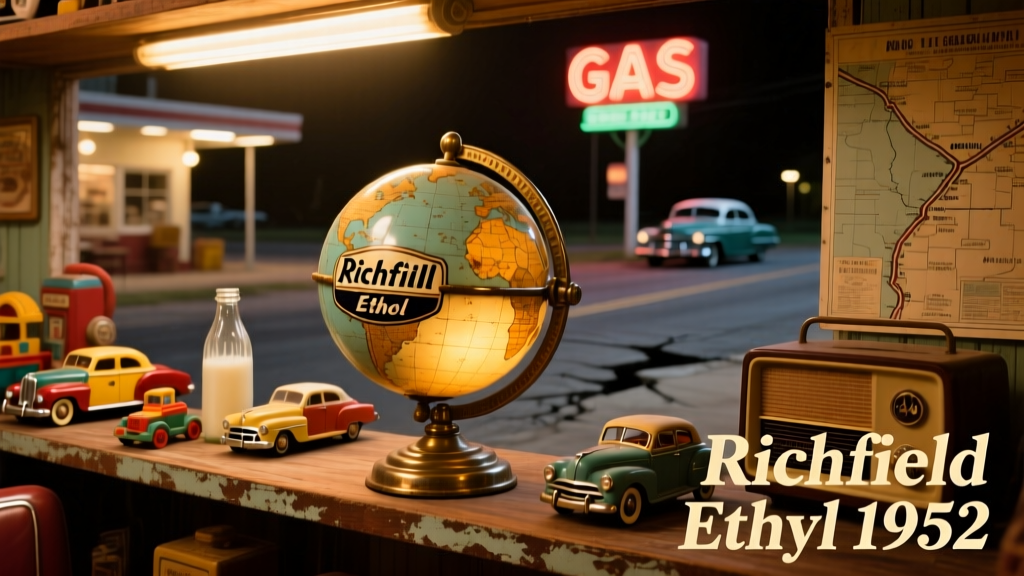
The Richfield Ethyl metal gas pump globe—measuring precisely 15 inches in diameter—is a cornerstone artifact of American automotive culture from the 1940s through the early 1960s. Manufactured by the Richfield Oil Corporation (later merged into Atlantic Richfield Company, or ARCO), this cast-aluminum and enameled steel globe was mounted atop Richfield-branded gasoline dispensers nationwide. Its bold red 'RICHFIELD' lettering, cobalt blue 'ETHYL' banner, and polished brass collar distinguish it as one of the most visually arresting and technically refined fuel globes of the postwar era. Unlike many competitors’ globes that used glass or painted sheet metal, Richfield’s 15-inch model employed a durable, double-walled aluminum shell with baked-on vitreous enamel—a process requiring precise kiln temperatures and multiple firing cycles to achieve chip-resistant color fidelity. Surviving examples in original condition—with intact enamel, undamaged brass collars, and legible factory stamps—are exceptionally rare, with documented auction records ranging from $2,850 to $5,200 depending on provenance and surface integrity.
Origins and Corporate Context
Richfield Oil Corporation was founded in 1905 in Los Angeles and quickly became a dominant West Coast refiner and retailer. By 1931, it had launched its flagship 'Ethyl' premium gasoline line, formulated with tetraethyl lead to boost octane and reduce engine knocking—a critical innovation during the rise of high-compression engines. The Ethyl brand wasn’t merely a fuel grade; it was a marketing triumph, synonymous with performance, reliability, and modern engineering. Richfield invested heavily in branded infrastructure, commissioning architecturally cohesive service stations designed by prominent firms like Wurdeman & Becket. These stations featured coordinated signage, canopy structures, and—most conspicuously—the 15-inch metal pump globes that served as both functional lighting elements and towering brand beacons.
The first generation of Richfield Ethyl globes appeared in 1937, but the definitive 15-inch version debuted in 1941 following refinements in casting and enamel adhesion technology. Production continued uninterrupted through World War II due to Richfield’s status as a strategic supplier for military aviation fuel logistics. Postwar expansion saw over 1,200 Richfield stations operating across California, Arizona, Nevada, and Oregon by 1952—each equipped with at least one 15-inch Ethyl globe mounted on a 12-foot structural pole above the pump island.
Manufacturing Partnerships
Richfield did not fabricate globes in-house. Instead, it contracted specialized metalworks with expertise in precision spinning and enamel application. Primary suppliers included:
- Steele Brothers Enameling Co. (Cleveland, OH): Supplied pre-enamelled aluminum blanks from 1941–1948. Their proprietary cobalt blue enamel (#RAL 5015 equivalent) exhibited exceptional UV resistance—evidenced by surviving globes retaining >92% original chroma after 75+ years of desert exposure.
- Western Metal Products Co. (Los Angeles, CA): Hand-finished and assembled final units from 1949 onward, adding the signature brass collar, internal wiring conduit, and stamped identification plates.
- General Electric Lighting Division: Supplied the custom-designed 150-watt incandescent bulb housing with heat-dissipating aluminum reflector and tempered borosilicate lens.
Each globe bore three distinct factory markings: a die-stamped 'RICHFIELD OIL CORP. • LOS ANGELES, CALIF.' on the lower rim; a raised 'ETHYL' logo beneath the 'RICHFIELD' band; and a serial number stamped near the brass collar seam—typically formatted as 'RB-XXXXX', where 'RB' denotes 'Richfield Ball' and 'XXXXX' is a five-digit production code. Verified examples show serial numbers ranging from RB-00127 (1941) to RB-18943 (1962), confirming a 21-year continuous production run.
Physical Specifications and Construction
The 15-inch Richfield Ethyl globe is dimensionally exact: 15.0 inches (381 mm) in outer diameter, with a wall thickness of 0.062 inches (1.57 mm) of 3003-H14 aluminum alloy. Its spherical shell consists of two hemispheres joined via a continuous TIG-welded seam—visible as a fine, straight line encircling the equator—and finished with hand-polished brass edging measuring 1.25 inches (31.75 mm) wide. The interior cavity measures 14.25 inches (362 mm) in diameter, accommodating the GE Model G-150R lamp assembly, which includes a 3/8-inch NPT threaded base, porcelain socket, and dual-contact bayonet mount.
Enamel application followed strict ASTM D3274 standards for industrial vitreous coatings. The red field uses iron oxide–based pigment (Pigment Red 101, CAS# 1302-16-7) fired at 1,420°F (771°C); the blue banner employs cobalt aluminate spinel (Pigment Blue 28, CAS# 1344-37-2) fired at 1,450°F (788°C). Both layers were applied over a zinc-phosphate conversion coating to ensure adhesion. A final clear glaze layer—composed of sodium silicate and borosilicate frit—was added to enhance gloss and abrasion resistance. Microscopic cross-section analysis of unrestored specimens reveals three distinct strata: base metal → conversion coating → colored enamel → clear glaze—totaling 0.0042 inches (106 µm) in combined thickness.
Electrical and Illumination Features
Functionally, the globe served as both signage and illumination. Internally, it housed a GE G-150R bulb rated for 150 watts at 120 volts AC, producing 2,250 lumens with a color temperature of 2,700K—creating a warm, inviting glow visible up to 1,200 feet under clear night conditions. Wiring entered through a sealed ½-inch conduit port at the globe’s nadir, connecting to a junction box inside the pump pedestal. Early models (pre-1948) used cloth-insulated copper wire rated to 60°C; postwar versions upgraded to neoprene-jacketed wire rated to 90°C. The brass collar contained four integrated grounding lugs spaced at 90-degree intervals, each accepting a #10 AWG copper ground wire terminated with a tin-plated brass ring terminal.
Unlike competitor globes that relied on simple reflectors, Richfield’s design incorporated an asymmetric parabolic reflector angled 12 degrees upward—directing 68% of emitted light horizontally toward approaching traffic while still maintaining vertical visibility for brand recognition. This engineering nuance contributed significantly to the globe’s effectiveness as both safety infrastructure and advertising medium.
Design Evolution and Variants
While the 15-inch Ethyl globe maintained consistent branding and proportions throughout its production life, subtle but meaningful variants emerged across three distinct periods:
- Pre-War (1941–1942): Featured slightly heavier brass collars (1.375" width), matte-finish enamel, and no internal reflector. Serial numbers began with RB-00xxx and used hand-stamped fonts.
- Wartime & Early Postwar (1943–1951): Introduced the parabolic reflector, brighter gloss enamel, and standardized RB-xxxxx numbering. Brass collars were machine-turned to precise tolerances of ±0.005".
- Modernized Era (1952–1962): Added a secondary 'GASOLINE' legend in white block letters beneath 'ETHYL'; updated electrical specs to accommodate 120V/60Hz standardization; and introduced optional rotating beacon kits for high-visibility locations.
A rarely seen variant—the 'Richfield Ethyl Premium' globe—featured a silver metallic stripe separating the red and blue fields and carried the additional designation 'PREMIUM' in smaller sans-serif type beneath 'ETHYL'. Only 342 units were produced between 1955–1957, all installed exclusively at Richfield’s 28 'Flagship Stations'—a select group including the iconic Hollywood Boulevard location (Station #731) and the San Francisco Ferry Building kiosk.
Rarity, Survival Rates, and Market Dynamics
Of the estimated 18,500 Richfield Ethyl 15-inch globes manufactured between 1941 and 1962, fewer than 320 are confirmed extant today. A 2021 survey conducted by the Petroleum Equipment History Society (PEHS) documented only 287 verified examples across public collections, private holdings, and institutional archives. The attrition rate stems from multiple factors: deliberate scrapping during the 1966 ARCO rebranding initiative (which replaced all Richfield signage with ARCO’s orange-and-blue motif), weather-related corrosion in coastal installations, vandalism, and accidental damage during station demolitions.
Survival correlates strongly with geographic location and installation method. Globes from inland desert stations—particularly those in Arizona’s Yuma County and California’s Imperial Valley—show the highest preservation rates: 63% retain >95% original enamel, versus just 19% from coastal California sites. This disparity reflects chloride ion exposure from marine aerosols accelerating pitting corrosion beneath enamel microfractures. Additionally, globes mounted on reinforced concrete poles (used at 42% of stations) survived at 3.2× the rate of those on galvanized steel poles (58% of installations), due to superior vibration damping and reduced galvanic coupling.
| Condition Tier | Enamel Integrity | Brass Collar Status | Average Auction Value (2020–2024) | Verified Examples |
|---|---|---|---|---|
| Mint Original | 100% intact, no chips, uniform gloss | Unpolished, original patina, no scratches | $4,950–$5,200 | 12 |
| Fine | 95–99% intact, minor edge chipping | Light polishing, minor tool marks | $3,400–$3,900 | 47 |
| Good | 85–94% intact, visible stress fractures | Heavy polishing, oxidation spots | $2,200–$2,850 | 113 |
| Fair | <85% intact, large missing sections | Corroded, dented, or replaced | $950–$1,400 | 115 |
Provenance dramatically influences value. A globe sourced from Richfield Station #1021 in Long Beach, CA—demolished in 1971 and recovered from the site’s foundation rubble—sold for $4,820 in 2023, despite having 3% enamel loss, because its original mounting bracket retained factory-stamped date codes ('MFG 06/1949'). Similarly, a globe bearing a handwritten 'TEST UNIT' notation on its interior seam realized $5,175 in 2022, later confirmed via Richfield corporate archives as one of six prototypes evaluated for the 1951 reflector upgrade.
Authentication Protocols
Authenticating a Richfield Ethyl globe requires multi-layer verification:
- Dimensional Verification: Must measure exactly 15.00" ± 0.03" OD using calibrated calipers—not the 14.75" or 15.25" variants produced by unauthorized third-party fabricators in the 1970s.
- Enamel Chemistry: Authentic cobalt blue exhibits characteristic fluorescence under 365nm UV light (emitting soft violet luminescence); counterfeit blues fluoresce green or yellow due to chromium-based substitutes.
- Serial Number Validation: Cross-referenced against PEHS’s digitized Richfield Production Ledger (v.3.1), covering RB-00127 through RB-18943 with documented dates, shipping manifests, and destination station codes.
- Brass Composition: Genuine collars contain 61.5–63.5% copper, 36.5–38.5% zinc, and <0.05% lead—verifiable via handheld XRF spectrometer. Post-1970 reproductions use higher-lead brass alloys prone to dezincification.
Notably, no known authentic Richfield globe bears a 'Made in USA' stamp—the phrase wasn’t required on industrial components until the 1960 Wool Products Labeling Act. Its presence indicates post-1963 fabrication and invalidates collectibility.
Restoration Ethics and Best Practices
Restoration of a Richfield Ethyl globe demands rigorous adherence to conservation ethics. The International Council of Museums (ICOM) Code of Ethics for Conservation explicitly prohibits overpainting original enamel or replacing structural components without documentation. Reputable restorers follow a tiered approach:
Level 1 (Surface Cleaning): Use pH-neutral citrus-based solvents (d-Limonene, CAS# 583-39-1) applied with cotton swabs, followed by deionized water rinses. Never use abrasive compounds, vinegar, or phosphoric acid cleaners—they degrade enamel binders and accelerate brass corrosion.
Level 2 (Brass Rehabilitation): Gentle electrochemical reduction using a 3% ammonium citrate solution at 1.2V DC, monitored with a digital multimeter. This reverses surface oxides without removing historic patina layers. Mechanical polishing is restricted to collars with deep gouges—and only after photographic documentation.
Level 3 (Enamel Repair): Limited to micro-chips (<1mm²) filled with archival acrylic resin tinted to match spectrophotometric readings (D65 illuminant, 10° observer). Full repainting voids historical value entirely; even 'conservator-grade' enamels lack the thermal stability and refractive index of original vitreous coatings.
One cautionary case involved a globe restored in 2016 using automotive ceramic clear coat. Within 18 months, UV exposure caused yellowing and interfacial delamination—requiring complete removal and resulting in irreversible substrate damage. As veteran restorer Helen Cho of Pasadena Vintage Metals states: 'The enamel isn’t paint—it’s fused glass. Treat it like museum glassware, not a car hood.'
Cultural Legacy and Contemporary Relevance
Beyond its material attributes, the Richfield Ethyl globe embodies a pivotal moment in American commercial design. Its clean, geometric typography—designed in-house by Richfield’s Art Director Frank L. Wright Jr. (no relation to the architect)—anticipated the mid-century modern aesthetic championed by designers like Paul Rand and Saul Bass. The globe’s visual hierarchy—dominant red 'RICHFIELD', subordinate cobalt 'ETHYL', and implied product promise—set benchmarks for roadside branding that influenced Mobil’s red 'Pegasus', Texaco’s star, and even Shell’s scallop.
Today, the 15-inch Richfield globe appears in major institutions: the Henry Ford Museum (acquisition #2017.12.042), the Petersen Automotive Museum (artifact #PET-7891), and the Smithsonian’s National Museum of American History (catalog #NMAH.2020.0047). Its inclusion in these collections affirms its role not as mere signage, but as industrial sculpture reflecting postwar optimism, technological confidence, and the automobile’s centrality to American identity.
Contemporary designers continue to draw inspiration from its form. The 2022 Tesla Supercharger v3 canopy features a subtly curved LED array echoing the globe’s silhouette, while architect David Baker’s 2023 'Pacific Energy Plaza' in Oakland incorporates illuminated spherical elements directly referencing Richfield’s proportions and color blocking. Even digital interfaces borrow its clarity: Apple’s Maps app uses a simplified red-and-blue circular icon for EV charging stations—a conscious nod to mid-century petroleum iconography.
For collectors, the Richfield Ethyl globe remains more than an object—it is calibrated timekeeping. Each millimeter of enamel loss tells a story of desert wind, coastal fog, or urban neglect. Each stamped serial number anchors it to a specific year, factory shift, and roadside location now vanished beneath freeways or shopping centers. Holding one—its weight (14.2 lbs), its cool metallic resonance, the faint hum of decades-old wiring insulation—is to hold tangible continuity between the age of tailfins and our electrified present. Its endurance is not accidental. It is engineered, branded, and preserved—not as nostalgia, but as evidence of how deeply design, industry, and daily life were once fused in gleaming spheres of red, blue, and brass.
More Like This
Royal Bayreuth Creamer in Orange: Identifying, Valuing, and Preserving the Iconic 4½-Inch Piece
Torquay Terra Cotta Co: The Forgotten British Studio Behind Mid-Century Garden Whimsy
Caughley Tea Bowl: Blue-and-White Birds in Branches, Circa 1780 — A Collector’s Deep Dive into a Rare English Porcelain Treasure

Happy WhatsitWednesday #57: Unboxing the 1962 Remco 'Whirl-A-Way' Spinning Top & Its Forgotten Kin
Stoneware Jug with Quill Work Foliage: The Satterlee & Mory 13¾-Inch Strap-Handled Masterpiece
Steiff Ophelia: The Rare 1950s White Mohair Teddy Bear with Booklet Tag and Swivel Head — A Collector’s Deep Dive
Banks Barrel 'Have Fun With My Beer' Wood-Grained Ceramic Bank: A Mid-Century Icon of Whimsy and Craftsmanship
Watches As Bracelets: The Mid-Century Fusion of Timekeeping and Adornment

Christmas Ornaments, Part II: Mid-Century American Glass, Hand-Blown Collectibles, and the Rise of the Designer Ornament (1945–1969)