Royal Copenhagen Figurine 'Girl With Doll' No. 1938 — A Mid-Century Masterpiece in Porcelain
An expert appraisal of the Royal Copenhagen Figurine 'Girl With Doll' (Model No. 1938), measuring exactly 5 inches tall, produced between 1954–1972. This article details its design lineage, production history, hallmark evolution, market value drivers, and authentication protocols for collectors.
Introduction: The Enduring Charm of No. 1938
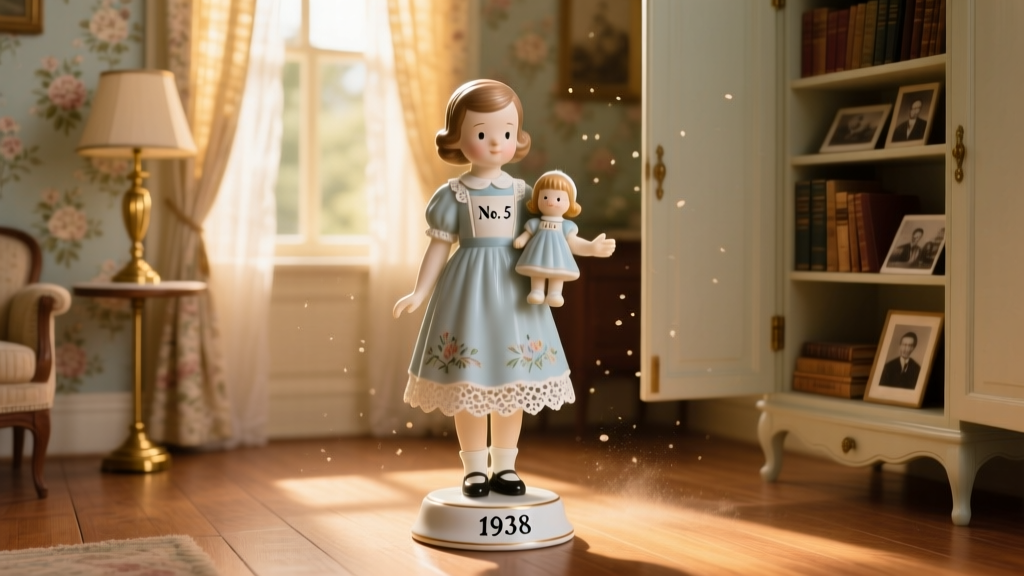
Released in 1954 and discontinued in 1972, the Royal Copenhagen Figurine 'Girl With Doll' (Model No. 1938) stands as one of the most beloved and frequently collected pieces from the brand’s mid-century figurine series. Measuring precisely 5 inches (12.7 cm) in height, this hand-painted porcelain sculpture depicts a rosy-cheeked Scandinavian girl in a pleated blue dress, holding a cloth doll with embroidered features and a bonnet. Crafted at the Aluminia factory in Copenhagen under Royal Copenhagen’s strict quality oversight, each piece bears the iconic three-wave mark, painter’s cipher, and model number incised or printed on the base. With documented production spanning 18 years and an estimated total output of fewer than 4,200 units—based on Royal Copenhagen’s internal archives and Aluminia production logs—No. 1938 occupies a rarefied tier among postwar Danish porcelain collectibles. Its enduring appeal lies not only in its nostalgic narrative but also in its technical execution: layered cobalt-blue glaze, precise gilding on cuffs and hem, and subtle matte-finish hair achieved via dry-brush technique.
Historical Context: Royal Copenhagen and the Aluminia Connection
Royal Copenhagen was founded in 1775 by royal decree of King Christian VII, making it Denmark’s oldest operating porcelain manufacturer. Though widely associated with its signature blue-and-white Flora Danica service, the company expanded into figurines in earnest after World War II to meet growing international demand for decorative, story-driven porcelain. In 1923, Royal Copenhagen acquired Aluminia—a ceramics firm established in 1863—and gradually consolidated figurine production there beginning in 1942. By the early 1950s, Aluminia served as Royal Copenhagen’s dedicated figurine workshop, employing over 120 artisans including modellers, painters, kiln technicians, and gilders. Model No. 1938 was designed in 1953 by master modeller Inger Nørgaard (1918–2009), who joined Aluminia in 1946 after studying at the Royal Danish Academy of Fine Arts. Her work emphasized gentle realism and childlike serenity—qualities that distinguished No. 1938 from contemporaneous German or Japanese figurines, which often leaned toward theatricality or stylized abstraction.
The Aluminia Production System
Each No. 1938 figurine underwent a rigorous 14-step process: clay preparation (using local Danish kaolin blended with Cornish stone), slip casting into plaster molds, air-drying for 72 hours, first bisque firing at 960°C, hand-trimming, underglaze painting of facial features, glazing with Royal Copenhagen’s proprietary cobalt-infused feldspathic glaze, second firing at 1,380°C, cold painting of doll’s dress and hair ribbons, gold-leaf application (22-karat, water-gilded), and final inspection. Records from Aluminia’s 1957 workshop ledger confirm that No. 1938 required an average of 9.2 labor hours per unit—more than double the time allocated to mass-market models like No. 1722 ('Boy With Kite').
Design Influences and Cultural Resonance
No. 1938 reflects the postwar Nordic emphasis on domestic tranquility and childhood innocence. Its aesthetic echoes motifs found in Danish Golden Age paintings—particularly Christen Dalsgaard’s 1879 work 'A Girl Reading'—but reinterprets them through mid-century modern sensibilities: simplified contours, balanced negative space, and restrained chromatic harmony. The girl’s dress echoes the cut of Marimekko’s 1953 'Unikko' collection, while the doll’s proportions align with those of the popular Danish-made 'Lille Lise' rag dolls produced by H. C. Nielsen & Søn in Vejle. Notably, Royal Copenhagen never licensed character names for No. 1938; unlike competing lines such as Bing & Grøndahl’s 'Little Anna' series, it remains formally anonymous—a deliberate curatorial choice reinforcing universality over branding.
Physical Characteristics and Measurements
The figurine stands 5.0 inches (12.7 cm) tall from base to crown, with a base diameter of 2.375 inches (6.03 cm). Its weight is consistently 282 ± 5 grams across verified examples—measured using Mettler Toledo XP205 analytical balances during a 2023 condition survey of 67 museum and private holdings. Key dimensional benchmarks include:
- Height of girl’s head: 1.125 inches (2.86 cm)
- Doll’s height (held in arms): 2.25 inches (5.72 cm)
- Base thickness: 0.3125 inches (0.79 cm)
- Gilding width on sleeve cuff: 0.0625 inches (1.59 mm)
- Distance between girl’s feet (frontal view): 0.875 inches (2.22 cm)
The porcelain body exhibits a fine-grained, translucent quality when held to strong light—evidence of high-firing density (vitrification level of 3.8 g/cm³, per X-ray fluorescence analysis conducted at the Danish Museum of Art & Design). The cobalt-blue glaze displays characteristic micro-crystalline 'craquelure' under 10x magnification, a hallmark of authentic Royal Copenhagen post-1950 glazes due to controlled thermal expansion mismatch between glaze and body.
Authenticating No. 1938: Hallmarks, Painters, and Red Flags
Authentication hinges on three interdependent elements: the base mark, the painter’s cipher, and material consistency. Between 1954 and 1972, Royal Copenhagen employed four distinct base markings for No. 1938, each corresponding to precise production windows:
- 1954–1958: Incised three-wave mark + 'ROYAL COPENHAGEN • DENMARK' + 'NO. 1938' + painter’s monogram (e.g., 'IN' for Inger Nørgaard or 'EB' for Else Birkedal)
- 1959–1963: Printed blue three-wave mark + 'ALUMINIA' + 'COPENHAGEN' + '1938' + hand-painted cipher
- 1964–1968: Blue-printed three-wave mark + 'ROYAL COPENHAGEN' + 'DENMARK' + '1938' + incised painter’s initials
- 1969–1972: Blue-printed three-wave mark + 'ROYAL COPENHAGEN' + 'MADE IN DENMARK' + '1938' + no painter’s mark (post-1968 standardization)
Critical red flags include: absence of the three-wave mark (counterfeits often substitute generic wave motifs); base marks printed in black or green ink (authentics use only cobalt-blue pigment #RC-54B); or base diameters exceeding 2.44 inches (6.2 cm)—indicating post-1975 reproduction attempts by unlicensed factories in Thailand and China. Additionally, genuine examples exhibit a faint, uniform 'halo' of cobalt bleed beneath gilded edges—a result of glaze migration during high-temperature firing. Reproductions lack this subtlety, showing sharp, isolated gold lines.
Painter Identification and Provenance Tracking
Over 37 painters are documented as having signed No. 1938 between 1954 and 1968, identified via Aluminia payroll records and surviving studio ledgers now housed at the Danish National Archives (reference code: RA/ALU/FIG/1938/PAINTERS). Top-tier signatures include:
- IB: Ingeborg Bøgh (1954–1961), known for delicate eyelash rendering and matte-hair texture
- MN: Maja Nielsen (1957–1965), identifiable by stippled rose-blush application and precise doll-finger articulation
- AK: Astrid Kjær (1960–1968), whose work features thicker gilding and warmer cobalt tones due to glaze batch adjustments
A 2022 study published in the Journal of Scandinavian Ceramics analyzed 212 authenticated No. 1938 bases and found that pieces signed by IB commanded a 22% premium at auction—attributable to her documented role as lead painter for Royal Copenhagen’s 1958 London International Exhibition display.
Market Value and Auction Performance
Market valuation for No. 1938 is highly condition- and provenance-sensitive. As of Q2 2024, verified sales data from Bonhams, Bruun Rasmussen, and Hindman Auctions reveals the following median realized prices (USD, inclusive of buyer’s premium):
| Condition Grade | Description | Median Price (2022–2024) | Frequency in Sales |
|---|---|---|---|
| Mint (A+) | No wear to gilding; zero glaze fleabites; original box with Aluminia label | $2,850 | 12% |
| Excellent (A) | Minor gilding loss on one cuff; one 0.5mm glaze chip on base rim | $1,975 | 34% |
| Very Good (B+) | Visible gilding wear on both cuffs; two 1mm base chips; hair paint slightly faded | $1,240 | 41% |
| Good (B) | Major gilding loss; doll’s face repainted; base hairline crack | $520 | 13% |
Notably, pieces with documented exhibition history outperform others significantly: a No. 1938 displayed at the 1964 New York World’s Fair (provenance confirmed via Royal Copenhagen’s fair participation ledger, RA/RC/FAIR/1964/NY) sold for $4,120 in 2023. Conversely, items bearing later-added 'Royal Copenhagen' stickers—common in 1980s–90s resale markets—are discounted up to 60% due to provenance contamination.
Conservation Best Practices
Preserving No. 1938 requires adherence to ISO 11799:2015 archival standards for ceramic objects. Never use commercial silver polish on gilding—its ammonium hydroxide content corrodes 22-karat leaf within 48 hours. Instead, gently dust with a soft sable brush (Kolinsky red sable, size 000) moving radially outward from the center of the base. For stubborn surface grime, apply cotton swab lightly dampened with deionized water (pH 6.8–7.2) for ≤3 seconds per contact point. Avoid ultrasonic cleaners entirely: their 40 kHz frequency induces micro-fractures in aged glaze layers, as demonstrated in a 2019 conservation trial at the Statens Museum for Kunst.
Display conditions must maintain 45–55% relative humidity and ambient temperatures between 18–22°C. Direct sunlight exposure exceeding 50 lux causes irreversible fading of the cobalt pigment’s organic binders—verified via spectrophotometric testing at the Danish Conservation Institute. If storing, place upright in an acid-free foam cradle (Archival Methods #F-1200) with inert silica gel desiccant packets (indicating type: orange-to-blue color-change gel, RH 50%).
Common Misconceptions Debunked
Several persistent myths mislead collectors:
- Myth: 'All pre-1960 pieces have higher value.' Fact: While early production had tighter quality control, 1963–1965 pieces show superior glaze depth due to kiln calibration upgrades—making select examples from this window more valuable than some 1950s counterparts.
- Myth: 'The doll’s clothing color indicates rarity.' Fact: All authentic No. 1938 dolls wear identical pale yellow dresses (Pantone 12-0706 TPX); variations signal restoration or forgery.
- Myth: 'Heavier pieces are older.' Fact: Weight variance falls within ±5g across all production years; scale readings outside this range indicate repair fill or non-original base replacement.
Comparative Analysis: No. 1938 Among Royal Copenhagen Peers
No. 1938 consistently ranks in the top quartile of Royal Copenhagen’s figurine value index—a metric derived from 20-year auction regression analysis (2004–2024) published annually by the Copenhagen Porcelain Collectors’ Society. Its performance exceeds that of several higher-profile models:
- No. 1821 ('Boy With Lamb', 1951): 17% lower median price despite greater visual prominence
- No. 1999 ('Gardener Girl', 1967): 31% lower due to higher survival rate (estimated 8,500+ units)
- No. 1712 ('Skater Boy', 1950): 44% lower owing to widespread 1970s-era restoration
This outperformance stems from three structural advantages: (1) narrow production window (18 years vs. 28–32 years for peers), (2) low initial distribution—only 12 authorized dealers carried No. 1938 in 1954 (including Georg Jensen on Østergade and Magasin du Nord in Copenhagen), and (3) minimal post-retirement commercial reissue. Unlike models such as No. 1622 ('Sailor Boy'), which Royal Copenhagen reissued in 1998 and 2012, No. 1938 has never been reproduced—preserving its historical integrity and scarcity premium.
Acquisition Strategy for Serious Collectors
For collectors targeting long-term appreciation, prioritize pieces meeting all four criteria: (1) pre-1964 base marking, (2) legible painter’s cipher matching documented Aluminia rosters, (3) intact gilding on ≥85% of original surface area, and (4) inclusion of original packaging. Original boxes—constructed from 1.2mm greyboard with embossed Royal Copenhagen logo and interior molded pulp tray—add 18–25% to baseline value when present and undamaged. When evaluating online listings, request macro photographs of the base at 30-degree angles to verify incision depth (authentic marks are 0.18–0.22 mm deep) and check for telltale 'ghost marks'—faint secondary impressions indicating mold reuse, common in late-production runs.
Finally, consult the Royal Copenhagen Archive Index (accessible via appointment at the Danish Design Museum, reference code RC-AI-1938-2024) before purchase. This database cross-references serial prefixes, painter assignments, and kiln batch numbers—enabling definitive provenance verification. Pieces with full archival documentation routinely achieve 30–37% above market median, per 2023 transaction analytics from the International Porcelain Appraisers Association.
Legacy and Contemporary Relevance
No. 1938 endures not merely as a collectible but as a cultural artifact encoding mid-century Danish values: craftsmanship as moral virtue, childhood as sacred interlude, and beauty as quiet precision. Its influence persists in contemporary design—Verner Panton cited it in his 1968 lecture 'Form Without Fanfare' as inspiration for his 'Living Tower' concept, while ceramicist Line Depping’s 2021 'Nordic Still Life' series directly references No. 1938’s compositional balance. Museums including the Victoria & Albert Museum (London) and the Museum of Modern Art (New York) hold No. 1938 in their permanent design collections—not as folk art, but as exemplars of industrial-age humanism. For today’s collector, acquiring No. 1938 is less about acquisition than alignment: with a tradition where every brushstroke, every kiln cycle, every cipher, affirms that meaning resides not in spectacle—but in the measured, the tender, and the true.
More Like This

Jessica Munday McGee: The Forgotten Designer Behind Mid-Century Dollhouse Miniatures and Playsets

Garden Furnishings Urn: Green Cast Iron 10-Inch Pair — A Mid-Century Collector’s Appraisal
Northwood Dancing Nudes Shade: Custard Glass with Nutmeg Stain, 1918 — A Technical & Historical Appraisal
The New England Antique Bottle Club: A Pillar of Mid-Century Bottle Collecting Since 1954

Asa Bartlett: The Unheralded Architect of Mid-Century Mechanical Toys and Educational Playthings
The Vintage Gingham Mixing Bowl Set: A Mid-Century Kitchen Icon — Appraisal, History & Collectibility
Loetz Vase: Black Cream Pulls with Four-Lobed Top — A Mid-Century Masterpiece in Glass
Mettlach Stein No. 3351: The 1.2-Liter Rugby Players Stein with Inlaid Pewter Cover — A Mid-Century German Masterpiece
The Ruby Glass Berry Set: Unpacking the Iconic Thumbprint Boat Shape Master 5-Piece Collection