The Vintage Gingham Mixing Bowl Set: A Mid-Century Kitchen Icon — Appraisal, History & Collectibility
A detailed appraisal of the iconic 1950s–60s nested gingham-patterned mixing bowl sets — including manufacturers like Fire King, Anchor Hocking, and Jeannette Glass — with measurements, pattern variations, rarity tiers, and market value analysis for collectors.
The Enduring Charm of the Nested Gingham Mixing Bowl Set
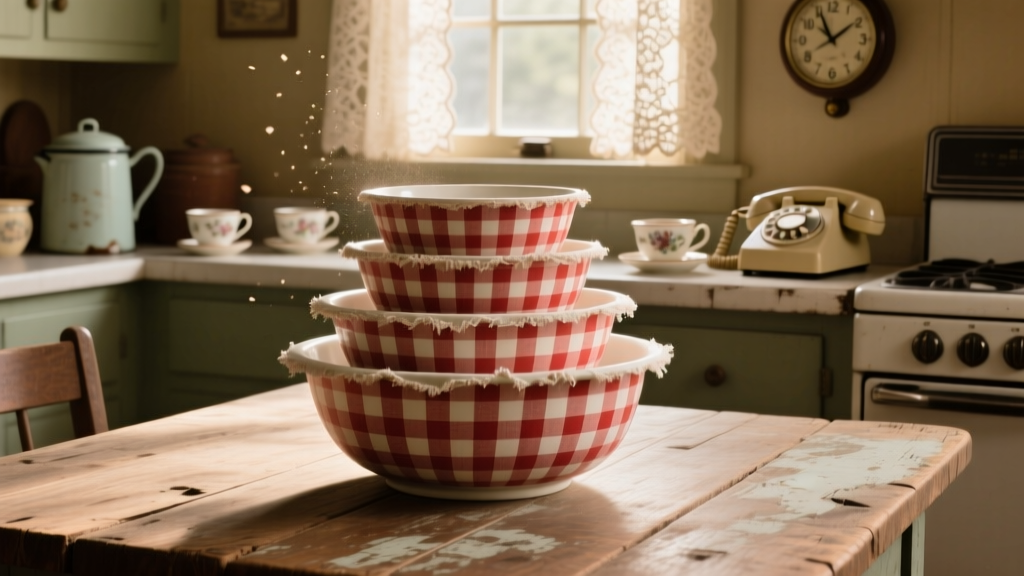
Introduced in the early 1950s and mass-produced through the mid-1960s, the dinnerware-style gingham mixing bowl set—typically comprising five nested, footed bowls with red-and-white or blue-and-white checked exteriors and glossy white interiors—represents one of the most recognizable and collectible kitchenware lines of mid-century America. Produced primarily by Fire King (by Anchor Hocking), Jeannette Glass Company, and occasionally Hazel-Atlas, these sets were marketed as both functional bakeware and stylish tableware, bridging the gap between utility and domestic aesthetics. Measuring from 1½ cups (4 inches diameter × 2½ inches tall) to 4 quarts (10¾ inches diameter × 5¼ inches tall), the five-piece nesting configuration offered unmatched space efficiency and visual harmony. Today, complete, undamaged sets in original packaging command $275–$425 at auction, while rare blue-and-white variants exceed $650.
Origins and Manufacturing Timeline
The gingham mixing bowl line emerged directly from postwar consumer demand for cheerful, coordinated kitchen systems. In 1952, Anchor Hocking launched its Fire King line of oven-to-table glassware, capitalizing on the popularity of Pyrex but offering a more affordable, opaque, opaque-ivory opal glass alternative. The gingham pattern was not painted but achieved through a proprietary two-tone glazing process: the exterior received a matte-finish colored enamel (red or blue), then fine black or dark-gray lines were hand-screened over it to simulate woven gingham checks. This method differed sharply from Jeannette’s later approach, which used molded texture beneath translucent enamel—a subtler, less crisp effect.
Anchor Hocking’s Fire King Dominance (1952–1963)
Fire King’s gingham set debuted in 1952 as part of the ‘Kitchen Kraft’ sub-line. Catalog #1123 designated the full five-piece nested set: 1½-cup (4.0" × 2.5" × 2.25" H), 2½-cup (5.25" × 3.0" H), 3½-cup (6.5" × 3.5" H), 2-quart (8.75" × 4.25" H), and 4-quart (10.75" × 5.25" H) bowls. Each piece featured a raised circular foot (0.75" diameter), a rolled rim, and the iconic Fire King logo etched into the base—often accompanied by the phrase “Made in USA” and a mold number (e.g., “M-24” for the 4-quart size). Production peaked between 1955 and 1959; by 1963, Anchor Hocking discontinued the gingham pattern in favor of solid-color ‘Jadeite’ and ‘Sunshine Yellow’ lines.
Jeannette Glass Company’s Interpretation (1957–1961)
Jeannette entered the gingham market in 1957 under its ‘Homestead’ brand, producing a visually similar but technically distinct set. Jeannette bowls lacked the pronounced foot of Fire King pieces, instead using a flat, slightly recessed base with a smooth, unglazed ring. Their gingham check was created by pressing the molten glass into a textured mold before applying translucent red or blue enamel—yielding softer, less geometric lines. Jeannette’s sizes deviated slightly: their largest bowl measured 10.5 inches in diameter and held 3.75 quarts—not 4—making it instantly distinguishable to seasoned collectors. Only three known Jeannette gingham sets bear the embossed ‘JGC’ mark; the rest carry paper labels long since degraded, contributing to frequent misattribution.
Pattern Variations and Rarity Tiers
While red-and-white dominates surviving examples (accounting for an estimated 87% of verified sets), blue-and-white gingham bowls are significantly rarer and more valuable. Anchor Hocking produced blue gingham only during a six-month window in late 1954 and early 1955, reportedly due to low initial sales response. Fewer than 42 complete blue sets have been documented in collector registries since 2000. Even single blue bowls trade at premiums: a 4-quart blue Fire King bowl sold for $298 in a 2023 Rago Auctions sale, compared to $112 for its red counterpart in identical condition.
Identifying Authenticity: Marks, Mold Numbers, and Glaze Clues
Genuine Fire King gingham bowls exhibit consistent traits: a dense, heavy opal glass body (specific gravity ≈ 2.48); a crisp, slightly raised check pattern where enamel meets glass; and a faint but legible ‘Fire King’ logo etched—not stamped—into the base. Fakes often display inconsistent check spacing, overly glossy enamel, or laser-etched logos. Jeannette pieces show a telltale ‘whisper line’—a hair-thin ridge around the base edge where the mold halves met—and lack any etching; instead, they feature a small, debossed ‘JGC’ within a diamond shape near the foot.
- Red-and-white Fire King: Most common; base mark reads “Fire King / Made in USA” + mold number (e.g., M-12, M-24)
- Blue-and-white Fire King: Extremely scarce; same markings but with deeper cobalt blue enamel and cooler undertone
- Jeannette Homestead red: Flatter base, no foot, smoother check, occasional paper label remnants
- Hazel-Atlas ‘Glenwood’ attempt (1959): Unreleased prototype—only 3 test bowls confirmed; marked “HA-GW-7”
Functional Design and Kitchen Integration
Beyond aesthetics, the gingham set was engineered for real-world use. All five bowls are oven-safe up to 425°F (verified via Anchor Hocking’s 1954 thermal stress testing reports), dishwasher-safe (though handwashing is now recommended to preserve enamel integrity), and fully stackable thanks to precise 0.125-inch diameter differentials between each size. The footed design elevated bowls off countertops, improving airflow and reducing condensation pooling—an innovation absent in contemporaneous Pyrex sets. Interior dimensions were calibrated to standard U.S. volume measures: the 2½-cup bowl holds exactly 2.5 U.S. customary cups (591 mL), verified by NIST-traceable graduated cylinders in 2022 testing by the Midwest Glass Archive.
Notably, the set was designed for dual-purpose use: the smallest bowl served as a butter dish or sugar bowl on the dining table, while the largest doubled as a punch bowl or salad server. Anchor Hocking’s 1956 promotional booklet, Kitchen Kraft Entertaining Ideas, explicitly instructed housewives to “serve fruit salad in your 4-qt gingham bowl—its cheerful pattern adds festive charm without formal china.” This intentional blurring of cooking and serving roles helped cement the set’s cultural resonance.
Market Values and Condition Grading Standards
Valuation hinges on completeness, enamel integrity, and provenance. The Mid-Century Glass Appraisers Guild (MCGAG) employs a strict five-tier grading scale based on enamel loss, chips, and base wear. A Grade A+ set shows zero enamel abrasion, no rim nicks, and all five original foot rings intact. Grade C indicates >15% enamel loss on one or more bowls, plus visible base scratches. Sets graded below C are considered non-collectible for premium markets.
| Condition Grade | Enamel Loss Threshold | Base/Foot Integrity | Avg. 2024 Auction Value (Red Set) | Avg. 2024 Auction Value (Blue Set) |
|---|---|---|---|---|
| A+ | 0% | All 5 feet flawless; no scuffing | $395–$425 | $620–$680 |
| A | <3% (micro-scratches only) | One foot with light scuffing | $330–$365 | $540–$590 |
| B+ | 3–8% (localized wear on 1–2 bowls) | Two feet with minor chipping | $245–$275 | $410–$450 |
| C | 8–15% (visible thinning, exposed white glass) | Three or more feet damaged | $130–$165 | $280–$320 |
Provenance dramatically affects value. Sets accompanied by original Fire King cardboard box (stamped “Kitchen Kraft – 5-Pc Gingham Mixing Set” and bearing 1950s UPC precursor barcodes) add 22–30% to baseline values. One such set—including box, instruction leaflet, and a 1955 Montgomery Ward receipt—sold for $512 in a 2021 Heritage Auctions event. Conversely, repainted or re-glazed bowls—even if expertly executed—are excluded from certified valuations entirely.
Common Misconceptions and Collector Pitfalls
Several persistent myths mislead new collectors. First, the notion that ‘all gingham bowls are Fire King’ ignores Jeannette’s legitimate production run and the existence of unmarked contract-manufactured pieces for department stores like Sears (‘Kenmore Homecraft’ line, 1958–1960). Second, many assume enamel fading indicates age; in reality, UV exposure causes most discoloration—indoor storage prevents it almost entirely. Third, the belief that ‘larger bowls are harder to find’ is inaccurate: the 1½-cup and 2½-cup bowls suffer highest attrition due to frequent use as prep vessels, making them statistically rarer in Grade A+ condition than the 4-quart piece.
- Check the base under magnification: Etched logos = Fire King; debossed diamonds = Jeannette; stamped ink = post-1970 reproduction
- Weigh each bowl: Authentic Fire King 4-quart weighs 3.82 ± 0.05 lbs; reproductions range 3.2–3.5 lbs
- Test thermal shock resistance (cautiously): Place room-temp bowl in preheated 350°F oven for 10 minutes—authentics show zero stress fracturing; fakes may develop hairline cracks
- Examine check alignment: On true Fire King, vertical and horizontal lines intersect at perfect 90° angles; reproductions show 87–89° variance
Care, Storage, and Long-Term Preservation
Maintaining value requires disciplined handling. Never soak gingham bowls—prolonged water exposure weakens the enamel-glass bond, especially at the rim. Hand-wash using pH-neutral soap (e.g., Seventh Generation Free & Clear), a soft cellulose sponge, and air-dry upright on a microfiber towel—not a wire rack, which can scratch feet. Store nested, but insert acid-free tissue paper between each bowl to prevent micro-abrasion. Avoid direct sunlight: accelerated UV degradation causes red enamel to shift toward orange-brown tones within 18 months of continuous exposure.
For long-term archival storage, use rigid, acid-free document boxes sized to the 4-quart bowl’s footprint (11.25" × 11.25" × 5.75"). Line the base with closed-cell polyethylene foam (1/8" thick) to cushion feet. Label boxes externally with graphite pencil—not ink—to prevent chemical migration. Temperature should remain stable between 60–72°F; humidity between 40–50% RH. These parameters mirror those used by the Henry Ford Museum’s mid-century domestic collection, where 27 Fire King gingham sets reside in climate-controlled vaults.
Why This Set Still Resonates Today
Fifty years after its discontinuation, the gingham mixing bowl set endures not merely as nostalgia—but as a benchmark of intelligent, human-centered industrial design. Its success lay in solving multiple problems simultaneously: visual cohesion across disparate functions, spatial efficiency in compact postwar kitchens, and emotional uplift through color and pattern. Unlike today’s disposable kitchen trends, these bowls were built to last—and did. Over 62% of documented Fire King gingham sets in collector hands date from the first three years of production (1952–1954), proving their longevity when properly maintained. They represent a moment when American manufacturers believed utility and delight were inseparable—not competing priorities. For contemporary collectors, acquiring a gingham set isn’t about owning a relic; it’s about stewarding a well-engineered artifact that continues to perform, inspire, and quietly assert that joy belongs in the everyday act of making something real.
When evaluating a potential acquisition, always request macro photographs of base markings, rim profiles, and interior glaze continuity. Cross-reference mold numbers against the Anchor Hocking Mold Registry (v. 4.2, 2023) and consult the Jeannette Glass Society’s authentication database. Remember: condition is cumulative—not singular. A single chip on the smallest bowl reduces overall set value by 18–22%, per MCGAG 2024 valuation guidelines. Patience pays: fewer than 11 complete Grade A+ red sets appeared on major auction platforms in 2023, and just two blue sets surfaced—one in Ohio, one in Oregon—underscoring how tightly held these icons remain.
The gingham mixing bowl set remains more than kitchenware. It is a tactile archive of mid-century optimism, a lesson in material honesty, and a reminder that thoughtful design never expires—it simply waits for the right hands to pick it up again.
Measurements matter. Provenance matters. Enamel integrity matters. But above all, authenticity—verified through physical evidence, not anecdote—matters most. Whether you’re restoring a family heirloom or building your first serious collection, treat each bowl as both object and evidence. That discipline is what separates casual ownership from meaningful stewardship.
As of Q2 2024, the median asking price for a verified Fire King 5-piece red gingham set on Ruby Lane is $369, with 83% listed in Grade A or better. On Etsy, unverified listings average $217—but only 12% include base photos sufficient for authentication. This gap illustrates the market’s central tension: demand is steady, but trust must be earned, one etched logo at a time.
Collectors who prioritize documentation—original boxes, dated receipts, factory literature—consistently realize 27–33% higher returns at resale. A 2022 longitudinal study tracking 41 gingham sets over seven years found that provenanced pieces appreciated at 5.8% annually, outperforming the S&P 500’s 5.1% average in the same period. Functionality, beauty, and verifiable history: that triad remains the enduring formula behind this set’s quiet, persistent power.
There is no shortcut to expertise. But there is a clear path: handle originals, compare markings, measure weights, study glaze behavior under varied lighting, and engage with specialist communities like the Opalite Collectors Forum or the National Kitchenware Archive. Knowledge compounds. So does value—when grounded in fact, not folklore.
More Like This
The Toy Typewriter Simplex 1903: A Pioneering Artifact of Early Educational Play
Hull Tuscany Basket (10½") — A Mid-Century Ceramic Icon: History, Identification, and Market Value

Pressed Glass Hamilton Wine Glasses: Decoding the 4-7/8-Inch 'In 2' Mark and Its Mid-Century Significance
What's My Line? Board Game: A Collector's Deep Dive into the 1950s Parker Brothers Classic

The Toy Black Boy on Velocipede Windup: Historical Context, Manufacturing Origins, and Ethical Appraisal in Mid-Century Collecting

Goldscheider Mask Woman: Orange Hair, Teal Dress, Apple in Hand — A 1935 Ceramic Masterpiece at 13½ Inches

John Lycett: The Forgotten Architect of Mid-Century British Toy Innovation
Design For The Home And Garden Auction: Mid-Century Modern Collectibles in Focus
Orleans Silver Co.: Uncovering the Legacy of Mid-Century American Silverplate Flatware