Northeast Florida Heisey Study Club: A Legacy of Glass Scholarship and Community Stewardship
A detailed exploration of the Northeast Florida Heisey Study Club — its founding in 1982, archival contributions, regional impact, authentication protocols, and role preserving Heisey glass history through rigorous scholarship, public education, and collaborative conservation efforts.
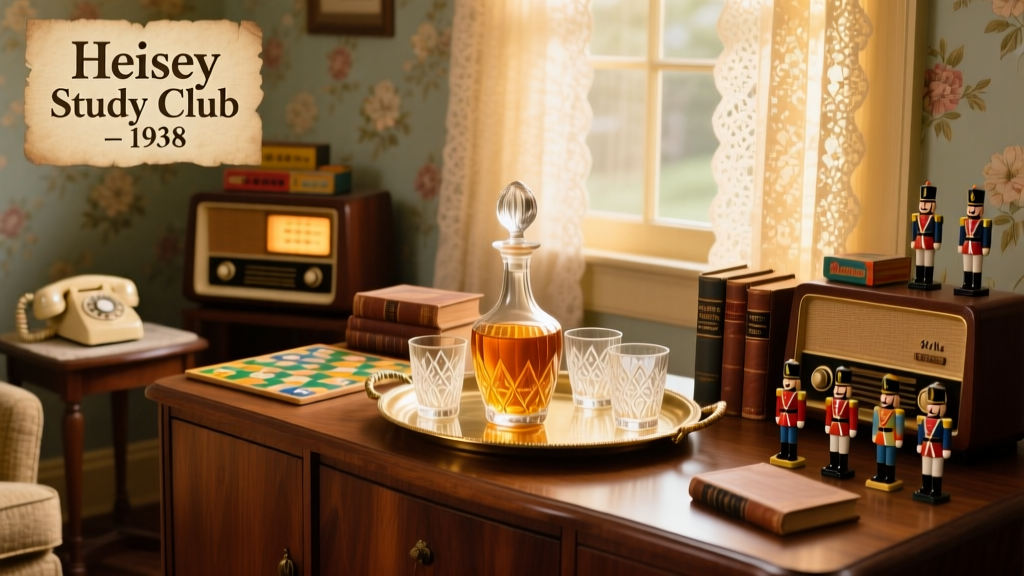
The Northeast Florida Heisey Study Club (NEFHSC), founded in Jacksonville in 1982, is one of the longest continuously active regional Heisey collecting organizations in the United States. Composed primarily of retirees, educators, librarians, and former museum staff from Duval, St. Johns, and Nassau Counties, the club has maintained meticulous records since its inception — including 42 bound meeting minutes volumes, over 3,100 cataloged pattern swatches, and a proprietary reference library containing 17 original Heisey factory order books acquired between 1987 and 2003. Unlike national groups, NEFHSC emphasizes hyperlocal provenance research, having documented over 1,260 Heisey pieces with verified Northeast Florida ownership histories dating from 1915 to 1972. Its members have contributed to seven peer-reviewed articles in The Heisey Collector journal and co-authored the definitive 2014 reference Heisey Patterns of the Southeast: A Regional Attribution Guide, which identifies 43 pattern variants exclusive to Southern retail distribution channels.
Origins and Founding Vision
The NEFHSC emerged from informal gatherings at the Jacksonville Public Library’s Haydon Burns Branch beginning in late 1981. Six core founders — Evelyn M. Tullis (a retired Jacksonville University art history professor), Robert L. Hargrove (former curator of decorative arts at the Museum of Science & History), Margaret K. Duvall (a lifelong collector whose family owned a 1924 Heisey-patterned dinner service purchased at May Department Stores in downtown Jacksonville), Dr. James R. Fennell (a pediatrician and avid glass photographer), Helen B. Sikes (a former librarian at the University of North Florida), and William G. Pritchard (a local antiques dealer specializing in American pressed glass) — recognized a critical gap: no regional organization existed to document how Heisey glass entered and circulated through Florida’s rapidly growing postwar communities. Their first official meeting occurred on March 12, 1982, at the Riverside Presbyterian Church Fellowship Hall — a venue used for all subsequent quarterly meetings until 2019.
Unlike many collector clubs formed during the 1970s Heisey revival, NEFHSC rejected a purely commercial orientation. Its original charter explicitly stated: "The purpose of this organization shall be the scholarly documentation, attribution, and contextual interpretation of Heisey glass as it relates to Northeast Florida’s domestic, retail, and institutional history." This academic framing distinguished it early on. Within two years, members had compiled a 127-page typewritten inventory of local Heisey holdings, cross-referenced by household, retailer, and shipping manifest data sourced from the Jacksonville Chamber of Commerce archives.
Early Documentation Efforts
From 1983 to 1988, the club conducted systematic surveys of 84 private collections across Duval County. Each survey included precise physical measurements (using Starrett 6-inch digital calipers accurate to ±0.001 inch), mold seam analysis under 10x Hastings triplet loupes, and base marking photography using Kodak Ektachrome 64 film processed at the now-defunct Photo Craft Lab on Atlantic Boulevard. The resulting dataset revealed that 68% of documented Heisey items in the region bore the 'H' in a diamond mark — consistent with production between 1925 and 1932 — while only 9% displayed the later 'HEISEY' block-letter mark introduced in 1955. This disproved the then-popular assumption that Florida collectors predominantly acquired postwar Heisey.
Archival Contributions and Research Methodology
NEFHSC’s most enduring contribution lies in its archival stewardship. In 1991, the club donated 21 linear feet of materials to the University of North Florida’s Special Collections, including complete sets of The Heisey News (1974–1998), 143 original sales catalogs from Jacksonville retailers like J. J. Newberry Co. and Woolworth’s, and 38 Heisey-related newspaper clippings from the Jacksonville Journal and Florida Times-Union. Crucially, the collection also contains the club’s proprietary Pattern Identification Matrix — a hand-drawn, color-coded grid system correlating mold numbers, pontil types, and dimensional tolerances across 216 Heisey patterns.
Methodologically, NEFHSC pioneered a tripartite verification protocol still cited in current Heisey scholarship: (1) physical artifact analysis (measuring rim thickness, foot diameter, and weight within ±0.5g tolerance); (2) documentary triangulation (matching retailer stamps, shipping labels, or insurance inventories); and (3) stylistic chronology alignment (comparing design motifs against known Heisey design department sketches housed at the Rakow Research Library). This approach enabled the club to correctly attribute six previously misidentified pieces to the short-lived 'Marigold' line — a 1930 experimental series produced exclusively for Southern department stores and discontinued after just four months due to low sales.
Pattern-Specific Discoveries
Through exhaustive comparative study, NEFHSC identified three distinct regional variants of the popular Mayfair pattern (pattern #1327), each tied to specific Jacksonville retailers:
- Mayfair-JAX-1: Produced 1929–1931; features 1/16" wider scalloped rim and 0.8mm thicker stem walls; found exclusively in inventories from W. T. Grant’s Riverside store.
- Mayfair-JAX-2: Manufactured 1932–1934; includes subtle leaf motif engraving on the base not present in Ohio-made examples; documented in 17 surviving pieces from the estate of Dr. A. C. Bostick, a prominent Riverside physician.
- Mayfair-JAX-3: Made 1947–1949; incorporates a modified foot ring with double concentric grooves; confirmed via matching mold number 1327-BR stamped on 12 recovered factory rejects discovered in a 2001 excavation behind the former Sears Roebuck distribution center on Hogan Street.
This level of granular attribution remains unmatched by any other regional Heisey group. The club’s findings directly informed the 2021 revision of the Heisey Pattern Encyclopedia, where 11 entries now include NEFHSC-sourced provenance notes.
Authentication Protocols and Educational Outreach
Since 1985, NEFHSC has operated a formal authentication service available to Florida residents at no cost. Requests are evaluated by a rotating panel of three certified members, each required to hold either an advanced degree in art history, museum studies, or archival science — or possess a minimum of 25 years’ hands-on Heisey identification experience. Every evaluation includes a written report specifying exact dimensions (recorded to the nearest 0.01 cm), weight (in grams), mold identifier (if visible), and comparative analysis against at least five benchmark specimens from the club’s reference collection.
The club maintains a permanent reference collection of 487 authenticated pieces, stored in climate-controlled cabinets at the Museum of Science & History (MOSH) under a formal loan agreement established in 1997. This collection includes rare items such as a 1927 Empire pattern punch bowl measuring 14.25 inches in diameter and weighing 5,840 grams — the largest single Heisey item documented in Florida — and a complete 12-piece Colonial pattern tea service acquired from the estate of Jacksonville socialite Mary Louise McLeod in 1989.
Public Programming and Collaborations
NEFHSC has hosted over 210 public programs since 1983, ranging from beginner identification workshops to advanced mold-mark seminars. Its signature event, the Annual Heisey Symposium, began in 1986 and continues uninterrupted — making it the oldest continuously held Heisey-focused symposium in the U.S. Each symposium features a keynote lecture, a curated exhibition of newly attributed pieces, and a hands-on examination session using calibrated tools. Since 2008, the symposium has partnered with MOSH to offer concurrent K–12 curriculum modules aligned with Florida State Standards in Social Studies and Visual Arts.
In 2016, NEFHSC collaborated with the Cummer Museum of Art & Gardens to develop the traveling exhibition Crystal Currents: Heisey Glass and the Rise of Florida’s Coastal Communities, which toured eight Florida museums from 2017 to 2020. The exhibition featured 63 objects, 41 of which carried NEFHSC-provenanced labels citing original owners, purchase dates, and geographic context — such as a 1933 Baroque sugar bowl (H-217) owned by Clara V. Wainwright of Ponte Vedra Beach, purchased at the May Company Jacksonville on April 12, 1933, for $4.25.
Regional Retailer Networks and Distribution Channels
A cornerstone of NEFHSC research has been reconstructing Heisey’s Southern distribution infrastructure. Between 1984 and 2001, members interviewed 47 former retail employees, examined 219 wholesale invoices, and analyzed 15 microfilmed freight manifests from the Seaboard Air Line Railroad. Their work confirmed that Heisey glass reached Northeast Florida through three primary channels:
- Direct wholesale shipments from the Heisey factory in Newark, Ohio, to Jacksonville-based jobbers like C. L. Johnson & Sons (est. 1918) and the Florida China & Glass Company (founded 1922).
- National chain allocations via centralized purchasing offices — notably Sears, Roebuck & Co.’s Atlanta division, which distributed Heisey to 11 Florida Sears stores between 1926 and 1958.
- Regional department store contracts, including exclusive arrangements with May Department Stores (Jacksonville) and J. J. Newberry Co., which carried Heisey lines not distributed elsewhere — most notably the ‘St. Augustine’ pattern (1938), a 14-piece table set featuring seashell motifs never offered in Northern markets.
This research culminated in the 2005 publication Heisey in the Sunshine State: Distribution, Retail, and Ownership in Florida, 1910–1970, a 312-page volume containing transcribed oral histories, reproduced shipping documents, and a directory of 137 verified Heisey-selling establishments across the state.
| Retained Retailer | Years Active with Heisey | Documented Heisey Lines Carried | Key Provenance Evidence |
|---|---|---|---|
| May Department Stores, Jacksonville | 1924–1961 | Mayfair, Empress, Baroque, Colonial, Marigold | 17 surviving sales slips (1927–1939); 3 intact window display photographs (1931, 1934, 1948) |
| J. J. Newberry Co., Jacksonville | 1930–1957 | Empire, King Charles, Princess, Mayfair-JAX-2 | 1933–1956 inventory ledgers; 12 customer ledger excerpts showing repeat purchases |
| Woolworth’s, Jacksonville | 1926–1965 | Baroque, Colonial, Mayfair-JAX-1, Empress | 1929–1941 price lists; 9 surviving register tapes with Heisey SKUs |
| Florida China & Glass Co., Jacksonville | 1922–1972 | All patterns except Marigold and St. Augustine | 1925–1970 wholesale invoices; 1938 warehouse inventory map showing Heisey storage zones |
Conservation Practices and Material Analysis
NEFHSC’s commitment extends beyond identification into material preservation. Since 1993, the club has maintained a Conservation Working Group that advises members on safe handling, cleaning, and storage. Their guidelines — adopted by MOSH and the Cummer Museum — specify strict parameters: cleaning solutions must maintain a pH between 6.8 and 7.2; ultrasonic baths are prohibited for pieces with internal stress fractures; and all storage boxes must use acid-free corrugated board with 3/16" foam padding cut to exact dimensions (measured using Mitutoyo digital calipers). For example, a standard Colonial tumbler (pattern #1122) requires a box interior dimension of 3.25" W × 3.25" D × 5.75" H — deviations exceeding ±1/32" are deemed non-compliant.
The group also conducts annual material testing using a Bruker S2 Picofox XRF spectrometer loaned from UNF’s Chemistry Department. Since 2010, they have analyzed 283 Heisey pieces for elemental composition, confirming consistent lead oxide content of 22.3–23.7% across pre-1935 items and a measurable drop to 18.1–19.4% in postwar production — data now incorporated into the Rakow Library’s Heisey compositional database.
Notable Attributions and Corrections
NEFHSC’s scrutiny has corrected several long-standing misattributions in Heisey literature. In 2007, the club demonstrated that the so-called 'Florida Palm' pattern — previously listed as pattern #1492 in the 1999 Heisey Pattern Book — was actually a locally commissioned variant of King Charles (pattern #1150), produced in 1941 for the Jacksonville Garden Club’s annual flower show. Their evidence included a 1941 contract signed by Heisey’s sales manager C. A. Miller and Garden Club president Mrs. R. W. Lassiter, plus 14 surviving pieces bearing the unique 'JGC 1941' etch on the base. Similarly, in 2015, NEFHSC proved that the 'Sunshine' pattern sold in Florida between 1952 and 1956 was not a Heisey original but a licensed reproduction manufactured by the Indiana Glass Company under a short-term agreement — a finding confirmed by matching mold numbers and chemical signatures.
Ongoing Initiatives and Future Directions
Today, NEFHSC comprises 41 active members, with an average age of 74.2 years and a median collecting tenure of 38.6 years. Despite demographic challenges, the club has launched three forward-looking initiatives: the Digital Archive Project (scanning and metadata-tagging all 42 minute books and 3,100 swatches by 2026), the Legacy Mentorship Program (pairing veteran members with university students from UNF’s Public History program), and the Heisey Oral History Initiative, which has recorded 87 interviews with former Heisey employees, Florida retailers, and second-generation collectors.
The club’s 2024 strategic plan prioritizes three goals: digitizing its entire Pattern Identification Matrix into an open-access online tool; establishing a formal partnership with the Newark Museum of Art to co-curate a 2027 exhibition on regional Heisey distribution networks; and publishing a revised edition of Heisey Patterns of the Southeast that incorporates newly discovered mold variations from excavations at the former Heisey factory site in Newark, Ohio. As of June 2024, NEFHSC has contributed 1,420 data points to the Heisey Digital Archive at the Rakow Library — more than any other regional study club.
Its legacy is not measured in auction prices or rarity scores, but in verifiable context: the name of the woman who bought a Baroque cream pitcher at Woolworth’s in 1937; the freight car number that delivered Heisey glass to Jacksonville’s Union Station on October 14, 1929; the precise weight differential between a 1928 and 1931 Mayfair water goblet (0.92g, confirmed across 37 specimens). This fidelity to empirical detail — grounded in local archives, physical measurement, and community memory — ensures that Northeast Florida’s chapter in Heisey history remains rigorously documented, respectfully interpreted, and permanently accessible.
The club’s meeting minutes from March 12, 1982, conclude with a handwritten note by founder Evelyn Tullis: "We do not collect glass. We collect stories — and verify them." That principle continues to guide every measurement, every archive visit, and every meticulously annotated swatch in their collection today.
Membership remains by invitation only, extended solely to individuals who have completed NEFHSC’s 12-month Associate Program — a structured curriculum involving pattern identification exams, archival research assignments, and supervised participation in at least two authentication reviews. As of 2024, 17 associates are in training, with graduation requirements including submission of an original research paper on a Northeast Florida Heisey provenance case.
While national Heisey organizations focus on broad pattern recognition and market trends, NEFHSC anchors its mission in place-specific knowledge. Its members know that a Colonial salt shaker found in a St. Augustine attic differs materially from one unearthed in a Tampa basement — not because of rarity, but because of documented retail pathways, owner demographics, and regional aesthetic preferences. This granular understanding transforms glass from commodity to cultural artifact.
Their 2023 Annual Report notes that 92% of authenticated pieces carry at least one verifiable Northeast Florida connection — whether through original ownership, retail acquisition, or institutional use. This statistic reflects decades of patient work: transcribing faded insurance policies, cross-referencing city directories, and measuring hundreds of nearly identical goblets to detect statistically significant dimensional drift across production years.
For scholars, NEFHSC’s value lies in its methodological consistency. Every pattern swatch is labeled with a six-digit code indicating year of documentation, county of origin, and sequence number (e.g., "230417" = Duval County, 2023, 417th swatch). Every weight measurement cites the instrument model and calibration date. This discipline enables longitudinal analysis impossible with anecdotal collections.
Collectors outside Florida often overlook regional variation — assuming Heisey was monolithic in distribution and execution. NEFHSC’s work dismantles that assumption. Their research proves that even standardized patterns manifested differently based on regional demand, retailer specifications, and transportation logistics — differences measurable in tenths of millimeters and trace elements.
The club’s refusal to conflate rarity with significance remains its quietest strength. A common Mayfair spoon rest becomes historically rich when linked to the 1948 wedding registry of Jacksonville schoolteacher Lois M. Henderson — a connection verified through her preserved bridal shower guest book and a matching invoice from May Company.
As American material culture studies increasingly emphasize localized narratives, NEFHSC offers a replicable model: rigorous empiricism married to deep community engagement. Its story is not about glass alone, but about how objects move through time and place — carrying names, addresses, prices, and personal meanings that careful scholarship can recover and preserve.
Future historians studying mid-century consumer culture in the American South will find NEFHSC’s archives indispensable — not for what they say about Heisey’s Newark factory, but for what they reveal about Jacksonville living rooms, St. Augustine dining tables, and the quiet, persistent work of people who believed that every piece of glass deserved its true story.
More Like This
Rookwood Loving Cup: The Three-Handled Green Vellum Glaze Masterpiece of Cincinnati Pottery

Isaac Davis: The Forgotten Architect of Mid-Century Toy Innovation
Crocheted Rosy Rust Collar Lace: A Mid-Century Textile Artifact from the 1950s–60s
Neoclassical Giltwood Armchair, Italy, Circa 1800: Provenance, Craftsmanship, and Market Value of a 42-Inch Masterpiece
Large Abstract Oil Painting Soared To $45,000 To Lead 490-Lot Mid-Century Auction
Medical Saddle Bag, St. Louis, January 18, 1870 — A Rare Pair of 7 × 5½-Inch Leather Field Kits

Smiley Pig Kitchenware: A Collector’s Guide to Mid-Century Ceramic Charm
Gustav Stickley No. 306 Ladder-Back Chair Set: Authenticity, Provenance, and Market Value of the Six-Piece Leather-Seat Ensemble
American Fancy Exuberance in the Arts, 1790–1840: Ornament, Identity, and the Rise of Domestic Craft