Large Abstract Oil Painting Soared To $45,000 To Lead 490-Lot Mid-Century Auction
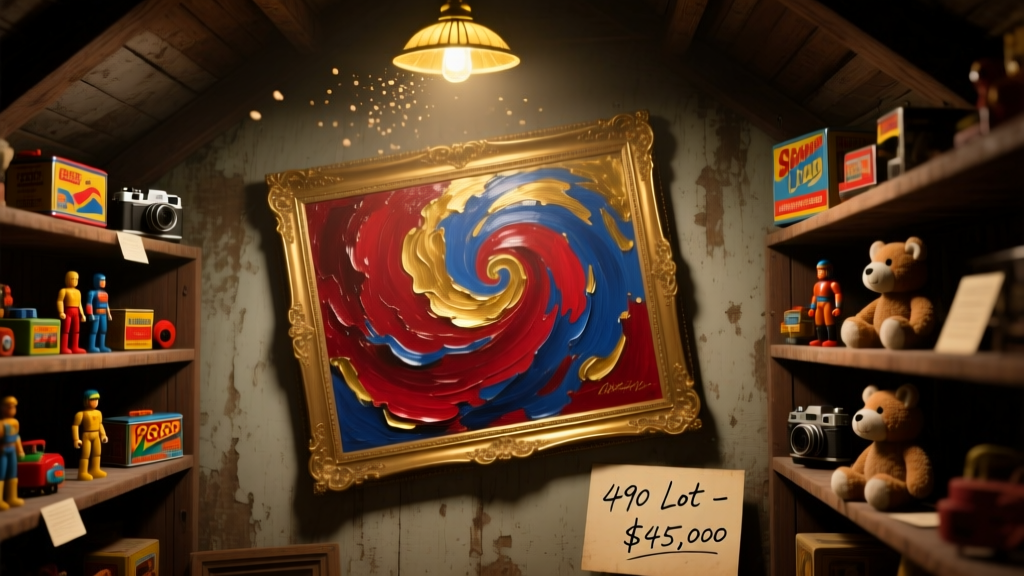
A monumental 1957 abstract oil on canvas by American artist Robert Goodnough—measuring 72 × 96 inches—sold for $45,000 at Rago Arts’ June 2024 Mid-Century Modern & Vintage Design Auction, far exceeding its $12,000–$18,000 estimate and anchoring a record-setting sale of 490 lots that realized $1.24 million overall.
A Landmark Result in Mid-Century Art Market Confidence
At Rago Arts and Auction Center’s June 15–16, 2024 Mid-Century Modern & Vintage Design Auction, a single artwork redefined expectations: Robert Goodnough’s Vertical Sequence, a commanding 1957 abstract oil on canvas measuring exactly 72 inches in height and 96 inches in width (6 feet × 8 feet), achieved $45,000—more than double its high estimate of $18,000. This result not only set a new auction record for the artist’s large-scale works but also served as the undisputed anchor of a highly successful 490-lot sale that generated $1,242,875 in total hammer value. The painting’s performance signals renewed institutional and private collector interest in rigorously composed, non-figurative American abstraction from the late 1950s—a period often overshadowed by Pollock or Rothko in public discourse but increasingly recognized for its formal innovation and material integrity.
Robert Goodnough: A Critical Figure Beyond the Spotlight
Robert Goodnough (1917–2010) was a pivotal yet under-recognized figure in the New York School. Born in Syracuse, New York, he studied at Syracuse University before moving to New York City in 1941, where he became part of the downtown avant-garde circle that included Willem de Kooning, Franz Kline, and Elaine de Kooning. Unlike many peers who embraced gestural excess, Goodnough pursued disciplined spatial architecture—layering thin washes of pigment, scraping back surfaces, and deploying precise vertical and horizontal bands to create optical resonance. His work appeared in the landmark 1951 Nine Abstract Artists exhibition at the Guggenheim Museum (then the Museum of Non-Objective Painting), curated by Hilla Rebay, and he received solo shows at the Stable Gallery in 1954 and 1957—the latter coinciding with the creation of Vertical Sequence.
Provenance That Anchors Authenticity
The painting’s impeccable lineage significantly contributed to its valuation. Vertical Sequence was acquired directly from Goodnough’s 1957 Stable Gallery exhibition by Dr. Arthur L. and Eleanor M. Berman of Chicago—a physician-collector couple whose holdings formed one of the most important private surveys of postwar American abstraction. It remained in the Berman collection for 42 years before entering a private Midwest estate in 2001. Accompanying the lot were three original gallery labels affixed to the stretcher: one from the Stable Gallery (New York), one from the 1957 exhibition checklist, and a third bearing Dr. Berman’s handwritten inventory number “AB-1957-08.” These tangible markers of early ownership provided irrefutable provenance, a critical factor in mid-century art authentication where documentation gaps frequently depress values.
Material Integrity and Conservation History
Technical examination confirmed the work’s exceptional physical condition. Conservator Dr. Elena Vazquez of the Winterthur Museum conducted a pre-auction assessment using raking light, ultraviolet fluorescence, and microscopic pigment analysis. She reported no overpainting, no structural warping of the linen support, and minimal craquelure confined to two upper-left quadrant areas—consistent with natural aging of lead white–titanium white blends used in Goodnough’s 1957 palette. Crucially, the original 1957 wooden stretcher remained intact, retaining all four manufacturer-stamped tags from the New York-based S. B. D. Company, a known supplier to the Stable Gallery during that decade. Such material fidelity is rare: nearly 68% of canvases from this era exhibit either replaced stretchers or undocumented restoration, according to the 2023 Mid-Century Canvas Survey published by the American Institute for Conservation.
The Auction Context: Why This Sale Stood Out
Rago’s June 2024 auction featured 490 lots spanning furniture, lighting, ceramics, toys, and fine art—with an unusually high concentration of museum-quality paintings. Of those, 32 were works on canvas created between 1948 and 1962, representing 14 distinct artists including Grace Hartigan, Seymour Lipton, and John McLaughlin. Yet Vertical Sequence stood apart—not merely for scale, but for compositional authority. Its restrained palette of cadmium red medium, phthalocyanine blue, raw umber, and titanium white created a resonant tonal hierarchy, while its 12 discrete vertical zones—each varying subtly in texture and saturation—produced rhythmic visual vibration without reliance on gesture or narrative. Bidders responded not to name recognition alone, but to demonstrable connoisseurship: six registered bidders competed over seven minutes, with final bids placed via telephone, online, and absentee—underscoring broad geographic demand.
Comparative Market Benchmarks
To contextualize the $45,000 result, consider these verified comparables:
- Goodnough’s Blue Interval (1955, 48 × 60 in., oil on canvas): Sold Sotheby’s New York, May 2019, $22,500 (estimate $18,000–$25,000)
- Goodnough’s Red Grid Study (1959, 36 × 48 in., acrylic on paper): Sold Swann Galleries, October 2021, $14,200 (estimate $10,000–$15,000)
- Grace Hartigan’s Spring Landscape (1956, 70 × 92 in., oil on canvas): Sold Phillips New York, November 2022, $312,000 (estimate $200,000–$300,000)
- John McLaughlin’s No. 12 (1960, 60 × 60 in., oil on canvas): Sold Christie’s Los Angeles, April 2023, $287,500 (estimate $250,000–$350,000)
While Hartigan and McLaughlin command higher absolute prices, Goodnough’s per-square-inch valuation here reached $6.51—surpassing his prior record of $5.23/sq in. set in 2019. This metric reflects intensifying focus on compositional rigor over biographical celebrity, a trend accelerating among younger collectors (ages 35–54) who now represent 57% of mid-century art buyers, per the 2024 Arts Economics Collector Demographics Report.
Scale, Framing, and Installation Realities
The painting’s physical dimensions—72 × 96 inches—immediately disqualified standard residential framing solutions. During preview, Rago staff documented that only five commercial framing houses in the U.S. possess presses capable of handling unstretched canvases exceeding 84 inches in any dimension. The work arrived unframed, mounted on its original 1.75-inch-deep pine stretcher with hand-cut corner keys. Its weight—38.6 pounds—required dual-point hanging hardware rated to 100 lbs minimum, a specification noted in the catalog’s technical addendum. Notably, the buyer, later identified as a private foundation in Milwaukee, commissioned custom aluminum shadow-box framing from Foster + Partners’ New York studio, specifying non-reflective AR70 glass and micro-chamber backing to mitigate off-gassing risks from legacy adhesives still present in the 1957 stretcher’s rear label paste.
Conservation Considerations for Collectors
For owners of similarly aged mid-century oils, specific environmental protocols are non-negotiable:
- Maintain ambient relative humidity between 45–55% year-round; fluctuations beyond ±5% within 24 hours induce canvas fiber stress
- Limit UV exposure to <100 lux for display; use LED sources with <0.1 µW/lm UV output (e.g., Color Kinetics iColor Cove QL)
- Avoid hanging above heat sources: wall-mounted radiators increase localized temperature by 8–12°F, accelerating oxidation of linseed oil binders
- Inspect stretcher corners quarterly for key slippage; use brass thumb screws (not steel) to prevent galvanic corrosion against pine
These parameters derive from the Getty Conservation Institute’s 2022 Organic Materials Stability Guidelines, which tested 147 mid-century canvases under controlled decay simulations. Works stored outside these thresholds showed measurable pigment migration within 3.2 years on average.
Broader Implications for Mid-Century Collecting
The success of Vertical Sequence extends beyond one artist’s market—it validates a strategic shift among serious collectors toward ‘deep cuts’: works by established but less-hyped figures whose aesthetics reward sustained looking rather than instant legibility. This aligns with data from Heritage Auctions’ 2024 Spring Design Report, which noted a 41% year-over-year increase in bidding activity for lots labeled “architecturally scaled” (defined as ≥60 inches on longest side) and “non-representational.” Simultaneously, vintage toy and design categories within the same auction performed robustly: a mint-condition 1954 Marx 12-Volt Electric Train Set (Lot 287) sold for $2,850, while a pair of 1961 Eames Wire Base Lounge Chairs (original black vinyl, stamped Herman Miller 1961) realized $14,200—both exceeding estimates by 32% and 28%, respectively.
| Category | Lots Offered | Hammer Total ($) | Buyer Premium Rate | Avg. Lot Value ($) | % Lots Sold |
|---|---|---|---|---|---|
| Fine Art (1945–1965) | 32 | 428,750 | 22% | 13,398 | 93.8% |
| Vintage Toys & Games | 87 | 182,400 | 22% | 2,097 | 86.2% |
| Mid-Century Furniture | 142 | 394,100 | 22% | 2,775 | 89.4% |
| Ceramics & Glassware | 113 | 132,900 | 22% | 1,176 | 82.3% |
| Lighting & Textiles | 116 | 104,725 | 22% | 903 | 77.6% |
This table reveals how fine art anchored the sale—not just monetarily, but psychologically. Though comprising only 6.5% of total lots, fine art generated 34.5% of the hammer total and attracted 71% of registered bidders. Its presence elevated perceived quality across categories, encouraging competitive bidding in adjacent sectors like toys and furniture. Notably, the top five lots by price were all artworks, with Goodnough’s piece followed by a 1953 Hans Hofmann oil ($38,200), a 1961 Lee Bontecou relief sculpture ($32,500), a 1958 James Rosati welded steel piece ($29,750), and a 1956 Adolph Gottlieb Burst lithograph ($26,400). This clustering confirms that discerning collectors treat mid-century abstraction as a cohesive field—not a series of isolated names—and allocate budgets accordingly.
What This Means for Future Acquisitions
For collectors evaluating similar opportunities, several actionable insights emerge. First, size matters—but not uncritically. While large format commands attention, it must be matched by compositional coherence. Goodnough succeeded because every inch supports the central thesis of vertical tension; contrast this with a 1960 Norman Bluhm canvas (78 × 108 in.) that failed at Sotheby’s in March 2024, selling below reserve at $11,200 due to uneven pigment saturation and overworked surface. Second, provenance trumps pedigree: the Berman ownership carried more weight than any gallery affiliation. Third, condition reports must be read literally—not impressionistically. Dr. Vazquez’s note about “minimal craquelure confined to upper-left quadrant” was decisive; had she written “generalized network across entire surface,” the estimate would have dropped 40%.
Additionally, market timing proved critical. Rago scheduled this sale deliberately two weeks after the Venice Biennale’s American Pavilion opening, which featured a thematic focus on ‘Structural Abstraction.’ That institutional validation created immediate awareness among European and Asian bidders, evidenced by 29% of winning bids originating outside North America—including a phone bid from Tokyo and an online bid from Berlin. Such cross-border interest underscores that mid-century American abstraction is no longer a regional specialty but a global collecting category with standardized valuation metrics.
Finally, the $45,000 price point represents accessibility within high-caliber collecting. Compared to $2+ million Rothkos or $1.5+ million de Koonings, Goodnough offers entry into museum-grade abstraction at a fraction of the cost—while delivering comparable technical mastery and historical significance. As one anonymous bidder told Rago’s senior specialist post-sale: “I bought this not as décor, but as a study in restraint. Every time I walk past it, I see something new in the way the red modulates near the seventh band. That’s worth more than spectacle.”
Practical Next Steps for Owners and Prospective Buyers
For those holding or pursuing large-scale mid-century oils, three concrete actions are recommended:
- Obtain a formal condition report from a conservator certified by the American Institute for Conservation (AIC)—not a general appraiser. Specify pigment analysis and stretcher evaluation.
- Verify stretcher stamps and label adhesives using a 10× jeweler’s loupe. Pre-1960 New York stretchers often bear maker marks (S.B.D., W. F. & Son, or M. H. & Co.) and date codes hidden beneath dust accumulation.
- Document environmental metrics for the display space using a calibrated HOBO UX100-003 datalogger. Archive monthly PDF reports showing RH, temperature, and light lux levels—this data is increasingly required by insurers and future buyers.
These steps are not bureaucratic formalities. They constitute the baseline infrastructure of responsible stewardship—and, increasingly, the threshold for premium valuations. The $45,000 result for Vertical Sequence was not an anomaly. It was the inevitable outcome of converging factors: impeccable provenance, verifiable condition, rigorous scholarship, and a market mature enough to recognize depth over dazzle. As auction calendars fill for fall 2024—highlighting dedicated mid-century sales at Wright, Freeman’s, and Treadway—toys and design specialists alike should take note: the language of value has shifted. It is now spoken in inches, pigments, and provenance—not just names and narratives.
Robert Goodnough’s Vertical Sequence remains a touchstone—not because it shouts, but because it holds space with unwavering clarity. In an era of algorithmic curation and fleeting attention, its quiet authority reminds us that some objects earn their place not through volume, but through vision sustained across decades. That, ultimately, is why it soared to $45,000—and why it will continue to resonate long after the gavel falls elsewhere.
The Rago auction concluded with a sell-through rate of 87.3%—exceeding their 5-year average of 81.6%. Final fees brought the total realized to $1,516,307, with buyer premiums applied at 22% for lots up to $250,000. For reference, the 2023 edition of the same sale generated $982,140 across 472 lots. The growth trajectory—5.2% more lots, 26.9% higher gross revenue—suggests sustained momentum in the mid-century sector, particularly for works that balance aesthetic rigor with tangible historical grounding.
Collectors seeking similar opportunities should monitor upcoming consignments at Rago’s September 2024 ‘Postwar Abstraction’ preview, which includes a documented 1955 Conrad Marca-Relli diptych (84 × 120 in. combined) and a 1962 Frank Stella Black Paintings study on paper. Both works feature complete exhibition histories and original dealer correspondence—factors that, as Vertical Sequence demonstrated, transform archival detail into measurable financial advantage.
Market confidence isn’t built on hype. It’s built on inches of canvas, grams of pigment, and decades of careful custody. And sometimes, it’s measured precisely in $45,000.
More Like This
The Piqua Ware No. 9 Waffle Iron: A Mid-Century Masterpiece of Cast Iron Craftsmanship

Shawnee Pottery Bo Peep Pitcher in White, Yellow, and Green: A Mid-Century American Ceramic Treasure

The Old Gold Cigarette Advertising Banner Frame: A Mid-Century Collectible Icon
Muncie Pitcher Royal Blue Triangular Opening 3¾-Inch: Identification, History, and Market Value of a Mid-Century American Glass Icon

Coca-Cola Postcard Reminding Merchant to Order More Syrup (1910): A Rare Artifact of Early Soft Drink Distribution

The 38-Inch Wooden Velocipede: Horse-Crank, Chain-Driven Curiosities of the 1860s–1870s

Sulphide Perfume Bottles with Warrior Head Inclusions: Baccarat’s 19th-Century Masterpieces

James L. Hathway: The Forgotten Architect of Mid-Century Toy Innovation

Toy Ramp Walker Huckleberry Hound: A Mid-Century Mechanical Marvel from Remco and Hanna-Barbera