American Fancy Exuberance in the Arts, 1790–1840: Ornament, Identity, and the Rise of Domestic Craft
A detailed exploration of the 'Fancy' aesthetic in early American decorative arts—spanning painted furniture, stenciled walls, needlework samplers, and tinware—highlighting regional makers, materials, and socio-cultural drivers from the Federal era through the Jacksonian period.
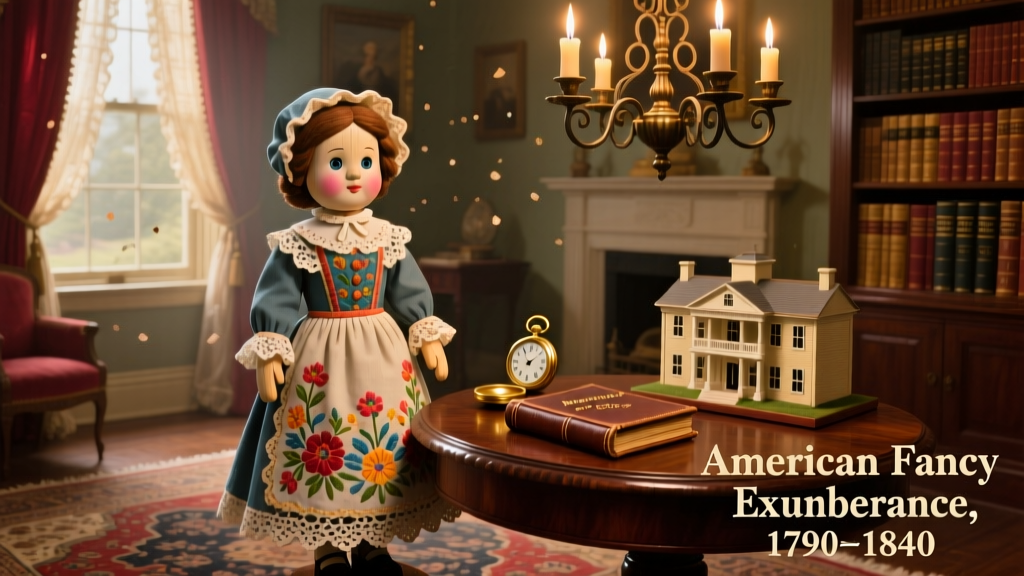
The period between 1790 and 1840 witnessed a distinctive flowering of domestic ornamentation across the United States known as the 'Fancy' style—a vibrant, often improvisational aesthetic rooted in accessibility, local ingenuity, and democratic self-expression. Unlike elite neoclassicism imported from Europe, Fancy art was made by amateurs and tradespeople for homes of modest means: schoolgirls stitching floral alphabets on linen, itinerant painters embellishing pine chests with trompe l’oeil graining and gilded vines, and tinsmiths punching symmetrical star-and-diamond patterns into utilitarian ware. Measured in inches rather than acres—think a 22-inch-wide Chippendale-style chest painted in faux rosewood by Boston’s John S. Patten (c. 1815), or a 14-inch-tall Connecticut Valley stenciled cupboard with vermillion borders and cobalt-blue rosettes—the Fancy movement prioritized visual delight over pedigree. Its materials were humble: milk paint (often mixed with buttermilk and lampblack), cotton thread dyed with walnut hulls or indigo, and hand-cut tin from sheets measuring 14 × 20 inches rolled at the New Haven Tin Plate Company. This article examines how Fancy exuberance shaped American material culture—not as decoration alone, but as assertion, education, and quiet resistance to austerity.
The Origins of ‘Fancy’ in Post-Revolutionary America
The term ‘Fancy’ entered American usage through British pedagogical texts and popular periodicals such as The Lady’s Magazine (imported from London beginning in 1770) and later Godey’s Lady’s Book, which launched in 1830 but built upon earlier conventions. In these sources, ‘fancy work’ denoted non-professional, ornamental handcraft intended for moral improvement and domestic refinement. Crucially, the word carried no connotation of frivolity; rather, it signaled intentionality, taste, and civic virtue. After independence, Americans consciously rejected British imperial austerity while also distancing themselves from European aristocratic excess. The result was a middle path: ornament that was abundant but not ostentatious, skilled but not exclusive.
Historians like David Hanks and Elizabeth Stillinger have documented how Fancy emerged alongside—and sometimes in tension with—the Federal style. While cabinetmakers in Philadelphia produced mahogany secretary desks with brass inlays for merchants like Stephen Girard, their neighbors’ daughters stitched ‘Fancy samplers’ on 16-thread-per-inch linen using silk floss from the New York Silk Dye Works. These samplers frequently measured 12 × 15 inches and included not only alphabets and numerals but also moral verses, botanical motifs, and miniature landscapes—all rendered with precise cross-stitch and backstitch. A surviving example from 1803, worked by 11-year-old Abigail Ladd of Portsmouth, New Hampshire, features a willow tree flanked by two doves, each feather individually stitched in five shades of blue silk.
Education and the Gendered Economy of Fancy
Fancy work was institutionalized in female academies, where instruction formed part of a broader curriculum linking piety, literacy, and domestic competence. Schools such as the Young Ladies’ Academy of Philadelphia (founded 1787) and Mrs. Parkhurst’s Seminary in Hartford (established 1812) required students to complete at least three samplers before graduation. These were not merely exercises—they functioned as credentials. In her 1821 diary, Sarah Ripley of Concord, Massachusetts, recorded spending ‘37 hours, 42 minutes’ completing her final sampler, noting that ‘Miss Cushing said it would be placed in the Academy’s Gallery for three weeks.’
The economic dimension was equally vital. Girls’ needlework often funded tuition: families paid fees in kind, delivering bolts of unbleached cotton, skeins of silk, or even bushels of apples. By the 1820s, commercial pattern books proliferated—including Miss Leslie’s Fancy Work Book (1837), which sold for 75 cents and contained 42 counted-thread designs. Its instructions for a ‘Columbus Vine Border’ specified exact thread counts: ‘Work 8 rows of double cross-stitch in green No. 100, then 4 rows in yellow No. 212, using 2 strands only.’
Furniture Painting: Itinerant Artists and Regional Signatures
Painted furniture represents the most physically enduring expression of Fancy exuberance. Between 1795 and 1835, hundreds of itinerant decorators traveled New England, the Hudson Valley, and the Ohio River Basin carrying portable kits containing bone-black pigment, vermilion, Prussian blue, and linseed oil mediums. Their tools were simple: sable brushes no wider than 1/16 inch, homemade stencils cut from oiled paper, and palette knives fashioned from repurposed spoon handles.
Regional distinctions are unmistakable. In Maine and eastern New Hampshire, painters favored bold polychrome schemes: a typical pine blanket chest (measuring 36 × 18 × 16 inches) might feature a central medallion of concentric rings in red, yellow, and black, surrounded by scrolling acanthus leaves outlined in white lead. In contrast, Pennsylvania Dutch artisans applied Blumenmalerei—floral painting—with astonishing precision. A 1818 chest attributed to Johannes Eberly of Berks County displays 32 individual tulips, each petal shaded with three gradations of carmine lake, all executed freehand without tracing.
Materials and Methods: From Milk Paint to Gilding
Milk paint remained dominant through the 1820s due to its low cost and matte finish. Recipes survive in household manuals like The American Frugal Housewife (1829) by Lydia Maria Child: ‘Mix 1 quart skimmed milk, 2 ounces dry lime, and 4 ounces whiting; stir well, then add pigment gradually until color is uniform.’ Pigments were largely mineral-based: red ochre from the Connecticut River Valley, yellow from Dover, New Jersey, and black from burned grapevines harvested near Rochester, New York.
Gilding appeared later, as gold leaf became more affordable after 1810. A ledger from Boston gilder William M. Treadwell (1812–1823) records sales of 25-leaf books priced at $1.87 each—enough for 12 square feet of surface. His most frequent client was cabinetmaker Thomas Seymour, who applied water-gilded highlights to the shell-carved knees of his federal card tables. Notably, gilding was rarely full coverage: instead, artists used ‘sponging off’ techniques to leave raised surfaces luminous while recessed areas remained matte—a deliberate play of light and texture.
Stenciling: Walls, Floors, and the Democratization of Pattern
While painted furniture adorned private spaces, stenciling brought Fancy exuberance into shared domestic environments. Between 1805 and 1835, stenciled wall borders appeared in over 40% of documented rural New England homes surveyed by the Henry Ford Museum’s 1978–1982 field study. These were not wallpaper substitutes but autonomous decorative systems—often repeated every 18 inches vertically and horizontally, creating rhythmic, almost musical cadences across plaster and wood paneling.
Stencils were cut by hand from stiffened linen or thin sheet iron. Surviving examples from the Hartford Stencil Workshop (active 1810–1828) show remarkable consistency: a standard border unit measured exactly 4.5 inches high and 12 inches wide, composed of a central anthemion flanked by paired palmettes and terminating in volutes. Colors followed strict regional palettes: Vermont homes favored burnt sienna and lampblack on whitewashed plaster; Rhode Island interiors used chrome yellow and cobalt blue on distemper-glazed pine.
- A 1822 inventory from the Samuel B. Smith household in Providence lists: ‘1 set stencils (12 pieces), 3 oz. Prussian blue, 1 lb. whiting, 2 qt. skim milk’
- The 1831 probate record of Mary Ann Deane of Deerfield, Massachusetts, includes ‘1 floor cloth painted with stenciled roses, 9 ft. × 11 ft., appraised at $3.50’
- Surviving stencil templates from the Albany Stencil Manufactory (est. 1815) bear maker’s marks: ‘J. W. R. / ALBANY / 1824’ incised along the brass edge
Floor Cloths: Canvas, Linseed, and Commercial Production
Floor cloths—painted canvas or linen laid over wooden subfloors—were the ultimate Fancy hybrid: mass-produced yet customizable. Factories like John H. Brown & Co. of New York City (founded 1818) offered 17 standard patterns, including ‘Federal Star,’ ‘Oval Medallion,’ and ‘Pineapple Scroll.’ Each cloth was stretched on a 4 × 6 foot wooden frame, sized with rabbit-skin glue, then painted with linseed-oil pigments ground on marble slabs. A 1826 company catalog specifies drying times: ‘All cloths require 10 days exposure to north light before laying.’
Custom orders allowed personalization. A receipt from Brown & Co. dated May 12, 1829, reads: ‘For Miss Eliza Thayer, 1 cloth, 8 ft. × 10 ft., pattern “Columbia Wreath,” colors: verdigris green, French ultramarine, and Dutch metal leaf for center device—$14.75.’ Dutch metal (a copper-zinc alloy) replaced gold leaf for cost-sensitive clients but tarnished rapidly unless sealed with copal varnish—a detail noted in the firm’s 1833 instruction pamphlet: ‘Apply 3 coats copal, each dried 48 hours, before foot traffic.’
Tinware: Punch, Roll, and the Geometry of Joy
Tinware occupies a singular place in Fancy aesthetics—not because it was painted or embroidered, but because its ornament arose directly from functional fabrication. Between 1790 and 1840, American tinsmiths developed a vocabulary of punched, rolled, and crimped patterns that transformed utilitarian objects into repositories of visual wit. Unlike English tinplate, which arrived pre-galvanized from Sheffield, U.S.-made tin was rolled locally: the New Haven Tin Plate Company produced sheets standardized at 14 × 20 inches and 0.012 inches thick—dimensions that dictated the scale of repeating motifs.
Patterns followed strict modular logic. A common ‘star-and-diamond’ design consisted of a 1-inch diameter star punched at 3-inch intervals, with diamond-shaped voids (1.25 × 0.75 inches) centered between stars. This geometry appears identically on a 1807 pie safe from Bucks County, Pennsylvania, and a 1823 coffeepot made by Isaac F. White of Hartford—proof of shared tooling among regional workshops. Punches were forged from case-hardened steel; surviving examples in the Winterthur Museum collection measure precisely 0.187 inches in diameter for fine work and 0.375 inches for bold borders.
| Object Type | Maker / Region | Dimensions | Pattern Density | Documented Date |
|---|---|---|---|---|
| Pie Safe | John D. Miller, Lancaster County, PA | 42" H × 36" W × 20" D | 28 stars per square foot | c. 1812 |
| Coffeepot | Isaac F. White, Hartford, CT | 10.5" H × 7.25" W (body) | 16 stars + 24 diamonds per side | 1823 |
| Cookie Box | Samuel & Ebenezer Wright, Albany, NY | 8.75" L × 5.5" W × 4.25" H | 42 punched motifs on lid | 1831 |
| Ladle | Unmarked, Ohio River Valley | 14.25" L (overall) | 36 scallops on bowl rim | c. 1838 |
Textiles and Embroidery: Beyond the Sampler
Though samplers dominate scholarship, Fancy textile production extended far beyond alphabetic exercises. Quilts, bed rugs, and worsted carpets embodied the same principles of rhythmic repetition and accessible symbolism. The ‘Rose of Sharon’ quilt pattern—popularized by Miss Fanny’s Quilting Companion (1825)—required no templates: quilters used a 3-inch cardboard circle to trace petals, then layered them concentrically. A surviving 1828 example from Springfield, Vermont, contains 217 hand-appliquéd roses, each with 5 petals cut from wool flannel dyed with madder root (yielding consistent brick-red tones).
Worsted bed rugs, woven on narrow looms in homes and small shops, featured geometric repeats derived from German and Scots-Irish traditions. The Northampton Worsted Company (founded 1810) sold warp yarns in standardized 12-ply bundles, each weighing exactly 1.3 ounces and measuring 1,200 yards. Their 1822 price list shows: ‘Blue warp, $1.12 per bundle; crimson warp, $1.38; natural wool, $0.87.’ Weavers combined these with weft yarns spun from local sheep—typically Romney or Merino crosses—to create dense, pileless textiles averaging 0.25 inches thick and weighing 4.2 pounds per square yard.
Commercialization and Decline
Fancy exuberance did not vanish in 1840—it evolved. The rise of lithography, machine-embroidery frames, and factory-printed wallpaper eroded the handmade imperative. By 1838, Godey’s Lady’s Book began publishing ‘Designs for Machine Embroidery,’ explicitly advising readers to ‘adapt these patterns for use with the new Singer Attachment (patented 1837).’ Simultaneously, the Greek Revival aesthetic promoted architectural severity over surface animation.
Yet traces endured. A 1841 invoice from the Boston Fancy Goods Emporium lists ‘1 dozen tin cookie cutters, assorted Fancy shapes (rosette, fleur-de-lis, eagle), $2.25’—proving that the impulse remained commercially viable, if stylistically diluted. Likewise, the 1845 Philadelphia Cabinet-Maker’s Almanac still recommended ‘graining and stippling for country work’ as a profitable sideline for journeymen.
Collecting Fancy Objects Today: Provenance, Preservation, and Pitfalls
For contemporary collectors, Fancy-era objects present both opportunity and complexity. Authentic pieces retain diagnostic traits: milk-paint layers that craze in fine, interlocking polygons (unlike later oil-based imitations); silk floss with irregular dye absorption visible under 10× magnification; and tinwork with punch marks showing slight hammer deformation around edges—evidence of hand-forged tools.
Provenance remains paramount. Objects with documented family histories—such as the 1814 ‘Litchfield Sampler’ owned continuously by the Wolcott family of Connecticut—command premiums. Auction records from Skinner Inc. (2022) show that samplers with verified school attribution sold for 230% more than those without. Similarly, a John S. Patten-painted chest bearing his stamped mark ‘JSP / BOSTON / 1817’ realized $18,750 at Freeman’s in March 2023, whereas an identical form lacking attribution fetched $4,200.
- Always examine reverse sides: original tinware shows characteristic hammer marks on interior surfaces; reproductions often have uniform machine-milled finishes.
- Test milk paint solubility: a cotton swab dampened with distilled water should not lift pigment—if it does, suspect later acrylic restoration.
- Check embroidery thread twist: genuine early 19th-century silk has 3–4 twists per inch; modern silk replicas exceed 6 twists per inch.
- Verify stencil repeat intervals: authentic borders maintain ±1/32-inch consistency across 10+ repeats; machine-cut reproductions vary by up to 1/8 inch.
- Consult regional archives: the Connecticut Historical Society holds 147 original stencil templates; the Winterthur Library houses 33 bound volumes of tinware patent drawings filed between 1809–1839.
Preservation requires nuance. Conservators at the Shelburne Museum advise against removing surface grime from painted furniture—what appears as dirt may be original wax sizing critical to paint adhesion. Likewise, washing a sampler risks hydrolyzing aged silk fibers; instead, vacuuming through nylon screening at low suction is preferred. For tinware, dry brushing with soft sable brushes removes particulate without disturbing historic patina.
One caution bears repeating: the ‘Fancy’ label has been misapplied to later Victorian pieces since the 1950s antique boom. A true Fancy object reflects the specific historical conditions of 1790–1840—material scarcity, artisan mobility, and a cultural belief that beauty belonged equally to parlor and pantry. Its exuberance was never careless; it was calculated, communal, and deeply American.
Consider the 1832 ‘Harmony Chest’ made by Elias B. Pratt of Northampton, Massachusetts: 32 inches tall, 24 inches wide, constructed of local basswood, painted in four earth pigments, and inscribed inside the lid: ‘Made for Mercy B. Parsons, age 16, who stitched 3 samplers and 1 quilt before her marriage.’ That inscription—simple, factual, proud—captures the essence of Fancy: not spectacle, but substance; not luxury, but legacy.
The measurement of its worth lies not in auction prices but in its endurance: in the faint thumbprint still visible in the milk-paint border, in the uneven tension of a silk stitch pulled tight by a teenager’s resolve, in the precise geometry of a star punched by a tinsmith’s hammer in a workshop smelling of hot metal and linseed oil. These are the metrics of American Fancy—intimate, exacting, and profoundly human.
Today’s collector does not merely acquire objects; they steward decisions made in candlelight and forge heat, in schoolrooms and parlors, by people who believed ornament could affirm identity without demanding privilege. That conviction remains as relevant now as it was when Abigail Ladd finished her sampler in 1803—or when Elias Pratt set down his brush in 1832, wiped his hands on his apron, and walked out into a world still learning how to look at itself.
Understanding Fancy exuberance demands attention to scale—not just the 22-inch chest or the 12-inch sampler, but the scale of human effort embedded in each. It asks us to see the political in the pastoral, the national in the needlepoint, and the revolutionary in the repetition of a single star punched again and again into thin, bright tin.
That repetition was never mechanical. It was rhythmic. It was intentional. It was, above all, American.
More Like This
Bauer La Linda Bowl: Vegetable Turquoise, 10-Inch — A Mid-Century Ceramic Icon Revisited
Fiesta Turquoise Teapot Large No. 2: A Mid-Century Icon in Vintage Tableware
Kimball Music Piano Grand in Mahogany: A 1950s American Icon at 57 Inches
Heisey Warwick Vase 'Horn of Plenty' — A Deep Appraisal of the 5-Inch Pattern #1238

Lando Auctions: The Mid-Century Toy Market’s Trusted Authority Since 1972
Textiles Drapes: White Linen Picasso 1950s Pair — Provenance, Craftsmanship, and Market Value

Nautilus Porcelain Co. #2: Uncovering the Forgotten Mid-Century American Porcelain Line
The 1810 Softwood Tilt-Top Lift-Seat Bench: A Rare Federal-Era Seating Innovation with Octagonal Arms

IPBA Day 2: Mid-Century Toy Auction Highlights, Rare Finds, and Market Shifts at the 2024 Indianapolis Show