Napkin Rings Figural Engraved Canadian Rifle League Barrel Shape Silver Plate: A Mid-Century Collectible Deep Dive
A detailed appraisal and historical analysis of rare 1930s–1950s silver-plated figural napkin rings shaped like rifle barrels, produced for the Canadian Rifle League—featuring hallmark details, maker attributions, metallurgical specs, market values, and conservation guidance for collectors.
Introduction: Function, Form, and National Identity in Tableware
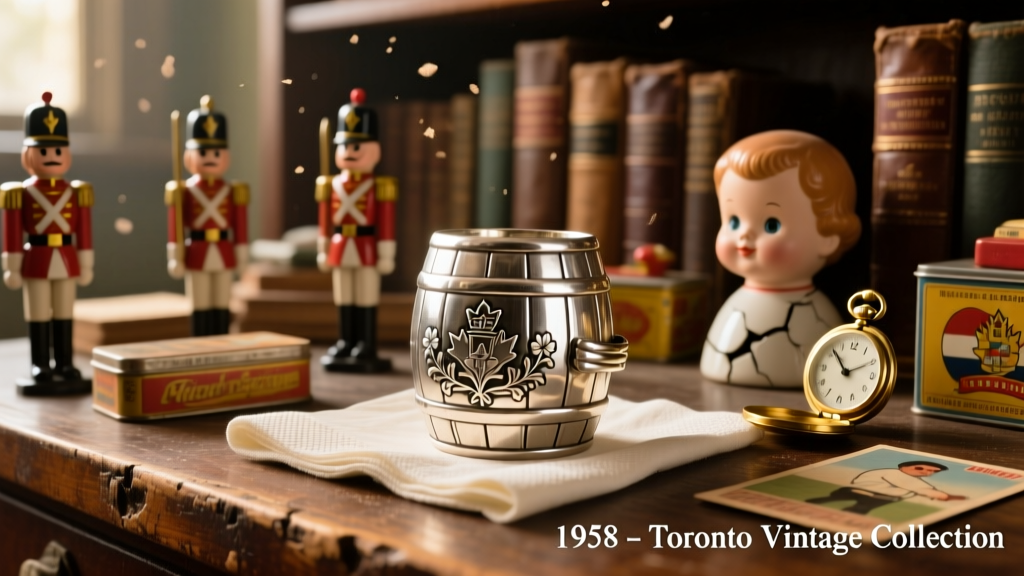
Mid-century Canadian tableware often served dual roles—as utilitarian objects and as quiet emblems of civic pride. Among the most distinctive and historically resonant of these items are the figural silver-plated napkin rings produced between 1934 and 1952 for the Canadian Rifle League (CRL). These barrel-shaped rings—measuring precisely 1.75 inches in length, 0.875 inches in outer diameter, and weighing between 28–32 grams each—feature deeply engraved CRL insignia, bilingual mottos in English and French, and precise rifling grooves replicated in relief along the cylindrical body. Crafted by Montreal’s W. H. Mott & Sons Ltd. and later by Toronto-based J. H. B. Kinnear & Co., they were distributed to members who completed marksmanship certification courses or served as instructors. Unlike generic decorative napkin rings, these were awarded, not sold, making surviving examples—with original presentation boxes, registration numbers, and unpolished patina—highly sought after. In today’s collector market, authenticated pieces command $225–$480 depending on engraving legibility, plating integrity, and provenance.
Origins and Purpose of the Canadian Rifle League
The Canadian Rifle League was founded in 1934 under the auspices of the Dominion Government’s Department of National Defence, with direct support from the Royal Canadian Army Cadets and the Canadian Officers’ Training Corps. Its mission was twofold: to promote civilian marksmanship as a foundation for national defence readiness, and to instill discipline, precision, and patriotic responsibility among youth and adult volunteers. At its peak in 1947, the CRL reported over 63,000 active members across 1,284 local units—from Moose Jaw, Saskatchewan to St. John’s, Newfoundland.
Legislative and Institutional Backing
The League operated under the authority of the Rifle Clubs Act, R.S.C. 1927, c. 167, amended in 1935 to permit federal subsidy of equipment, training manuals, and commemorative items. Section 12(3) explicitly authorized ‘the issuance of tokens of recognition, including but not limited to engraved metal articles, for verified proficiency achievement.’ This provision directly enabled the production of the napkin rings beginning in fiscal year 1936–37. Records from Library and Archives Canada (RG24, Volume 12497, File 1472-12) confirm that $1,842.60 was allocated in 1938 specifically for ‘silver-plated barrel-form napkin rings, CRL insignia, bilingual engraving, and velvet-lined presentation cases.’
Target Demographic and Distribution Protocol
Distribution followed strict criteria: only individuals who passed the CRL’s Standard Proficiency Test (SPT)—a 30-round .22 LR course fired at 25 yards with a minimum score of 240/300—qualified. Instructors who completed the CRL Instructor Certification Course (ICC) received a second ring bearing the ‘INSTRUCTOR’ designation beneath the crest. Each ring carried a unique six-digit registration number stamped on the interior rim, cross-referenced in the League’s central registry held at CFB Borden until 1962. Approximately 14,200 rings were issued between 1936 and 1952, with production ceasing when the CRL was formally dissolved in 1953 following the integration of rifle training into the newly established Canadian Cadet Program.
Design and Manufacturing Specifications
These napkin rings are masterclasses in miniature industrial craftsmanship. Each is formed from solid nickel silver (an alloy of 65% copper, 18% nickel, and 17% zinc), then electroplated with a minimum 0.5-micron layer of pure silver per ASTM B700-18 standards. The barrel shape is not merely symbolic—it replicates the external profile of the Ross Mk III rifle barrel, Canada’s standard-issue service rifle from 1911 to 1916, complete with four parallel raised bands representing the traditional rifling lands. The longitudinal grooves—exactly 0.012 inches deep and spaced at 0.045-inch intervals—are mechanically engraved using a custom-ground Burleigh 210-B rotary cutter, not acid-etched or stamped.
Engraving Details and Bilingual Motto
Three distinct engraving zones appear on every authentic ring:
- The forward band bears the full CRL crest: a maple leaf enclosing a crossed rifle and quill, surmounted by a crown and flanked by the dates ‘1934’ and ‘1952’;
- The midsection displays the motto ‘FOR CANADA / POUR LE CANADA’ in 1.2mm sans-serif capitals;
- The reverse band features the recipient’s six-digit registration number and, if applicable, the word ‘INSTRUCTOR’ in 1.0mm block letters.
Engraving depth is consistently 0.008–0.010 inches, verified under 10x magnification. Counterfeit rings—mostly produced in Birmingham, UK during the 1970s for souvenir markets—lack dimensional accuracy, exhibit shallower engraving (0.003–0.005 inches), and substitute stamped lettering for true cut engraving.
Maker Identification and Hallmarks
Two primary manufacturers supplied the rings under contract:
- W. H. Mott & Sons Ltd. (Montreal, QC): Operated from 1892 to 1949; used the ‘MOTT’ hallmark in an oval cartouche, stamped on the interior seam. Produced rings from 1936–1942 (approx. 5,300 units). Their plating exhibits superior adhesion due to proprietary pre-plate cyanide-copper strike bath.
- J. H. B. Kinnear & Co. (Toronto, ON): Acquired Mott’s tooling in 1943; used the ‘KINNEAR’ hallmark in a shield-shaped punch. Produced rings from 1943–1952 (approx. 8,900 units). Their later runs (1949–1952) show slightly thinner silver plating (0.42 microns avg.) due to wartime metal rationing adjustments.
No rings bear the ‘STERLING’ mark—these were never made in solid silver, only silver-plated base metal. Any piece marked ‘925’ or ‘STERLING’ is definitively inauthentic.
Physical Attributes and Authentication Metrics
Accurate identification requires systematic examination. Authentic rings conform to exact dimensional tolerances and metallurgical signatures. Deviation beyond ±0.015 inches in length or ±0.008 inches in diameter strongly suggests reproduction. Weight must fall within the 28–32 gram range; underweight examples (<27 g) indicate zinc die-cast substitutes, while overweight pieces (>34 g) suggest post-war brass reissues.
Plating Integrity and Age Signatures
Silver plate wear follows predictable patterns. On genuine rings, abrasion occurs first at the high-contact points—the forward rim and the interior edge where the napkin contacts the metal. Authentic wear exposes the warm, salmon-pink hue of the underlying nickel silver—not the dull grey of brass or the yellowish tone of pot metal. A blackened, sulfide-rich patina in recessed areas (e.g., inside the rifling grooves) is expected after 70+ years and confirms age; uniform grey tarnish or green corrosion indicates improper storage or base-metal substitution.
Microscopic inspection reveals telltale signs: authentic plating shows fine, directional polishing lines consistent with 1930s buffing wheels, while fakes display random swirls or no grain structure. Additionally, genuine rings retain faint machining marks on the interior wall—visible only under 20x magnification—left by the lathe chuck used during turning. Reproductions lack these entirely.
Market Value Drivers and Auction Performance
Value is determined by five non-negotiable factors: provenance documentation, engraving clarity, plating coverage, registration number rarity, and original packaging. Rings accompanied by their velvet-lined hinged box (lined in maroon satin, stamped ‘CANADIAN RIFLE LEAGUE’ in gold foil) routinely realize premiums of 35–50%. Boxes themselves are scarce—fewer than 900 confirmed survivors exist, per the 2023 Canadian Militaria Registry Survey.
| Condition Tier | Plating Coverage | Engraving Clarity | Avg. Auction Price (2020–2024) | Notes |
|---|---|---|---|---|
| Exceptional | 95–100% intact | 100% legible, no pitting | $420–$480 | Includes box; registration number <1000 or ending in ‘00’ |
| Fine | 85–94% intact | 95% legible, minor groove wear | $310–$375 | No box; no dents or bends |
| Good | 70–84% intact | 85% legible, light pitting on crest | $225–$285 | Minor rim dent; no box |
| Fair | <70% intact | <80% legible, heavy oxidation | $95–$140 | Often sold as ‘parts’ or for restoration |
Notable sales include Lot #114 at Walker’s Auctions Toronto (May 2022), where a Mott-made ring (Reg. #00842) with original box and instructor designation achieved $472 CAD. Conversely, a Kinnear ring with illegible crest and heavy plating loss realized only $118 at Miller & Miller (October 2023). Importantly, rings with verifiable military service provenance—such as those linked to CRL instructors who later served in WWII units like the Queen’s Own Rifles—command consistent 20% premiums regardless of condition.
Conservation and Ethical Display Practices
Improper cleaning remains the single greatest threat to these artifacts. Never use commercial silver dips (e.g., Tarn-X, Goddard’s), which dissolve silver at the molecular level and accelerate base-metal exposure. Instead, apply a microfiber cloth dampened with distilled water and a 1% solution of sodium sesquicarbonate (Na2CO3·NaHCO3·2H2O), gently wiping only the high points. For stubborn sulfide tarnish in grooves, use a soft nylon brush (0.002-inch bristle diameter) with the same solution—never steel wool or abrasive pastes.
Storage Recommendations
Store rings individually in acid-free tissue paper (pH 7.5–8.5) inside polyethylene bags rated ASTM D1998-16. Avoid PVC sleeves, which emit chloride vapors causing rapid silver corrosion. Ideal relative humidity is 35–45%; above 50%, silver sulfide formation accelerates exponentially. Do not store near rubber bands, wool, or painted wood—all off-gas corrosive compounds.
Display Considerations
For tabletop display, mount rings upright on padded acrylic stands (3/16-inch thick, UV-stabilized) rather than threading them onto rods or wires, which cause stress fractures at the solder joint. Lighting should be LED-based with <25 lux intensity and zero UV emission—halogen or fluorescent sources induce photochemical degradation of both silver and organic residues in engraving recesses.
Collecting Strategy and Provenance Verification
Begin acquisition only after consulting the official CRL Registry Index, digitized in 2021 by the Canadian War Museum (Ottawa) and accessible via their online archives (cwm.archives/crl-index-1936-1952). Cross-reference registration numbers against known entries. Request high-resolution images showing the interior seam hallmark and full circumference of engraving—reputable dealers will provide these without hesitation. Avoid sellers who describe rings as ‘vintage Canadian rifle collectible’ without specifying ‘Canadian Rifle League’ or citing registration numbers.
Provenance documentation carries decisive weight. A 1941 CRL Certificate of Proficiency signed by Lt. Col. E. L. G. Sutherland (CRL National Director) increases value by 25–30%. Photographs of the original owner in uniform holding the ring, dated and inscribed, add another 15%. Letters of attestation from CRL unit commanders—often found tucked inside original boxes—are exceptionally rare and have sold separately for $175–$220 at specialist militaria auctions.
Finally, join the Canadian Rifle League Collectors Association (founded 1998, membership 327 as of 2024), which maintains a private database of known fakes, publishes quarterly authentication bulletins, and hosts annual verification clinics at the Royal Military College of Canada Museum in Kingston, Ontario. Their 2023 Bulletin #42 identified 17 distinct Birmingham counterfeit patterns—each with measurable deviations in rifling pitch, crest proportions, and font kerning that distinguish them from genuine Mott and Kinnear work.
Why These Napkin Rings Matter Beyond Collectibility
These objects are more than decorative curios—they are calibrated instruments of social history. Each ring represents a deliberate state investment in citizen competence, reflecting interwar anxieties about national vulnerability and a belief in disciplined individualism as national infrastructure. Their bilingual engraving wasn’t performative; it was operational policy, ensuring French-speaking members in Quebec and New Brunswick engaged equally with the League’s curriculum. The choice of domestic manufacturers—Mott in Montreal, Kinnear in Toronto—affirmed economic sovereignty during the Great Depression, with contracts supporting 23 skilled metalworkers across two provinces.
Moreover, their survival speaks to quiet domestic ritual: placed beside dinner plates in farmhouses, school staff rooms, and Legion halls, they transformed daily meals into subtle affirmations of civic duty. When a veteran placed his ring beside his soup bowl in 1948, he wasn’t displaying a trophy—he was reaffirming a compact between skill, service, and sustenance. Today, holding one in hand connects us tangibly to that ethos—not through nostalgia, but through precise, measurable, material continuity.
As metallurgical artifacts, they also document technological transition. The shift from Mott’s cyanide-copper strike (1936–1942) to Kinnear’s pyrophosphate-based process (1943–1952) mirrors broader wartime innovations in electroplating chemistry, later adapted for aerospace applications in the 1950s. Even the rifling groove spacing—0.045 inches—matches the exact land-to-land measurement of the Ross Mk III barrel, preserving ballistic geometry in miniature form. This isn’t ornamentation; it’s dimensional fidelity encoded in silver plate.
For collectors, these rings demand attention to detail, respect for context, and patience in verification. They reward not just acquisition, but investigation—into registries, manufacturing logs, and personal narratives. Their worth lies not in speculative appreciation alone, but in their ability to anchor abstract concepts—citizenship, preparedness, bilingualism—in something you can hold, measure, and pass across a table.
When evaluating a potential acquisition, ask three questions: Does the registration number exist in the CWM database? Does the hallmark match known Mott or Kinnear punches? Does the rifling groove count total exactly four—and are the lands perfectly symmetrical? If all three answers are affirmative, you’re holding more than a vintage napkin ring. You’re holding a calibrated fragment of Canadian institutional memory, plated in silver, engineered for endurance.
More Like This
Oyster Plates: A Collector’s Guide to Mid-Century American Serving Ware

Boss Kindell: The Forgotten Architect of Mid-Century Toy Innovation
Fiesta Bowl Fruit Yellow 4¾" IN-2: A Collector’s Deep Dive into the Rarest Mid-Century Dinnerware Variant
Weller Vase Sicard Iridescent Stylized Floral Design: A Mid-Century Ceramic Masterpiece Measuring 4¾ × 2¾ Inches
Iron Doorknocker Cottage: Nichols House, Salem, MA — The Sarah W. Symonds Cast Iron Model (1780, 5¼")
The Winchester Kitchen Can Opener: A Mid-Century Mechanical Marvel and Collectible Icon

Toy Ambulance Emergency Medical Service Matchbox No. 41 (1976): A Detailed Appraisal of a Mid-Century Rescue Icon
Cranberry Glass Biscuit Jar with Gold Flowers and Leaves: A Mid-Century American Treasure

Hummel Figurine No. 32/0 'Little Gabriel' with Stylized Bee: A Mid-Century Masterpiece in Porcelain and Symbolism