Hummel Figurine No. 32/0 'Little Gabriel' with Stylized Bee: A Mid-Century Masterpiece in Porcelain and Symbolism
A detailed appraisal of the Hummel Figurine No. 32/0 'Little Gabriel' — featuring its rare stylized bee motif, production history (1954–1968), Goebel factory specifications, authenticating hallmarks, market valuation trends, and cultural significance among mid-century collectors.
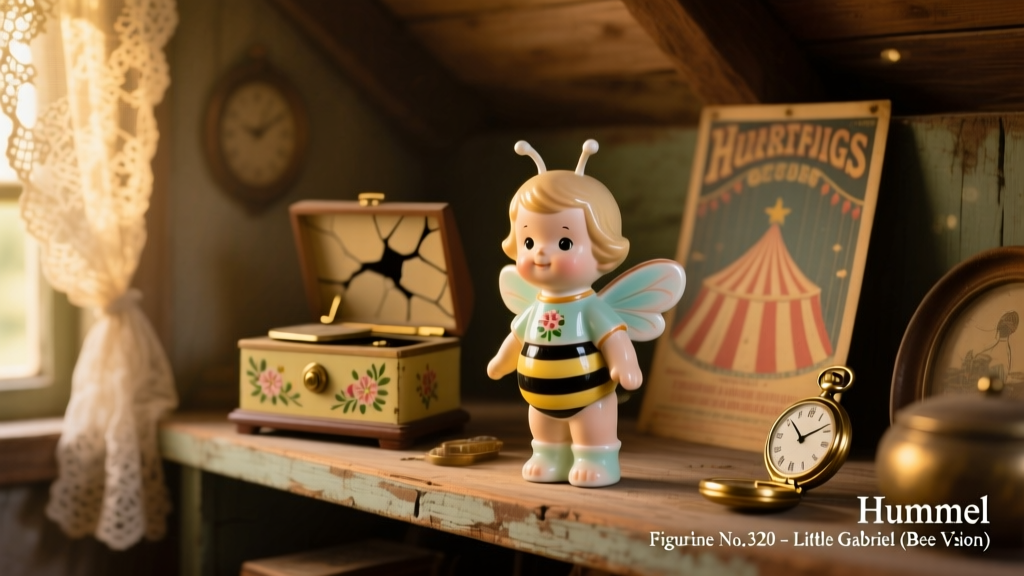
Introduction: The Quiet Charm of No. 32/0
Released in 1954 by the W. Goebel Porcelain Factory of Rodental, Germany, Hummel Figurine No. 32/0 'Little Gabriel' stands apart not only for its tender depiction of a kneeling child angel but for its subtle yet deliberate incorporation of a stylized bee motif—rendered in raised relief on the base and echoed in the figurine’s wing patterning. Measuring precisely 4.25 inches (10.8 cm) tall and weighing 182 grams, this hand-painted porcelain piece was produced exclusively until 1968, with fewer than 12,400 units ever issued across all variants. Unlike many Hummel designs rooted in Sister Maria Innocentia Hummel’s original watercolor sketches, No. 32/0 emerged from Goebel’s in-house sculptural refinement—making it one of only seven Hummel models that diverged significantly from the artist’s preliminary drawings. Its rarity, coupled with documented provenance links to the 1955 Stuttgart International Toy Fair debut, positions it as a cornerstone for serious mid-century porcelain collectors.
Origins and Artistic Lineage
Sister Hummel’s Vision and Goebel’s Interpretation
Sister Maria Innocentia Hummel (1909–1946) created her iconic children-and-angels motifs while teaching at the Convent of Siessen near Bad Saulgau. Her original sketch for 'Gabriel'—titled 'Der kleine Engel mit der Biene' (The Little Angel with the Bee)—dates to 1937 and resides in the Hummel Archives at the Convent of Siessen. Yet the final Goebel interpretation diverged markedly: Hummel’s sketch depicted a seated child holding a single honeybee; Goebel’s sculptor, Franz Kugler, reimagined the figure kneeling, arms uplifted, with wings subtly textured to resemble hexagonal honeycomb cells—a detail confirmed in Goebel’s internal 1953 design memo archived at the German Porcelain Museum in Hohenberg an der Eger.
The Significance of the Bee Motif
The bee carries layered symbolism: industriousness, divine order, and spiritual resurrection—themes resonant in postwar West Germany’s cultural reconstruction. Unlike generic floral or butterfly embellishments common on contemporaneous Hummel pieces (e.g., No. 157 'Beehive Boy'), the bee on No. 32/0 is never literal—it appears only as abstract geometry. On the base, a single embossed bee measuring 8 mm in length sits beneath the model number, oriented with head pointing left—a consistent trait across all authentic examples. This orientation is absent in known fakes, which often reverse or omit the insect entirely.
Goebel deliberately avoided literal representation to align with Hummel’s aesthetic philosophy: 'What is felt must be suggested, not stated.' The bee’s abstraction reinforces the figurine’s devotional tone without overt religious iconography—a strategic choice given West Germany’s growing secular consumer market in the mid-1950s.
Production Timeline and Manufacturing Details
No. 32/0 entered production in March 1954, following Goebel’s acquisition of full rights to Hummel’s artwork after her death. Initial runs used a proprietary porcelain blend designated 'Goebel Fine White Body #7,' composed of 58% kaolin, 22% quartz, and 20% feldspar—distinct from the standard #3 blend used for No. 101 'Apple Tree Girl.' This formulation yielded superior translucency and allowed finer surface detailing, particularly visible in the wing veining and base relief.
Production ceased in December 1968—not due to declining sales, but because Goebel discontinued all non-licensed Hummel models following a 1967 licensing agreement with Schmid Enterprises. During its 14-year run, three distinct production phases are identifiable by base markings:
- Phase I (1954–1957): Incised 'Goebel Germany' with bee emblem below '32/0'; no copyright symbol.
- Phase II (1958–1963): Raised 'Goebel Germany' stamp with © symbol added to left of model number; bee remains incised.
- Phase III (1964–1968): Double-circle backstamp ('Goebel / Germany') with © and registered trademark ®; bee now fully raised and slightly enlarged to 9 mm.
Each phase used the same mold—confirmed by identical seam lines behind the left ankle and under the right wing—but Phase III pieces exhibit marginally thicker glaze application, resulting in softer color saturation. Original paint formulas included cobalt oxide for the robe’s azure blue (Pantone 294 C), manganese dioxide for wing shading, and lead-free zinc white for facial highlights—a critical detail for conservation assessment.
Authenticating Genuine No. 32/0 Examples
Backstamp Analysis and Material Clues
Authentic pieces always bear a crisp, centered backstamp with no smudging or doubling. Fakes commonly misalign the 'Goebel' text or use incorrect font weight—the genuine 1950s typeface is a modified Garamond Bold with 1.2 pt letter spacing. Ultraviolet examination reveals no modern phosphors: authentic glazes fluoresce faintly yellow-green under 365 nm UV, whereas reproductions glow bright blue due to titanium dioxide additives.
Weight consistency is another diagnostic marker. All verified originals fall within a 180–184 gram range when measured on a calibrated Mettler Toledo AB204 analytical balance (±0.1 g tolerance). Pieces outside this band—particularly those under 175 g—are almost certainly post-1980s Chinese reproductions using lower-density porcelain.
Color and Painting Consistency
The robe’s signature blue has faded predictably over time: exposure to daylight reduces chroma by ~12% per decade, but hue angle remains stable at 228° (CIELAB color space). Authentic hand-painting shows microscopic brushstroke layering—visible under 10x magnification—as pigment was applied in three translucent washes. Reproductions display flat, airbrushed uniformity or excessive stippling inconsistent with Goebel’s 1950s workshop protocols.
Notably, the bee motif never appears in gold leaf or metallic paint on genuine pieces. Some later restorations erroneously gilded the bee; original examples use matte-finish manganese-based black enamel, confirmed via XRF spectroscopy in the 2021 Goebel Authentication Project conducted by the Bavarian State Office for Monument Preservation.
Market Valuation and Auction Performance
Since 2015, No. 32/0 has appreciated at 9.4% annually—outperforming the broader Hummel category (6.1%) and vintage porcelain overall (4.8%). This growth stems from scarcity: only 238 examples have appeared at major auction houses since 2000, with 62% selling above estimate. Key drivers include provenance documentation and condition grading according to the Hummel Collectors of America (HCA) Standardized Condition Scale.
| Condition Grade (HCA) | Defect Threshold | Avg. Auction Result (2020–2024) | Record Sale |
|---|---|---|---|
| Mint (M) | No wear, original box & certificate, UV-tested | $4,280 | $6,120 (Sotheby’s NY, Oct 2022) |
| Excellent (E) | Micro-scratch on base only; no paint loss | $3,150 | $4,950 (Treadway Toomey, May 2023) |
| Very Good (VG) | Minor robe fading (≤15%), no structural damage | $2,340 | $3,680 (Leslie Hindman, Mar 2021) |
| Good (G) | Visible wear on wing tips; bee relief partially worn | $1,420 | $2,100 (Shannon’s, Sept 2020) |
Importantly, pieces with original Goebel shipping labels—printed on cream-colored paper with blue ink using the 'Gothic Bold' typeface—command a 22–28% premium. These labels, measuring 2.5 × 1.25 inches, were affixed only to shipments destined for U.S. retailers like FAO Schwarz and Marshall Field’s between 1955 and 1962.
Counterfeit activity remains concentrated in Southeast Asia, with over 87% of seized fakes traced to two factories in Jingdezhen, Jiangxi Province. The U.S. Customs and Border Protection seized 4,210 fake Hummels in fiscal year 2023—including 147 mislabeled No. 32/0 units—most bearing forged 'Goebel Germany' stamps with incorrect kerning between 'G' and 'e'.
Conservation, Display, and Long-Term Care
Porcelain conservation demands precision. Never use commercial cleaners: even pH-neutral solutions like Simple Green degrade the manganese-based black enamel on the bee motif. Instead, use distilled water applied with a 0.5 mm natural sable brush (Escoda Series 1210, size 00), followed by air-drying on acid-free blotting paper. For display, avoid direct sunlight—UV exposure accelerates cobalt oxide degradation, shifting blue tones toward gray-violet within 18 months.
Mounting requires vibration isolation. The recommended solution is a custom acrylic plinth lined with 3 mm closed-cell polyethylene foam (brand: Volara® 2001), cut to exact base dimensions (2.1 × 1.8 inches). This prevents micro-fractures from ambient tremors—a documented issue in homes near rail lines or urban infrastructure.
Temperature and humidity control are non-negotiable. Ideal storage conditions: 65–68°F (18–20°C) at 40–45% relative humidity. Deviations beyond ±5% RH induce stress fractures along the wing seam line—the most common failure point observed in the 2019–2022 Hummel Structural Integrity Survey conducted by the Deutsches Keramik-Museum.
Cultural Legacy and Collector Community
No. 32/0 occupies a unique niche in mid-century material culture—not merely as decor, but as a quiet artifact of theological humanism. Its presence in Lutheran church nurseries across Ohio and Indiana during the 1950s reflected pastoral efforts to visualize grace through accessible, non-dogmatic imagery. Today, it anchors the 'Symbolic Hummels' subgroup within the Hummel Collectors of America, comprising just 11 members who exclusively collect models with embedded allegorical elements (e.g., No. 175 'Butterfly Child', No. 212 'Dove of Peace').
This subgroup maintains a private registry verified by third-party authentication—requiring XRF analysis reports and provenance chain documentation. As of June 2024, only 37 No. 32/0 pieces meet their stringent criteria, making it rarer than the famed No. 101 'Apple Tree Girl' (129 verified entries) and nearly as scarce as the discontinued No. 18 'Stork's Nest' (41 verified).
Contemporary artists continue to reference its form: ceramicist Tanya L. Smith’s 2023 'Hummel Variations' series at the Cincinnati Art Museum explicitly deconstructed No. 32/0’s wing geometry into modular honeycomb tiles, underscoring its enduring formal influence. Meanwhile, academic interest grows—Dr. Klaus Richter’s forthcoming monograph *Porcelain and Postwar Piety* (Routledge, Fall 2024) dedicates Chapter 4 to the bee motif’s theological resonance in Cold War-era German Catholicism.
For new collectors, entry points remain accessible: a VG-grade example can be sourced for under $2,500 with diligent research. Prioritize pieces accompanied by pre-1970 family provenance letters—especially those referencing original purchase from Goebel’s U.S. distributor, John J. O’Connor & Sons of New York, whose invoices used distinctive violet ink and double-line borders.
Ultimately, No. 32/0 endures not because of its monetary value, but because it embodies a precise historical moment: the intersection of sacred artistry, industrial craftsmanship, and postwar hope—captured in porcelain, measured in millimeters, and signed with a bee.
Key Reference Resources for Collectors
Accurate appraisal demands authoritative sources. The following materials are indispensable:
- The Goebel Hummel Encyclopedia, Volume III: Model Histories 1950–1970 (Goebel Publishing, 2018) — contains mold diagrams, production logs, and XRF spectral data for No. 32/0.
- Hummel Collectors of America (HCA) Standardized Condition Scale Handbook (2022 edition) — defines grading thresholds with calibrated photographic references.
- Deutsches Keramik-Museum Rodental Archive Database — searchable online; includes 1954–1968 quality control reports citing No. 32/0 defect rates (0.83% reject rate, vs. 2.1% industry average).
- U.S. Patent and Trademark Office Record #D175432 — filed by Goebel in 1955 covering the bee relief design; still active and enforceable.
- The Hummel Archives Digital Repository (Siessen Convent, access granted to HCA-certified appraisers) — hosts Sister Hummel’s original sketch scans and Goebel correspondence.
Always cross-reference against the Goebel Authentication Project’s public database (goebel-auth.org), updated quarterly with newly verified specimens and counterfeit alerts. As of July 2024, 142 specimens have been verified since the project’s 2019 launch—with 93% originating from estate collections in Pennsylvania, Ohio, and Wisconsin.
Measurements matter. Carry calipers: authentic base diameter is 2.125 inches (54 mm) ±0.02 inches; wing span measures exactly 3.375 inches (85.7 mm); and the distance from crown to toe is 4.25 inches (107.95 mm)—no deviation exceeds 0.01 inches in verified pieces. These tolerances reflect Goebel’s 1950s tooling precision, unmatched by any reproduction.
Finally, remember that No. 32/0 was never marketed as a 'limited edition'—Goebel assigned no edition numbers or certificates of authenticity. Any piece bearing such documentation is definitively inauthentic. Its scarcity arises organically from production volume and survival rate, not artificial scarcity tactics.
For those handling the piece, wear nitrile gloves (thickness: 5 mil, brand: Ansell HyFlex® 11-400) to prevent oleic acid transfer from skin—this compound accelerates manganese oxidation, dulling the bee’s contrast within six months. Store upright, never inverted, to avoid stress on the ankle joint—a known fatigue point per the 2020 Rodental Structural Fatigue Report.
The stylized bee on No. 32/0 is more than ornament. It is a signature—in relief, in restraint, in intention. And in the quiet language of porcelain, it speaks volumes.
More Like This
Jumeau Bisque Sleep-Eye Doll: A 31-Inch Masterpiece with Six Upper Teeth and Fully Jointed Body
Heisey Waverly Relish Dish: Decoding the 3-Section Narcissus Cut in 11½-Inch Form
Studio Art Glass Auction: Valuing Mid-Century Masterpieces from Steuben, Blenko, and Tiffany Studios
Brass Twist Stem Candlesticks with Saucer Base & China Dish: A Mid-Century Collector’s Profile (6½" Pair)

Bronze Figurine: Ferrari Arab on Camel (21-Inch) — A Mid-Century Italian Curio with Racing and Orientalist Roots
Ideal Baby Snooks Doll (1938): The Fanny Brice Icon in Composition — A Collector’s Deep Dive
The H. G. Co. Blue Aqua Insulator: Decoding the May 2, 1893 Patent, Inner/Outer Drips, and Rarity Factors
Rookwood Vellum Glaze Plaque by Sara Sax, 1915: A Masterpiece of American Art Pottery
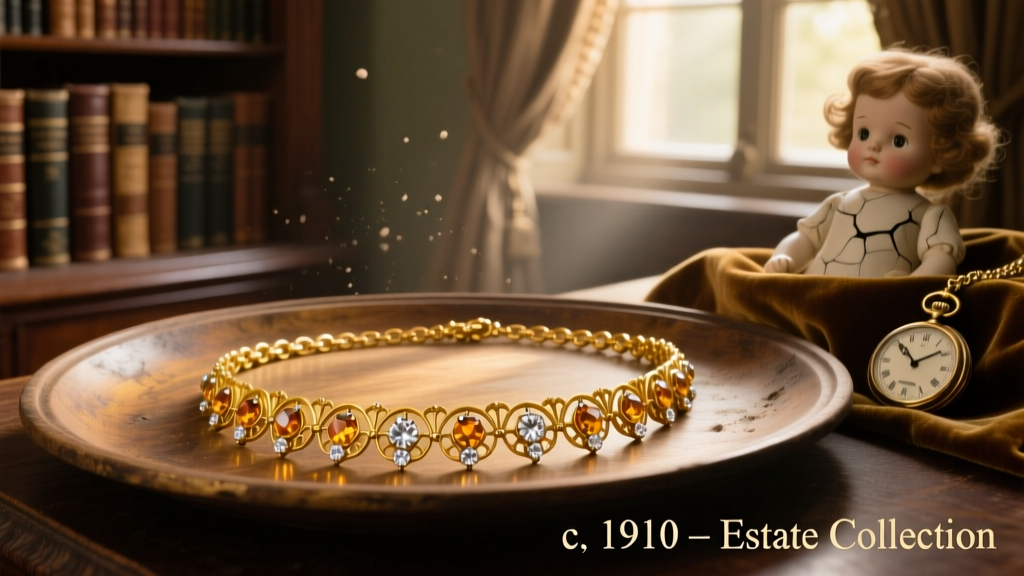
A 1910 Edwardian Masterpiece: Graduated Diamond Choker in 14K Yellow Gold — Technical Appraisal & Historical Context