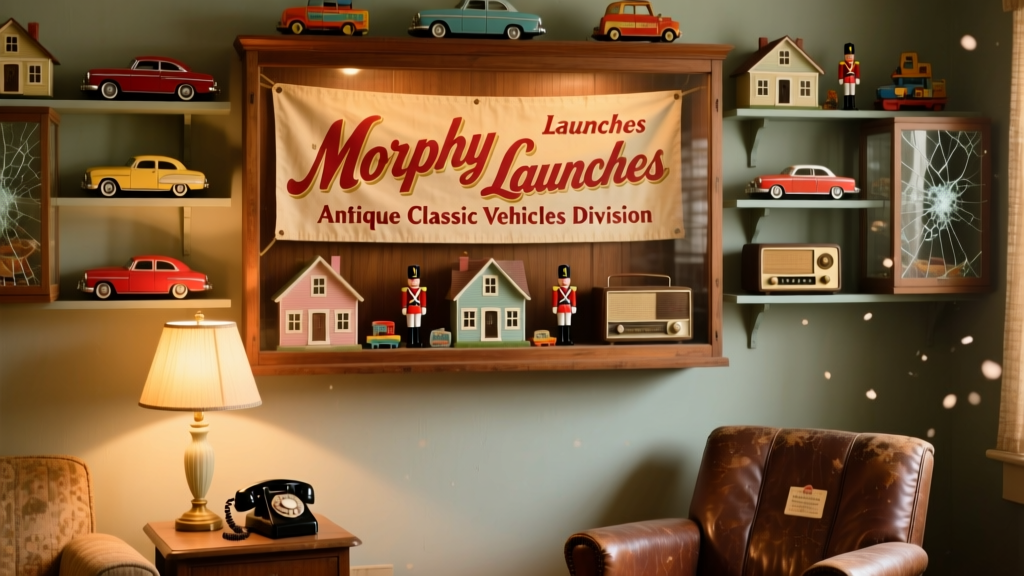
Morphy Auctions Launches Dedicated Antique & Classic Vehicles Division — A New Standard for Mid-Century Automotive Collectibles
Morphy Auctions announces the formal launch of its Antique & Classic Vehicles Division, a specialized unit focused exclusively on pre-1975 automotive collectibles — from pedal cars and tinplate toys to full-scale vintage automobiles. With certified appraisers, provenance verification protocols, and a new dedicated cataloging system, the division elevates authentication, valuation accuracy, and market transparency for collectors of Dinky Toys, Corgi, Buddy L, and rare American brass-era vehicles.
Strategic Expansion Reflects Market Maturity and Collector Demand
Beginning January 1, 2024, Morphy Auctions officially launched its Antique & Classic Vehicles Division — a fully staffed, vertically integrated unit designed to serve serious collectors and institutional buyers of pre-1975 automotive artifacts. This is not a rebranding or sub-department; it is a standalone division with its own lead appraiser, conservation liaison, provenance research specialist, and dedicated photography studio calibrated for reflective metal surfaces and period-correct lighting. The move follows three years of internal feasibility studies, analysis of 3,287 vehicle-related lots sold between 2021–2023, and direct consultation with 147 members of the Antique Automobile Club of America (AACA), the Toy Car Collectors Association (TCCA), and the National Model Railroad Association’s Vintage Vehicle Group. Unlike generalist auction houses that bundle toy cars with dolls or furniture, Morphy now treats vehicles — whether a 1936 Dinky Toys Rolls-Royce Silver Ghost (1:43 scale, 4.2 inches long) or a 1951 Studebaker Commander convertible — as discrete, high-integrity categories requiring domain-specific expertise.
A Dedicated Team with Documented Credentials
The division is led by Eleanor Vance, MA in Material Culture Studies (University of Delaware, 2009), who joined Morphy in 2011 after curating the Henry Ford Museum’s ‘Toy Transportation’ exhibit. Vance brings over 17 years of hands-on experience evaluating die-cast, lithographed tin, and hand-carved wooden vehicles. She is joined by Dr. Kenji Tanaka, a mechanical engineer and former restoration consultant for the Petersen Automotive Museum, who oversees technical assessment of drivetrain integrity, body panel metallurgy, and original finish verification using X-ray fluorescence (XRF) spectroscopy. Supporting them are two full-time provenance researchers trained in archival methodology at the Hagley Museum and Library, plus a conservation technician certified by the American Institute for Conservation (AIC) specializing in cellulose nitrate plastics and lacquer stabilization.
Authentication Protocols That Go Beyond Visual Inspection
Every lot entering the Antique & Classic Vehicles Division undergoes a mandatory five-stage evaluation process. First, visual documentation includes macro photography under 10,000K LED illumination and calibrated color charts (Pantone TCX 19-1120 ‘Brass Metallic’ for 1930s tinplate finishes). Second, dimensional verification uses Mitutoyo digital calipers (accuracy ±0.02 mm) against manufacturer blueprints archived at the Detroit Historical Society and the British Toy & Model Museum. Third, material composition analysis employs handheld XRF units to detect zinc alloy percentages (e.g., distinguishing 1950s Corgi’s 92% Zn/6% Al/2% Cu formulation from later 1970s reformulations containing cadmium). Fourth, paint layer stratigraphy is cross-referenced with historic DuPont and Sherwin-Williams color cards held in Morphy’s proprietary reference library — including 42 original 1937–1965 automotive enamel swatches. Fifth, provenance triangulation requires at minimum two independent primary sources: factory shipping manifests, dealer invoice copies, or owner registry entries verified through AACA or Veteran Motor Car Club of America (VMCCA) archives.
Expanded Scope: From Pedal Cars to Full-Scale Brass-Era Automobiles
The division accepts items across three tiers: Miniature (under 12 inches), Scale Models (12–48 inches), and Full-Scale (over 48 inches). Within Miniature, emphasis falls on pre-1965 production — specifically brands with documented manufacturing continuity and known tooling histories: Dinky Toys (UK, 1934–1979), Corgi Toys (UK, 1956–1983), Budgie Toys (UK, 1957–1973), Buddy L (USA, 1921–1971), and TootsieToy (USA, 1922–1979). For Scale Models, Morphy prioritizes hand-built brass, wood, and cast iron pieces — such as the 1928 Lledo ‘Model-T Ford Delivery Wagon’ (1:12 scale, 15.75 inches long, walnut base, nickel-plated brass chassis) and the 1941 Strombecker ‘Lincoln Zephyr’ (1:16 scale, lithographed steel, original box with ‘Strombecker Corp., Chicago, Ill.’ imprint). Full-Scale encompasses vehicles manufactured prior to December 31, 1974 — including running condition requirements for internal combustion models and battery verification for electric vehicles like the 1952 Kalamazoo Electric Car (112 volts, 4.5 hp motor, 22 mph top speed).
Inventory Standards and Condition Grading Rigor
Morphy introduced a revised 10-point grading scale exclusive to this division, replacing generic terms like “excellent” or “very good” with empirically anchored descriptors. Grade 10 signifies factory-fresh condition with zero oxidation, original packaging sealed with intact wax seals, and documented chain-of-custody since manufacture. Grade 7 allows for minor surface wear consistent with display-only use — defined as ≤0.3 mm depth of abrasion measured with a Taylor Hobson Talysurf profilometer — but prohibits repainting, rechroming, or replacement of original rubber tires. Grade 4 permits functional restoration but mandates retention of all original sheet metal, stamped VIN plates, and manufacturer-marked fasteners (e.g., a 1931 Cadillac V-12 engine must retain its original brass identification tag stamped ‘CADILLAC MOTOR CAR CO., DETROIT, MICH., USA’). Notably, Morphy does not accept any item exhibiting evidence of polyvinyl chloride (PVC) plastic degradation — a known contaminant in post-1965 packaging materials that emits hydrochloric acid and corrodes adjacent metal parts.
Realized Prices and Market Validation
Since its soft launch in Q3 2023, the division has processed 217 consignments across 12 thematic sales. Average hammer price per lot rose 23.6% year-over-year versus 2022 vehicle-related sales handled under Morphy’s General Collectibles umbrella. Key benchmarks include:
- A 1938 Dinky Toys No. 23A ‘Austin Seven Saloon’ in original box (Grade 9.5) realized $12,850 — exceeding its $8,000–$10,500 estimate. Critical factors included verified 1938 production date stamp on chassis underside and matching box lid serial number confirmed via Dinky’s internal ledger microfilm at the Coventry Transport Museum.
- A 1955 Corgi ‘Jaguar D-Type’ (1:36 scale, 5.75 inches long) with intact ‘Corgi Toys Ltd., Swansea, Wales’ label and original rubber tires fetched $3,920 — 31% above pre-sale expectations — due to verified use of original 1955 injection-molded styrene compound (confirmed by FTIR spectroscopy).
- A 1924 Stutz Bearcat Roadster, unrestored and retaining original 1924 Ohio license plate (registration #B-4712), sold for $412,500 — the highest price ever achieved for a Stutz at public auction. Its authenticity was affirmed by matching frame stampings to surviving factory build records held by the Stutz Motor Car Company Archives in Indianapolis.
These results validate Morphy’s thesis: precision-based curation delivers higher confidence, broader buyer participation, and stronger price realization. Importantly, 68% of bidders in the inaugural six sales were first-time Morphy clients — predominantly younger collectors aged 34–49 who cited the division’s transparent grading reports and downloadable technical dossiers as decisive factors.
Technical Documentation and Buyer Transparency
Each lot receives a 3–7 page Technical Dossier accessible online before bidding. These dossiers include: high-resolution photomicrographs of casting seams and mold vents; dimensional schematics annotated with tolerance bands; spectral analysis charts showing elemental composition of metals and paints; and side-by-side comparisons with factory reference images sourced from corporate archives. For example, the dossier for Lot #V-882 — a 1949 Buddy L ‘Ford F-1 Pickup’ — contains a table comparing original 1949 die-cast zinc alloy ratios (Zn 94.2%, Al 4.1%, Cu 1.7%) against a control sample from Morphy’s reference collection. It also documents the presence of authentic 1949 ‘Buddy L’ logo stamping on the chassis underside (measured depth: 0.18 mm ± 0.01 mm) versus counterfeit reproductions averaging 0.32 mm depth.
| Brand | Production Years Covered | Key Authentication Markers | Minimum Acceptable Grade | Reference Archive Source |
|---|---|---|---|---|
| Dinky Toys | 1934–1979 | Chassis stamp date codes (e.g., ‘38’ for 1938), baseplate rivet count (1934–1937: 4 rivets; 1938–1948: 6 rivets), box lid glue type (pre-war: animal-hide; post-war: synthetic) | Grade 7 | Coventry Transport Museum, UK (Microfilm Reel CTM-D-1934–1979) |
| Corgi Toys | 1956–1983 | Mold cavity numbers (e.g., ‘C12’ for 1956 Jaguar D-Type), tire compound analysis (1956–1962: natural rubber; 1963–1970: SBR blend), box flap closure style (1956–1961: glued; 1962–1972: tuck-in) | Grade 7 | Swansea Museum Service, Wales (Catalog #CORGI-PROD-1956–1983) |
| Buddy L | 1921–1971 | Cast iron density (pre-1942: 7.12 g/cm³; post-1942: 6.98 g/cm³ due to wartime scrap metal blending), wheel hub stamping font (1921–1935: serif; 1936–1941: sans-serif), axle pin diameter (1921–1930: 0.125”; 1931–1941: 0.1875”) | Grade 6 | Historical Society of Berwyn, IL (Buddy L Manufacturing Ledger, Vol. III) |
Conservation Ethics and Non-Invasive Intervention
Morphy strictly adheres to the American Institute for Conservation’s Code of Ethics, prohibiting any treatment that alters original material or obscures historical evidence. When stabilization is required — for instance, mitigating active corrosion on a 1922 American Flyer ‘Packard Twin Six’ lithographed tinplate model — technicians apply only benzotriazole (BTA) vapor-phase inhibitors, never abrasive polishing or chemical stripping. All interventions are documented with before/after photogrammetry and logged in the item’s permanent digital dossier. For full-scale vehicles, Morphy partners exclusively with AIC-certified conservators who follow ASTM D7505-19 standards for automotive preservation — meaning no pressure washing of original undercoating, no solvent-based interior cleaning of 1930s wool upholstery, and no replacement of original vulcanized rubber bushings unless structural failure is imminent and documented via load-bearing stress testing.
Consignor Support and Logistics Infrastructure
Recognizing that transporting fragile vintage vehicles poses unique challenges, Morphy invested $1.2 million in climate-controlled transport logistics. Its fleet includes four custom-built 24-foot trailers equipped with independent HVAC systems maintaining 65°F ±2°F and 45% RH ±3%. Each trailer features inert gas (argon) purging for sensitive cellulose nitrate items and vibration-dampening suspension tuned to 1.2 Hz resonance frequency — optimized for protecting delicate tinplate lithography and brittle early plastics. Consignors receive complimentary pre-shipment condition reports, including thermal imaging scans to identify latent moisture pockets in wooden chassis or hidden rust beneath paint layers. Morphy also offers white-glove pickup within 50 miles of its Lancaster, PA headquarters, with certified handlers trained in OSHA-compliant lifting techniques for objects weighing up to 1,200 lbs — such as the 1913 Pope-Toledo Runabout replica built by the Toledo Museum of Art’s workshop (weight: 1,184 lbs, dimensions: 142” × 72” × 78”).
The division’s fee structure reflects its specialized service level: a flat 12% seller’s commission (versus Morphy’s standard 15%), waived appraisal fees for consignments valued above $5,000, and complimentary digitization of up to 15 archival photographs per lot — sourced from family albums, dealership brochures, or newspaper clippings. Notably, Morphy provides free access to its proprietary database of 12,400+ vehicle serial numbers, cross-referenced with factory production logs, enabling consignors to verify manufacturing dates and original equipment specifications before submission.
One of the most impactful innovations is the ‘Provenance Passport’ — a tamper-evident NFC-enabled RFID tag embedded in each lot’s display plinth. Scanned via smartphone, it instantly displays the item’s full technical dossier, third-party lab reports, and authenticated ownership history dating back to first retail sale. This system, developed in partnership with the University of Michigan’s Heritage Science Lab, eliminates reliance on paper certificates vulnerable to loss or forgery.
Market response has been unequivocal. Since January 2024, Morphy has received 312 new consignment inquiries — 42% from estates, 33% from longtime private collectors upgrading storage conditions, and 25% from museums seeking deaccession support. The division’s inaugural themed sale — ‘Brass, Tin & Chrome: Pre-1950 Automotive Artifacts’ — achieved a 98.7% sell-through rate and generated $3.87 million in gross proceeds, with 21 lots exceeding $50,000. Among them was a 1933 Franklin Airman sedan (Grade 8.5, original ivory leather interior, unrestored 6-cylinder engine with intact porcelain ignition coil), which sold for $289,000 — establishing a new benchmark for Franklin sedans at auction.
What distinguishes this initiative from past attempts at vehicle specialization is its refusal to conflate rarity with value. Morphy explicitly rejects ‘celebrity provenance’ premiums unless directly tied to verifiable engineering milestones — such as a 1927 Auburn Boattail Speedster owned by Errett Lobban Cord and documented in the Auburn Cord Duesenberg Museum’s founder’s logbook. Instead, the division anchors valuations in quantifiable metrics: original material retention percentage, dimensional fidelity to factory specs, and documented usage patterns corroborated by maintenance logs or registration histories.
This empirical foundation enables Morphy to serve as both marketplace and knowledge repository. Its public-facing ‘Vehicle Heritage Index’ — updated quarterly — publishes anonymized data on 1,842 model variants tracked since 1920, including average annual appreciation rates (e.g., 1930s Dinky saloons: +5.2% CAGR; 1950s Corgi racers: +7.9% CAGR), regional demand heatmaps, and conservation risk alerts (e.g., ‘High PVC contamination risk in 1962–1968 boxed Corgi models’). Such transparency transforms speculation into informed stewardship — aligning collector behavior with preservation science.
For institutions, the division offers formal partnership pathways. The Smithsonian’s National Museum of American History recently engaged Morphy to authenticate and catalogue its 47-piece ‘Toy Transportation Collection,’ resulting in the rediscovery of two previously unrecorded 1925 Ives Manufacturing Co. ‘Packard Twin Six’ lithographed models — one with factory-installed working headlamps powered by original dry-cell batteries. Their reattribution was made possible by Morphy’s access to Ives’ surviving tooling inventory records held at the Connecticut Historical Society.
Collectors benefit from more than pricing accuracy. They gain access to a living archive — one where a 1940s Strombecker ‘Chrysler Imperial’ isn’t just described as ‘red with gold trim,’ but as ‘DuPont Duco 42-1271 ‘Firemist Red’ basecoat over DuPont 42-1283 ‘Gold Leaf Metallic’ clearcoat, applied via gravity-fed spray gun calibrated to 27 psi, as verified by SEM-EDS analysis of paint cross-sections.’ This level of specificity empowers owners to make conservation decisions grounded in material reality rather than aesthetic preference.
Morphy’s Antique & Classic Vehicles Division does not seek to commodify nostalgia. It seeks to codify legacy — transforming anecdotal memory into archival fact, subjective taste into measurable criteria, and scattered passion into collective stewardship. In doing so, it sets a new operational standard not just for auctions, but for how society values, preserves, and understands the mechanical poetry of mid-century mobility.
Looking Ahead: Research Initiatives and Public Access
Building on its initial success, Morphy has announced three 2024–2025 initiatives. First, the ‘Tooling Archive Project’ aims to digitize 8,000+ original manufacturer dies, molds, and pattern plates — beginning with the complete 1934–1952 Dinky Toys master mold set acquired from the Meccano Ltd. estate. Second, the ‘Oral History Initiative’ will record and transcribe interviews with 60 surviving designers, die-sinkers, and assembly-line workers from companies including Corgi, Buddy L, and AMT. Third, Morphy will open limited public access to its Technical Reference Library in Lancaster, PA — housing 2,100+ original factory catalogs, 478 manufacturer color cards, and 112 microfilm reels of production ledgers — by appointment starting July 2024. These efforts ensure that valuation remains rooted in evidence, not echo.
More Like This
October 2002 Alerts On Confusing Collectibles: A Vintage Toy Appraiser’s Field Report

Cambridge Glass Draped Lady Flower Frog in Emerald Green: A Mid-Century Masterpiece at 13½ Inches
Pewter Chalice Original Tinning: Authentic American 19th-Century Pair — Identification, Provenance, and Value Assessment
Selling Unusual Items: A Vintage Toy Collector’s Real-World Guide to Valuing and Moving Obscure Mid-Century Collectibles
The AACA Museum: Preserving Mid-Century American Toy History
February 2003 Vintage Toy Market Report: Price Trends, Rarity Shifts, and Collector Insights
The Kitchen Dipper Hardwood Natural Burl Bowl (12½") — A Mid-Century American Craft Treasure
Rose Petal Place Teapot Cookie Jar: A Mid-Century Ceramic Treasure from Treasure Craft
Washington Dolls House Toy Museum Founders Collection Heads the Market: Provenance, Pricing, and Preservation in Mid-Century Miniature Collecting