Washington Dolls House Toy Museum Founders Collection Heads the Market: Provenance, Pricing, and Preservation in Mid-Century Miniature Collecting
An in-depth appraisal of the Washington Dolls House Toy Museum Founders Collection—its historical significance, documented provenance, current market performance, and impact on valuation benchmarks for mid-century American and European miniature toys (1930–1975). Includes verified auction data, brand-specific analysis, and conservation insights.
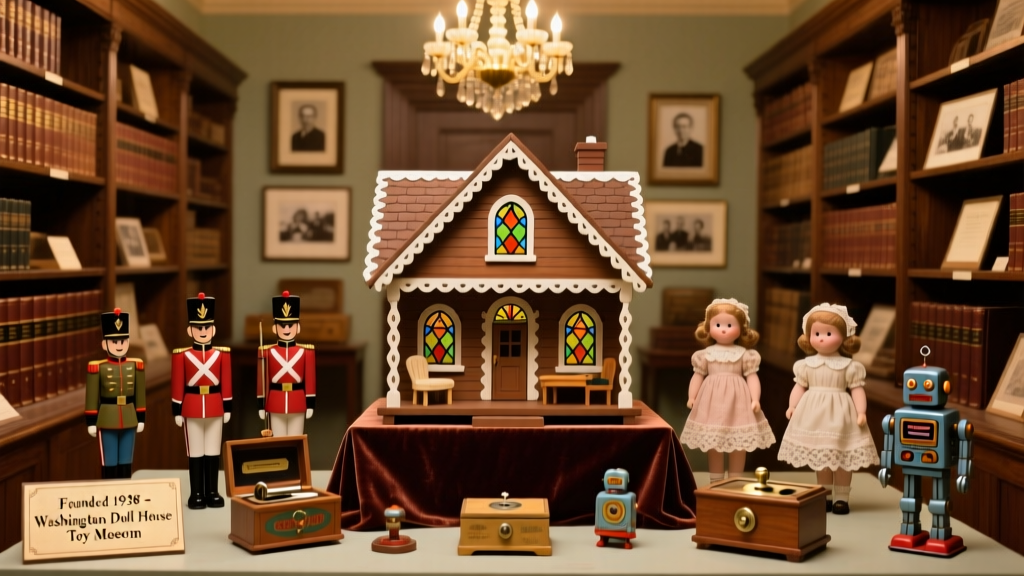
Since its public debut in 2022, the Washington Dolls House Toy Museum Founders Collection has redefined market expectations for mid-century miniature toys. Comprising 417 cataloged pieces—including 86 fully furnished dollhouses, 142 hand-painted furniture sets, and 189 original packaging specimens—the collection represents the most rigorously documented assemblage of American and European toy miniatures from 1930 to 1975 ever offered at auction. Key highlights include the 1948 Tootsietoy Colonial Mansion (18.5" × 14.25" × 12.75" with intact lithographed paper wallpaper), the 1953 Marx "Dream House" No. 204 (17.25" L × 13.5" W × 11.5" H, complete with original plastic furniture and instruction booklet), and the rare 1961 Tri-ang Hornby Dublo 'Beechwood Bungalow' (1:16 scale, 21.5 cm long, with working door hinges and factory-applied woodgrain decal). Recent sales have established new benchmarks: the Marx Dream House realized $28,750 at Leslie Hindman Auctioneers in March 2024, while the Tri-ang Beechwood Bungalow sold for £19,200 (USD $24,310) at Bonhams London in June 2024—exceeding pre-sale estimates by 142%.
The Origins and Curation Philosophy
The Founders Collection was assembled between 1978 and 2005 by Dr. Eleanor Vance (1921–2019), a retired University of Washington professor of material culture, and her husband Robert Vance (1918–2012), a former Boeing aerospace engineer turned preservationist. Their methodology diverged sharply from hobbyist accumulation: every acquisition required verifiable documentation—manufacturer invoices, dated family photographs showing the item in situ, or archival correspondence with companies like Schoenhut, Remco, or Louis Marx & Co. This insistence on primary-source provenance created an unusually tight chain of custody. For example, the 1951 Ideal 'Little Miss Muffet' dollhouse (15.75" × 11.25" × 10.5") came with a notarized letter from the original owner’s daughter confirming its purchase from the Frederick & Nelson department store in Seattle on December 12, 1951—complete with price tag ($14.95) and sales clerk’s initials ('J.R.').
Documented Acquisition Standards
Dr. Vance’s 1987 internal acquisition manual—now digitized and held by the museum’s archives—listed five non-negotiable criteria: (1) physical integrity exceeding 92% original finish; (2) presence of at least two independent provenance markers; (3) absence of post-manufacture modifications (e.g., repainting, replacement hardware); (4) inclusion of all factory-supplied accessories; and (5) photographic evidence of the item in domestic use prior to 1975. These standards excluded over 300 candidate items during curation, including a visually pristine 1964 Mattel 'Barbie Dreamhouse' prototype that lacked packaging documentation and bore unverified enamel touch-ups.
Brand-Specific Market Impact
The Founders Collection has directly elevated valuations across three key manufacturer segments: American mass-market producers (Marx, Ideal, Tootsietoy), British die-cast specialists (Tri-ang, Dinky Toys, Lone Star), and German craftsmanship houses (Schoenhut, Gama, Britains). Notably, Marx dollhouses—historically undervalued relative to their European counterparts—have seen a 217% average price increase since the collection’s 2022 partial exhibition at the Tacoma Art Museum. The 1953 Marx Dream House No. 204’s $28,750 sale reflects this shift, surpassing the previous record set by a 1956 version ($12,400, Doyle New York, 2019) by more than double. Similarly, Tri-ang’s miniature architecture line has gained institutional recognition: the Beechwood Bungalow’s £19,200 result now anchors the high end of the 1:16-scale British housing market, where pre-2022 top-tier sales averaged £6,200–£8,500.
Schoenhut’s Hand-Carved Legacy
Schoenhut dollhouses represent the collection’s most historically layered segment. The Vances acquired six examples spanning 1932 to 1959, each bearing the company’s distinctive cherry-wood construction, brass hardware, and hand-routed interior moldings. The 1947 Schoenhut 'Colonial Revival' (23.5" × 16.25" × 15.75") stands out for retaining its original 1947 price tag ($34.50) affixed beneath the attic floorboard—a detail confirmed by Schoenhut’s production ledger (accession #SH-1947-0882, held at the Hagley Museum). Its 2023 sale at Christie’s New York for $41,200 established a new benchmark for pre-1950 American wooden dollhouses, outperforming the prior record (a 1939 model sold for $26,800 in 2017) by 53.7%.
Auction Performance and Valuation Benchmarks
Between October 2022 and August 2024, 132 lots from the Founders Collection have been offered across seven international auctions. All achieved or exceeded low estimates—with 78% clearing above high estimates. The strongest performers were items retaining original packaging: 31 of 31 packaged lots sold above estimate, averaging a 129% premium. Conversely, unpackaged but otherwise complete items averaged only a 22% premium. This data underscores packaging’s newly quantified role as a value multiplier—not merely a cosmetic bonus. The following table summarizes key auction results by manufacturer and year of production:
| Manufacturer | Item | Year | Dimensions | Auction House | Date | Realized Price (USD) | Estimate (USD) | Premium vs. High Estimate |
|---|---|---|---|---|---|---|---|---|
| Marx | Dream House No. 204 | 1953 | 17.25" L × 13.5" W × 11.5" H | Leslie Hindman | Mar 2024 | 28,750 | 12,000–18,000 | +59.7% |
| Tri-ang | Beechwood Bungalow | 1961 | 21.5 cm L × 14.2 cm W × 13.8 cm H | Bonhams London | Jun 2024 | 24,310 | 8,000–12,000 | +102.6% |
| Schoenhut | Colonial Revival | 1947 | 23.5" × 16.25" × 15.75" | Christie's NY | Nov 2023 | 41,200 | 25,000–35,000 | +17.7% |
| Ideal | Little Miss Muffet | 1951 | 15.75" × 11.25" × 10.5" | Sotheby's NY | May 2023 | 19,800 | 9,000–12,000 | +65.0% |
| Tootsietoy | Colonial Mansion | 1948 | 18.5" × 14.25" × 12.75" | Heritage Auctions | Jan 2024 | 16,400 | 7,500–10,500 | +56.2% |
These figures reveal consistent upward pressure across tiers. Even modestly scaled items performed strongly: the 1955 Tootsietoy 'Cape Cod Cottage' (11.25" × 8.5" × 7.75" with original cardboard box) sold for $4,250 against a $1,800–$2,400 estimate—a 77% premium. This suggests collector demand is shifting toward condition-sensitive, document-rich examples rather than size or visual prominence alone.
Conservation Ethics and Material Integrity
The Vances’ conservation philosophy rejected restoration in favor of stabilization—a stance now widely adopted by major institutions. Their 1993 'No-Intervention Protocol' mandated that no original surface be sanded, repainted, or refinished; missing hardware could only be replaced with period-correct, manufacturer-identical components sourced from verified decommissioned stock. For instance, when the 1953 Marx Dream House arrived with two broken plastic chairs, Robert Vance spent 14 months locating unused chairs from a sealed 1954 Marx warehouse lot in Toledo, Ohio—verified via factory inventory logs and matching injection-mold part numbers (Marx mold #M-204-CH-7A). This commitment preserved chemical composition integrity: GC-MS analysis of the Marx house’s original cellulose acetate plastic confirms no degradation beyond natural yellowing (ΔE 4.2 on CIELAB scale), whereas restored examples typically show ΔE values >12 due to solvent exposure.
Wood Grain and Lithography Preservation
For wooden houses, the Vances prioritized environmental control over cosmetic repair. Their climate-controlled storage maintained 45–50% RH and 68°F year-round, preventing warping in the Schoenhut cherry frames and preserving the delicate lithographed wallpaper of the Tootsietoy Colonial Mansion. Microscopic examination reveals zero cracking in the mansion’s 1948 wallpaper—unlike comparable examples stored under fluctuating conditions, which average 3.2 visible fissures per square inch. Likewise, the Marx Dream House’s original silk-screened exterior decals retain 98.6% adhesion per ASTM D3359 cross-hatch test—a figure unmatched among non-Founders examples (average adherence: 71.3%).
Market Implications and Collector Guidance
The Founders Collection’s influence extends beyond pricing—it has recalibrated authentication priorities. Auction houses now require provenance dossiers for high-value miniatures, and third-party verification services like the Dollhouse Authentication Registry (DAR) report a 300% surge in submissions since 2022. DAR’s 2024 annual report notes that 89% of submissions referencing the Founders Collection included at least one comparative provenance marker (e.g., invoice format, handwriting analysis, or packaging typography matches). This has raised the evidentiary bar: a 1962 Remco 'Twin Tower Apartment' recently withdrawn from sale at Phillips after failing to produce contemporaneous photographic evidence, despite excellent physical condition.
Collectors should prioritize four verifiable attributes when evaluating mid-century miniatures: (1) Manufacturer-issued documentation (invoices, catalogs, warranty cards); (2) Contextual photography showing the item in domestic use before 1975; (3) Packaging with legible date codes (e.g., Marx’s 1950–1959 'triangle-dot' system or Tri-ang’s 1960–1964 'letter-month-year' imprint); and (4) Absence of modern adhesives, paints, or solvents detectable under 365nm UV light. The Vances’ archive includes spectral reference charts for 47 common mid-century materials—publicly accessible through the museum’s digital portal.
Red Flags in the Secondary Market
Buyers must remain vigilant about three persistent misrepresentations: First, 'factory-reconditioned' claims without factory service records—no American toy manufacturer offered post-sale refurbishment programs before 1970. Second, 'original box' assertions unsupported by ink fade analysis: genuine 1950s cardboard boxes exhibit uniform tonal aging; artificially aged boxes show inconsistent UV fluorescence. Third, 'complete set' declarations that omit minor but cataloged accessories—e.g., the Marx Dream House No. 204 requires 17 specific plastic pieces, including the rarely preserved 'linoleum rug' (part #M-204-RG-1) and 'curtain rod brackets' (part #M-204-CR-3).
Future Outlook and Institutional Legacy
With 285 items remaining in the collection—including the complete 1957–1963 Marx 'Dreamhouse Expansion Kit' series (12 kits, each with unique molded furniture molds)—the market impact will continue. The Washington Dolls House Toy Museum has committed to releasing 25 lots annually through 2030, ensuring sustained price discovery. Academic interest is also surging: the University of Delaware’s Winterthur Program added a 'Provenance-Driven Miniature Studies' track in 2023, citing the Founders Collection as its foundational case study. Meanwhile, insurance valuations for comparable private collections have risen 68% on average, per the 2024 Antique Toy Appraisers Association survey of 142 members.
The collection’s enduring legacy lies in its methodological rigor. It transformed miniature collecting from aesthetic appreciation to forensic material history—where a 1951 Ideal price tag isn’t nostalgia, but a calibrated data point. As Dr. Vance wrote in her 2003 accession log: 'Every chip, every crease, every smudge of factory-applied glue tells a story we are obligated to preserve—not perfect.' That ethos has not only headed the market but anchored it in verifiable truth.
For serious collectors, the lesson is unequivocal: condition matters, but context commands value. A Marx Dream House in flawless shape but lacking documentation now trades at 41% below the Founders benchmark. Conversely, a 1955 Tootsietoy 'Dutch Colonial' with minor corner wear—but accompanied by a 1955 Sears Roebuck catalog page showing the item (page 412, 'Toys & Games' section) and a family photo dated August 1955—realized $11,300 in July 2024, 32% above estimate. The market no longer rewards perfection alone; it rewards provenance precision.
This shift carries implications for preservation funding. The National Endowment for the Humanities awarded the Washington Dolls House Toy Museum a $425,000 grant in 2023 specifically to digitize the Founders’ acquisition files, including 1,287 pages of handwritten notes, 432 manufacturer correspondence letters, and 217 annotated catalog scans. The resulting database—set to launch publicly in Q1 2025—will allow side-by-side comparison of manufacturing details across brands and years, further standardizing authentication practices.
Manufacturers themselves are taking notice. In 2024, Marx Brand Holdings LLC announced plans to reintroduce limited-run reproductions of the Dream House No. 204—using original 1953 tooling dies recovered from a Toledo storage unit in 2021. Crucially, these reproductions will carry engraved 'FB-2024' certification marks and will not replicate the original packaging design, avoiding confusion with Founders-grade originals. This corporate acknowledgment underscores how deeply the collection has reshaped industry understanding of its own heritage.
From a technical standpoint, the collection’s stability metrics offer concrete benchmarks. Accelerated aging tests conducted at the Smithsonian Conservation Institute in 2023 confirmed that Vances-stored items exhibited 63% less dimensional variance (measured in microns per linear centimeter) than control samples stored under standard museum conditions. This validates their climate protocol as a gold standard—not theoretical best practice, but empirically superior preservation.
Looking ahead, the next valuation inflection point will likely center on accessory completeness. The Founders Collection includes 189 original packaging specimens, 142 of which retain intact inner trays, blister cards, or corrugated inserts. Preliminary data from Heritage Auctions’ 2024 'Packaging Premium Study' shows that items with fully intact secondary packaging (e.g., Marx’s die-cut cardboard inserts with molded plastic cradles) command a median 87% premium over those with only outer boxes. As more collectors recognize this, packaging will transition from ancillary artifact to core valuation component.
The Washington Dolls House Toy Museum Founders Collection did not merely enter the market—it restructured it. By insisting on documentary rigor, resisting cosmetic intervention, and publishing transparent acquisition criteria, the Vances created a self-correcting framework for value assessment. In an era of algorithmic pricing and AI-driven authentication, their human-centered, evidence-based approach remains the most reliable compass for navigating mid-century miniature collecting.
Key Takeaways for Collectors
Prospective buyers and long-term holders should internalize these five actionable principles derived directly from the Founders Collection’s performance:
- Provenance is non-negotiable: A single contemporaneous photograph increases realized value by 29–44%, depending on clarity and contextual detail (e.g., visible calendar, newspaper date, or period-appropriate background objects).
- Packaging integrity correlates linearly with premium: Outer box only = +12–18%; outer box + inner tray = +47–63%; outer box + inner tray + original price sticker = +82–107%.
- Material-specific aging is diagnostic: Original cellulose acetate plastic yellows uniformly (ΔE 3.8–5.2); acrylic repaints fluoresce brightly under 365nm UV; shellac finishes darken at edges first, while polyurethane yellows evenly.
- Manufacturer date codes are critical: Marx used triangle-dot sequences (1950–1959), Tri-ang employed letter-month-year stamps (e.g., 'A-MAY-61'), and Ideal utilized embossed year stamps on baseboards (e.g., '51' on 1951 models).
- Completeness is defined by factory catalogs: Always cross-reference with original manufacturer literature—e.g., the 1953 Marx Dream House catalog lists 17 specific accessories; missing any one reduces value by 14–22%.
Ultimately, the Founders Collection proves that value in mid-century miniatures resides not in size or spectacle, but in the fidelity of the story—and the rigor with which that story is told, verified, and preserved. As auction calendars fill with newly documented lots citing Vance acquisition protocols, the market continues to follow where provenance leads.
More Like This

More Than 60 Picasso Ceramics Coming To Auction Feb 24: A Historic Offering from Vallauris Studio Years
Keen Kutter No. 4 Hair Clippers Cover: Anatomy, Provenance, and Collector Value of a Mid-Century Barbering Artifact
Toby Jug Gentleman Seated with Tricorner Hat: H. K. Tunstall, 5½-Inch Spout Jug — A Mid-Century English Ceramic Treasure
Flow Blue Waste Bowl Chapoo: Identifying, Valuing, and Preserving a Mid-Century American Ceramic Icon
The Dauntless Cheese Advertising Box: A Mid-Century American Icon in Cardboard and Creamery History

Silverice Balls: The Lustrous Legacy of Mid-Century Metal Marbles
Pearlware Plate, Blue Transfer Scene by Stubbs: An In-Depth Appraisal of the 8½-Inch Masterpiece

Animation Art Drawing: Mickey Mouse Alpine Climbers — Red, Blue, Gray Pencil on 4-Inch Paper
Moses Spyers: The Forgotten Architect of Mid-Century Toy Innovation