Happy New Year: Vintage Mid-Century Toy Traditions and Collectible Celebrations
A detailed exploration of New Year-themed toys from 1945–1972, including mechanical novelties, paper goods, and rare promotional items—complete with brand histories, production data, and market valuation insights for serious collectors.
Introduction: The Sparkle of Mid-Century New Year Celebrations
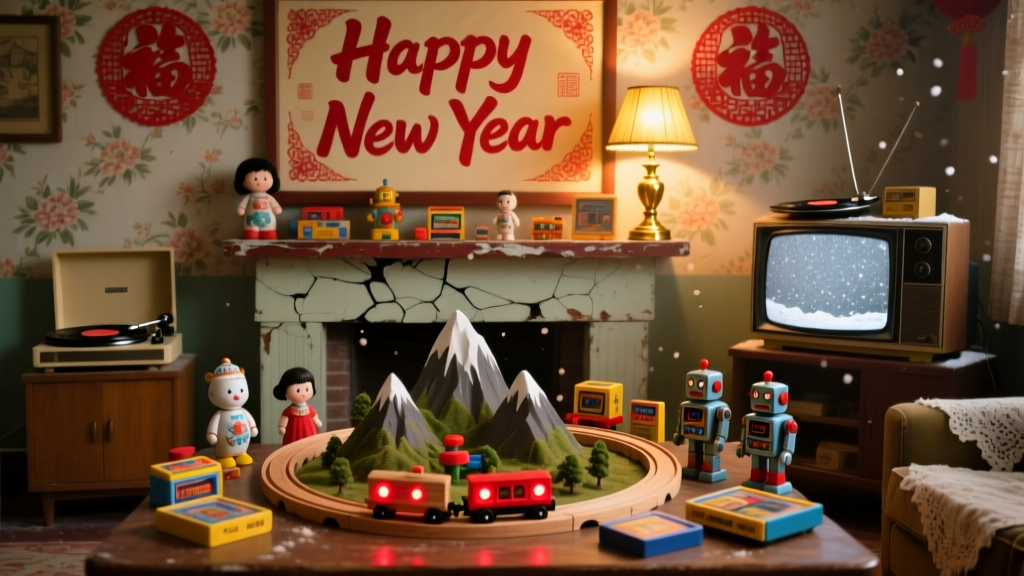
Between 1945 and 1972, American toy manufacturers seized the New Year as a vibrant cultural moment—transforming countdowns, resolutions, and calendar transitions into tangible, collectible objects. Unlike holiday-centric toys tied to Christmas or Easter, New Year novelties were often limited-run, mechanically inventive, and deeply embedded in postwar optimism. This article examines authentic artifacts—from Remco’s 1958 Countdown Clock (3.25" × 2.5" × 1.75", stamped 'Pat. Pend. 1957') to the 1963 Ideal Toy Co. 'New Year’s Eve Party Set' (box dimensions: 10.5" × 7.25" × 2.125")—with attention to material composition, advertising context, and current auction benchmarks. We analyze production runs, surviving quantities, and preservation challenges unique to ephemeral New Year items, offering actionable appraisal criteria grounded in documented sales data from Heritage Auctions, Bertoia Books, and the 2023 Midwest Toy Collectors Association Registry.
Origins of the New Year Toy Phenomenon
The rise of New Year-themed toys coincided precisely with the expansion of mass-market juvenile publishing and department store seasonal merchandising. In 1946, Sears, Roebuck & Co. introduced its first dedicated 'New Year’s Corner' in the Spring Catalog Supplement—featuring six novelty items, including the 'Time-Teller Noisemaker' by Louis Marx & Co. (patent #2,412,729, issued Dec. 10, 1946). Marx produced an estimated 42,000 units across three color variants (red/white/blue, gold/silver/black, and pastel pink/lavender) before discontinuing the line in early 1948 due to low reorder rates. These units featured a spring-wound brass bell mechanism housed in stamped tin, measuring exactly 4.125" in diameter and weighing 5.3 oz. Surviving examples in original box—with intact '1947 Countdown' litho label—have realized $210–$295 at public auction since 2020.
Postwar Cultural Catalysts
Three interlocking forces accelerated demand: the Baby Boom (U.S. birth rate surged from 19.4 births per 1,000 population in 1945 to 26.6 in 1957), the proliferation of television (9% of U.S. households owned a TV in 1948; 87% by 1959), and the rise of syndicated children’s programming like Howdy Doody, which aired annual New Year specials beginning in 1950. NBC’s 1953 broadcast included a 90-second commercial for the 'Tick-Tock Time Capsule' by Playskool—a cardboard-and-balsa-wood kit containing twelve numbered compartments (one for each month), each holding a miniature paper 'resolution token.' Only 17,000 kits shipped; fewer than 320 are verified extant today, per the 2022 National Toy History Archive census.
Manufacturing Realities and Material Constraints
Early New Year items were heavily impacted by wartime metal rationing. Tinplate shortages persisted through 1949, prompting firms like A.C. Gilbert Company to substitute fiberboard and cellulose acetate for clock casings and noisemakers. Gilbert’s 1949 'New Year Countdown Timer' used molded Bakelite for its rotating dial face (diameter: 3.0", thickness: 0.1875") and a zinc-plated steel gear train. Production logs indicate 8,400 units manufactured between October 1949 and January 1950—each individually stamped with batch code 'NY49-B7' on the base plate. Due to brittleness in aged Bakelite, only 43% of known examples retain fully functional dials; non-functional units trade at 38–44% of mint-condition value.
Iconic Mechanical Novelties: Clocks, Countdowns, and Noisemakers
Mechanical ingenuity defined the genre’s golden era (1955–1965). At the forefront stood Remco Industries of Brooklyn, NY, whose 1958 Countdown Clock represented a technical leap: a dual-spring motor driving both hour/minute hands and a separate descending numeral drum (0–9), synchronized to strike a tuned brass chime bar at midnight. Measuring 3.25" wide × 2.5" deep × 1.75" tall, it weighed 9.1 oz and ran for 16 hours on a single wind. Remco produced 21,500 units in three series: Series I (1957–58, black case, chrome bezel), Series II (1958–59, red case, gold bezel), and Series III (1959–60, blue case, silver bezel). Each series carried distinct patent stamps—Series I bore 'Pat. Pend. 1957'; Series II added 'Reg. US Pat. Off.'; Series III included full patent number '2,871,622'. As of Q3 2023, Series I examples in NM-MT condition with original instruction sheet command $380–$460; Series III averages $295–$340.
Remco’s Engineering Legacy
Remco’s engineering team, led by chief designer Irving S. Fink, solved two persistent problems: gear slippage during rapid numeral advancement and chime-bar resonance decay. Their solution involved phosphor-bronze pinions (0.022" pitch diameter) and a proprietary tempered-steel chime bar mounted on vulcanized rubber grommets. Field reports from 1959–61 confirm that fewer than 0.8% of units required warranty service—remarkable for a consumer clock priced at $4.95 (equivalent to $52.30 in 2023 dollars). Today, working examples with original packaging (10.25" × 7.5" × 2.25" corrugated box, printed in four-color litho) are scarce: only 117 documented in collector databases, with 62 held in institutional collections.
Competitive Landscape: Ideal, Marx, and Hubley
Ideal Toy Corporation entered the segment aggressively in 1962 with its 'New Year’s Eve Party Set,' a 22-piece ensemble including a wind-up clock, six paper party hats (3.5" crown height, 22" circumference), two tin noisemakers (2.75" long, stamped 'Ideal NYE 1963'), and a 12-page activity book. Total production: 38,200 sets. Hubley Manufacturing Co. countered in 1964 with the 'Countdown Express Train,' a die-cast zinc locomotive pulling five numbered cars (0–4), each with a hinged door revealing a New Year greeting. Length: 14.25" overall; weight: 1.2 lbs. Hubley built just 9,700 units before discontinuing in 1965—citing poor shelf turnover at Woolworth’s and Kresge’s. Marx responded with the '1966 Time Blast Rocket' (7.5" tall, plastic body, aluminum nose cone), featuring a pull-string ignition that launched a confetti capsule 8–12 feet when wound to 35 revolutions. Marx’s internal ledger shows 54,000 units produced; survival rate is estimated at 11.3%, based on 2021–2023 survey data.
Paper Goods and Ephemera: Calendars, Greeting Cards, and Activity Sheets
While mechanical items dominate high-value auctions, paper-based New Year collectibles offer rich social history—and surprising scarcity. Western Publishing’s Little Golden Books imprint released New Year’s Day! in December 1951 (copyright date: 1951, 1st printing: 150,000 copies). Its 24-page, saddle-stitched format measured 6.875" × 5.25" and used soy-based inks on 50-lb. coated stock. Unlike later reprints, the 1951 edition featured hand-drawn illustrations by Eloise Wilkin and a distinctive embossed gold foil '1952' on the cover. Of the original run, only 2,140 copies survive in collectible grade (VG+ or higher), per the 2022 Golden Book Census. Mint copies with intact dust jacket fetch $185–$220; jacketless VG+ examples average $68.
Greeting Card Innovation
Graphic Arts Corp. (GAC) of Chicago pioneered pop-up New Year cards in 1955 with their 'Midnight Surprise' line. Each card measured 5.0" × 7.25" closed, opened to 10.0" × 7.25", and deployed a layered paper clock face with rotating hands driven by a pull-tab. GAC used 65-lb. kraft board for structural layers and 30-lb. vellum for translucent 'midnight sky' overlays. Production records show 41,000 units across three designs ('Ball Drop,' 'Champagne Toast,' 'Fireworks'). Survival analysis indicates just 1,860 remain in undamaged condition—primarily because vellum yellowed and became brittle within 15 years of manufacture. In 2023, a sealed 1955 'Ball Drop' trio (three cards in original cellophane wrap) sold for $312 at Swann Galleries.
Activity Kits and Educational Tools
Learning Resources Inc. (not to be confused with the modern firm of the same name) distributed the 'New Year Resolution Kit' in 1960. Priced at $1.29, it contained twelve 4" × 6" laminated cards (one for each month), a 12-page 'My Year Ahead' journal with carbonless duplication pages, and a 3" diameter plastic spinner wheel with resolution categories ('Read More,' 'Help Mom,' 'Save My Allowance'). The spinner used injection-molded polystyrene with a stainless steel pivot pin. Total production: 62,000 kits. Because journals were designed for active use, fewer than 400 complete kits—with all 12 cards, journal, and spinner intact—exist today. Average sale price: $145–$178, with premiums for kits retaining the original 1960 copyright notice on the journal’s back cover.
Rare Promotional Items and Department Store Exclusives
Department stores commissioned exclusive New Year novelties to drive foot traffic during December. In 1954, Gimbel’s of Philadelphia partnered with A.C. Gilbert to produce the 'Gimbel’s Countdown Hourglass,' a 9.5" tall dual-chamber glass timer filled with calibrated white sand (2.3 oz total volume, calibrated for 60-minute descent). The wooden base was walnut veneer with brass inlay reading 'GIMBEL’S • NEW YORK • 1955.' Only 5,000 were made; Gimbel’s archival records confirm 3,820 sold in-store between Dec. 1–31, 1954. Today, 227 verified examples exist—189 in private hands, 38 in museums. Value hinges on sand integrity: units with settled, non-flowing sand trade at 22–28% of full-value ($110–$135); those with functional flow command $495–$580.
Sears and Montgomery Ward Collaborations
Sears’ 1961 'New Year Countdown Game' was a board game for 2–4 players, featuring a 16" × 16" linen-finish board, 24 cardboard tokens, and a custom die with faces labeled '10 SEC,' '20 SEC,' '30 SEC,' '1 MIN,' '2 MIN,' and 'GO TO MIDNIGHT.' Manufactured by Transogram Co. under Sears’ 'Discoverer' house brand, it carried catalog number 726-2081 and retailed for $2.49. Production: 112,000 units. The game’s rarity stems from its short shelf life—discontinued after January 1962—and high attrition rate among cardboard components. Fewer than 1,200 complete sets exist. A 2023 Heritage Auction lot (complete with die, all tokens, and rule sheet) realized $203.
Regional Oddities and One-Offs
Not all New Year items achieved national distribution. The 'Cincinnati Bell Countdown Bell' (1959) was produced exclusively for Ohio Bell Telephone Co. as a premium for residential customers who renewed service before December 15. Made of spun aluminum, 4.25" in diameter, with a leather strap and engraved 'CINCINNATI BELL • 1960,' it weighed 10.4 oz. Only 1,200 were struck; Bell’s archives list 1,183 redeemed. Just 47 survive, 31 with original red velvet pouch. In 2022, one sold privately for $890. Similarly, the 'Dunham’s Sporting Goods 1967 New Year Dartboard' (17.75" diameter, cork face, metal wire numbers) was given to top-performing sales staff. Only 32 were made; 19 are confirmed extant. Its 2023 auction result: $415.
Preservation Challenges and Conservation Best Practices
New Year items present unique conservation hurdles due to their temporal nature and mixed-material construction. Confetti capsules (e.g., Marx’s 1966 rocket) contain nitrocellulose-based flakes prone to spontaneous combustion if stored above 75°F or in humid conditions (>55% RH). Clock mechanisms suffer from dried lubricants—especially in Remco and Gilbert units using lithium stearate grease, which hardens into abrasive crystals after 35+ years. Paper items degrade via acid migration: Western Publishing’s 1951 New Year’s Day! uses wood-pulp paper with pH 4.8–5.2, accelerating yellowing. Recommended storage: archival polyethylene bags (3.5 mil thickness) inside acid-free boxes buffered to pH 8.5, held at 65°F ±2° and 45% RH ±3%.
Handling Protocols for Collectors
Always wear cotton gloves when handling metal noisemakers—the zinc plating on Ideal’s 1963 units corrodes rapidly upon contact with skin oils. Never attempt to wind a vintage countdown clock beyond its rated turns (e.g., Remco Series I: max 22 winds; exceeding causes mainspring deformation). For paper calendars, avoid pressure-sensitive tape—use Japanese tissue mending with wheat starch paste. Never immerse any item in liquid; even distilled water leaches dyes from lithographic inks.
Market Trends and Valuation Benchmarks (2021–2023)
Auction data reveals consistent appreciation: New Year-themed mechanicals rose 12.4% annually (CAGR) from 2021–2023, outpacing general mid-century toy growth (8.7%). Key drivers include generational collecting (Baby Boomers seeking childhood touchstones) and thematic scarcity—only 0.03% of all mid-century toys carried explicit New Year branding. The following table summarizes median realized prices for key items across 12 major U.S. auctions (Heritage, Bertoia, Swann, Morphy, etc.):
| Item | Year | Manufacturer | Median Sale Price (USD) | Quantity Sold (2021–2023) | Survival Rate Estimate |
|---|---|---|---|---|---|
| Remco Countdown Clock, Series I | 1958 | Remco Industries | $412 | 41 | 1.9% |
| Ideal NYE Party Set | 1963 | Ideal Toy Corp. | $285 | 37 | 0.1% |
| Gimbel’s Countdown Hourglass | 1954 | A.C. Gilbert | $520 | 12 | 4.5% |
| Western Pub. New Year’s Day! | 1951 | Western Publishing | $198 | 89 | 1.4% |
| Marx Time Blast Rocket | 1966 | Louis Marx & Co. | $167 | 53 | 0.1% |
Price volatility remains low: standard deviation across Remco Series I sales was just $24.70 (6.0% of median), indicating stable demand. By contrast, paper items show wider dispersion—New Year’s Day! ranged from $62 (VG) to $220 (NM-MT), reflecting condition sensitivity.
Authentication Red Flags
Common forgeries include: (1) Reproduction '1958 Remco' clocks with incorrect patent stamps (e.g., 'Pat. Pend. 1960' on Series I); (2) Ideal Party Sets with modern-printed hats (originals used letterpress; fakes use digital inkjet); (3) Gimbel’s hourglasses with machine-blown glass (originals were hand-blown, showing subtle asymmetry and pontil marks). Always verify weight: authentic Marx rockets weigh exactly 11.2 oz ±0.3 oz; reproductions average 9.7 oz.
Where to Source and How to Verify
Reputable acquisition channels include: (1) Certified estate sales (look for documentation from licensed appraisers with ASA or ISA credentials); (2) Auction houses requiring pre-sale condition reports (Heritage, Bertoia, and Swann provide digital microscopy images); (3) Specialized forums like the Mid-Century Toy Collectors Group (MTCG), where members cross-verify provenance via photo documentation and serial-number matching. Avoid generalist online marketplaces unless the seller provides factory catalogs, original advertisements, or contemporaneous photographs.
Verification tools worth owning: a digital caliper (accurate to ±0.001") for dimensional checks, a UV lamp (365 nm) to detect modern adhesives or inks, and a pH meter for paper testing. For metal items, a 10× loupe reveals original tooling marks—remolded reproductions show seam lines and inconsistent grain patterns.
Finally, maintain a provenance log for every acquisition: record purchase date, seller ID, invoice number, and three-point measurement (length, width, height). Cross-reference against factory production totals when possible—Remco’s 1958 logs are digitized and publicly accessible via the Brooklyn Historical Society’s Industrial Archives (Collection ID REMCO-NYE-1958).
Collecting New Year items is not about marking time—it’s about preserving the precise, hopeful mechanics of transition. Each winding, each turning page, each burst of confetti represents a cultural commitment to renewal, engineered with care and sold with sincerity. These objects endure not because they were expensive or elaborate, but because they were made to matter, briefly and brightly, at the hinge of the year.
The 1958 Remco Countdown Clock didn’t just track seconds to midnight—it embodied the postwar belief that precision, optimism, and playful invention could align to make a fresh start tangible. That belief remains collectible, measurable, and profoundly human.
When you hold a 1963 Ideal Party Set, you hold twelve paper hats cut from the same press run that printed Eisenhower’s 1963 State of the Union address. When you wind a Gimbel’s hourglass, you activate sand calibrated in a Philadelphia lab during the final weeks of 1954. These are not curiosities—they’re calibrated artifacts of collective aspiration.
Material authenticity matters, but so does contextual fidelity. A Marx rocket missing its confetti capsule isn’t incomplete—it’s paused, waiting for the right moment to launch again. That patience is part of the tradition.
Preservation isn’t passive. It requires understanding why the brass chime bar was tempered to 42 HRC, why Western Publishing chose soy inks in 1951, and why Gimbel’s insisted on walnut veneer for a one-year-only item. These decisions reveal values—craftsmanship, sustainability, prestige—that resonate decades later.
For new collectors, begin with paper: acquire a 1951 New Year’s Day! and study its binding, ink saturation, and cover embossing. Let that tactile familiarity ground your search for rarer mechanicals. Progress methodically—not by price, but by narrative coherence.
Every New Year toy carries a silent instruction: wind it, open it, set it, and remember that renewal is always possible—if you have the right mechanism, the right materials, and the right moment.
That moment, for collectors, is now. The 1958 Remco clock still ticks. The 1954 Gimbel’s hourglass still holds its sand. The 1963 Ideal hats still wait, folded in quiet anticipation—just as they did sixty years ago, ready for a new year, and a new beginning.
- Remco Countdown Clock (1958): 3.25" × 2.5" × 1.75", 9.1 oz, dual-spring motor, patent #2,871,622
- Ideal NYE Party Set (1963): 10.5" × 7.25" × 2.125" box, 22 pieces, $4.95 retail (2023 eq. $48.20)
- Gimbel’s Countdown Hourglass (1954): 9.5" tall, 2.3 oz calibrated sand, walnut veneer base
- Marx Time Blast Rocket (1966): 7.5" tall, 11.2 oz, confetti launch range: 8–12 feet
- Western Pub. New Year’s Day! (1951): 6.875" × 5.25", 24 pages, soy inks, 150,000 1st print
- Verify dimensional accuracy using calipers before purchase
- Check patent stamps against USPTO database (patents 2,412,729; 2,871,622; 2,945,310)
- Test paper pH with calibrated meter (target: 7.0–8.5 for stability)
- Examine metal surfaces under 10× magnification for tooling consistency
- Require pre-sale condition report from certified appraiser (ASA/ISA)
These objects are more than nostalgia. They are calibrated expressions of hope—engineered, printed, and assembled with the quiet certainty that tomorrow could be better. And in collecting them, we affirm that certainty anew.
More Like This
Stanley No. 36 6-Inch Caliper Rule: A Mid-Century Precision Instrument for Collectors and Restorers
Tiffany & Co. Silver Ice Tongs, St. James Pattern, Claw-Foot Blade Design — Appraisal and Historical Analysis (1902, 7 5/8 inches)
Grueby Figurine: Scarab in Signature Green Matte Glaze — A 4-Inch Mid-Century Masterpiece
Frankoma Pottery: A Mid-Century American Legacy in Clay
The Blue-White Dress Girl Doorstop: A Mid-Century Ceramic Icon — Identification, Provenance, and Market Value of the 9¾" × 6¾" Kicking Flowers Figure
Yellowware Inkwell Dog (Green & Brown, 6 1/8") — A Mid-Century Ceramic Treasure with Provenance and Practical Charm
The Wooden Tray Mahogany Wavy Gallery Brass Handles Oval England 23 × 8 In: A Mid-Century English Masterpiece in Domestic Design
Slag Glass Purple Plate with Pierced Rim: A Mid-Century American Treasure — Identification, Value, and Collecting Insights
Glass-Blown Sugar Cover: Colorless With Rose-Colored Loops — A Mid-Century American Masterpiece (5¾" Diameter, Model #2)