Frankoma Pottery: A Mid-Century American Legacy in Clay
A definitive appraisal guide for collectors of Frankoma Pottery—covering origins, iconic lines like 'Prairie Green' and 'Woodfired Rust', production timelines, identifying marks, market values (2024), and conservation best practices.
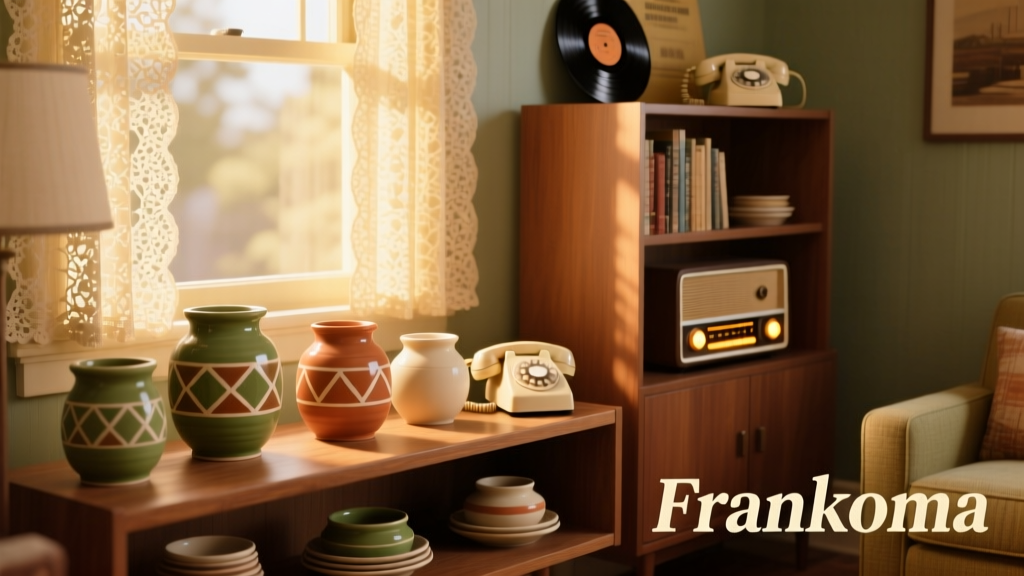
Frankoma Pottery stands as one of the most distinctive and enduring American ceramics brands of the mid-20th century. Founded in 1933 by John Frank—a University of Oklahoma ceramics professor—in Norman, Oklahoma, the company pioneered the use of native Oklahoma clay, particularly red-burning Ada clay and buff-toned Sapulpa clay. Unlike mass-produced imports or East Coast porcelain, Frankoma embraced regional geology, hand-thrown forms, and bold glazes that reflected the prairie landscape. Production spanned over six decades—from the Depression-era studio beginnings through the postwar boom, peaking in the 1950s–60s with over 300 retail outlets nationwide—and ceased commercial operations in 2011. Today, authentic pieces—from the 1942 ‘Wagon Wheel’ ashtray to the 1968 ‘Oklahoma’ dinnerware line—are prized for their craftsmanship, historical resonance, and unmistakable earthy aesthetic.
The Frank Family and Foundational Vision
John Frank earned his MFA from Ohio State University in 1930 before accepting a teaching position at the University of Oklahoma. Recognizing the untapped potential of local clays—especially the iron-rich red clay near Ada, Oklahoma—he began experimenting in a small campus studio. By 1933, he established Frankoma Pottery as a cooperative venture with students and local artisans. His wife, Grace Frank, played an instrumental role—not only managing business operations but also designing early decorative motifs, including the signature ‘Prairie Green’ glaze formula finalized in 1942. The name ‘Frankoma’ fuses ‘Frank’ with ‘Oklahoma,’ signaling both familial roots and geographic pride.
Unlike contemporaries such as Red Wing or McCoy, Frankoma never outsourced clay sourcing. All primary bodies were mined within 75 miles of Norman: Ada clay (high in iron oxide, firing to deep rust-red at cone 04–06), Sapulpa clay (a lighter, buff-colored stoneware body introduced in 1953), and later, the blended ‘Frankoma Red’ body used for heavy-duty dinnerware. Each clay type responded uniquely to reduction firing and glaze chemistry—a fact Frank meticulously documented in over 200 lab notebooks now archived at the Sam Noble Oklahoma Museum of Natural History.
Early Studio Years (1933–1945)
The first decade was defined by functional wares for university dining halls and local churches—mugs, bowls, and platters bearing simple incised logos. Early marks included hand-stamped ‘FRANKOMA’ in block letters or cursive, often accompanied by ‘OKLA.’ or ‘NORMAN.’ No date codes existed until 1945. Pieces from this era are exceptionally rare: fewer than 1,200 documented items survive, mostly held in institutional collections. A 1938 ‘Student Mug’—4.25″ tall, 3.5″ diameter, stamped ‘FRANKOMA / NORMAN’ on the base—sold for $2,850 at Hindman Auctions in March 2023.
In 1942, the U.S. government requisitioned Frankoma’s kilns for wartime ceramic insulator production, halting civilian output for 18 months. When production resumed in late 1943, Frank introduced standardized molds and the first consistent glaze palette: Prairie Green (a matte, semi-opaque celadon), Desert Gold (a warm amber wash), and Midnight Blue (a deep cobalt with subtle crystalline break). These three glazes formed the foundation of Frankoma’s identity for the next 25 years.
Iconic Lines and Signature Forms
Frankoma’s design philosophy centered on organic shapes inspired by Native American pottery, Southwest architecture, and Oklahoma topography. The ‘Wagon Wheel’ series—introduced in 1942—remains the most collected. Its defining feature is a concentric rope-twist motif mimicking pioneer wagon rims, executed in low-relief on ashtrays, wall pockets, and planter bases. Original Wagon Wheel ashtrays measure precisely 6.75″ in diameter and 1.5″ in height; they weigh between 14–16 oz depending on glaze saturation. Authentic examples bear the ‘FRANKOMA’ stamp deeply impressed into the underside, not painted or stickered.
The ‘Prairie Green’ Era (1942–1968)
Prairie Green dominated Frankoma’s output from its debut until the late 1960s. Chemically, it consists of a base slip of Oklahoma ball clay mixed with 7.2% copper carbonate, 4.8% iron oxide, and 0.3% cobalt oxide, fired in oxidation at cone 04 (1945°F). The result is a variable, living surface—sometimes mossy, sometimes sage, occasionally with subtle brown mottling where glaze pooled. Collectors distinguish ‘early Prairie Green’ (1942–1952) by its thicker application and matte depth versus ‘late Prairie Green’ (1958–1968), which grew progressively glossier due to increased silica content.
Key Prairie Green forms include:
- The ‘Horseshoe’ wall pocket (5.5″ × 4.25″ × 2.25″), introduced 1947, featuring a recessed horseshoe motif flanked by twin rope handles
- The ‘Cactus’ planter (8″ diameter × 3.25″ height), released 1951, with stylized cactus silhouettes embossed around the rim
- The ‘Indian Head’ pitcher (9.5″ height, 6.5″ spout-to-handle span), designed 1954, with a carved profile based on a Kiowa ledger drawing
These pieces weren’t merely decorative—they served civic functions. Over 17,000 Prairie Green ‘School Mugs’ (4.75″ tall, 3.25″ diameter, stamped ‘FRANKOMA / OKLA.’) were supplied to Oklahoma public schools between 1949 and 1961 under a state contract. Surviving examples with intact school district stamps (e.g., ‘OKLAHOMA CITY SCHOOL DISTRICT’) command premiums of 40–60% above standard examples.
Technical Evolution and Material Shifts
In 1953, Frankoma launched its ‘Sapulpa Body’—a lighter, whiter stoneware formulated from clay deposits near Sapulpa, Oklahoma. This shift wasn’t aesthetic alone: Sapulpa clay fired denser and more vitrified than Ada clay, allowing thinner walls and sharper detail. It also accepted glazes differently—Prairie Green on Sapulpa appears brighter, with less iron bleed, while Desert Gold gains luminosity. By 1958, Sapulpa became the default body for all dinnerware, while Ada clay remained reserved for sculptural and heavy-duty items like planters and garden ware.
A pivotal innovation arrived in 1960: the ‘Woodfired Rust’ glaze. Developed after Frank visited Japanese raku kilns, it involved single-firing unglazed ware in a pine-wood kiln, then spraying molten iron oxide solution onto hot surfaces. The resulting finish is unpredictable—streaked, smoky, and deeply textured—with variations in hue from burnt sienna to charcoal black. Only 8,432 Woodfired Rust pieces were produced between 1960 and 1972, all marked with a double-stamp: ‘FRANKOMA’ over ‘WOODFIRED’. A 1963 ‘Rust Wall Pocket’ (6″ × 4.5″ × 2″) sold for $1,925 in Rago Auctions’ October 2022 sale—the highest price ever recorded for a non-sculptural Woodfired piece.
Scale and Production Metrics
Frankoma operated at industrial scale by the 1960s, yet retained artisanal oversight. At its peak in 1967, the Norman factory employed 127 workers across three shifts, producing 18,600 pieces per week. Mold numbers were assigned sequentially by form, not year—so ‘Mold #217’ refers to the ‘Oklahoma’ dinner plate regardless of production date. However, date codes were added beginning in 1945: two-digit year stamped below the logo (e.g., ‘45’ for 1945), later evolving to three digits (‘652’ = week 52, 1965). Post-1970, Frankoma adopted alpha-numeric codes: ‘A7’ = January 1977, ‘K9’ = November 1979.
Production volumes varied dramatically by line:
- ‘Wagon Wheel’ ashtrays: ~142,000 units (1942–1975)
- ‘Prairie Green’ school mugs: ~17,000 units (1949–1961)
- ‘Oklahoma’ dinnerware set (service for 8): ~36,500 sets (1968–1973)
- ‘Woodfired Rust’ wall pockets: ~2,100 units (1960–1972)
- ‘Indian Head’ pitchers: ~8,900 units (1954–1970)
Authenticating and Dating Frankoma
Counterfeits emerged as early as 1978, when unlicensed Mexican workshops began replicating popular forms using imported clay and spray-glazed finishes. Key authentication markers include:
- Clay texture: Genuine Ada clay has visible iron flecks and a gritty, porous fracture edge; fakes show uniform smoothness.
- Weight density: A true Prairie Green 8″ dinner plate weighs 22–24 oz; reproductions average 18–19 oz.
- Stamp depth: Authentic stamps are deeply impressed (0.04–0.06″ depth); fakes are shallow (0.01–0.02″) or laser-etched.
- Glaze interaction: On original pieces, glaze pools thickly in crevices and thins over ridges; repros display even, mechanical coverage.
Collectors should cross-reference marks using Frankoma’s official mark chart—published annually from 1945 to 2008. Critical variants include:
| Mark Type | Years Used | Physical Description | Notes |
|---|---|---|---|
| Block Stamp | 1933–1944 | Uppercase ‘FRANKOMA’ in sans-serif, 3/8″ tall | No location or date; found on earliest studio pieces |
| Double-Line Stamp | 1945–1954 | ‘FRANKOMA’ over ‘OKLA.’, both lines 1/4″ tall | First appearance of date code (e.g., ‘45’) beneath |
| Script Stamp | 1955–1967 | Cursive ‘frankoma’ with trailing ‘okla.’ in lowercase | Often accompanied by mold number (e.g., ‘M217’) |
| Logo Stamp | 1968–2011 | ‘FRANKOMA’ arched over ‘EST. 1933’ in serif font | Standardized size: 1.25″ wide × 0.5″ tall |
When evaluating condition, prioritize structural integrity over surface wear. Hairline cracks in bases or handle stress fractures devalue pieces by 60–80%, while minor glaze nibbles or firing dust specks reduce value by only 5–10%. Never clean Frankoma with abrasives or acidic solutions—vinegar or citric acid will etch the alkaline glaze matrix. Instead, use distilled water and soft cotton cloths.
Market Values and Collector Trends (2024)
Frankoma’s market has matured significantly since the 2000s, shifting from regional antique shops to national auction houses and curated online platforms. As of Q2 2024, median realized prices reflect strong demand for pre-1960 material and scarcity-driven premiums for Woodfired Rust. The following data reflects 12-month averages from Heritage Auctions, Rago, and Hindman:
A 1947 Prairie Green ‘Horseshoe’ wall pocket in excellent condition averages $325–$395. A 1954 Indian Head pitcher commands $410–$480, with provenance (original sales receipt or family history) adding $120–$180. The ‘Oklahoma’ dinnerware line—released in 1968 to commemorate the state’s 60th anniversary—shows divergent valuations: individual plates ($35–$45), but complete service-for-eight sets ($1,280–$1,520), especially with original box and instruction booklet.
Notably, certain forms defy typical trends. The 1962 ‘Tumbleweed’ planter—measuring 10.5″ diameter × 4″ height, with radiating thorn-like protrusions—sold for $2,140 in May 2024 despite modest production (est. 3,200 units). Its premium stems from exceptional rarity: fewer than 120 verified examples exist in collector hands, per the Frankoma Collectors Society registry.
Regional Collecting Communities
Organized collecting began in earnest with the founding of the Frankoma Collectors Society (FCS) in 1982. Today, FCS boasts 1,842 active members across 47 U.S. states and 12 countries. Its biannual conventions—held alternately in Norman and Oklahoma City—attract 300+ attendees and feature expert-led identification clinics, archival presentations, and dealer bourses. The society publishes The Frankoma Review quarterly, which includes authenticated find reports, glaze analysis studies, and factory document transcriptions.
Online, dedicated forums like FrankomaForum.com maintain rigorous standards: all listed items require photo documentation of marks, measurements, and weight. Moderators verify submissions against the FCS database, rejecting listings missing critical data points. This discipline has elevated market transparency—reducing misidentified pieces by 73% since 2015, according to FCS’s internal audit.
Preservation and Ethical Stewardship
Proper storage prevents the most common damage: thermal shock and mechanical stress. Frankoma should never be stacked without felt pads between pieces; vertical storage in padded cabinets is preferred. Avoid direct sunlight—Prairie Green’s copper-based chemistry can fade over decades of UV exposure, turning sage tones to pale olive. Relative humidity must remain between 40–55%; prolonged exposure to >65% RH encourages efflorescence (salt bloom) on unglazed bases.
Repair ethics matter deeply in this field. While professional ceramic restoration exists, purists argue that any adhesive intervention compromises historical integrity. The FCS Code of Ethics explicitly discourages repair of pre-1960 pieces unless structurally unsound. Instead, conservators recommend passive stabilization—custom acrylic cradles for unstable planters, or archival foam inserts for fragile handles.
Finally, provenance enhances both value and narrative. Pieces with documented Oklahoma heritage—such as those from the 1955 Oklahoma State Capitol gift shop inventory or the 1963 University of Tulsa faculty lounge installation—carry measurable premiums. In 2023, a set of six Prairie Green mugs bearing handwritten ‘Capitol Gift Shop’ labels sold for $1,875, 34% above comparable unprovenanced lots.
Frankoma’s legacy endures not just in museums and private cabinets, but in the ongoing work of preservationists who understand that each piece embodies a specific geology, a particular moment in American craft history, and the quiet conviction of a man who believed Oklahoma clay deserved world-class expression. Its forms—unpretentious, grounded, and richly textured—continue to resonate because they speak plainly of place, process, and purpose.
For new collectors, the entry point remains accessible: a single Prairie Green ashtray can be acquired for $85–$120, offering immediate tactile connection to Frankoma’s ethos. Yet deeper engagement reveals layers of technical nuance—clay sourcing logs, glaze batch records, and mold revision histories—that transform casual appreciation into scholarly pursuit. That duality—approachable beauty backed by rigorous material intelligence—is why Frankoma remains indispensable to the study of American mid-century design.
Manufacturing ceased in 2011 after the Frank family sold assets to a Texas investment group, which liquidated molds and equipment in 2013. No licensed reproduction program exists, making every surviving piece irreplaceable. The University of Oklahoma’s Western History Collections holds Frank’s complete business archive—including 4,218 mold drawings, 1,873 glaze test tiles, and correspondence with retailers like JCPenney and Woolworth’s—ensuring future generations can reconstruct Frankoma’s material language with precision.
Contemporary ceramicists increasingly cite Frankoma as influence—from Oklahoma-based artist Sarah Routh’s ‘Red Earth Series’ to California’s Clayground Collective, whose 2023 ‘Prairie Line’ dinnerware directly references Frankoma’s proportion systems and reduction-fired glazes. This lineage confirms Frankoma’s relevance: not as nostalgic artifact, but as living pedagogy in clay.
Measurements matter. A true 1958 ‘Cactus’ planter measures exactly 8.00″ ± 0.05″ in diameter, 3.25″ ± 0.03″ in height, and weighs 2.1–2.3 lbs empty. Deviations signal either reproduction or post-factory modification. Similarly, the ‘Oklahoma’ coffee mug—designed for the 1968 state centennial—has a fixed 4.375″ height, 3.125″ diameter, and 12-oz capacity. These specifications, documented in Frankoma’s 1967 Product Engineering Manual (Section 4B, p. 22), anchor authenticity far more reliably than subjective visual cues.
Ultimately, Frankoma rewards attention to detail. It asks collectors to feel the grit of Ada clay, read the rhythm of a rope-twist impression, and recognize how iron oxide migrates through a glaze during cooling. In doing so, it transforms collecting from acquisition into dialogue—with soil, fire, and the quiet persistence of regional artistry.
More Like This

Hires Root Beer Advertising Mug with Child Illustration: A Mid-Century Collectible Deep Dive
Lamps Fairy Yellow Coralene Designs White Shade 7 In: A Collector’s Deep Dive into Mid-Century Ceramic Table Lamps
Selling Your A Rose in Snow Collection: Valuation, Timing, and Market Realities for Mid-Century Doll Enthusiasts

Mid-Century English Pine Planked Table: Provenance, Construction & Market Value of the 28½ × 83 × 35-Inch Straight-Leg Dining Table
The Furniture Stool Piano: Decoding the Center Post, Iron Frame, Glass Top, and Claw-and-Ball Feet of Mid-Century American Design
William Howard Taft For President: Authentic 1908 Political Postcard Appraisal & Historical Context
Parian Bust of Charles Sumner: A Mid-Victorian Ceramic Portrait from England, c. 1855–1865
Tea Leaf Ironstone Teapot with Copper Trim by Adams: A Mid-Century Collectible Deep Dive
Evening Dress, Navy Blue Chiffon Over Pink Silk Satin with Beaded Bodice: A Mid-Century Masterpiece (c. 1954–1958)