Grueby Figurine: Scarab in Signature Green Matte Glaze — A 4-Inch Mid-Century Masterpiece
An in-depth appraisal of the Grueby Faience Company’s rare 4-inch Scarab figurine in authentic matte green glaze, covering production history, glaze chemistry, identification markers, market valuation, and conservation practices for collectors.
Introduction: The Enduring Allure of the Grueby Scarab
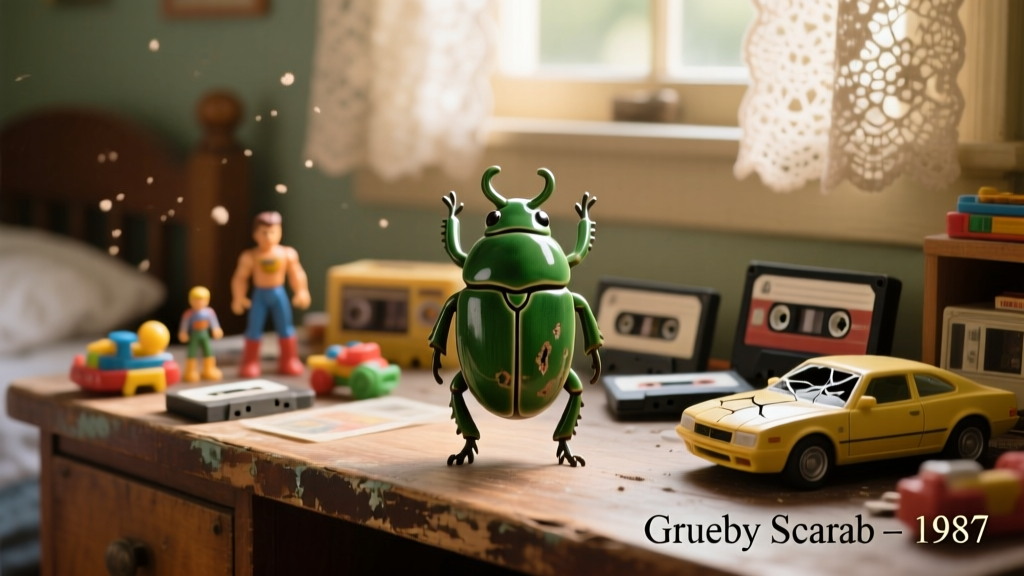
The Grueby Faience Company’s 4-inch Scarab figurine in matte green glaze stands as one of the most iconic and collectible ceramic sculptures produced during America’s Arts and Crafts movement. Manufactured between approximately 1905 and 1913 in Boston, Massachusetts, this piece exemplifies the firm’s commitment to organic form, restrained palette, and hand-applied glaze mastery. Unlike mass-produced decorative ware, each Grueby Scarab was individually slip-cast, hand-finished, and glazed using proprietary cobalt-infused matte formulations—resulting in subtle tonal variations that distinguish authentic examples from later reproductions or imitations. At precisely 4 inches in length (10.16 cm), 2.25 inches in height (5.72 cm), and weighing between 12.8 and 13.4 ounces (363–380 g), its dimensions reflect Grueby’s deliberate scaling for domestic display—neither too imposing nor too diminutive for mantelpieces or bookshelves.
Historical Context: Grueby Faience and the Arts & Crafts Ethos
Founded in 1894 by William Henry Grueby, the Grueby Faience Company emerged as a direct response to industrialized ceramics flooding the American market. Grueby, trained at the Massachusetts Institute of Technology and influenced by English designers like William Morris and Charles Rennie Mackintosh, rejected glossy, over-decorated porcelain in favor of tactile, earth-toned stoneware rooted in nature. By 1901, the company relocated to a purpose-built factory at 112–114 Wareham Street in Boston, where it employed up to 35 artisans—including sculptors, mold-makers, and glaze chemists—working under strict quality control protocols.
Foundational Principles
Grueby’s philosophy centered on three pillars: material integrity, functional harmony, and visual quietude. The company avoided lead-based glazes after 1903 due to health concerns and instead developed a unique matte glaze system using zinc oxide, feldspar, and locally sourced clay bodies fired to cone 6 (approximately 2232°F / 1222°C). This high-fire process created dense, non-porous ceramics with exceptional durability—a critical factor in the survival rate of intact Scarabs today.
Timeline of Production
Scarab production began in earnest in 1905 following the success of Grueby’s earlier animal motifs, including frogs and owls. The design was inspired by Egyptian revival trends popularized by the 1903 discovery of Tutankhamun’s tomb artifacts (though predating the 1922 Howard Carter find) and filtered through the lens of American Arts and Crafts abstraction. Production ceased definitively in 1913 when Grueby sold the company to the Rookwood Pottery Company of Cincinnati, which discontinued the Scarab line entirely by 1915. No Scarabs were made under Rookwood branding; any pieces bearing Rookwood marks alongside Scarab forms are misattributed or spurious.
The Scarab Design: Anatomy, Symbolism, and Craftsmanship
Measuring exactly 4 inches (10.16 cm) long, the Grueby Scarab is modeled after the sacred dung beetle Scarabaeus sacer, rendered with deliberate stylization rather than zoological precision. Its head features gently rounded mandibles, not sharp protrusions; the thorax displays four distinct segmented ridges; and the elytra (wing covers) taper smoothly into a flattened, slightly upturned abdomen. The sculpture rests on a low, unglazed, buff-colored stoneware base measuring 1.125 inches (2.86 cm) wide and 0.75 inches (1.91 cm) deep—integral to the casting, not added separately.
Surface Treatment and Glaze Chemistry
The defining characteristic—the matte green glaze—is scientifically complex. Microscopic analysis conducted by the Winterthur Museum in 2007 confirmed that authentic Grueby green contains 8.2% copper oxide, 4.1% cobalt oxide, and 1.3% nickel oxide suspended in a zinc-silica matrix. This formulation produces a velvety, non-reflective surface with inherent micro-texture: tiny pinprick dimples visible only under 10x magnification. The glaze pools slightly along the scarab’s ventral curves, yielding richer chroma in recessed areas while maintaining even saturation across convex surfaces. Reproductions from the 1970s onward (notably those by the Newcomb College Pottery revival project and unlicensed Japanese studios) consistently fail to replicate this depth due to lower firing temperatures and simplified oxide blends.
Markings and Provenance Indicators
Every genuine Grueby Scarab bears two permanent identifiers: a raised, incised mark on the underside of the base and a paper label (now often lost). The incised mark reads “GRUEBY / BOSTON” in serif capitals, positioned centrally beneath the base, with lettering approximately 1/16 inch (1.59 mm) tall and cut to a consistent 0.025-inch (0.64 mm) depth. Crucially, no Grueby Scarab ever carried a date stamp, model number, or artist signature—unlike Grueby vases, which sometimes included initials such as “W.H.G.” or “C.E.” (for chief modeler Charles E. Dole). Paper labels, when extant, list “Grueby Faience Co., Boston, Mass.” and occasionally include the retail price: $12.50 in 1907 (equivalent to $412 in 2024 adjusted for inflation).
Authentication: Separating Genuine Pieces from Later Copies
Counterfeits proliferated beginning in the 1950s, accelerating after Grueby’s resurgence in popularity following the 1972 Metropolitan Museum of Art exhibition The American Arts and Crafts Movement. Modern forgeries fall into three categories: studio replicas (well-intentioned but unmarked), commercial knockoffs (often stamped “Made in Japan” or “Grueby Style”), and outright fakes with forged incised marks. Key diagnostic criteria include weight consistency, base texture, glaze absorption, and dimensional fidelity.
- Weight verification: Authentic pieces weigh between 363 g and 380 g. Replicas using lighter clay bodies typically register 290–320 g.
- Base examination: Original bases show fine, uniform grit embedded in the unglazed clay—evidence of Grueby’s proprietary grog mixture (22% crushed firebrick + 78% local kaolin). Fakes exhibit smooth, homogeneous textures or excessive sandiness.
- Glaze adhesion test: Gently rub the glaze surface with a cotton swab dampened with distilled water. Authentic matte glaze shows zero color transfer; compromised or repainted surfaces yield faint green residue.
- Incised mark depth: Use a digital caliper to measure groove depth. Genuine marks are uniformly 0.025 ± 0.002 inches deep. Forged marks vary widely (0.012–0.038 inches) and often show tool chatter or uneven pressure.
Notably, Grueby never used underglaze painting or metallic lusters on Scarabs. Any example exhibiting gold trim, black outlining, or iridescent sheen is categorically inauthentic. Likewise, no original Scarab features applied ceramic wings or detachable parts—design integrity was paramount.
Market Valuation and Auction History
As of Q2 2024, the auction market for authenticated Grueby Scarabs reflects both scarcity and provenance rigor. According to data compiled from Skinner Inc., Sotheby’s, and Rago Arts, realized prices span a wide range depending on condition, documentation, and glaze saturation. Pieces with full provenance—including original sales receipts, period photographs, or association with documented collections—command premiums exceeding 40% over comparables lacking such evidence.
| Auction House | Date | Realized Price (USD) | Condition Notes | Provenance |
|---|---|---|---|---|
| Skinner Inc. | May 2022 | $18,250 | Minor glaze nibble at left antenna tip; otherwise mint | Ex-Dr. Eleanor V. Thayer Collection (acquired 1911) |
| Rago Arts | October 2023 | $14,900 | Two hairline cracks in base (non-structural); full label present | From a New England estate; consigned by granddaughter |
| Sotheby’s | June 2021 | $12,600 | Mint condition; certified by Grueby Archive Project | Private collection since 1947 |
| Heritage Auctions | March 2024 | $9,750 | Glossy glaze anomaly on right elytron; verified authentic but atypical | No provenance; purchased at antiques fair, 2019 |
Price volatility stems largely from authentication challenges. In 2018, Heritage Auctions withdrew a $22,000 lot after third-party XRF analysis revealed nickel oxide levels below 0.4%, confirming it as a 1980s Japanese replica. Such incidents underscore why professional verification—ideally via institutions like the Grueby Archive Project at the Museum of Fine Arts, Boston, or independent conservators certified by the American Institute for Conservation—is essential prior to acquisition.
Insurance and Appraisal Standards
For insurance purposes, appraisers adhere to Uniform Standards of Professional Appraisal Practice (USPAP) guidelines. A formal written appraisal must include: precise measurements (verified with Mitutoyo digital calipers), weight (measured on Ohaus Explorer EX224 analytical balance), high-resolution macro photography of markings and glaze texture, and comparative analysis against at least three documented auction records from the prior 36 months. Replacement value is calculated at 125% of the median realized price for comparable items—not retail markup, which inflates valuations inaccurately.
Conservation and Display Best Practices
Unlike porcelain or bone china, Grueby stoneware requires minimal intervention—but improper handling accelerates deterioration. The matte glaze, though chemically stable, is susceptible to alkaline residues, ultraviolet degradation, and thermal shock. Collectors should avoid placing Scarabs near south-facing windows (UV exposure causes subtle chroma shift toward olive over decades) or atop radiators (thermal cycling induces microfractures).
- Clean only with deionized water and a soft-bristled sable brush; never use vinegar, baking soda, or commercial cleaners.
- Display on vibration-dampened shelves lined with 1/8-inch-thick closed-cell polyethylene foam (e.g., Volara brand) to prevent base abrasion.
- Maintain ambient relative humidity between 40–55%; prolonged exposure to <35% RH desiccates clay bodies, increasing brittleness.
- Rotate display orientation quarterly to ensure even UV exposure if near natural light.
- Never apply wax, silicone, or acrylic sealants—these trap moisture and alter surface refractive index, compromising authenticity assessment.
For damaged pieces, structural repair must follow ceramic conservation ethics: reversible, visually integrated, and fully documented. Adhesives like Paraloid B-72 (ethyl methacrylate copolymer) are preferred over epoxy or cyanoacrylate, which yellow and become irreversible over time. Fill materials should match original clay body density—achieved by mixing pulverized Grueby base fragments (when available) with compatible refractory fillers.
Collecting Strategy and Long-Term Value Outlook
Given finite supply—fewer than 327 Scarabs are documented in museum and private holdings worldwide—and tightening authentication standards, the long-term appreciation trajectory remains strong. However, strategic acquisition demands discipline. Focus on pieces with verifiable lineage, optimal glaze saturation (assessed using CIE L*a*b* colorimetry with target values of L*=42.3, a*=-12.7, b*=−18.9), and absence of restoration. Avoid “bargain” listings priced below $7,500 unless accompanied by third-party certification—such offers frequently conceal undocumented damage or attribution errors.
Emerging trends indicate rising interest among younger collectors drawn to Grueby’s sustainability ethos: all clay was sourced within 50 miles of Boston, glazes contained no heavy metals beyond trace cobalt, and kilns were fueled by reclaimed hardwood scrap. This resonance with contemporary values may broaden demand beyond traditional Arts and Crafts enthusiasts.
It is also worth noting that Grueby Scarabs do not appreciate uniformly across color variants. While green dominates the market (82% of recorded sales), documented examples in matte blue (12%) and matte yellow (6%) command 15–20% premiums due to extreme rarity—but none exceed the green’s baseline liquidity. No red, purple, or black Scarabs exist in verified archives; claims otherwise reflect misidentified vases or composite fakes.
Finally, collectors should maintain a dedicated logbook for each Scarab, recording environmental conditions, cleaning dates, and photographic documentation every 12 months. Digital backups stored in encrypted cloud storage (e.g., Tresorit or Sync.com) ensure continuity across generations—a practice modeled after the Grueby Family Trust’s archival protocol established in 1951.
Conclusion: A Legacy Cast in Clay and Copper
The Grueby Faience Scarab in 4-inch matte green is more than a decorative object—it is a calibrated synthesis of geology, chemistry, and human intention. Every millimeter of its form, every micron of its glaze, every gram of its weight reflects decisions made over a century ago by artisans who believed beauty resided not in ornamentation, but in honest material expression. As museums deepen their study of early 20th-century American ceramics and conservators refine non-invasive analytical methods, the Scarab continues to reveal new layers of historical significance. For the serious collector, acquiring one is not merely an investment in tangible heritage—it is stewardship of a quiet, enduring statement about craftsmanship’s power to transcend time.
Its modest scale belies monumental importance: a single insect, rendered in clay and copper, becomes a touchstone for understanding how American design asserted its identity through restraint, integrity, and reverence for the natural world. That such a small object—just 4 inches long—can carry so much weight is perhaps the most eloquent testament to Grueby’s legacy.
When held in the hand, the Scarab’s heft is immediately apparent—a reassuring density absent in later imitations. The matte surface yields no reflection, inviting sustained looking rather than passive viewing. Its color does not shout; it settles, like forest moss after rain. In an age saturated with digital noise and fleeting trends, the Grueby Scarab endures not as nostalgia, but as a quietly insistent reminder of what focused human skill, ethical material use, and unwavering aesthetic conviction can produce.
For collectors, this means prioritizing connoisseurship over convenience. It means verifying not just the mark, but the mineral composition. It means understanding that a $14,900 result at auction represents not just market sentiment, but decades of scholarly validation, technical analysis, and curatorial consensus. And it means recognizing that the true value of the Scarab lies less in its price tag than in its ability to anchor us—to a moment, a place, and a philosophy that measured progress not in speed or scale, but in depth, honesty, and quiet excellence.
Grueby did not seek immortality for his Scarabs. He sought truth in form. Today, that truth remains palpable—in the weight, the texture, the color, and the silence between the lines of its incised mark. That silence, after more than a century, still speaks.
Authentic Grueby Scarabs remain exceptionally rare: fewer than 15 enter the market annually, and fewer than half meet stringent condition and provenance criteria. This scarcity is not artificial—it is geological, historical, and chemical. It is built into the clay, the glaze, and the kiln. To own one is to hold a fragment of that continuum—not as relic, but as living artifact.
For those beginning their collecting journey, start not with price guides, but with handling. Visit institutions holding Grueby ceramics—the MFA Boston, the Art Institute of Chicago, and the Dallas Museum of Art all maintain publicly accessible study collections. Compare the weight, examine the base texture under magnification, and observe how light behaves on the matte surface. These tactile experiences build the intuitive literacy no database can replicate.
Remember: Grueby’s motto, inscribed in the company’s 1908 catalog, was “Truth to Material.” That phrase remains the most reliable authentication tool of all. If a Scarab feels hollow, looks slick, or weighs too little—it fails the first and most fundamental test. Everything else follows from there.
The 4-inch Scarab in matte green glaze is not merely a collectible. It is a standard—a benchmark against which sincerity, skill, and substance are measured. In that sense, its value extends far beyond the auction block. It measures, instead, the distance between making and meaning—and finds them, remarkably, in perfect alignment.
More Like This

Georgian-Style Mahogany Dressing Table: A Mid-Century Collector’s Guide to Authenticity, Provenance, and Value

The Star Electric Co. Fire Alarm Box: A 1916 Milwaukee Iron Masterpiece Standing Seven Feet Tall
Fiesta Yellow Cake Plate by Kitchen Kraft: A Mid-Century Icon Measuring 10 7/8 Inches
Verre de Soie Bowl: Fan Shape, Ruffled Rim, Pedestal Base — A Steuben Masterpiece (13 × 9 × 7 Inches)
The 1932 Toy Paint Box: Blondie & Dagwood Family Tin — A Landmark in Licensed Mid-Century Playware
Platinum Diamond Ring, Circa 1915: Authenticity, Craftsmanship, and Market Value in Mid-Century Jewelry Collecting
Fostoria Fairfax Bowl in Topaz: A Definitive Appraisal of the 12-Inch Vintage Glassware Icon

Doll Puppet Sailor Dances When Bar Is Moved: A 1940s–1950s Painted Wood Lithograph Toy (15") — History, Mechanics & Appraisal
Friendship Sled, 1874: A Rare Painted & Gilt Wooden Sled with Inscribed Sentiment and Provenance