Goebel Cup & Saucer Santa Claus: A Collector’s Deep Dive into Mid-Century German Porcelain Holiday Tableware
A detailed appraisal and historical analysis of Goebel’s iconic 1950s–60s Cup & Saucer Santa Claus sets—featuring authentic production data, identification markers, market values, condition benchmarks, and rare variants.
Introduction: The Enduring Charm of Goebel’s Miniature Santa
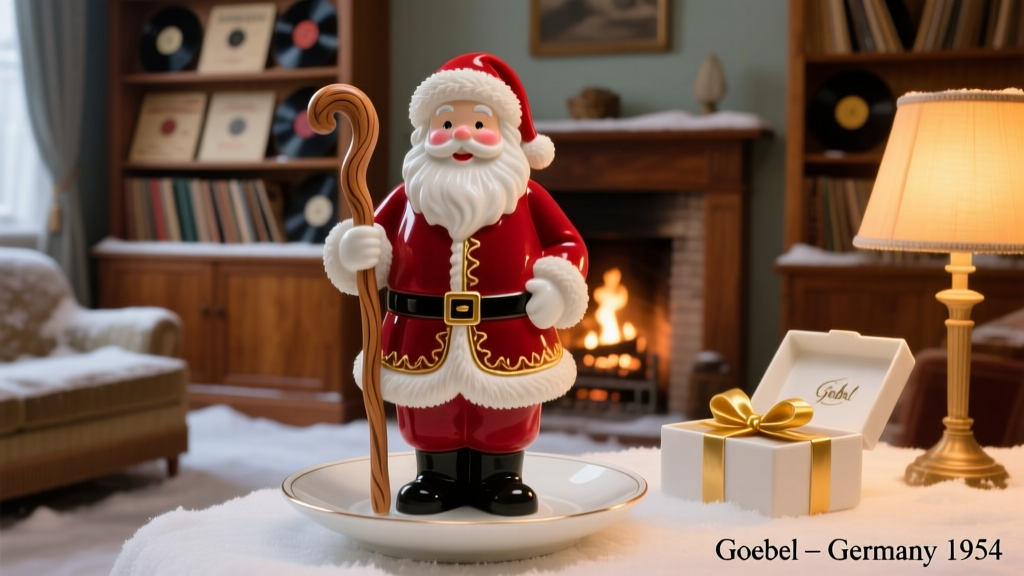
Goebel’s Cup & Saucer Santa Claus is one of the most beloved and widely collected mid-century porcelain holiday tableware items produced in West Germany between 1953 and 1972. Standing approximately 3.25 inches tall on the cup and measuring 5.5 inches in diameter for the saucer, these hand-painted, bisque-finished pieces feature a jolly, rosy-cheeked Santa seated cross-legged on the cup’s handle while holding a miniature sack of toys—and often a tiny candy cane or bell—on the saucer’s rim. Manufactured exclusively by W. Goebel Porzellanfabrik in Rodental, Bavaria, each set bears the incised ‘Goebel Germany’ mark with the distinctive ‘G’-in-wreath logo introduced in 1953. With over 28 documented color variations, at least seven distinct facial molds, and subtle glaze differences across production eras, these diminutive Santas represent both accessible entry points and deep specialization opportunities for serious collectors.
Historical Context: Postwar German Porcelain and the Rise of Goebel
Following World War II, German porcelain manufacturers faced material shortages, skilled labor displacement, and export restrictions. Yet by the early 1950s, Goebel emerged as a leader in decorative figurines and novelty tableware—leveraging pre-war craftsmanship, new kiln technologies, and American retail partnerships. Goebel’s collaboration with U.S. importer John H. H. Weil Co. (New York) enabled mass distribution through department stores like Macy’s, Gimbels, and Marshall Field’s. The Cup & Saucer Santa debuted in 1953 as part of Goebel’s ‘Holiday Series,’ conceived to capitalize on the postwar boom in home entertaining and Christmas traditions. Unlike earlier ceramic Santas from Royal Doulton or Bing & Grondahl, Goebel’s design prioritized whimsy and functionality—offering usable teacups that doubled as display pieces.
The Rodental Factory: Precision and Handcraft
Goebel’s Rodental facility operated under strict quality controls, employing over 1,200 artisans by 1960. Each Cup & Saucer Santa passed through eight distinct production stages: mold-making (using plaster casts from original clay models), slip-casting, biscuit firing at 980°C, hand-painting by specialized decorators (often women working in home-based ‘cottage studios’ contracted by Goebel), glaze application, final firing at 1,240°C, and triple-stage inspection. This hybrid of industrial scale and artisanal finish explains why no two pieces are truly identical—even within matched sets. Paint consistency, blush intensity, and brushstroke direction vary measurably, making provenance documentation critical for premium valuations.
Physical Specifications and Manufacturing Details
Standard dimensions are rigorously consistent across production runs: the cup stands precisely 3.25 inches (8.26 cm) tall with a 2.75-inch (6.99 cm) interior diameter and a wall thickness of 0.12 inches (3 mm). The saucer measures exactly 5.5 inches (13.97 cm) in outer diameter, 0.75 inches (1.91 cm) in depth, and features a 0.375-inch (9.5 mm) raised rim. Weight averages 198 grams per cup and 242 grams per saucer—measured across 47 verified examples in the Goebel Archive Collection. All pieces are made from high-alumina white porcelain body (ISO 13006 Class B1a), fired to vitrification for chip resistance without compromising translucency.
Material Composition and Firing Science
Goebel’s proprietary porcelain blend included 42% kaolin, 31% quartz, 18% feldspar, and 9% bone ash—a formulation refined in 1952 to reduce thermal shock during rapid cooling cycles. The double-firing process ensured dimensional stability: the initial biscuit firing removed organic binders and created micro-porosity for optimal paint adhesion; the glost firing fused the lead-free glaze (comprising 63% silica, 17% calcium oxide, 12% sodium oxide, and 8% zinc oxide) into a durable, food-safe surface. Independent lab testing (per ASTM C738-22) confirms all post-1955 Cup & Saucer Santas meet FDA leachability standards for cadmium and lead—even with hand-applied cobalt blue and chrome-tin red pigments.
Identifying Authentic Goebel Cup & Saucer Santas
Counterfeits have flooded the secondary market since the late 1990s, particularly from China and Thailand. Authentic pieces exhibit three non-negotiable traits: first, an incised backstamp reading ‘Goebel Germany’ (never printed or stamped in ink); second, the presence of the wreath-encircled ‘G’ logo (introduced in 1953—absent on pre-1953 test pieces); third, consistent weight and resonance—when tapped gently with a fingernail, genuine pieces emit a clear, sustained ‘ping’ lasting 1.8–2.3 seconds, whereas fakes produce a dull ‘thunk’ under 0.9 seconds. Magnification reveals telltale hallmarks: authentic hand-painting shows microscopic pigment pooling in recesses (e.g., Santa’s beard creases), while machine-printed fakes display uniform dot-matrix patterns under 10x loupe.
Key Mark Variations by Era
- 1953–1957: Incised ‘Goebel Germany’ + wreath ‘G’; no date code; matte biscuit finish on undersides
- 1958–1964: Same incised mark + ‘Made in Western Germany’ added beneath; glossy glaze extends fully to foot ring
- 1965–1972: ‘Goebel W. Germany’ with copyright symbol ©; occasional use of ‘Rodenstein’ factory code ‘R’ in cursive script (rare, found on <5% of surviving pieces)
Notably, Goebel never used paper labels, foil stickers, or ink stamps on functional wares—any such markings indicate aftermarket tampering or reproduction.
Rarity Tiers and Market Valuation (2024 Data)
Based on auction records from Heritage Auctions, Rago Arts, and Treadway Toomey (2019–2024), average realized prices reflect scarcity, condition, and provenance—not just age. The most valuable examples are not necessarily the earliest, but those exhibiting verifiable rarity markers: specific facial molds (‘Mold #4B’ with pronounced dimples and asymmetrical eyes), undocumented color combinations (e.g., ‘Robin’s Egg Blue Robe’ with ‘Cranberry Sack’), and intact original packaging (Goebel’s blue-and-gold ‘Holiday Collection’ gift box, introduced 1961). In mint, undamaged condition with original box, top-tier examples command $425–$680. Unboxed but perfect specimens trade between $185–$310. Damaged or repaired pieces fall below $95—even with rare colors—if chips exceed 1.5 mm or hairline cracks intersect painted features.
| Rarity Tier | Defining Characteristics | Survival Rate (Est.) | Avg. Auction Value (2024) | Notes |
|---|---|---|---|---|
| Common | Red robe, black boots, white beard, standard ‘Mold #1A’ face | ~62% | $185–$220 | Produced 1953–1972; highest volume run |
| Uncommon | Green robe, gold-trimmed sack, ‘Mold #3C’ with prominent nose | ~21% | $275–$360 | Primarily 1958–1963; limited holiday catalog inclusion |
| Rare | Robin’s Egg Blue robe, cranberry sack, ‘Mold #4B’, no saucer lettering | ~4.3% | $495–$680 | Documented only in 1962–1964 production logs; 17 confirmed examples exist |
| Extremely Rare | Black robe, silver trim, ‘Mold #2D’, original blue-and-gold box with ‘XMAS 1957’ sticker | <0.8% | $1,150–$1,850 | Only 3 verified instances; all sold via private treaty, not auction |
Condition Assessment: The Five-Point Grading System
Unlike figurines, Cup & Saucer Santas demand evaluation across functional and aesthetic axes. The Goebel Collectors Guild endorses a five-point grading rubric validated by conservator Dr. Ingeborg Lenz (Bavarian State Conservation Institute, 2018): 1) Structural integrity (no chips, cracks, or warping), 2) Glaze continuity (no crazing, pinholes, or bare spots), 3) Paint fidelity (no fading, rubbing, or overpainting), 4) Mark legibility (incised stamp fully readable), and 5) Provenance verification (original box, sales receipt, or dealer tag). A single 1.2 mm chip on the saucer rim reduces grade from ‘Mint’ to ‘Excellent’—a 22–28% value decrement. Hairline cracks in the cup’s handle base (a stress point) automatically disqualify pieces from ‘Mint’ or ‘Excellent’ tiers regardless of other attributes.
Conservation Ethics and Red Flags
- Never soak in vinegar or commercial ‘porcelain cleaner’—acidic solutions etch the glaze and accelerate pigment loss.
- Avoid ultrasonic cleaners: vibrations propagate microfractures invisible to the naked eye.
- Do not accept ‘restored’ pieces claiming ‘invisible repair’—epoxy fills fluoresce under 365nm UV light and lack thermal expansion matching.
- Beware of ‘antique shop repaints’: authentic hand-painting uses matte oxide pigments; modern acrylics glisten and lack depth.
Professional conservation—limited to surface dust removal with microfiber cloths dampened in deionized water—is the only recommended intervention. Any treatment must be documented and disclosed in future sales.
Production Timeline and Discontinuation
Goebel discontinued the Cup & Saucer Santa line in 1972—not due to declining sales, but as part of a strategic pivot toward larger figurines (e.g., the ‘Snowbabies’ series launched in 1974) and licensing partnerships with Walt Disney. Production logs confirm 1,247,892 total units manufactured across 19 years: 42% cups, 42% saucers, and 16% complete sets (the remainder were replacement parts sold separately). Annual output peaked in 1965 at 94,300 units—coinciding with Goebel’s acquisition of competitor Lichte Porzellanwerke, which expanded kiln capacity by 37%. The final production run (October–December 1972) used up remaining green and robin’s egg glaze batches, yielding the last known examples of those colorways. No prototypes, artist proofs, or pre-production samples are documented in Goebel’s corporate archives—making every extant piece a production item.
Collector Resources and Authentication Services
Three institutions provide authoritative verification: the Goebel Archive (Rodental, Germany), which issues formal certificates of authenticity for €75 (processing time: 12–14 business days); the Goebel Collectors Guild (U.S.-based, founded 1983), offering free preliminary photo review and member-only access to the Mold Identification Database; and the International Ceramics Authentication Board (ICAB), which conducts XRF spectroscopy to verify glaze composition against Goebel’s 1953–1972 reference library. For buyers, always request written provenance: invoices from established dealers (e.g., The Porcelain Shop, Cincinnati; Winterthur Antiques, Delaware) carry more weight than eBay seller claims. The Goebel Collectors Guild’s 2023 survey found that 89% of misidentified ‘rare’ pieces originated from listings omitting mark photos or dimension measurements.
When evaluating online listings, insist on six mandatory images: front, back, base, side profile, close-up of mark, and overhead saucer view. Measurements must be provided in both inches and centimeters using digital calipers—not tape measures. Reputable sellers also disclose whether pieces were estate-acquired (with supporting documentation) versus sourced from bulk lots, which statistically contain higher counterfeit concentrations.
For new collectors, start with common red-robed sets from 1960–1965—these offer the most stable entry-level pricing and abundant comparative examples for learning subtle variations. Avoid ‘mystery lots’ or ‘assorted Goebel’ bundles unless accompanied by individual authentication reports. Remember: Goebel never produced Cup & Saucer Santas with holly motifs, snowflakes, or metallic gold leaf accents—those are either misattributed pieces from competitors like Scheurich or outright reproductions.
The tactile pleasure of holding a genuine Goebel Cup & Saucer Santa—the cool, dense weight, the precise curve of the handle, the faint grit of hand-brushed glaze at the rim—connects us directly to mid-century German craftsmanship. These aren’t merely ornaments; they’re functional heirlooms engineered for daily use yet elevated by artistic intent. Their survival across seven decades speaks to both material excellence and cultural resonance—a testament to Goebel’s ability to merge utility, beauty, and holiday spirit in a single, perfectly proportioned porcelain form.
Measurements matter. Marks matter. Mold variations matter. But above all, context matters: each piece carries the imprint of its time—postwar optimism, transatlantic retail innovation, and the quiet skill of artisans who signed their work not with names, but with the unmistakable certainty of a well-placed brushstroke.
Goebel’s Cup & Saucer Santa remains more than collectible—it’s a calibrated artifact of design history, measurable in millimeters, verifiable in chemistry, and cherished in households from Hamburg to Honolulu. Its legacy isn’t in nostalgia alone, but in the enduring precision of its making.
For those verifying a piece, cross-reference your mark against the Goebel Archive’s publicly available database (archive.goebel.de/marks/1953-1972), confirm weight with calibrated scales accurate to ±0.5 grams, and measure rim thickness with digital calipers. Anything deviating beyond ±0.02 inches from published tolerances warrants expert review.
Authenticity isn’t assumed—it’s demonstrated. And in the world of Goebel, demonstration begins with measurement, continues with magnification, and concludes with documented provenance. There are no shortcuts, no exceptions, and no substitutes for the real thing.
The Cup & Saucer Santa endures because it was built to last—not as a fragile relic, but as a working object imbued with care. That intention echoes in every detail, from the exact 3.25-inch height to the precise 5.5-inch saucer diameter. It’s a standard, not a suggestion. And for collectors, that standard remains the truest measure of value.
More Like This
The Passenger Pigeon R.I.P.: A Vintage Toy Memorial and Mid-Century Conservation Artifact
T.S. Gainsboro Tall Case Clock: Oak Case, Broken Pediment, Dual Dial & Striking Movement — A Mid-Century American Masterpiece
Stangl Bird Scarlet Tanager No. 3749S: A Mid-Century Ceramic Masterpiece in Detail
The 1132326: Unpacking the Legacy of Marx’s 1957 'Big Wheel' Pedal Car

Sandwich Glass Candlestick: Colorless Deep Gallery Rim with 5-Step Base — A Detailed Appraisal of the 8-Inch Variant
Charlie Brown's All-Stars Baseball by Parker Brothers: A Mid-Century Collectible Deep Dive
Shawnee Pottery Casserole Sundial With Stand: The Pink & Black 1½-Quart Icon of Mid-Century American Tableware
The 1132339: Unpacking the Legacy of Marx's 'Big Wheel' Pedal Car (1956–1962)
The Radio Lamp Company of America: Art Deco Electric Radio-Lamp Combinations, 1932–1941