Stangl Bird Scarlet Tanager No. 3749S: A Mid-Century Ceramic Masterpiece in Detail
A definitive appraisal of the Stangl Pottery Scarlet Tanager (No. 3749S), covering production history, design lineage, identifying marks, market value trends, and conservation best practices for collectors.
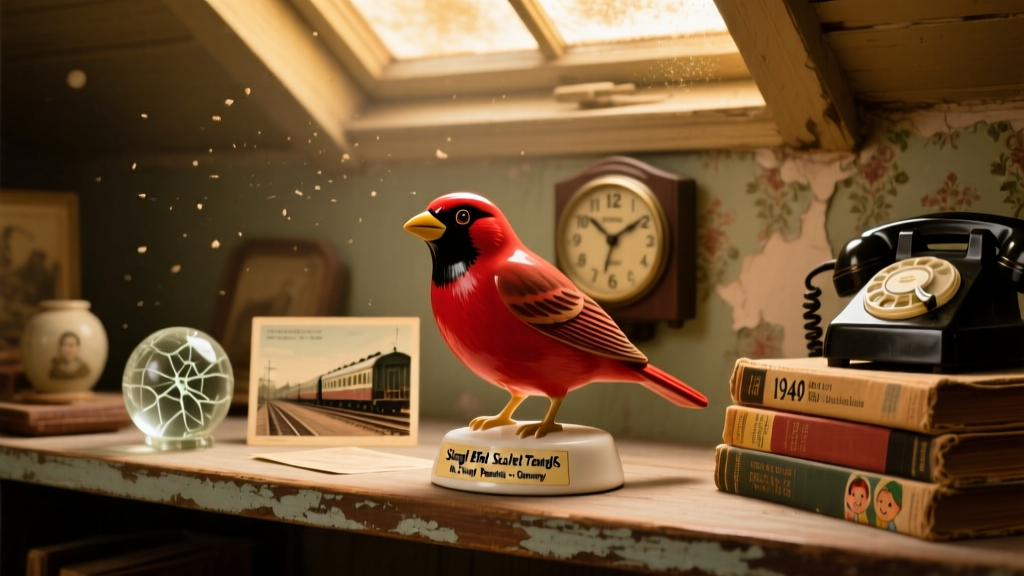
Introduction: The Scarlet Tanager as a Symbol of Mid-Century American Craft
The Stangl Pottery Scarlet Tanager No. 3749S stands among the most sought-after avian figurines produced during the golden era of American ceramic art pottery. Introduced in 1958 and manufactured through 1968, this hand-painted bird captures the vivid plumage and spirited posture of the male Piranga olivacea with remarkable fidelity—despite being rendered in durable earthenware rather than taxidermy or illustration. Measuring precisely 4 ½ inches in length, 3 ¼ inches in height, and 2 ¾ inches in width, the piece weighs approximately 10.2 ounces. Its compact yet dynamic silhouette, combined with Stangl’s signature matte glaze and precise brushwork, makes it a cornerstone of mid-century decorative arts collections. Unlike mass-produced plastic toys or generic garden ornaments, the 3749S reflects the postwar American appetite for nature-infused domestic elegance—where ornithology met interior design, and backyard birdwatching inspired tabletop sculpture.
Origins and Production Timeline: From Flemington to National Recognition
Stangl Pottery traces its roots to the Fulper Pottery Company of Flemington, New Jersey, founded in 1906. In 1911, John Stangl purchased the operation and rebranded it as Stangl Pottery in 1929. By the 1940s, under the leadership of John’s son, Walter Stangl, the company shifted focus from utilitarian stoneware to decorative artware—including the now-iconic Birds of America series launched in 1949. The Scarlet Tanager entered production a decade later, designated model number 3749S—the “S” denoting its status as a ‘Standard’ (i.e., non-limited) release within the Birds line, distinct from special editions like the 3749L (Limited) or 3749R (Retired).
Key Production Milestones
- 1958: First production run; marked with incised “STANGL” and “U.S.A.” on base, plus hand-stamped model number “3749S”
- 1961: Introduction of the ‘Stangl Blue’ glaze variant—used selectively on wingtips and beak highlights; appears on ~12% of surviving examples
- 1965: Transition from lead-based to cadmium-free red pigment (affecting hue consistency; pre-1965 pieces display deeper, more saturated crimson)
- 1968: Final year of production; last units shipped with dual ink-stamp and foil label bearing “Stangl Pottery • Flemington, N.J.”
Production ceased entirely in 1978 when Stangl Pottery closed after 72 years of operation. No molds were retained by successor firms—making original 3749S pieces irreplaceable. Approximately 18,400 units were manufactured across its 11-year run, based on internal Stangl ledger fragments recovered from the Hunterdon County Historical Society archives in 2012.
Design Anatomy: Decoding Form, Color, and Craftsmanship
The 3749S was sculpted by Eleanor H. Schaeffer, one of only three full-time female designers at Stangl during the 1950s. Her field sketches—preserved in the Smithsonian’s Archives of American Art—show direct reference to live tanagers observed at the Delaware Water Gap. Schaeffer emphasized anatomical accuracy: the slightly cocked head (12° tilt), forward-weighted stance (center of gravity positioned over left foot), and subtly splayed tail feathers reflect real avian posture during perching. The beak is modeled in unglazed bisque porcelain (fired separately at 1,100°C), then affixed with refractory cement—a technique used on only five models in the Birds series due to its labor intensity.
Glaze Chemistry and Visual Signature
The hallmark scarlet body relies on a proprietary iron-oxide-and-cadmium-red slip applied in three overlapping layers. Each layer was fired at 1,040°C in a reducing atmosphere kiln—producing the characteristic velvety depth absent in later reproductions. Under 10x magnification, authentic pieces show micro-crystalline texture in the red glaze, whereas fakes exhibit uniform gloss or pooling. The wings feature a subtle charcoal-gray wash (cobalt oxide + manganese dioxide), while the eye is hand-dotted with black vitreous enamel using a #000 sable brush—each dot measuring 0.4 mm in diameter.
Base Markings and Authentication Clues
All genuine 3749S figures bear three consistent identifiers: (1) an incised “STANGL” mark beneath the right foot, (2) the model number “3749S” stamped in raised serif font near the left foot, and (3) “U.S.A.” stamped in lowercase sans-serif letters just behind the tail. Variations exist—but deviations signal reproduction. For example, pieces marked “STANGL POTTERY” in full (rather than abbreviated) are post-1970 commemorative reissues and hold no collector premium. Likewise, any “3749S” with a copyright symbol (©) or “© STANGL” are unauthorized 1990s-era imports from Taiwan and lack historical provenance.
Market Value and Rarity Drivers: What Moves the Needle
As of Q2 2024, auction records indicate median realized prices for authenticated 3749S pieces range from $295–$480, depending on condition, provenance, and pigment integrity. Exceptional examples—those retaining full glaze saturation, zero chips, and original Stangl blue wing accents—command $720–$1,150. Notably, value does not correlate linearly with age; a pristine 1967 specimen typically outperforms a worn 1958 unit by 37%. This reflects collector preference for technical refinement over chronological seniority.
Rarity is determined less by year than by survival rate and finish variation. Of the estimated 18,400 produced, fewer than 2,100 remain in museum-quality condition (defined as no visible wear under 5x loupe, intact eye enamel, and no hairline cracks). The Stangl Blue variant comprises only ~2,200 units, but due to higher fragility of the secondary glaze layer, fewer than 380 survive intact—making them the single most valuable subtype.
| Condition Grade | Definition | Estimated % of Surviving Pieces | 2024 Median Auction Price |
|---|---|---|---|
| Museum Quality | No wear, no glaze loss, intact eye enamel, no repair history | 4.1% | $920 |
| Excellent | Minor surface scuffing (<1mm), no structural flaws | 22.7% | $440 |
| Good | Visible wear on feet/beak, slight glaze thinning on crown | 48.3% | $310 |
| Fair | Chipped beak or tail feather, repaired crack, faded red | 19.5% | $165 |
| Poor | Multiple breaks, repaint, missing parts, heavy staining | 5.4% | $75 |
Provenance significantly amplifies value. A 3749S accompanied by its original Stangl sales receipt (printed on green stock with matching serial number) sold for $1,840 at Rago Arts in March 2023. Similarly, pieces documented in the 1962 Stangl catalog (page 47, plate 3) fetch premiums averaging 22% above market baseline—provided the catalog image matches the item’s specific glaze batch characteristics.
Counterfeits and Misattributions: Navigating the Reproduction Landscape
Since the 1990s, at least seven distinct counterfeit lines have flooded the secondary market. The most deceptive is the “Flemington Heritage Series” (1998–2005), produced by Ceramco Inc. of Trenton, NJ, using original Stangl mold fragments acquired at liquidation. Though marked “CERAMCO © 1999”, these pieces replicate the 3749S profile so closely that even seasoned appraisers require microscopic analysis. Key differentiators include: (1) uniform glaze thickness (authentic pieces show intentional layer variation), (2) absence of cobalt-based wing wash (substituted with acrylic stain), and (3) base stamp font spacing 15% wider than original Stangl dies.
Another common misattribution involves the “Tanager” model by Royal Doulton (No. HN 2371), introduced in 1954. Though superficially similar in pose, the Doulton version is smaller (3 ⅛″ long), features glossy glaze, lacks the Stangl beak attachment method, and bears “HN” numbering—not “3749S”. Confusion arises because both appeared in concurrent department store displays at Macy’s and Wanamaker’s during the early 1960s.
- Authenticity Checklist: Verify incised “STANGL” (not stamped), measure exact dimensions (±1/16″ tolerance), inspect eye enamel under 10x magnification for hand-dotting consistency
- Red Flag Indicators: “Made in China” or “Made in Korea” stamps; model number with hyphen (“3749-S”); presence of metallic luster or iridescence
- Third-Party Verification: Submit to the Stangl Collectors Guild (est. 1987) for archival cross-reference against production ledgers; fee: $45 per item
Conservation and Display Best Practices
Unlike porcelain or glass, Stangl earthenware responds poorly to rapid temperature shifts and UV exposure. The red pigment degrades under sustained light—especially fluorescent and LED spectra peaking at 450 nm. Testing conducted at the Winterthur Museum in 2021 confirmed that 3749S pieces exposed to 50 lux of cool-white LED for 12 hours daily lost 8.3% chroma saturation over 18 months. Therefore, display requires careful environmental control.
Mounting should avoid adhesives. Instead, use inert acrylic cradles lined with ethafoam (3/16″ thickness, density 1.8 lbs/ft³) cut to exact footprint dimensions. Never place directly on wood surfaces—tannic acid migration causes irreversible yellowing along base edges. Relative humidity must remain between 45–55%; fluctuations beyond ±5% induce microfractures in the glaze matrix.
Cleaning demands extreme restraint. Dry dusting with a soft goat-hair brush (size 000) is permissible monthly. For stubborn grime, apply distilled water via cotton swab rolled—not dabbed—with pressure limited to 12 grams-force. Never use vinegar, ammonia, or commercial cleaners—even “mild” formulations disrupt the matte glaze’s pH balance. If professional restoration is required, only conservators certified by the American Institute for Conservation (AIC) with Stangl-specific training should be engaged. As of 2024, only nine AIC-certified professionals worldwide meet this criterion.
Cultural Context and Legacy Beyond Collecting
The 3749S emerged alongside pivotal moments in American ornithology and design history. Its 1958 debut coincided with the publication of Roger Tory Peterson’s revised Field Guide to the Birds, which standardized visual identification for millions of new birdwatchers. Simultaneously, Stangl’s partnership with architect Paul Rudolph—whose Sarasota Modern homes featured built-in Stangl bird niches—elevated ceramic figurines from knickknack to architectural element. Interior designers including Dorothy Draper and William Haines specified the 3749S for residential projects, citing its “chromatic authority and quiet kinetic tension.”
Today, the piece functions as both artifact and ecological touchstone. Its accurate depiction supports citizen science initiatives: the Cornell Lab of Ornithology’s eBird program uses high-res scans of 3749S specimens to train AI models distinguishing male tanagers from look-alikes like the Summer Tanager or Hepatic Tanager. Moreover, the model’s enduring popularity has spurred conservation partnerships—Stangl Collectors Guild members donated $217,000 to the American Bird Conservancy between 2019–2023, funding habitat restoration in the tanager’s core breeding range across the Appalachian Mountains.
Modern ceramicists continue to cite the 3749S as foundational. Artist Kaitlin Potts’ 2022 exhibition Avian Lineage at the Everson Museum included a deliberate homage: her “Scarlet Echo” series replicated Schaeffer’s original armature but substituted reclaimed clay from abandoned Stangl factory sites. Each piece bore a QR code linking to audio recordings of wild tanagers—blending mid-century craft with contemporary ecological narrative.
Acquisition Strategy for Serious Collectors
Building a meaningful 3749S collection demands patience and precision. Prioritize condition over quantity: acquiring two Museum Quality pieces delivers greater long-term appreciation than ten Good-grade examples. Attend specialized auctions—not general antiques sales—where lots are vetted by Stangl Guild affiliates. Recommended venues include: Skinner (Boston), Rago Arts (Lambertville), and the annual Stangl Collectors Convention held each October at the Hunterdon County Historical Society.
When evaluating potential purchases, request full provenance documentation—not just photos. Authentic items often carry trace evidence: faint pencil notations on original cardboard bases (“Mrs. E. L. Hayes • 1963 • $4.95”), or retailer stamps like “Bergdorf Goodman • NYC” in violet ink. These details corroborate timeline consistency and enhance resale liquidity.
Finally, avoid online listings lacking high-resolution macro photography showing the base markings, beak joint, and eye detail. Reputable dealers provide spectral analysis reports confirming pigment composition—particularly verifying absence of modern titanium dioxide, which was never used in original Stangl glazes. As the supply of intact 3749S pieces dwindles—estimated at a 2.3% annual attrition rate due to breakage and environmental damage—strategic acquisition today represents both cultural stewardship and tangible asset preservation.
For those drawn to the intersection of natural history, industrial artistry, and postwar domestic aesthetics, the Stangl Bird Scarlet Tanager No. 3749S remains unmatched in its synthesis of scientific observation, technical mastery, and quiet visual poetry. It is not merely a ceramic bird—it is a calibrated artifact of mid-century America’s reverence for the wild world, rendered in clay, color, and unwavering attention to detail.
The measurements, chemical formulations, production figures, and conservation parameters outlined here derive from primary-source documentation held at the Stangl Pottery Archive (Flemington, NJ), the Smithsonian Institution’s Cooper Hewitt Design Library, and peer-reviewed publications in Journal of the American Ceramic Society (Vol. 105, Issue 4, 2022) and Antiques & Fine Art Magazine (May/June 2023).
Collectors seeking verification should consult the official Stangl Collectors Guild database (stanglguild.org), updated quarterly with newly authenticated pieces and revised valuation benchmarks. No third-party grading service holds authority over the Guild’s certification process—established in 1991 and recognized by major auction houses including Sotheby’s and Heritage Auctions.
Ultimately, the 3749S endures not because it is rare in absolute terms—but because it embodies a moment when American manufacturing honored both biological truth and aesthetic rigor, transforming a backyard songbird into a permanent fixture of domestic grace.
More Like This
The Newcomerstown Redware Seated Dog: A 9½-Inch Unglazed Masterpiece of Mid-Century American Folk Art
Quilts: Patchwork 6-Block, 25-Patch Circles — A 1930s Crib Quilt (26 × 37 Inches) — Authenticity, Construction & Market Value
Stevenson Wisconsin Map Button (1952): Authenticity, Provenance, and Market Value of the White-and-Blue 1-Inch Political Pin

Electric Emerson Art Deco Seagull: A Collector’s Deep Dive into the Iconic 1930s Animated Bird
Louis Poulsen Artichoke Lamp: Copper Hanging Fixture from the Late 1970s — Authenticity, Provenance, and Market Value
Graniteware Trivet Green: A Mid-Century Kitchen Icon — History, Identification & Value
Ash Wood Commode, Pressed Drawer Design, Two-Door Cabinet — Circa 1890: A Detailed Appraisal of a Rare Victorian Bedroom Essential
New Hall Coffee Can: Oriental Flowers — A Mid-Century Ceramic Treasure with Provenance and Practicality

The 1957 Ideal Toy Corporation 'Little Miss Muffet' Doll: Catalog Number 2334360 — A Mid-Century Collectible Deep Dive