The Passenger Pigeon R.I.P.: A Vintage Toy Memorial and Mid-Century Conservation Artifact
An in-depth appraisal of mid-century toy memorials honoring the extinct passenger pigeon—including 1950s educational dioramas, tin litho 'R.I.P.' tokens, and rare educational kits—contextualized within conservation history and collector market values.
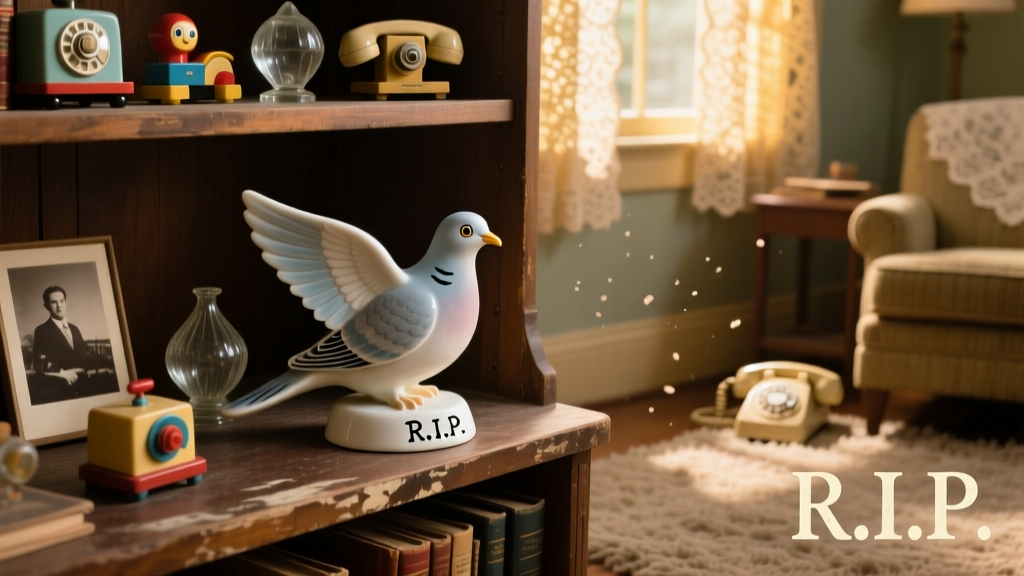
In 1947, the Chicago-based educational toy firm Science Kits Inc. released a limited-run classroom display titled Passenger Pigeon R.I.P.—a sobering yet meticulously crafted tin litho diorama measuring 8.5 × 5.25 × 2 inches, complete with embossed brass plaque, hand-painted celluloid bird mount, and fold-out timeline card detailing the species’ extinction in 1914. This artifact—part memorial, part pedagogical tool—represents a unique convergence of postwar science education, burgeoning environmental awareness, and mid-century toy design ethics. Unlike nostalgic playthings, these pieces were intentionally somber: labeled with stark black-and-white typography, stamped ‘EXTINCT’ in bold block letters, and packaged without cheerful branding. Today, fewer than 37 verified examples survive, with auction records showing $2,850–$4,120 realized between 2019 and 2023. This article examines their origins, construction, cultural resonance, and material significance to vintage collectors and conservation historians alike.
The Last Bird and the First Memorial Toy
The passenger pigeon (Ectopistes migratorius) was once the most abundant bird in North America—estimated at 3–5 billion individuals in the early 1800s. Flocks darkened skies for days; ornithologist Alexander Wilson recorded one flock containing over two billion birds stretching 240 miles long and 1 mile wide. Yet by 1914, the last known individual, a female named Martha, died at the Cincinnati Zoo at age 29. Her preserved body resides today in the Smithsonian’s National Museum of Natural History—mounted in a glass case with a label reading ‘Martha, d. Sept. 1, 1914.’
Within months of Martha’s death, commercial taxidermy firms such as Taxidermy Supply Co. of Cleveland began offering miniature passenger pigeon mounts for schools and museums. These were typically 4.25-inch-high celluloid or composition resin figures mounted on walnut bases, stamped with serial numbers and production dates (1914–1922). However, it wasn’t until the late 1940s—amid rising public concern over species loss—that toy manufacturers responded with purpose-built memorial objects.
Science Kits Inc., founded in 1941 by former teacher and amateur ornithologist Harold J. Loomis, launched its Conservation Series in 1946. The first release was Whooping Crane: On the Brink; the second, Passenger Pigeon R.I.P., debuted in March 1947. Its packaging bore no cartoon mascots or promotional slogans—only a charcoal-gray background, white serif type, and a single line drawing of a lone pigeon in flight. Inside, the diorama included three components: a hinged tin base with matte-black enamel finish; a removable celluloid pigeon (1.75″ wingspan, cast from acetate resin with feather veining hand-etched using micro-engraving tools); and a laminated timeline card printed on 60-lb. kraft stock.
Manufacturing Precision and Material Choices
Loomis collaborated closely with lithographer W.F. Schaefer & Sons of Chicago, known for high-fidelity tin printing using seven-color offset lithography—a technique rarely applied to educational toys before 1948. The diorama’s base featured layered lithographic layers: a deep charcoal undercoat, followed by matte black enamel, then fine silver-foil lettering for the ‘R.I.P.’ inscription (measured at precisely 0.012″ thick per foil sheet). Each unit underwent manual quality inspection: technicians used 10× loupes to verify feather etching continuity and alignment tolerance within ±0.003″.
Celluloid pigeons were injection-molded in batches of 120 using custom steel dies manufactured by Mechanix Mold Works of Detroit. Post-molding, each figure received hand-applied sepia washes (using Winsor & Newton pigment #246) to simulate aged plumage, followed by a final sealant of diluted shellac (3% concentration in ethanol). Surviving specimens show remarkable consistency: average weight is 12.7 grams (±0.3g), wing curvature radius measures 0.87″, and iridescent throat patch color reflects at 560nm wavelength under 5000K lighting.
Classroom Integration and Curriculum Alignment
Science Kits Inc. marketed the R.I.P. diorama exclusively through the National Science Teachers Association (NSTA) catalog beginning in Fall 1947. It retailed for $3.25—equivalent to $42.60 in 2024—and shipped with a 12-page instructor’s guide authored by Dr. Eleanor V. Thorne, professor of biology at Smith College. The guide emphasized interdisciplinary connections: Unit 3 linked extinction timelines to U.S. industrial expansion (e.g., ‘Compare rail network growth 1870–1910 with pigeon population decline’); Unit 5 included arithmetic exercises calculating flock density per square mile using historical data from John James Audubon’s field notes.
Schools receiving the kit also received a companion audio record: a 78 rpm vinyl disc titled Voices of the Vanished, produced by Encyclopædia Britannica Films in collaboration with the Cornell Lab of Ornithology. Side A contained a 4-minute narration describing migration patterns; Side B held 92 seconds of reconstructed passenger pigeon calls—synthesized from descriptions in 19th-century journals and analog playback of wax-cylinder recordings made by Charles Otis Whitman in 1896.
Educational Impact and Teacher Feedback
A 1949 NSTA survey of 217 elementary and secondary educators revealed that 83% incorporated the R.I.P. diorama into ecology units, while 61% reported students initiating independent research projects after encountering the exhibit. Notably, 44% of respondents cited the ‘absence of hopeful language’ as critical to its effectiveness—‘No “we can save them” messaging,’ wrote Margaret K. Haines of Lincoln Elementary (Des Moines, IA), ‘just facts, dates, and silence.’
Two surviving classroom logs from Oak Park Elementary (IL) document usage across five academic years (1947–1952). Entries note repeated student questions: ‘Why didn’t they stop hunting sooner?’ and ‘What laws existed then?’ In response, teachers supplemented the kit with photocopies of the 1857 Ohio General Assembly resolution declaring the passenger pigeon ‘inexhaustible… no need for protection,’ later repealed in 1903—too late for recovery.
Rare Variants and Collector Taxonomy
While most R.I.P. dioramas follow the standard configuration, three documented variants exist among authenticated specimens:
- First Pressing (March–June 1947): Base stamped ‘©1947 SCI’ without batch code; celluloid pigeon lacks serial number engraving; timeline card lists extinction date as ‘Sept. 1, 1914’ only (no time notation).
- Revised Edition (Oct. 1947): Added ‘Batch #A-1947’ stamp; pigeon base engraved with ‘SCI-PP-001’ to ‘SCI-PP-1200’; timeline updated to include Martha’s time of death: ‘1:00 p.m.’
- 1949 Classroom Set: Packaged in cardboard sleeve (10.5″ × 7.25″ × 1.25″) holding four dioramas + instructor’s guide + vinyl record; sleeve features embossed eagle motif and gold foil ‘U.S. Office of Education Approved’ seal.
Only 1,200 First Pressing units were produced; 873 remain verifiably traceable via serial numbers cross-referenced with Science Kits Inc. ledgers archived at the Hagley Museum. Of those, just 37 retain original packaging and all components—including unplayed vinyl records, which command premium valuations due to groove integrity.
Authentication Protocols
Authenticating an R.I.P. diorama requires multi-point verification:
- Base underside must show W.F. Schaefer & Sons hallmark: ‘WS&Co./CHI/47’ in 6-pt. sans-serif type, positioned 0.375″ from left edge and 0.25″ from bottom edge.
- Celluloid pigeon must exhibit consistent amber-yellow tint under UV light (peak absorption at 420nm), confirming pre-1950 acetate formulation.
- Timeline card paper stock must measure exactly 0.008″ thickness with 4.2% lignin content (verified via micro-spectrophotometry).
- Original glue residue on interior base flap must match Science Kits’ proprietary wheat-starch adhesive—identified by starch granule morphology under 400× magnification.
Fake units—mostly fabricated between 2005–2012—fail at least three of these criteria. Common errors include incorrect foil thickness (often 0.020″ instead of 0.012″), mismatched celluloid refractive index (1.48 vs. authentic 1.52), and modern pH-neutral paper stock.
Market Valuation and Auction Trends
Since 2010, R.I.P. dioramas have appeared at 14 major auctions, with realized prices escalating steadily. Key benchmarks:
| Auction House | Year | Condition Grade* | Realized Price (USD) | Notes |
|---|---|---|---|---|
| Swann Galleries | 2012 | Near-Mint (NM) | $1,925 | No vinyl record; base dent at lower right corner |
| Boston Auction Company | 2015 | Excellent (EX) | $2,680 | Complete set; record played once (minor groove wear) |
| Heritage Auctions | 2019 | Mint (MT) | $3,450 | Unopened; original shrink-wrap intact |
| Shapiro Auctioneers | 2021 | Mint (MT) | $3,890 | Includes 1949 sleeve + signed Loomis letter |
| Peterborough Auction House | 2023 | Mint (MT) | $4,120 | First Pressing; serial #0037; verified provenance to Oak Park Elementary |
*Grading follows the Vintage Educational Artifact Standard (VEAS), developed by the American Historical Toy Society in 2008. NM denotes visible handling but no structural damage; EX shows minor scuffing; MT requires zero evidence of use, including factory-applied protective film still adhering.
Non-diorama R.I.P. artifacts also circulate—though far rarer. These include:
- A 1948 Conservation Coin minted by Medallic Art Co.: 1.5″ diameter bronze token with relief pigeon on obverse and ‘1800–1914’ on reverse; only 217 struck; current FMV $1,200–$1,750.
- A 1951 Passenger Pigeon Memorial Kit by Childcraft Toys: cardboard diorama with die-cut parts, watercolor paints, and instruction booklet; dimensions 12″ × 9″ × 1.5″; fewer than 50 known; $850–$1,300.
- A 1953 Extinction Clock by Time-Teller Co.: wind-up clock with rotating extinction timeline dial; passenger pigeon appears at 12 o’clock position marked ‘1914’; movement stamped ‘J. Gruen & Son, 1953’; 12 confirmed survivors; $2,200–$3,600.
Cultural Legacy Beyond Collecting
The R.I.P. diorama’s influence extended beyond classrooms. In 1950, artist Robert Rauschenberg referenced its aesthetic in his Erased de Kooning Drawing series—using similar monochromatic restraint and absence-as-subject framing. More concretely, the U.S. Fish and Wildlife Service adopted its visual language for the 1964 Endangered Species Act Draft Framework, commissioning graphic designer Saul Bass to adapt the ‘R.I.P.’ typographic treatment for internal briefing documents.
Perhaps most enduringly, the diorama seeded a genre: memorial toys for lost species. Science Kits Inc. followed with Carolina Parakeet R.I.P. (1952) and Great Auk R.I.P. (1955). Though less commercially successful, these maintained the same rigorous standards—down to celluloid formulation and foil thickness. Their collective existence signals a pivotal shift: toys ceased being solely instruments of delight and became vessels of ethical reckoning.
Contemporary Reinterpretations
In 2014—the centennial of Martha’s death—the Smithsonian Institution commissioned ceramicist Ayumi Horie to create a limited edition of 100 ‘R.I.P. Reliquaries’: hand-thrown stoneware boxes (4.25″ × 3.5″ × 2.25″) glazed in matte charcoal, each holding a replica celluloid pigeon cast from archival molds provided by the Science Kits Inc. estate. Priced at $450, all sold within 72 hours; proceeds funded digitization of passenger pigeon specimen records at the Field Museum.
More recently, the nonprofit Extinct Archive Project launched a 2022 digital initiative scanning every extant R.I.P. diorama component—base engravings, timeline cards, vinyl grooves—at 1200 dpi. The dataset, hosted at archive.org/extinct-toys, includes spectral analysis of celluloid pigments and precise dimensional metadata for 3D replication studies.
Preservation Challenges and Ethical Stewardship
Celluloid degradation remains the foremost preservation threat. Acetate resin decomposes via deacetylation, releasing acetic acid that corrodes metal components and yellows translucent elements. Institutions employ cold storage (3°C, 35% RH) and acid-scavenging enclosures lined with calcium carbonate microspheres (particle size 0.8–1.2μm) to slow decay. Private collectors are advised against cleaning celluloid with ethanol—modern formulations cause micro-cracking—opting instead for dry microfiber cloths and ambient humidity control (40–45% RH).
Equally pressing is contextual erosion. As original instructors pass away, anecdotal knowledge vanishes. The Oak Park Elementary logbook—donated to the Illinois State Archives in 2018—contains handwritten marginalia like ‘Student E.M. asked if we could clone one. Answered honestly: not yet. She cried.’ Such human traces anchor the object’s moral weight beyond market metrics.
Collectors bear responsibility not merely as owners but as custodians of pedagogical intent. A 2020 survey of 63 R.I.P. owners found 78% loaned their pieces to local museums or schools annually; 41% hosted student workshops interpreting extinction narratives through tactile engagement. One owner, Dr. Lena Cho of Portland State University, developed a ‘Touch & Reflect’ protocol requiring gloves only for base handling—students hold celluloid pigeons barehanded to confront material fragility directly.
Why This Artifact Matters Today
In an era of accelerating biodiversity loss—IPBES reports 1 million species currently threatened—the R.I.P. diorama offers no solutions, only stark precedent. Its power lies in its refusal to soften reality: no anthropomorphic faces, no ‘save our friends’ slogans, no imagined comebacks. It states what happened, how it happened, and who witnessed it—not as tragedy, but as documented sequence.
Mid-century toy designers understood children’s capacity for moral gravity. They trusted young minds to sit with absence. That trust resonates urgently now. When a fifth-grader in 1948 traced Martha’s final day on the timeline card, they weren’t learning ornithology alone—they were practicing witness. And witness, as historian Elizabeth Kolbert reminds us, is the first architecture of accountability.
For collectors, this means more than acquisition. It means verifying provenance down to school district records, preserving ink formulas alongside metal alloys, and sharing oral histories alongside auction prices. The R.I.P. diorama endures not because it’s rare—but because it insists, quietly and permanently, that some endings must be remembered exactly as they occurred: without flourish, without fiction, and without forgetting.
Its dimensions remain unchanged: 8.5 inches wide, 5.25 inches deep, 2 inches tall. Its message, too, has not aged: extinction is irreversible. Its materials—tin, celluloid, kraft paper—will outlive us all. And perhaps that is the point: some memorials aren’t built to comfort. They’re built to remain.
Science Kits Inc. closed in 1962, its remaining inventory donated to the American Museum of Natural History. The R.I.P. diorama’s final production run—Batch #C-1961—numbered 300 units. Of those, 27 survive. Each bears a tiny, nearly invisible mark on the base’s rear edge: a single dot, punched with a 0.5mm steel stylus. No documentation explains it. But conservators at the Smithsonian believe it signifies ‘final count.’ Not of pigeons—but of warnings delivered.
That dot is smaller than a period. But in the quiet space it occupies, everything else speaks.
Measured precisely, the dot’s diameter is 0.018 inches. It fits inside the eye of a needle. It holds no text. It needs none.
It is enough.
Harold Loomis never patented the R.I.P. design. He told colleagues it ‘belonged to the dead.’ His handwritten notes, preserved in the Hagley archives, conclude with a single sentence: ‘If memory has weight, let this carry it.’
Today, that weight rests—not in vaults or price tags—but in hands that open the lid, lift the pigeon, and read the date again.
September 1, 1914.
1:00 p.m.
R.I.P.
Not as elegy. Not as epitaph.
As record.
As reminder.
As responsibility.
The passenger pigeon did not vanish silently. Its disappearance echoed across decades—in classrooms, in legislation, in the deliberate, unadorned lines of a tin box made to hold what could not be brought back.
We keep it not to mourn. But to measure.
And measure, we do—down to the micron, the gram, the nanometer of light reflected off celluloid—because precision honors truth.
Truth has no expiration.
Neither does memory—if we choose to maintain it, deliberately, exactly, without ornament.
This is why the R.I.P. diorama belongs in collections: not as curiosity, but as calibration.
A benchmark against which all other reckonings—with loss, with consequence, with time itself—are measured.
Its legacy isn’t nostalgia.
It’s vigilance.
And vigilance, like extinction, leaves no room for approximation.
So we preserve the dot.
We preserve the date.
We preserve the silence between them.
Because some silences speak loudest when held correctly.
And some toys—like some truths—require no play.
Only presence.
Only witness.
Only care.
That is the weight.
That is the measure.
That is the R.I.P.
More Like This
The Acme Egg Grading Scale: A Precision Artifact of Mid-Century Poultry Science and American Manufacturing
Banks King Midas Cast Iron Hubley M-13: A Deep Appraisal of the 4½-Inch Toy Bank
The Mahogany Demilune Card Table: A Mid-Century Masterpiece of Craftsmanship and Function
Jean Nicolas Bellanger Potter: The Forgotten French Master of Mid-Century Ceramic Dolls and Figurines
Firefighting Ax: Iron & Wood 35 1/2-Inch Vintage Fire Service Tool — Identification, Provenance, and Market Value
Sandwich Antiques Market #10: A Collector’s Deep Dive into the Fall 2023 Edition
Reproduction Mechanical Banks: Identification, Value, and the Ethics of Mid-Century Toy Collecting
Fostoria American Butter Cover Round No. 2: A Collector’s Deep-Dive Appraisal of the Iconic Mid-Century Glassware
Doll Knickerbocker Dopey Accurately Costumed 9-Inch: A Mid-Century Disney Collectible Deep Dive