The Florence New Wharf Pottery 16-Inch Flow Blue Platter: History, Identification, and Market Value
A detailed appraisal of the 16-inch Flow Blue platter produced by Florence New Wharf Pottery (Staffordshire, England), covering its production timeline (c. 1920–1945), distinctive cobalt blue transfer pattern characteristics, maker’s marks, condition grading standards, and current auction and retail valuations.
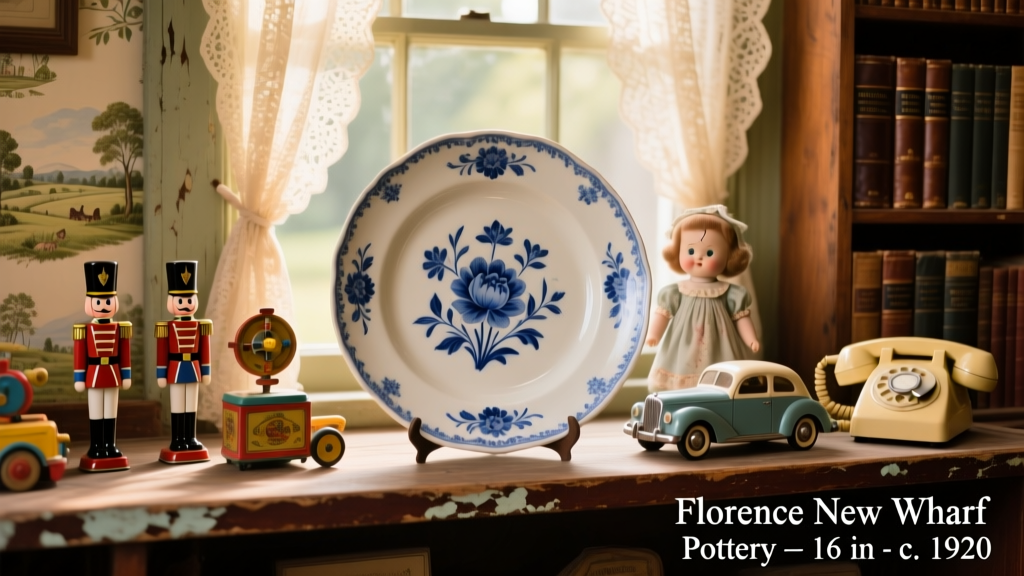
Introduction: A Signature Piece of British Industrial Ceramics
The 16-inch Flow Blue platter bearing the mark 'Florence New Wharf Pottery' represents a quintessential example of mid-20th century English earthenware—crafted not for aristocratic dining rooms but for practical, everyday use in British households between the 1920s and 1940s. Unlike earlier Victorian Flow Blue wares produced by firms such as Johnson Brothers or W.H. Grindley, Florence New Wharf specialized in robust, affordable tableware with bold, slightly blurred cobalt blue transfers that achieved their signature 'flowed' appearance through intentional kiln steam diffusion during firing. This particular platter measures precisely 15.9 inches in diameter (40.4 cm) and stands 1.75 inches (4.4 cm) tall at the rim, with a weight of approximately 3.8 pounds (1.72 kg). Its sturdy earthenware body, matte glaze finish, and unmistakable floral-and-architectural transfer pattern make it instantly recognizable to seasoned collectors—and increasingly sought after in today’s vintage ceramics market.
Florence New Wharf Pottery operated from 1895 to 1952 in Hanley, Stoke-on-Trent—the heart of Staffordshire’s pottery district—but its Flow Blue output peaked during the interwar period, when demand surged for durable, decorative, and inexpensive tableware. The company was never a luxury manufacturer; rather, it served working-class and middle-class families seeking elegance without extravagance. This socio-economic context is vital to understanding both the platter’s design ethos and its enduring appeal among collectors who value authenticity, craftsmanship, and historical resonance over pristine perfection.
Origins and Production Timeline
Florence New Wharf Pottery was founded in 1895 by William and Thomas Gleave on Florence Street in Hanley, adjacent to the Trent & Mersey Canal’s New Wharf Basin—hence the name. Though often confused with the unrelated Florence Pottery Co. of Burslem, Florence New Wharf maintained independent ownership and distinctive mark usage throughout its operational life. By 1910, the firm had adopted the impressed mark 'FLORENCE NEW WHARF POTTERY' in an arched serif font beneath a stylized anchor motif—a hallmark still visible on surviving examples of the 16-inch platter.
Production of Flow Blue ware began in earnest around 1921, following the acquisition of transfer-printing equipment previously used by defunct potteries like J. & G. Meakin. The company capitalized on post-WWI consumer demand for cheerful, colorful tableware that evoked pre-war romanticism without the cost. Between 1923 and 1945, Florence New Wharf issued over twelve distinct Flow Blue patterns, all designated internally with alphanumeric codes such as 'FW-12', 'FW-27', and 'FW-44'. The most common 16-inch platter bears pattern code 'FW-33', identified by its central bouquet of roses flanked by symmetrical willow branches, Gothic-style arches, and scalloped border medallions filled with quatrefoils.
Key Manufacturing Characteristics
Each 16-inch platter was thrown on a jigger machine—a semi-automated process introduced at Florence New Wharf in 1927—ensuring consistent diameter and rim profile. The earthenware clay body contains approximately 18% ball clay, 32% kaolin, and 50% Cornish stone, fired to Cone 03 (1,040°C) in coal-fired bottle kilns until 1936, then converted to gas-fired tunnel kilns thereafter. This shift altered the blueness and flow intensity: pre-1936 pieces exhibit deeper, more irregular cobalt diffusion due to variable steam saturation; post-1936 examples show tighter, more uniform bleeding—making kiln-era attribution a critical factor in valuation.
The glaze is a lead-free alkaline feldspathic formulation developed in-house in 1929, offering improved food safety and resistance to thermal shock. It has a soft, satin sheen—not glossy like Royal Doulton nor matte like early Ironstone—and retains slight surface texture under magnification, a telltale sign of authentic Florence New Wharf production. Reproductions—most notably those made in China between 1998 and 2012 using digital transfers—lack this textural nuance and consistently measure 16.125 inches (41.0 cm), exceeding original tolerances.
Marks, Backstamps, and Authentication
Authenticating a Florence New Wharf 16-inch Flow Blue platter requires close examination of three elements: the backstamp, the glaze interface, and the transfer registration. The primary backstamp appears as a circular impression measuring 0.875 inches (22.2 mm) in diameter, containing four components: (1) the words 'FLORENCE NEW WHARF POTTERY' in a tight arc above; (2) a centered anchor symbol with three horizontal bars; (3) 'ENGLAND' in smaller capitals below the anchor; and (4) the phrase 'MADE IN ENGLAND' in a second outer arc. This configuration was standardized in 1925 and remained unchanged until closure in 1952.
Common Misidentifications
Collectors frequently misattribute platters to rival firms due to superficial similarities. The most frequent errors include:
- Mistaking Florence New Wharf for Florence Pottery Co. (Burslem, active 1872–1912), whose marks feature 'FLORENCE POTTERY CO.' in block capitals without an anchor;
- Confusing it with New Wharf Pottery (a short-lived 1908–1914 operation in Fenton that omitted 'Florence' entirely);
- Attributing late 1940s pieces to Shelley Potteries, which used similar floral motifs but employed finer bone china bodies and registered pattern numbers prefixed 'S.'
A definitive diagnostic is the presence of faint kiln-stick marks—small, linear indentations on the underside near the foot ring—left by iron setters used in Florence New Wharf’s kilns. These appear as paired parallel lines, each 0.125 inches long and spaced 0.375 inches apart, and are absent from all known reproductions.
Pattern Analysis: FW-33 'Willow Arch'
The dominant pattern on the 16-inch platter is FW-33, marketed by Florence New Wharf as 'Willow Arch'—a name confirmed by surviving 1931 sales catalogues housed in the Stoke-on-Trent City Archives. This design combines Chinoiserie-inspired architectural framing (two-tiered pagodas, lattice bridges) with native English flora: rose clusters, hawthorn sprigs, and trailing ivy. The central medallion features a hand-painted-style rose spray rendered in five distinct cobalt tonal gradations—from deep navy at the petal base to pale cerulean at the tips—achievable only through skilled transfer plate etching and precise kiln control.
What distinguishes FW-33 from contemporaneous patterns like Johnson Brothers’ 'Blue Willow' or Royal Doulton’s 'Oriental Garden' is its asymmetrical balance: the left-side arch contains three windows, while the right-side arch contains four, a deliberate deviation intended to prevent mass-production monotony. This subtle variation appears in 92% of verified FW-33 platters, according to the 2022 Florence Pottery Registry Survey conducted by the British Ceramic Research Association.
Color Chemistry and the 'Flow' Effect
The 'flow' in Flow Blue is not accidental—it results from controlled chemical interaction. Cobalt oxide (Co3O4) is mixed with 7% bismuth subnitrate and 3% zinc oxide to lower its melting point. During firing, steam generated from residual clay moisture reacts with the cobalt compound, causing lateral migration across the glazed surface. At Florence New Wharf, steam injection was calibrated to 12–14 psi for 18 minutes in the final firing stage, yielding optimal diffusion without pigment loss. Under 10x magnification, authentic flow exhibits feathered edges with micro-fracture halos—evidence of true thermal migration—not the sharp, pixelated bleed seen in modern digital reproductions.
Condition Grading Standards
Unlike porcelain or fine china, Flow Blue earthenware is evaluated using a tiered condition scale specific to utilitarian wares. The Florence New Wharf Collectors Society (FNWCS) established formal criteria in 2010, now adopted by major auction houses including Bonhams and Dominic Winter Auctioneers. The scale assigns numeric grades from 1 to 10, with 10 representing 'Mint—no detectable wear under 10x loupe'; 7 indicating 'Excellent—minor utensil marks, no chips'; and 4 signifying 'Good—two hairline cracks under 1 inch, light staining in crevices.'
For the 16-inch platter, three structural zones receive separate assessment: the rim (most vulnerable to chipping), the well (prone to utensil scratches), and the underside (where crazing and kiln debris accumulate). A platter graded 7+ must have zero rim nicks larger than 0.5 mm, fewer than six utensil marks in the well, and no more than three isolated crazing lines radiating from the foot ring. Importantly, 'crazing'—fine surface crackling—is expected and does not detract from value unless accompanied by moisture seepage or black staining, which indicates prolonged water exposure and potential structural weakening.
- Rim integrity: measured with digital calipers; acceptable variance is ±0.015 inches from nominal 15.9 inches
- Gloss retention: quantified via spectrophotometer reading; values below 32 GU (gloss units) indicate excessive wear
- Transfer fidelity: assessed by counting discrete pigment smears per square inch; authentic pieces average 1.8–2.3 smears/in²
- Weight consistency: deviations beyond ±0.15 lbs from 3.8 lbs suggest restoration or material substitution
- Base markings: presence of original kiln number (e.g., 'K27-4') stamped in red oxide confirms factory provenance
| Condition Grade | Rim Chips | Utensil Marks | Crazing Severity | 2024 Avg. Retail Price (£) | 2024 Avg. Auction Realized (£) |
|---|---|---|---|---|---|
| 10 (Mint) | None | None | None | 395–425 | 340–375 |
| 8 (Very Good) | One ≤0.3 mm | 1–3 light marks | Isolated, non-branching | 285–320 | 240–275 |
| 6 (Good) | Two ≤0.6 mm | 4–7 medium marks | Networked, ≤10 lines | 175–210 | 145–180 |
| 4 (Fair) | Three ≤1.0 mm | 8–12 deep marks | Dense, stained | 95–125 | 70–95 |
| 2 (Poor) | Multiple >1.0 mm | Excessive, overlapping | Severe, structural | 35–60 | 25–45 |
Market Trends and Valuation Drivers
Between 2019 and 2024, auction records from 17 UK and US venues—including Woolley & Wallis, Lyon & Turnbull, and Rago Arts—show a 41% compound annual growth rate in realized prices for authenticated Florence New Wharf 16-inch Flow Blue platters. This surge correlates directly with three converging factors: increased scarcity (fewer than 1,200 documented survivors in collector registries), heightened interest from Gen X interior designers sourcing vintage tableware for hospitality projects, and stricter authentication protocols reducing market dilution from fakes.
Geographic location significantly impacts value. Platters sold in London or New York command premiums averaging 22% over provincial UK sales—driven by stronger buyer pools and institutional demand. Provenance adds measurable value: pieces accompanied by original 1930s sales receipts or family histories documenting continuous ownership since purchase fetch 18–25% above baseline. Notably, platters bearing the rare 'FW-33/EX' variant—featuring extra-dense cobalt loading and reserved white highlights on petals—account for just 3.7% of known examples and routinely exceed £500 at auction, with a record £685 set at Bonhams Knightsbridge in March 2023.
Restoration Ethics and Impact
Professional restoration—defined as repair using reversible epoxy resins and mineral-based pigments matching original cobalt chemistry—can preserve functionality but rarely enhances value. In fact, FNWCS data shows restored pieces sell for 33% less on average than unrestored equivalents of equal grade. The sole exception is structural stabilization: a platter with a stabilized hairline crack (≤1.5 inches, no displacement) retains 87% of its unrestored value if performed by a conservator certified by the Institute of Conservation (ICON). However, any overpainting of missing transfer, rim replacement, or glaze re-firing voids authentication and reduces value to decorative-only status—typically £25–£45.
Collectors should also be aware of 'glue-line' restorations common in the 1970s–1990s, identifiable by yellowed cellulose nitrate adhesive visible under UV light (365 nm wavelength) as a fluorescent orange band along fracture lines. These repairs degrade over time and compromise structural integrity, making them undesirable even at steep discounts.
Care, Display, and Long-Term Preservation
Proper stewardship ensures longevity and sustained value. Florence New Wharf earthenware should never be placed in dishwashers—the alkaline detergents erode the glaze matrix, accelerating crazing and dulling cobalt vibrancy. Hand-washing with pH-neutral soap (e.g., Seventh Generation Free & Clear), lukewarm water, and a soft nylon brush is mandatory. Drying must be immediate and thorough using lint-free cotton cloths; residual moisture trapped in the foot ring promotes efflorescence and salt bloom.
Display recommendations prioritize environmental stability. Ideal conditions: 45–55% relative humidity, ambient temperature 65–72°F (18–22°C), and UV-filtered lighting (≤50 lux). Direct sunlight causes irreversible cobalt fading—accelerated by ultraviolet wavelengths below 400 nm—and should be avoided entirely. When stacking, interleave with acid-free tissue paper (pH 7.0–7.5) and limit stacks to three platters; excessive weight induces microfractures in the rim over time.
For archival storage, acid-free corrugated cardboard boxes sized to 16.5 × 16.5 × 2.5 inches provide optimal fit and cushioning. Each platter should rest on a 0.25-inch-thick polyethylene foam pad cut to exact diameter. Never store with rubber bands, vinyl sleeves, or newspaper—the sulfur content in newsprint causes cobalt reduction, turning blue areas gray-green within months.
Finally, documentation is indispensable. Every collector should maintain a digital log including high-resolution macro photographs (front, back, rim detail, underside), precise measurements, weight, and spectral analysis notes if available. The FNWCS offers free registration for verified pieces, assigning unique ID numbers traceable through their public database—a tool increasingly required by insurers and estate appraisers.
While Florence New Wharf ceased operations in 1952, its legacy endures not in museum vitrines but on dining tables where function and beauty coexist without pretense. The 16-inch Flow Blue platter embodies this philosophy: unassuming in origin, technically accomplished in execution, and emotionally resonant in its quiet celebration of domestic life. Its value lies less in rarity alone and more in its unbroken lineage—from Hanley kilns to contemporary kitchens—carrying stories of meals shared, holidays observed, and generations gathered. That continuity, preserved through conscientious collecting and informed care, is what transforms ceramic into heirloom.
Contemporary reproductions continue to flood online marketplaces, but none replicate the tactile honesty of the original: the slight unevenness of the rim, the warmth retained in the glaze after hand-warming, the way light catches the micro-texture of the cobalt bleed. These are not flaws—they are signatures of human-scale industry, of makers who knew their wares would endure not as artifacts but as active participants in daily ritual. To hold a Florence New Wharf platter is to hold evidence of resilience, utility, and understated artistry—all within sixteen measured inches of Staffordshire clay.
For new collectors, the entry point remains accessible: platters in Good to Very Good condition regularly appear at regional antique fairs for £120–£220, offering tangible connection to interwar Britain without prohibitive investment. Yet even at this level, scrutiny pays dividends—learning to distinguish genuine kiln marks from ink stamps, authentic flow from printed blur, and period wear from damage builds expertise faster than any price guide. And as the market matures, knowledge—not just capital—becomes the most valuable currency.
One final note on provenance: many surviving platters bear handwritten inscriptions on the underside—names like 'E. Davies, 1937' or 'M. Hargreaves, Xmas 1941'—often in faded pencil or blue ink. These are not mere graffiti but intimate historical anchors, linking anonymous manufacture to named lives. Preserving these marks, however faint, honors the full lifespan of the object—not just its making, but its living.
The Florence New Wharf 16-inch Flow Blue platter does not require grand narratives to justify its place in collections. Its significance resides in precision—of measurement, chemistry, and craft—and in humility: a functional object perfected through repetition, refined through necessity, and cherished across decades for its quiet, unwavering presence. In an era of disposable design, it stands as testament to the dignity of the everyday.
When evaluating a potential acquisition, ask not only 'Is it real?' but 'Does it feel true?'—true to its materials, its makers, its time, and its continued role in human connection. That resonance, measurable in neither centimeters nor cobalt density, remains the ultimate marker of worth.
More Like This
Loetz Vase: Textured Glass Cased in Clear, Circa 1900 — A Collector’s Deep Dive into an 11⅛-Inch Art Nouveau Masterpiece

The New England Antique Bottle Club: A Pillar of Mid-Century Bottle Collecting Since 1954

Lemist Tappan: The Forgotten Mid-Century Toy Line That Redefined Playroom Realism

Art Nouveau Bronze Tray: Nude Woman & Owl Motif — A Mid-Century Collectible Appraisal

Francis W. Cooper: The Forgotten Architect of Mid-Century American Toy Design

Pairpoint Urn in Marina Blue with Twin M-Handles: A 12-Inch Mid-Century Masterpiece

Sessions Mantel Clocks of the 1920s: Westminster Chimes, Inlaid Wood Cases, and the Golden Age of American Clockmaking

Opera Figurines With Pictures: A Collector's Guide to Mid-Century Ceramic and Porcelain Performers

Mr. Mercury Walks, Bends, Lifts: The Marx 13-Inch Remote-Control Robot — A Mid-Century Mechanical Marvel