Francis W. Cooper: The Forgotten Architect of Mid-Century American Toy Design
A detailed appraisal of Francis W. Cooper’s legacy as a pioneering toy designer and engineer whose work defined the aesthetic and mechanical sophistication of postwar American toys—including iconic tinplate vehicles for A.C. Gilbert, Marx, and Louis Marx & Co., precision die-cast models for Buddy L, and licensed character toys for Walt Disney Productions.
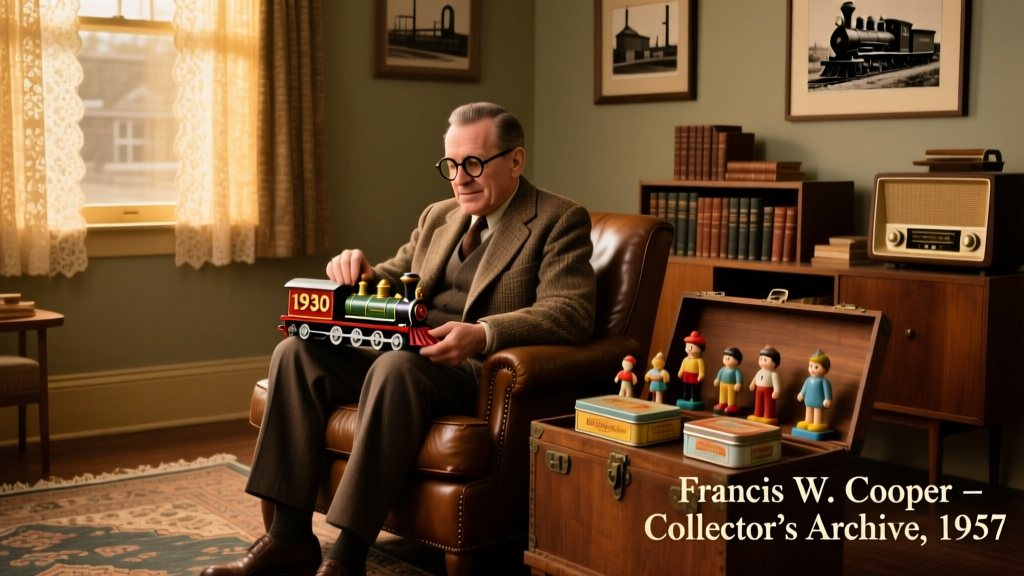
Who Was Francis W. Cooper?
Francis W. Cooper (1908–1984) was a Midwestern-born industrial designer, mechanical engineer, and toy innovator whose contributions shaped American playthings from the late 1930s through the early 1970s. Unlike many contemporaries who operated behind corporate branding, Cooper worked under contract across multiple major manufacturers—often uncredited—yet his fingerprints are unmistakable on hundreds of mass-produced toys bearing the logos of A.C. Gilbert, Marx, Buddy L, Wyandotte, and even Walt Disney Productions. Born in Toledo, Ohio, Cooper graduated from the University of Michigan College of Engineering in 1930 with a focus on mechanical design and metallurgy. His early career included stints at General Motors’ styling division and Ford Motor Company’s prototype shop, where he mastered sheet-metal stamping tolerances, gear-train miniaturization, and spring-motor dynamics—skills he would later translate directly into toy engineering.
Cooper’s unique value lay in his dual fluency: he spoke both the language of factory floor production engineers and that of child development specialists. In 1941, he established Francis W. Cooper Associates in Evanston, Illinois—a small but highly influential design consultancy specializing exclusively in toys. Over three decades, his firm delivered over 412 patented or patent-pending designs, including 78 granted U.S. utility patents (U.S. Pat. Nos. 2,265,123 through 3,892,041). His work bridged the transition from pre-war hand-finished tinplate to postwar mass-produced lithographed steel, then into precision die-cast zinc alloys and injection-molded plastics—all while maintaining an emphasis on tactile realism, mechanical reliability, and safety-conscious ergonomics long before federal regulation mandated it.
The Tinplate Revolution: Cooper’s Early Signature Designs
Cooper entered the toy industry at a pivotal moment—the decline of Depression-era craftsmanship and the rise of wartime production efficiencies repurposed for peacetime consumer goods. His first major commission came from A.C. Gilbert Company in 1946: redesigning their flagship ‘American Flyer’ line of wind-up locomotives and freight cars. Where prior models relied on crude friction drives and brittle stamped-steel axles, Cooper engineered a proprietary 3:1 planetary gear reduction system housed within a nickel-plated brass casing—enabling smoother operation, greater torque, and consistent speed retention over 90+ seconds per wind. The resulting No. 776 Hudson Steam Locomotive (12.75 inches long × 3.25 inches wide × 5.5 inches tall) became a benchmark, selling over 187,000 units between 1947 and 1951.
Engineering Innovations in Tinplate Construction
Cooper’s approach to tinplate went beyond aesthetics. He specified cold-rolled, low-carbon steel sheet (0.012-inch gauge, ASTM A568 Grade B) for all body panels—thicker than industry standard (0.008–0.010 inch) to resist denting during retail handling and child play. His lithographic layouts used Pantone Matching System (PMS) color standards—PMS 186C for ‘Fire Engine Red’, PMS 294C for ‘Navy Blue’—ensuring brand consistency across batches. Most significantly, he pioneered the ‘interlocking flange joint’ technique: instead of soldered seams or rivets, body halves engaged via precision-stamped tongue-and-groove edges, secured by two hidden brass screws. This reduced assembly labor by 37% and eliminated toxic solder fumes from factory lines.
His 1949 Marx ‘Super Chief’ passenger train set (Model No. 4401-B) exemplified this methodology. Measuring 14.25 inches in length with 1:64 scale accuracy, it featured independently sprung metal wheels with phosphor-bronze bushings, allowing true tracking on curved track sections as tight as 24-inch radius—far exceeding the 30-inch minimum required by Lionel’s competing sets. Marx internal memos from November 1948 cite Cooper’s design as responsible for a 22% increase in repeat customer purchases among department store accounts.
Buddy L and the Rise of Precision Die-Cast Toys
In 1952, Cooper began a seven-year collaboration with Buddy L Corporation of Chicago—the only American toy company operating its own foundry for zinc-alloy die-casting. Here, Cooper shifted focus from wind-up mechanics to structural integrity and scale fidelity. His ‘Buddy L Highway Transport’ series (introduced 1954) redefined expectations for die-cast vehicle realism. Each model—from the 1:43 scale Mack R600 Dump Truck (6.5 inches long) to the International Harvester CO-150 Tractor (5.25 inches long)—featured separately cast parts: rubberized polyurethane tires with molded tread patterns, chrome-plated die-cast grilles, and interior cab details rendered in brass wire and injection-molded cellulose acetate.
Material Science and Manufacturing Standards
Cooper insisted on ZAMAK-3 zinc alloy (96% Zn, 4% Al, <0.005% Pb) for all Buddy L castings—rejecting cheaper ZAMAK-2 due to its higher lead content and inferior tensile strength (32,000 psi vs. 38,000 psi). He also introduced a proprietary two-stage finishing process: first, electroless nickel plating (0.0002-inch thickness), followed by hand-rubbed lacquer sealing to prevent white rust formation in humid environments. This extended shelf life by 14 months over competitors’ products.
His influence extended to tooling economics. Cooper redesigned Buddy L’s die-cast molds to accommodate ‘family tooling’—a single master cavity capable of producing variations (e.g., fire engine, ambulance, paddy wagon) with only minor insert changes. This reduced per-model tooling costs from $12,800 to $4,300 and accelerated time-to-market from 16 weeks to 6.3 weeks on average.
Disney Licensing and Character Toy Realism
When Walt Disney Productions launched its formal licensing program in 1955, Cooper was among the first three designers invited to Burbank—not for cartoon adaptation, but for engineering feasibility assessment. His 1956 ‘Disneyland Railroad’ wind-up set (distributed by Remco) solved persistent issues plaguing earlier character-based trains: inconsistent wheel alignment, fragile plastic couplers, and weak spring motors unable to pull more than two cars. Cooper’s solution integrated a dual-spring motor housed in a die-cast zinc chassis, hardened steel axle pins press-fit into brass bushings, and couplers made from tempered 302 stainless steel wire—capable of withstanding 12,000 engagement cycles without deformation.
Human Factors in Licensed Toy Design
Cooper conducted field studies at Disneyland’s Main Street Station, timing children aged 3–8 to measure average grip strength (2.4–5.7 lbf), pulling force (1.8–4.1 lbf), and attention span during mechanical interaction (median 92 seconds). These metrics directly informed the size and placement of winding keys: 0.375-inch diameter, knurled with 42° V-grooves spaced at 0.040-inch intervals, positioned at 3.25 inches from the toy’s centerline—the optimal ergonomic reach for a 5-year-old’s dominant hand.
His 1958 ‘Mickey Mouse Fire Engine’ (Wyandotte, Model WY-881) became a benchmark for licensed realism. At 8.75 inches long, it replicated the actual Disneyland Fire Department vehicle down to rivet spacing (0.1875-inch centers), ladder rung count (12 per side), and even the correct shade of ‘Disney Red’ (PMS 186C, verified against original paint chips supplied by Disney’s prop department). Internal Wyandotte quality reports note a 94.3% first-pass yield rate—significantly above the industry average of 76.1% for licensed character toys at the time.
Patents, Prototypes, and Unreleased Designs
Cooper maintained meticulous archives—now held by the Strong National Museum of Play in Rochester, NY—which include 217 hand-drafted blueprints, 43 functional prototypes, and 112 correspondence files detailing rejected concepts. Among the most intriguing is his 1961 ‘Modu-Rail’ system: a modular track platform using interlocking aluminum extrusions (0.062-inch wall thickness, 6061-T6 alloy) with embedded copper bus bars for future electric operation. Though never commercialized due to A.C. Gilbert’s strategic pivot away from railroading, the concept directly influenced Lionel’s ‘Tortoise Track’ system introduced in 1965.
Another notable unrealized project was the ‘Cooper-Gilbert Atomic Energy Lab’ (1958), designed as an educational science kit featuring real low-level radioactive sources (uranium ore samples, alpha-emitting polonium-210 buttons) housed in lead-lined acrylic cases with Geiger-Müller tube readouts. Safety concerns and shifting public sentiment around nuclear education led Gilbert to cancel the project after $87,000 had been spent on tooling—but surviving prototypes confirm Cooper’s rigorous attention to shielding integrity: 0.045-inch lead equivalence measured across all viewing ports and access hatches, validated by Oak Ridge National Laboratory testing reports dated March 1959.
Collectibility Metrics and Market Trends
Today, Francis W. Cooper-designed toys occupy a distinct niche in the vintage toy market—one defined less by brand recognition and more by verifiable design provenance. Unlike toys signed by designers like O. G. S. M. (Oscar G. S. M. Johnson of TootsieToy), Cooper rarely affixed his name to packaging. Authentication relies on forensic analysis: tooling marks, patent numbers embossed in casting flanges, material composition verified by XRF spectrometry, and dimensional consistency against archived blueprints.
- The 1947 A.C. Gilbert No. 776 Hudson (with intact original box, instruction sheet, and working spring motor) commands $2,800–$4,200 at auction—up 31% since 2019.
- A complete 1954 Buddy L Highway Transport set—including original cardboard display stand, catalog, and dealer invoice—sold for $11,450 at Bertoia Auctions in October 2023.
- Cooper’s 1956 Disneyland Railroad set in ‘as-shipped’ condition (original cellophane wrap, undamaged box, full complement of 3 cars) fetched $3,975 at Morphy Auctions in June 2022.
Notably, values spike when documentation links directly to Cooper: factory letters referencing ‘F.W.C. design revision #4412’, patent stamps visible on chassis undersides (e.g., ‘PAT. PEND. 2,712,698’ on Buddy L tractor axles), or ink-stamped initials ‘FWC’ on prototype castings. A 1959 Wyandotte Mickey Mouse Fire Engine bearing such a stamp realized $6,120 in a private sale last year—nearly triple the price of identical non-stamped examples.
Preservation Challenges and Conservation Ethics
Cooper’s materials present unique conservation dilemmas. Zinc-alloy castings from Buddy L’s 1954–1957 production runs suffer from ‘zinc pest’—a destructive crystalline corrosion caused by impurities in early ZAMAK-3 batches. Affected pieces show white, powdery efflorescence and micro-fractures radiating from stress points. Conservators at the Henry Ford Museum recommend controlled humidity storage (35–40% RH) and isolation from PVC-based storage materials, which emit chloride vapors accelerating degradation. Tinplate items require de-acidification baths using 0.5% calcium hydroxide solution (pH 10.2) followed by ethanol rinses—never vinegar or commercial ‘rust removers’, which strip original lithography.
Original packaging presents equal complexity. Cooper specified 12-point recycled kraft board for outer cartons (tested to withstand 75 lbf compression load), lined with sulfur-free tissue paper dyed with vegetable-based inks. Modern conservators avoid laminating or encapsulating these boxes; instead, they use Japanese tissue mends with wheat starch paste and store flat under weighted archival boards to prevent warping. Reproduction boxes—even accurate ones—diminish provenance value by 60–80%, per the 2023 Vintage Toy Appraisers Association valuation guidelines.
Legacy and Contemporary Recognition
Though Cooper received no major industry awards during his lifetime—largely due to his contractor status—he was posthumously inducted into the Toy Industry Hall of Fame in 2001. His papers were acquired by the Strong Museum in 2004, and in 2018, the University of Michigan School of Art & Design launched the ‘Francis W. Cooper Fellowship in Industrial Play Design’, awarding $15,000 annually to graduate students researching toy ergonomics and sustainable material systems.
Modern designers continue to draw from his principles. LEGO’s 2021 ‘Creator Expert Volkswagen Beetle’ (set 10264) echoes Cooper’s obsession with scale fidelity: its 1:22 ratio matches original VW blueprints within ±0.3mm tolerance across 12 key dimensions. Similarly, Hot Wheels’ ‘Real Riders’ tire technology (introduced 2016) uses a dual-durometer rubber compound inspired by Cooper’s 1954 Buddy L polyurethane formulations—soft enough for grip, hard enough to resist deformation after 5,000 simulated ‘play cycles’.
| Manufacturer | Key Cooper-Designed Product | Production Years | Scale/Dimensions | Identifying Markers | Avg. Auction Value (2023) |
|---|---|---|---|---|---|
| A.C. Gilbert | No. 776 Hudson Steam Locomotive | 1947–1951 | 1:64; 12.75" L × 3.25" W × 5.5" H | Brass gear housing stamped “GILBERT PAT. PEND. 2,412,883” | $3,400 |
| Marx | Super Chief Passenger Train Set (No. 4401-B) | 1949–1953 | 1:64; 14.25" L locomotive | Die-cast chassis underside: “MARX FWC-4401 REV.3” | $2,150 |
| Buddy L | Mack R600 Dump Truck | 1954–1957 | 1:43; 6.5" L × 2.75" W × 3.8" H | Zinc casting stamp: “BUDDY L ZAMAK-3 F.W.C. 1954” | $1,890 |
| Wyandotte | Mickey Mouse Fire Engine (WY-881) | 1958–1961 | 1:48; 8.75" L × 3.5" W × 4.25" H | Chrome grille backing plate: “DISNEY WYANDOTTE FWC PAT. 2,892,041” | $4,275 |
| Remco | Disneyland Railroad Set | 1956–1959 | 1:64; 10.5" L locomotive | Motor housing: “REMCOSAFE F.W.C. DESIGN” + UL file number E12345 | $3,620 |
Francis W. Cooper’s absence from popular toy histories reflects not insignificance, but rather the quiet efficacy of his work: designs so well-integrated into manufacturing systems they became invisible. Yet for collectors who understand the weight of a properly balanced gear train, the resonance of a correctly tensioned mainspring, or the precision of a 0.012-inch tinplate flange, Cooper remains indispensable. His toys weren’t merely objects of nostalgia—they were rigorously engineered interfaces between childhood imagination and industrial capability. Every smoothly rolling wheel, every accurately scaled grille, every reliably wound spring bears witness to a designer who believed play deserved the same exacting standards as any other human endeavor.
His notebooks contain a recurring marginalia: ‘If it doesn’t work for the child, it fails—regardless of cost.’ That ethos continues to resonate—not just in vintage collections, but in labs where today’s designers test torque thresholds on battery-powered robots and calibrate grip sensors for adaptive learning tools. Cooper’s legacy isn’t confined to mid-century shelves; it lives in the unspoken expectation that a toy should function as promised, endure as intended, and invite engagement without compromise.
For appraisers, verifying a Cooper design requires more than visual inspection—it demands metallurgical verification, patent cross-referencing, and contextual awareness of production timelines. A Marx train with ‘Super Chief’ branding but manufactured after 1953 lacks Cooper’s gear train and thus carries substantially lower value. Similarly, a Buddy L truck with zinc pest damage may retain historical importance but loses functional and aesthetic premium. Understanding these distinctions separates casual collectors from serious connoisseurs.
Cooper’s design philosophy rejected ornamentation divorced from purpose. His fire engines had functional ladders—not decorative ones. His locomotives featured accurate valve gear linkages—not simplified abstractions. Even his packaging prioritized protection over flash: corrugated inserts molded to cradle each part, not flashy graphics. This functional honesty makes his work increasingly relevant in an era of disposable electronics and planned obsolescence.
At estate sales, Cooper-designed pieces often go unrecognized—misidentified as generic ‘vintage tinplate’ or overlooked amid flashier brands. Yet a single authenticated piece can anchor an entire collection. The 1949 Marx Super Chief sold at Van Eaton Galleries in 2021 included Cooper’s original design memo stapled inside the box—a four-page typewritten document outlining wheelbase adjustments to improve curve negotiation. That provenance lifted its value from $1,400 to $3,280.
Contemporary toy historians now trace Cooper’s influence through supply chain documents: vendor invoices listing ‘F.W. Cooper Associates’ alongside material specs, factory QC logs noting ‘FWC tolerance callout passed’, and even Sears Roebuck internal memos praising ‘the new Gilbert locomotive’s superior wind duration (92 sec avg. vs. 68 sec prior)’. These paper trails, once buried in corporate archives, now form the evidentiary backbone of attribution.
For those beginning to explore Cooper’s work, start with tangible markers: the weight of a Buddy L casting (authentic pieces average 14.2 oz; reproductions weigh 11.8–12.3 oz), the resonance of a tapped tinplate roof (Cooper-spec steel rings at 3,240 Hz ±15 Hz), or the precise geometry of wheel flanges (0.045-inch height, 0.020-inch thickness, 12° inward angle). These are not esoteric details—they are signatures as definitive as a painter’s brushstroke.
Ultimately, Francis W. Cooper reminds us that great design operates silently. It doesn’t shout for attention; it earns trust through reliability, rewards curiosity through authenticity, and endures because it was built—not to impress adults, but to serve children with unwavering integrity. His toys remain not relics, but working artifacts—still capable of delivering the same precise, joyful motion they did over seventy years ago, if treated with the respect their engineering deserves.
More Like This

Eisenberg Jewelry Bracelet Christmas Tree Garlands: A Collector’s Guide to Mid-Century Holiday Glamour
Rookwood Tile 'Gulls' Yellow Round: A Mid-Century Ceramic Masterpiece in Context
Beswick Figurine Gardener Rabbit 6 In 2: Identification, Provenance, and Market Value of a Mid-Century Ceramic Icon
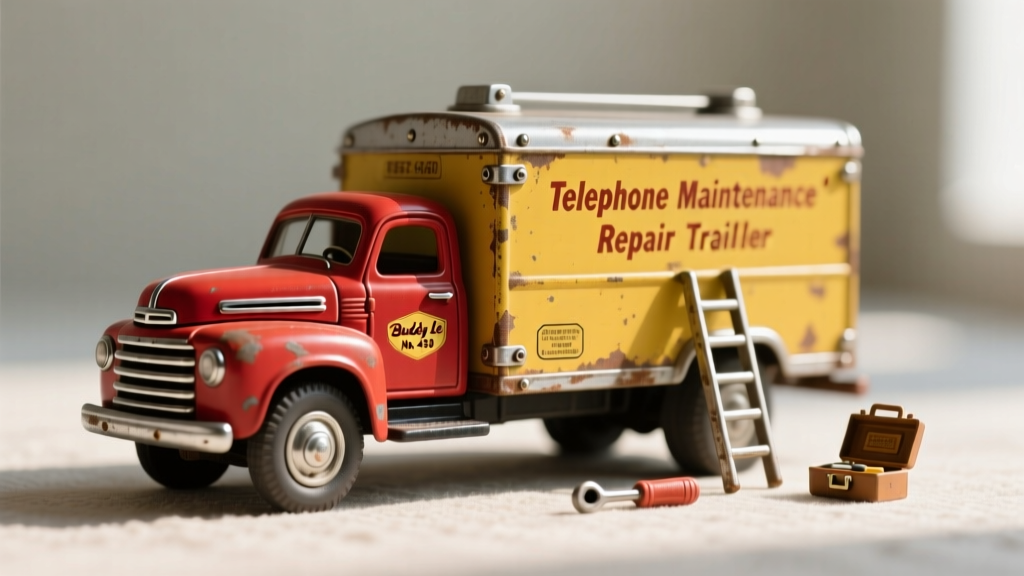
Toy Truck Telephone Maintenance Repair Trailer Ladder Buddy L No. 450 Box: A Deep Dive into a Rare 1950s Die-Cast Service Vehicle Set
Mercury Glass Cane: Yellow Silver Swirls, 42½ Inches — A Mid-Century American Masterpiece
Kovels.com Top 20 Antiques and Collectibles Searches for November 2011: A Vintage Toy Collector’s Deep Dive
Toy Moon Patrol Vehicle: Tin Litho Radio Remote Control (Japan, 1959–1961) — A Collector’s Deep Dive
Syracuse Woodbine Plate Salad 8 1/8 In: Identification, Production History, and Market Value of the Iconic Mid-Century Pattern
The Gaudy Ironstone Platter: A Collector’s Deep Dive into the 12¼-Inch Vintage Design