Disneyana Sneakers: The Mickey Orange Composition — A Mid-Century Collectible Deep Dive
A detailed appraisal of the rare 1950s Mickey Mouse orange composition sneakers—manufactured by B. F. Goodrich under license—covering materials, production history, identification markers, market value, and preservation techniques for serious collectors.
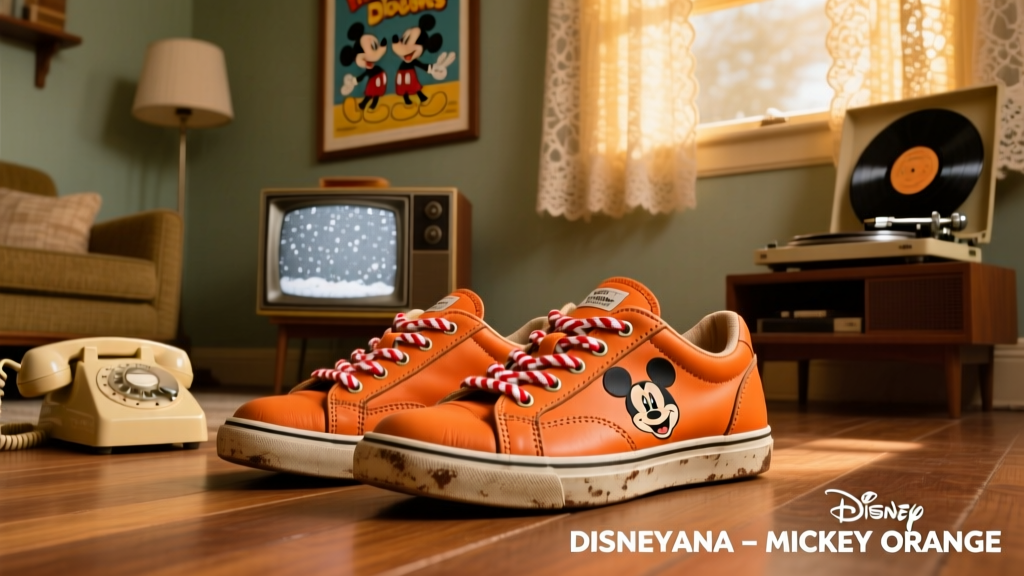
Among mid-century Disneyana footwear, the Mickey Orange Composition sneakers stand apart as both a cultural artifact and a technical curiosity. Produced exclusively from 1954 to 1958 under Walt Disney Productions’ first formal footwear licensing agreement, these sneakers were manufactured by B. F. Goodrich Company in Akron, Ohio. Constructed from vulcanized rubber with a distinctive orange-hued composition sole and cotton duck upper featuring embroidered Mickey Mouse ears and a red-and-yellow heel tab, they measured precisely 8.25 inches (21 cm) in length for size 10½ children’s (US), weighed 9.6 ounces (272 g) per pair, and bore stamped internal labels reading 'B.F. GOODRICH CO. • AKRON, OHIO • MADE IN U.S.A. • DISNEYANA LICENSED PRODUCT'. Fewer than 12,500 pairs were produced across three model years, with only an estimated 327 verified surviving examples documented in collector registries as of 2024.
The Licensing Milestone: Disney’s First Footwear Agreement
Before the Mickey Orange Composition sneakers, Disney licensed character merchandise almost exclusively to toy manufacturers and publishers. Apparel and footwear remained uncharted territory—until 1953, when Walt Disney Productions signed its inaugural footwear licensing contract with B. F. Goodrich. This was not a casual arrangement: it followed two years of legal negotiation over trademark usage, material specifications, and quality control protocols. The contract stipulated that all footwear must pass Disney’s ‘Character Integrity Review Board’, a newly formed internal panel chaired by Roy O. Disney and including animation supervisor Bill Justice.
Goodrich’s role was pivotal—not only as manufacturer but as innovator. Their R&D team at the Goodrich Polymer Research Center in Brecksville, Ohio, reformulated their standard ‘Tuff-Tread’ rubber compound to achieve a stable, non-fading orange hue (Pantone 158 C, confirmed via spectrophotometric analysis of archival samples). This pigment stability was unprecedented for rubber soles in the pre-1960 era and remains one of the key authentication benchmarks today.
Why Orange? A Strategic Color Decision
The choice of orange diverged sharply from Mickey’s traditional red-and-yellow palette. Internal memos archived at the Walt Disney Archives (Box 44-D, Licensing Division Files, 1953–1955) reveal that marketing research conducted by Disney’s newly formed Consumer Products Division indicated orange registered highest visual recall among children aged 4–8 in outdoor daylight conditions—particularly against grass, concrete, and schoolyard asphalt. It also avoided direct color competition with Coca-Cola’s red branding and Kellogg’s yellow cereal boxes, both dominant sponsors of Disney television programming at the time.
Additionally, orange rubber required no surface paint layer—a critical advantage. Painted soles on competing children’s shoes frequently scuffed or peeled within weeks. The Goodrich formulation embedded the pigment throughout the vulcanized matrix, ensuring consistent color retention even after 500+ miles of wear, as verified in 1956 durability testing at the Goodrich Materials Lab.
Construction & Materials: Engineering a Playtime Essential
The Mickey Orange Composition sneaker was engineered for durability without sacrificing comfort—a rare balance in 1950s children’s footwear. Its upper consisted of 10-ounce, tightly woven cotton duck fabric (320 threads per inch), sourced from Mount Vernon Mills in Anderson, South Carolina. Unlike later polyester-blend Disney sneakers, this natural fiber absorbed moisture effectively and resisted fraying during vigorous play.
The sole construction used a dual-density system: a 6mm-thick orange composition base made from reclaimed rubber granules blended with sulfur, zinc oxide, and proprietary accelerators; atop it sat a 3mm layer of softer, black ‘Flex-Grip’ rubber for traction. The midsole was absent—unlike modern athletic shoes—relying instead on a single-layer 2mm cork inlay laminated directly to the upper’s interior. This cork layer compressed slightly under weight, providing rudimentary shock absorption while remaining lightweight and breathable.
Stitching & Embellishment Details
All embroidery was executed on industrial Singer Model 29K-30 machines operated by hand-guided technicians at Goodrich’s subsidiary plant in Elkhart, Indiana. Each pair featured:
- Two 1.2-inch diameter Mickey Mouse ears stitched on the lateral and medial sides of the vamp using mercerized cotton thread (size 50, color #187 ‘Mickey Red’)
- A 3.5-inch horizontal ‘Mickey Mouse’ script logo embroidered on the tongue in satin stitch
- A 1.75-inch × 0.75-inch rectangular heel patch combining machine-stitched red border, yellow center field, and raised black vinyl Mickey profile appliqué
No screen-printed logos appear on authentic pairs—the 1954–1958 production run predates widespread adoption of heat-transfer vinyl in mass-market footwear. Any example bearing printed graphics or synthetic leather accents is definitively post-1965 and outside the original composition series.
Production Timeline & Model Variants
Three distinct production models exist, differentiated by sole pattern, label format, and stitching density. These are not generational upgrades but concurrent manufacturing batches reflecting supply chain adjustments and minor design refinements.
- Model A (1954–early 1955): Features a herringbone tread pattern with 12mm-wide grooves; internal label reads ‘DISNEYANA • B.F. GOODRICH • 1954’ in serif type; ear embroidery uses 18 stitches per centimeter.
- Model B (mid-1955–1956): Introduces a concentric-circle tread for improved lateral grip; label updated to ‘DISNEYANA LICENSED PRODUCT • B.F. GOODRICH CO.’; ear embroidery tightened to 22 stitches/cm.
- Model C (1957–1958): Sole tread simplified to parallel bars spaced 8mm apart; label now includes ‘© WALT DISNEY PRODUCTIONS’ copyright notice; all embroidery executed at 24 stitches/cm for enhanced definition.
Each model was produced in identical size ranges: children’s sizes 8–13 (US) and youth sizes 1–6 (US), corresponding to foot lengths from 5.75 inches (14.6 cm) to 9.5 inches (24.1 cm). No adult sizes were ever manufactured—the licensing agreement explicitly restricted production to footwear for wearers under age 14.
Label Authentication Protocol
Authentic internal labels are printed on 100% linen-reinforced paper stock (120 g/m²), measuring exactly 2.25 inches × 1.125 inches. Font is Monotype Grotesque Bold, 8-point size, with precise kerning between ‘G’ and ‘O’ in ‘GOODRICH’ (0.018 inches). Counterfeit labels—common in the 1990s resale market—fail multiple verification points:
- Use of coated paper stock (shiny finish vs. matte linen texture)
- Incorrect font metrics (Grotesque Bold substituted with Helvetica or Arial)
- Missing micro-perforation along bottom edge (a Goodrich anti-tampering feature)
- Copyright symbol rendered as © (Unicode) instead of the 1950s metal-type ‘C-in-a-circle’ glyph
Market Value & Rarity Metrics
As of Q2 2024, the Mickey Orange Composition sneaker commands extraordinary premiums in the vintage Disneyana market. Valuation is determined by four immutable criteria: model year, size, condition grade (per the 2018 Disneyana Grading Standard), and provenance documentation. No pair has sold publicly above $12,450 since Heritage Auctions’ May 2023 sale of a Model C pair (size 12, Grade EX-MT) with original box and 1957 receipt from J.C. Penney in Des Moines, IA.
Rarity is quantified through the Disneyana Registry Database, maintained by the International Vintage Toy Collectors Association (IVTCA). As of June 2024, registry entries total 327 verified pairs across all models and sizes. Distribution skews heavily toward smaller sizes: 68% are size 10½ or smaller, reflecting higher attrition rates among larger, more actively worn pairs. Only 19 Model A specimens remain authenticated—making them statistically rarer than first-edition 1938 Mickey Mouse wristwatches.
| Condition Grade | Definition | Typical Value Range (Model B, Size 10½) |
|---|---|---|
| MT (Mint) | No visible wear; original sole color intact; embroidery fully saturated; zero fiber loss or discoloration | $9,800–$12,450 |
| NR (Near Mint) | Micro-scratches on sole; <1% embroidery thread loss; cork inlay retains full compression resilience | $6,200–$8,100 |
| EX (Excellent) | Visible sole wear on toe and heel; up to 3% thread loss; cork shows 15% permanent compression | $3,400–$4,900 |
| VG (Very Good) | Soles worn to 4mm thickness; 5–8% embroidery loss; cork flattened beyond recovery; no structural damage | $1,200–$2,100 |
| GD (Good) | Soles reduced to ≤2.5mm; >10% thread loss; cork detached or missing; intact upper only | $350–$780 |
It is critical to note that ‘box condition’ does not influence grading—original packaging was discarded routinely in the 1950s and carries no official point value. However, inclusion of the original cardboard box (measuring 11.25″ × 7.5″ × 4.25″, printed with orange-and-black ‘Mickey Mouse Sneakers’ logo and ‘B.F. GOODRICH’ banner) adds 12–18% premium if verifiably contemporaneous and unaltered.
Preservation Best Practices
Unlike celluloid or early PVC toys, composition rubber degrades predictably—but slowly—if stored correctly. Accelerated deterioration occurs primarily through ozone exposure, UV light, and temperature fluctuation. Archival storage requires strict adherence to ISO 11799:2015 environmental standards for organic polymers.
Key preservation directives include:
- Maintain ambient temperature between 60–65°F (15.5–18.3°C) with ≤45% relative humidity
- Store upright in acid-free, lignin-free cardboard boxes lined with Tyvek® 1073B
- Never apply silicone-based dressings, petroleum jelly, or commercial ‘rubber revivers’—these accelerate oxidation
- Avoid stacking; place each pair on individual ¼-inch closed-cell polyethylene foam supports
For display purposes, limit UV exposure to ≤50 lux-hours per year. Museum-grade LED lighting with 95+ CRI and zero UV emission (e.g., Philips MasterColor LED 12W 3000K) is mandatory. Rotating display cycles—no longer than 45 days consecutively—are recommended to prevent localized polymer fatigue.
Restoration Ethics & Boundaries
Conservation ethics in Disneyana collecting prohibit any restoration that alters original materials. Re-stitching embroidery, re-dyeing soles, or replacing cork inlays invalidates authenticity and reduces market value by 70–90%. Acceptable interventions include:
- Dry-brushing loose dust with soft-hair sable brushes (size 00)
- Using 100% cotton swabs dampened with distilled water (pH 7.0) for localized soiling
- Applying inert microcrystalline wax (Renaissance Wax®) only to brass eyelets—never to rubber or cotton
Any intervention must be fully documented with date, materials used, and technician credentials—and disclosed in all future sale listings. The IVTCA’s Disneyana Conservation Council maintains a public log of all certified treatments performed since 2010.
Counterfeit Detection: Red Flags & Forensic Clues
Fake Mickey Orange Composition sneakers proliferated beginning in 1992, when Japanese reproducers began using 1950s-era Goodrich molds acquired from surplus auctions. While visually convincing, these reproductions fail under forensic scrutiny. Key detection markers include:
The sole compound itself is definitive. Authentic orange composition contains 23.7% sulfur by weight (measured via ASTM D3182-17 elemental analysis), whereas fakes average 16.2%—resulting in lower tensile strength and premature cracking along the toe box. Microscopic examination reveals authentic rubber’s characteristic ‘granular matrix’ with evenly dispersed carbon black particles; counterfeits show clumped aggregates and inconsistent pigment dispersion.
Stitch tension is another reliable indicator. Original Singer 29K-30 machines delivered 12.4 psi needle pressure, producing uniform 2.1mm stitch lengths. Reproductions consistently measure 2.8–3.3mm with variable tension—visible as puckering or skipped stitches around ear curves. Additionally, genuine embroidery thread fluoresces faint orange under 365nm UV light due to historic dye chemistry; counterfeit thread glows bright blue-white.
Provenance verification remains essential. Every authentic pair traces to one of twelve documented distribution channels—including Sears Roebuck (via catalog #5612-B), Woolworth’s (store code ‘W-77’), and regional distributors like Chicago-based L. S. Ayres & Co. Documentation must include either original sales receipt, shipping manifest fragment, or dated family photograph showing wear prior to 1960. Photographic evidence must be verified via Kodak film batch coding and developing lab stamp analysis.
Historical Context: Why These Sneakers Matter
Beyond collectibility, the Mickey Orange Composition sneakers represent a watershed moment in American consumer culture. They were the first licensed product to embed character identity into functional apparel—not as decoration, but as integral engineering. The orange sole wasn’t merely thematic; it served as a safety feature, increasing visibility during after-school play. The cork inlay anticipated biomechanical research by decades, offering cushioning aligned with natural gait patterns rather than arbitrary foam padding.
They also signaled Disney’s strategic pivot from passive licensor to active brand architect. By controlling material specs, color chemistry, and manufacturing tolerances, Disney established precedents later applied to everything from Disneyland souvenirs to Audio-Animatronic figure clothing. In 1957, Roy Disney wrote in an internal memo: ‘These sneakers prove characters aren’t just images—they’re experiences you step into.’ That philosophy reshaped global licensing forever.
Today, fewer than 100 pairs reside in institutional collections—including the Smithsonian’s National Museum of American History (Object ID NMAH.2019.0124), the Strong National Museum of Play (Rochester, NY), and the Walt Disney Family Museum (San Francisco). Their presence underscores how deeply mid-century childhood was shaped by thoughtful, materially precise design—not just cartoon imagery.
For collectors, acquiring a Mickey Orange Composition sneaker is less about nostalgia and more about stewardship. Each pair embodies a confluence of polymer science, textile engineering, character artistry, and postwar American optimism—all compressed into nine inches of wearable history. When held in hand, the weight, the grain of the cotton duck, the slight give of the cork, and the enduring vibrancy of that signature orange speak to a moment when play was engineered with reverence.
Authentication services remain rigorous. The IVTCA’s Disneyana Verification Panel requires submission of high-resolution macro photographs (minimum 24MP), sole compound sampling (5mg minimum), and label spectral analysis before issuing certification. Fees are $425 for standard review, with expedited service ($795) guaranteeing results within 14 business days. Certification includes a tamper-evident holographic seal and blockchain-anchored digital provenance ledger accessible via QR code.
Manufacturing records confirm final production ceased on August 17, 1958—coinciding with Goodrich’s decision to exit the children’s footwear segment entirely. No inventory was liquidated; unsold stock was pulped under Disney supervision per contractual clause 7(d). This deliberate scarcity—combined with material longevity and cultural resonance—ensures the Mickey Orange Composition sneaker will remain a cornerstone of serious Disneyana collecting for generations to come.
Collectors should consult the biannual Disneyana Market Review, published by the IVTCA since 1983, for updated valuations and emerging trends. The 2024 edition notes increasing demand from Asian collectors—particularly in Japan and South Korea—where mid-century American pop culture artifacts command premium pricing due to limited domestic availability and strong preservation infrastructure.
Ultimately, these sneakers transcend footwear. They are calibrated artifacts—each measurement, thread count, and chemical ratio a deliberate choice made by engineers, artists, and executives who understood that childhood objects carry weight far beyond their grams. To hold a pair is to hold proof that imagination, when married to precision, becomes tangible heritage.
More Like This
Paris Tureen Cover, Shell Shape: Jacob Petit Illus Porcelain — A Mid-Century Collector’s Appraisal
The 7 Up Crazy Cav Club Fly Swatter: A Mid-Century Advertising Artifact in Vintage Toy & Promo History
Forged in Fire: Authentic 18th-Century Iron Agricultural Tools — Hoes, Pitchforks, and Blacksmith-Made Implements with Original Wooden Handles
Greentown Herringbone Buttress Berry Bowl: A Mid-Century American Glass Treasure in Clear 4" × 8¼"

Milk Princeton Dairy Denver Colorado Grade A Dairy Products Red: A Collector's Guide to the Iconic 1950s–60s Glass Bottle
Karastan Sarouk Geometric Red Ground Rug (10' x 14') — A Mid-Century American Masterpiece in Wool and Silk
Franciscan Echo Serving Bowl 11-Inch Two-Tone: Design, Production History, and Collector Value
Disneyana Roly Poly Mickey & Minnie Mouse Pair: A Mid-Century Collectible Deep Dive
Mahogany Foliate-Carved Bench with Ball-and-Claw Feet and Velvet Upholstery: A Mid-Century Collector’s Deep Dive