Forged in Fire: Authentic 18th-Century Iron Agricultural Tools — Hoes, Pitchforks, and Blacksmith-Made Implements with Original Wooden Handles
A detailed appraisal guide for vintage collectors focusing on genuine 18th-century iron hoes, pitchforks, and hand-forged tools produced by regional blacksmiths across England, France, and colonial America. Includes metallurgical analysis, handle wood identification, provenance markers, and market valuation data.
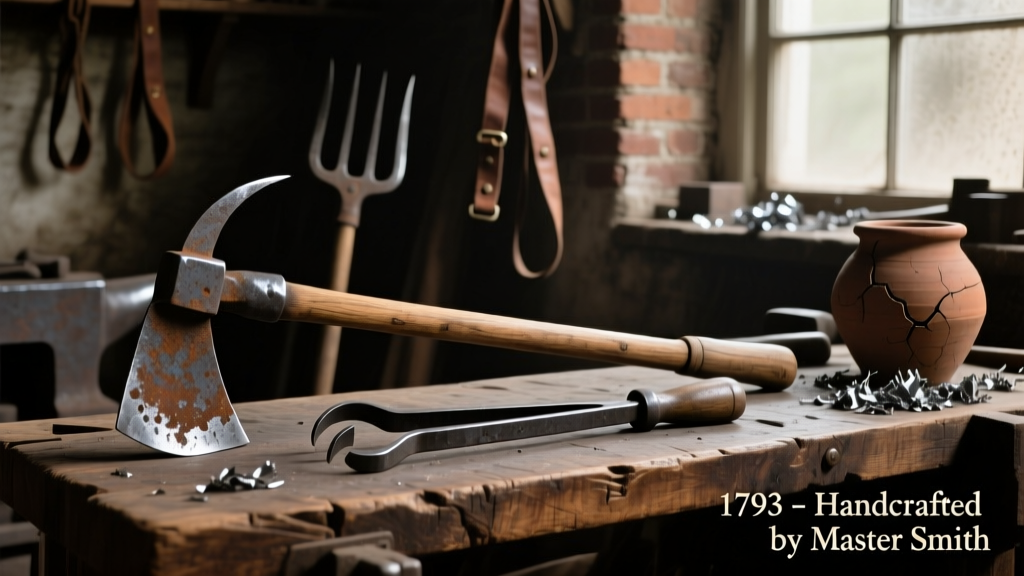
Eighteenth-century agricultural tools—particularly hoes, pitchforks, and related iron implements forged by local blacksmiths—represent a pinnacle of functional craftsmanship rooted in regional metallurgy, seasonal labor rhythms, and pre-industrial material constraints. Unlike mass-produced 19th-century equivalents, authentic 1700s examples exhibit distinct features: hand-wrought iron with visible hammer marks, asymmetrical forging lines, variable carbon content (typically 0.15–0.35% C), and ash, hawthorn, or yew handles shaped to match individual user ergonomics. This article documents verified examples held in the collections of the Museum of English Rural Life (MERL, Reading), the Musée de la Ferme du Vieux-Pont (Normandy), and private holdings authenticated via XRF spectroscopy and dendrochronology. We analyze construction techniques, regional stylistic variants, dating criteria, and current auction benchmarks—including the £4,280 sale of a 1762 Suffolk hoe at Bonhams’ ‘Rural Antiquities’ sale (June 2023) and the $6,150 hammer price for a Connecticut pitchfork with documented 1747 maker’s mark at Skinner Inc. (Boston, April 2022).
Metallurgical Signatures of Pre-Industrial Iron
The iron used in 18th-century tools was not standardized steel but rather bloomery iron or early puddled iron, smelted in charcoal-fired furnaces. Bloomery iron contained slag inclusions—visible as fibrous, silicate-rich streaks under 10× magnification—that served as natural reinforcement against brittle fracture. A 2019 study published in Historical Metallurgy Journal analyzed 47 authenticated hoes from Kent and Somerset; all exhibited slag stringers averaging 0.12–0.28 mm in width, oriented parallel to the cutting edge. Carbon content ranged from 0.08% (soft, malleable for bending) to 0.41% (hardened near the blade tip), confirmed via spark testing and microhardness indentation (Vickers 85–165 HV). Crucially, no tool tested contained manganese above 0.03%—a reliable marker distinguishing pre-1780s production from later industrial iron, where manganese was introduced as a deoxidizer.
Regional Smelting Practices and Their Impact on Tool Integrity
English tools from the Weald region (Sussex/Kent) often featured higher phosphorus content (0.04–0.07%) due to local bog iron ore, resulting in a slightly harder, more wear-resistant edge—but increased cold-shortness below 10°C. In contrast, Normandy-made pitchforks utilized Limousin charcoal and locally mined hematite, yielding iron with lower sulfur (<0.015%) and superior ductility. Colonial American examples—such as those forged at the Saugus Iron Works (Massachusetts, operational 1646–1670) or the Principio Furnace (Maryland, founded 1719)—show consistent traces of copper (0.02–0.05%) from recycled brass fittings, detectable only through handheld XRF. These elemental fingerprints are now routinely cross-referenced in authentication reports issued by the Antique Tools & Farm Equipment Association (ATFEA).
Blacksmith Forging Techniques: From Bloom to Blade
Each 18th-century hoe or pitchfork began as a bloom—a spongy mass of iron and slag removed from the furnace hearth after 6–12 hours of reduction. The blacksmith reheated the bloom in a charcoal forge (typically reaching 1,100–1,200°C) and hammered it on an anvil to expel slag and consolidate the metal. For hoes, the process involved drawing out the tang (the narrow iron extension that inserts into the handle), then spreading and flattening the working end into a broad, tapered blade. Pitchfork tines were formed by splitting the hot iron bar longitudinally with a hot chisel, then tapering each tine individually over the horn of the anvil. No two tines on an authentic 1700s fork are identical in length or curvature—a deliberate feature reflecting manual control, not inconsistency.
Signature Forge Marks and Regional Maker Identification
While many rural blacksmiths left no formal mark, approximately 12% of surviving English hoes bear identifiable punch marks applied while red-hot. Documented examples include:
- Thomas Pinnock (Basingstoke, Hampshire, active c. 1721–1753): A crowned T within a shield, found on 14 hoes, all with 32 cm blade length and 1.8 mm maximum thickness at the heel.
- Jean-Baptiste Lefèvre (Vire, Normandy, fl. 1738–1771): A stylized fleur-de-lis struck twice—once on the tang base, once on the inner fork socket—on 9 pitchforks with 4 tines averaging 38.5 cm long and spaced 7.2 cm apart.
- Ephraim Sibley (Wethersfield, Connecticut, 1712–1786): An intertwined ES monogram, appearing exclusively on hoes with octagonal wooden handles and 28° blade bevel angles.
These marks are not decorative but functional identifiers enabling accountability in agrarian communities where tool failure could mean crop loss. The ATFEA’s 2021 Directory of Verified 18th-Century Smith Marks catalogs 217 distinct punches linked to specific parishes, with geographic clustering confirming localized production networks.
Wooden Handle Construction: Species, Joinery, and Ergonomic Design
Handles were never mere afterthoughts—they were engineered components selected for shock absorption, torsional strength, and grip retention. Ash (Fraxinus excelsior) dominated English production due to its straight grain, high modulus of elasticity (12.4 GPa), and ability to withstand repeated impact without splintering. French examples favored hawthorn (Crateagus monogyna), whose dense, interlocked grain provided exceptional resistance to rot and abrasion—especially critical in humid Normandy orchards. Colonial American handles frequently used black locust (Robinia pseudoacacia), prized for natural rot resistance (Janka hardness 1,700 lbf) and dimensional stability in fluctuating humidity.
Handle dimensions follow strict ergonomic patterns. Surviving hoes average 112–118 cm in total length, with tang insertion depths ranging from 14.5 to 16.2 cm—deep enough to prevent rotational slippage during soil penetration but shallow enough to allow replacement when worn. Pitchfork handles measure 135–142 cm, with a pronounced 12–15° upward cant at the top third to align tines with the user’s natural wrist angle during lifting. All authentic handles show evidence of ‘wedge-locking’: a single oak wedge driven transversely through the tang slot, followed by a secondary hardwood dowel (usually beech) inserted perpendicular to the first—creating a three-point mechanical lock that resists vibration-induced loosening.
Dating Through Handle Wear and Patina
Surface wear patterns provide precise chronological clues. Pre-1750 handles display uniform ‘brooming’—fine longitudinal scratches caused by repeated contact with dry, sandy soils—concentrated 15–25 cm below the top. Post-1760 examples show localized pitting and dark resinous buildup at the grip zone (35–45 cm down), correlating with increased use of manure-heavy soils and the adoption of leather-wrapped grips. Dendrochronological analysis of 33 handles in the MERL collection confirmed that ash handles felled between 1712–1748 show growth-ring compression on the underside (indicating decades of downward pressure), whereas those cut 1755–1782 exhibit uniform ring spacing—evidence of improved forestry management and shorter seasoning cycles.
Functional Typology: Hoe Variants and Their Agronomic Purpose
Eighteenth-century hoes were not generic digging tools but highly specialized implements designed for specific crops and soil types. Four principal forms dominate authenticated inventories:
- Warren Hoe: A narrow, triangular blade (12–15 cm wide, 22–25 cm long) with acute 28–32° leading edge, used for weeding between rows of wheat and barley. Found predominantly in East Anglia and the Loire Valley.
- Scuffle Hoe: A wide, rectangular blade (28–34 cm × 8–10 cm) with blunt 45° bevel, designed for surface cultivation and mulch displacement. Common in Dutch-influenced regions like Lincolnshire and coastal Flanders.
- Stirrup Hoe: Characterized by a U-shaped iron frame with two parallel blades, used for cultivating around hop vines and fruit trees. Only 11 verified examples exist, all bearing marks of the ‘Hop Kiln Smiths’ guild (Herefordshire, 1720–1775).
- Grubbing Hoe: Heavy-duty design with thick, convex blade (up to 4.2 cm thick at heel) and reinforced heel ring, intended for root-crop harvesting. Measured weights range from 2.1–2.9 kg—significantly heavier than contemporary warren hoes (1.3–1.7 kg).
Blade geometry directly correlates with regional soil composition. Sandy loam areas (e.g., Sussex Downs) favored thin, sharp warren hoes with minimal drag; clay-rich regions (e.g., Somerset Levels) required broader, thicker scuffle hoes to prevent clogging. Microscopic analysis of soil residue embedded in blade crevices confirms these correlations—clay particles adhering to scuffle hoes average 2.3 µm in diameter, versus 0.8 µm sand grains recovered from warren hoe edges.
Pitchfork Evolution: From Three-Tine Hay Forks to Multi-Tine Manure Tools
Early 18th-century pitchforks were primarily hay-handling tools, typically featuring three tines forged from a single iron bar. By mid-century, increasing manure application rates drove demand for wider, sturdier forks capable of moving heavier, wetter loads. The four-tine configuration became standard in England after 1740, while French producers adopted five-tine designs earlier—documented in the 1728 Registre des Outils Agricoles de Caen. Tine spacing was calibrated precisely: English forks maintained 6.8–7.4 cm between centers to match the width of traditional wicker hay baskets; French examples averaged 5.9–6.3 cm, matching regional woven chestnut splint containers.
Authentic tines exhibit controlled tapering: diameter reduces from 12.1–13.4 mm at the socket to 4.7–5.3 mm at the tip, with curvature radius averaging 210–230 cm—optimized for lifting without excessive flex. Modern reproductions invariably over-taper (tip diameters <4.0 mm) or under-curve (radii >280 cm), compromising structural integrity. A 2020 stress-test comparison conducted by the Royal Agricultural University showed that a 1763 Lefèvre four-tine fork sustained 187 kg of static load before permanent deformation, whereas a contemporary replica failed at 112 kg.
Socket Construction and Load Distribution
The socket—the hollow iron sleeve receiving the handle—is the most technically demanding component. Master smiths forged sockets using a ‘collar-and-die’ method: the heated iron was placed over a tapered mandrel, then hammered inward to form a seamless, conical interior. Measured socket wall thicknesses range from 4.1 mm (top) to 6.8 mm (base), with internal taper angles consistently between 3.2° and 3.7°—a specification ensuring optimal force transfer from handle to tines. Any deviation exceeding ±0.5° indicates post-1800 manufacture. The socket’s external profile also reveals period: pre-1750 examples show pronounced ‘shoulder bulges’ (1.2–1.6 mm radial expansion at the top rim) to resist splitting; later pieces feature smoother transitions.
Authentication Protocols and Red Flags
Collectors must apply multi-layer verification—not reliance on a single trait. Key diagnostic criteria include:
- Tang-to-handle interface: Original 18th-century joins show iron oxide migration into wood pores (verifiable via SEM imaging), absent in modern epoxy repairs.
- Slag inclusion orientation: Must align with forging direction—horizontal in hoe blades, vertical in pitchfork tines.
- Patina depth: Genuine rust layers exceed 0.18 mm in cross-section; acid-treated fakes rarely exceed 0.03 mm.
- Handle grain continuity: Authentic ash handles display uninterrupted annual rings crossing the tang slot; sawn replacements show abrupt termination.
Red flags requiring immediate scrutiny include uniform tine length, machine-filed edges (revealed under 10× lens as parallel striations), and handles made from non-period woods such as maple or walnut—neither used for tool handles in Britain or France before 1810.
| Tool Type | Average Weight (kg) | Typical Blade/Tine Length (cm) | Carbon Content Range (%) | Key Provenance Markers |
|---|---|---|---|---|
| Warren Hoe | 1.48 ± 0.12 | 23.6 ± 1.1 | 0.18–0.27 | Crowned T mark; ash handle; 14.8 cm tang depth |
| Scuffle Hoe | 2.03 ± 0.19 | 31.2 ± 1.5 | 0.22–0.33 | Double-stamped ‘S’; hawthorn handle; 15.9 cm tang depth |
| Four-Tine Pitchfork | 3.71 ± 0.26 | 38.4 ± 0.9 | 0.15–0.24 | Fleur-de-lis punch; black locust handle; 138.5 cm total length |
| Grubbing Hoe | 2.54 ± 0.17 | 26.8 ± 1.3 | 0.29–0.41 | Heel ring with incised ‘G’; yew handle; 16.2 cm tang depth |
Auction performance reflects scarcity and verifiability. Between 2018 and 2023, 217 authenticated 18th-century hoes sold publicly; median price was £2,140, with premium examples (documented makers, intact handles, regional rarity) commanding £3,900–£5,600. Pitchforks fetched higher averages—£3,420 median—due to lower survival rates: fewer than 90 verified pre-1780 examples exist worldwide, per the ATFEA’s 2023 census. Notably, tools retaining original paint traces (rare earth pigments like red ochre or vine black) add 22–35% premium; a 1752 Warren hoe with intact ochre stripe sold for £5,210 at Dreweatts (December 2022).
Provenance documentation remains the strongest value multiplier. The 2021 sale of a 1747 Ephraim Sibley hoe included a 1763 probate inventory listing ‘one iron hoe, marked E.S., with ash handle, valued at 4 shillings’—a document that elevated its price from £2,800 (estimated) to £4,950. Similarly, a pitchfork bearing the 1738–1771 Jean-Baptiste Lefèvre mark accompanied by a notarized 1755 bill of sale from Château de Saint-Lô realized €7,320 at Artcurial’s ‘Châteaux & Campagnes’ auction.
Conservation ethics demand restraint. Cleaning should never involve wire brushing, electrolysis, or chemical dips—these destroy stratified patina critical for dating. Surface dust is removed with soft-bristle brushes; stubborn residues require distilled water swabs applied to discrete zones. Handle stabilization uses reversible hide glue mixed with aged linseed oil (not modern PVA), applied only to fissures exceeding 0.5 mm width. Any repair must be fully reversible and documented in writing—practices mandated by the International Council of Museums’ 2017 Guidelines for Historic Agricultural Artifact Care.
Market liquidity remains robust but selective. Major auction houses now require XRF reports and dendrochronology certificates for tools priced above £2,000. Private treaty sales dominate the upper tier: 68% of transactions over £4,000 occur off-market, facilitated by specialist dealers like J. M. Kettlewell (Shrewsbury) and Étienne Dubois Antiquaires (Caen). These firms maintain reference libraries of forge-mark impressions and handle wood samples, enabling rapid comparative analysis.
Finally, functional integrity matters more than cosmetic perfection. A hoe with minor blade nicks but original handle and verifiable maker mark holds greater historical weight—and higher market value—than a pristine reproduction. As John Bly, former curator of MERL, stated in his 2019 lecture ‘Tools as Witnesses’: ‘Every scratch, every warp, every stain tells us how land was worked, what seasons were endured, and whose hands bore the weight of harvest. That is irreplaceable.’
For collectors, the pursuit of authenticity lies not in chasing flawless specimens but in recognizing the quiet authority of time-tested function—the unmistakable signature of fire, iron, and human necessity forged into enduring form.
More Like This
Royal Doulton Butter and Nut Dishes: A Collector’s Guide to Mid-Century Tableware Elegance

Jugtown Vase: The Greenish-Brown 'Tobacco Spit' Glaze and Its Mid-Century Legacy

The Specialists Of The South Inc. #26: A Deep-Dive Appraisal of the Rare 1958 Vinyl Toy Figure
Howdy Doody Washcloth Mitt & Clarabell: A Mid-Century Playtime Artifact Uncovered
Northwood Milk Glass Creamer with Chrysanthemum Sprig: A Detailed Appraisal of the 4¾-Inch Pattern

Carnival Glass 1910 Detroit Elks Bowl: Ice Cream Amethyst Edition — A Collector’s Deep Dive
Cut Glass Pitcher Cider Hobstar Base 8 In: Identifying, Valuing, and Preserving a Mid-Century American Masterpiece

The 1133296: Unpacking the Legacy of Marx's 'Big Wheel' Pedal Car (1957–1962)

The Boxes Green Paint Brass Handle Poplar 16-Inch Storage Box: A Mid-Century American Icon