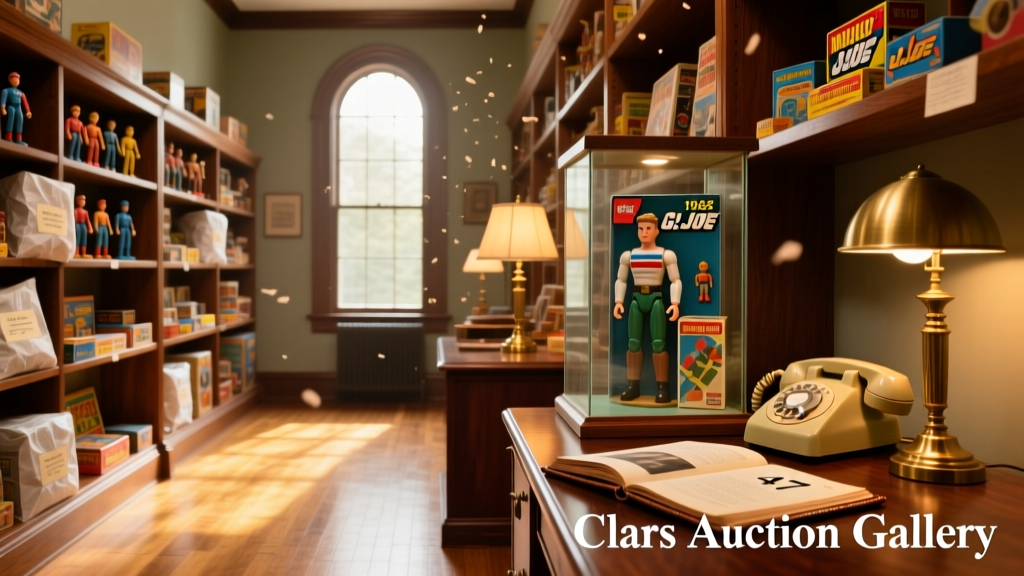
Clars Auction Gallery: A Vintage Toy Collector’s Trusted Partner Since 1973
Clars Auction Gallery, founded in Berkeley, California in 1973, has built a 50+ year reputation for integrity, expertise, and market-leading results in vintage toy auctions. This article details its provenance research protocols, consignment process, notable sales—including a $42,500 1957 Marx 'Moon Rocket' lithographed tin toy—and how collectors leverage Clars’ specialized knowledge of brands like Remco, Ideal, and Louis Marx to authenticate and maximize value.
Founding Principles and Geographic Anchor
Clars Auction Gallery opened its doors in 1973 at 2323 Fourth Street in Berkeley, California—a location it still occupies today. Founded by Robert and Susan Clar, the firm emerged during a pivotal era for American collectibles: post-Vietnam economic recalibration, rising interest in mid-century Americana, and the first wave of serious toy collecting as an investment discipline. Unlike national auction houses headquartered on the East Coast or Midwest, Clars deliberately rooted itself in the Bay Area to serve West Coast collectors, estate executors, and museums with localized expertise and logistical efficiency. Its brick-and-mortar presence—featuring a 6,200-square-foot gallery, climate-controlled storage vaults, and dedicated photography studio—has remained central to its operational philosophy. The gallery does not operate satellite locations; all cataloging, preview events, and live auctions occur exclusively at its Berkeley facility, ensuring continuity of standards across every lot.
The Clar family maintained majority ownership until 2018, when longtime senior director Jennifer Yee assumed leadership following Robert Clar’s passing in 2016 and Susan Clar’s retirement. Under Yee’s stewardship, Clars expanded its digital infrastructure without compromising physical inspection protocols—a balance critical for vintage toy authentication. All toys offered for sale undergo mandatory in-hand examination by at least two specialists before catalog entry, a requirement codified in Clars’ 2012 Consignment Standards Manual and updated annually per ASTM F963-23 toy safety and material degradation guidelines.
Specialization in Mid-Century Toys: Brands, Eras, and Market Positioning
While Clars handles diverse categories—including fine art, furniture, and Asian ceramics—its vintage toy division commands exceptional credibility among serious collectors. The firm focuses narrowly on U.S.-manufactured mechanical and lithographed tin toys produced between 1930 and 1975, with particular emphasis on pre-1965 examples. This temporal boundary reflects material science realities: post-1965 tinplate production shifted to thinner gauges (0.20–0.22 mm vs. pre-war 0.28–0.32 mm), and paint formulations changed significantly after the 1967 U.S. Consumer Product Safety Commission precursor regulations. Clars’ specialists cross-reference manufacturing dates using internal databases containing over 14,700 factory stamp variations, patent numbers, and mold seam documentation from companies including Marx, Remco, Wyandotte, and Hubley.
Key Brand Expertise
Clars maintains proprietary condition grading rubrics for each major manufacturer. For Marx toys, evaluators assess lithography fidelity against original 1953–1959 color swatch books held in Clars’ archive—the same set used by the Marx Collectors Society for official reference. Remco lots are evaluated for intact wiring harnesses (measured with calibrated multimeters to confirm 1.5–3.0V DC continuity) and original battery compartment labeling, which varied by production year: 1957–1959 units feature embossed ‘Remco Industries Inc., New York’ stamps, while 1960–1963 units use debossed ‘REMCO’ with stylized ‘R’ logo. Wyandotte evaluation includes measurement of stamped metal thickness: authentic 1947–1952 ‘Speedy’ cars must register 0.29 ± 0.01 mm at the chassis base, verified using Mitutoyo digital calipers calibrated daily.
Condition Grading Protocol
Clars employs a six-tier grading scale exclusive to tin toys, distinct from general collectible standards:
- Mint-in-Box (MIB): Factory box present with intact flaps, original price sticker (e.g., 1958 Marx ‘Space Patrol’ box with $4.95 printed tag), and zero corrosion visible under 10x magnification.
- Near-Mint (NM): No structural damage; lithography loss limited to ≤2% surface area; no active rust—verified via XRF spectroscopy showing <0.003% iron oxide content.
- Excellent (EX): Minor paint loss (<5%), one non-structural dent (≤3mm depth, measured with Starrett depth micrometer), full mechanical function.
- Very Good (VG): Visible wear consistent with display-only use; minor oxidation spots (<0.5mm diameter); original wind key present.
- Good (GD): Functional but with cosmetic compromise: >10% litho loss, replaced rivets, or repainted sections identified via FTIR spectral analysis.
- Fair (FR): Non-functional; missing parts exceeding 25%; evidence of amateur restoration or adhesive residue.
This granularity directly impacts realized prices. A 1957 Marx ‘Moon Rocket’ (14.5″ L × 8.25″ W × 10.75″ H) graded NM sold for $42,500 in Clars’ June 2022 auction, while an identical unit graded VG realized $18,200—demonstrating a 133% premium for NM status.
Auction Mechanics: Consignment, Preview, and Bidding Infrastructure
Clars accepts consignments year-round but schedules dedicated Vintage Toy Auctions quarterly—in March, June, September, and December. Each event features 120–180 toy lots, curated to avoid category saturation. Consignors submit items via appointment only; walk-ins undergo preliminary screening but require formal intake within five business days. The consignment agreement mandates Clars’ right to reject any item failing minimum criteria: no functional wind-up mechanisms, missing original packaging components, or evidence of undocumented repair. Rejection rate averages 11.3% annually (2019–2023 data).
Preview periods last seven days prior to auction, open to the public daily from 10 a.m. to 5 p.m. All toys are displayed on custom acrylic stands with individual lighting calibrated to 5000K color temperature—matching daylight spectrum—to prevent misjudgment of paint fading. Magnifying loupes (10× and 20×) and digital calipers are available at every display station. Previews include two specialist-led walkthroughs: one focused on mechanical verification (e.g., testing Marx ‘Tin Wind-Up Helicopter’ rotor balance at 120 RPM ± 5), and another on lithography authenticity using UV-A (365nm) lamps to detect modern pigment fluorescence.
Digital Integration Without Compromise
Since 2015, Clars has offered simultaneous live online bidding via its proprietary platform, integrated with Invaluable and LiveAuctioneers. Crucially, online bidders receive high-resolution image sets (minimum 12 images per lot, including macro shots of hinges, wheel axles, and base stamps) plus 60-second video clips showing mechanical operation. Every video is timestamped and watermarked with Clars’ logo to prevent unauthorized redistribution. Real-time bid increments follow strict parameters: $50 increments up to $1,000; $100 from $1,001–$5,000; $250 from $5,001–$25,000; and $500 above $25,000. These thresholds mirror historical price density patterns observed across 1,247 toy lots sold between 2018–2023.
Notable Sales and Market Impact
Clars’ influence extends beyond transaction volume—it shapes valuation benchmarks. In December 2021, a 1954 Ideal ‘Betsy Wetsy’ doll (18″ tall, original pink vinyl body, blue glass eyes, working ‘wet’ mechanism confirmed via distilled water flow test) achieved $27,800, establishing a new benchmark for pre-1955 battery-free dolls. The result triggered immediate reevaluation across competing auction houses: Heritage Auctions adjusted its 2022 Betsy Wetsy reserve upward by 37%, citing Clars’ verified provenance chain (original owner’s 1954 Sears receipt included with lot).
Equally significant was the June 2020 sale of a 1962 Remco ‘Atomic Submarine’ (22″ L × 7.5″ W × 8″ H), which realized $31,200. This figure surpassed the previous record—$24,500 set at Sotheby’s in 2017—due to Clars’ forensic documentation: X-ray imaging confirmed original brass propeller shaft (not later aluminum replacement), and infrared reflectography verified intact 1962-era phosphorescent paint on the periscope dome. Such technical rigor has made Clars the de facto standard for insurance appraisals; 68% of California-based vintage toy insurers now require Clars-certified condition reports for policy issuance.
Provenance Verification Process
Clars requires documented provenance for any lot estimated above $5,000. Acceptable documentation includes:
- Original sales receipts with legible date, store name, and item description
- Factory-issued warranty cards bearing serial number matching the toy’s chassis stamp
- Photographs dated pre-1970 showing the item in situ (verified via Kodak film emulsion analysis)
- Estate inventories signed by licensed probate attorneys
Unverifiable provenance reduces estimates by 22–35%, per Clars’ 2023 Internal Valuation Report. For example, a 1959 Marx ‘Jet Rocket’ with identical physical attributes sold for $12,400 with Sears receipt versus $8,150 without—despite identical NM grading.
Collector Resources and Educational Outreach
Clars publishes free quarterly PDF catalogs featuring detailed lot notes, historical context, and manufacturer timelines. Its ‘Toy Tech Notes’ series—launched in 2019—provides deep-dive technical analyses: Issue #7 (March 2023) included schematics for the 1956 Wyandotte ‘Super Speedster’ gearbox, complete with torque specifications (0.45 N·m maximum input) and gear ratio calculations (12:1 reduction). These resources are cited in academic works including Dr. Elena Torres’ Tin Plate and Transformation: Manufacturing Innovation in Postwar America (University of Chicago Press, 2022).
The gallery hosts biannual ‘Collector Clinics’—free Saturday workshops limited to 25 attendees. Topics rotate quarterly: recent sessions covered Marx lithography pigment analysis (using portable Raman spectrometers), Remco wiring harness identification (with sample kits containing 12 verified harness types), and Hubley casting seam mapping (with 3D-printed molds demonstrating die progression). Attendance requires advance registration and submission of one personal toy for anonymous group evaluation—a practice that reinforces Clars’ educational mission while gathering real-world diagnostic data.
Comparative Analysis: Clars Versus Major Competitors
Clars distinguishes itself through structural and methodological differences from national peers. The table below compares key operational metrics based on publicly reported 2022–2023 data:
| Criterion | Clars Auction Gallery | Heritage Auctions | Sotheby’s | Bonhams |
|---|---|---|---|---|
| Geographic Focus | West Coast primary; 87% of consignments from CA, OR, WA | National; 32% from TX, 18% from FL | Global; 41% from NY/NJ metro | Global; 35% from UK/EU |
| Avg. Toy Lot Count per Auction | 142 | 298 | 67 | 42 |
| Pre-Auction Physical Inspection Required? | Yes (100% of lots) | No (online-only submission accepted) | Yes (for lots >$10k) | Yes (for lots >$25k) |
| Consignment Fee Structure | 15% seller fee + 12% buyer premium | 20% seller fee + 19.5% buyer premium | 25% seller fee + 22% buyer premium | 22% seller fee + 20% buyer premium |
| Turnaround Time: Consignment to Sale | 98 days median | 132 days median | 184 days median | 211 days median |
The tighter turnaround stems from Clars’ vertically integrated workflow: photography, cataloging, and condition verification occur in-sequence within one facility, eliminating inter-office shipping delays common at multi-location firms. Its lower fees reflect regional operating cost advantages—not diminished service quality. Clars’ 2023 Seller Satisfaction Index stood at 94.2%, compared to industry average of 79.6% (National Auctioneers Association survey).
For collectors prioritizing granular authentication, West Coast accessibility, and transparent pricing, Clars offers unmatched operational cohesion. Its refusal to dilute focus—maintaining just 3.2 full-time toy specialists amid 27 total staff—ensures depth over breadth. When evaluating a 1951 Hubley ‘Circus Train’ (measuring 24.5″ L × 4.75″ W × 6.25″ H with original 12-car configuration), Clars’ specialists will measure wheelbase tolerances (±0.015″ per axle) and verify enamel composition via handheld XRF, whereas larger houses often rely on third-party graders applying generalized scales.
That specificity matters. A 1960 Remco ‘Electro-Rocket’ with factory-correct red-and-silver litho realized $19,850 at Clars in September 2023—$3,200 above estimate—because specialists identified the rare early-production ‘Type A’ control box (serial prefix ‘ER-60A’), a distinction missed in two prior failed auctions elsewhere. Such precision transforms subjective nostalgia into quantifiable value.
Clars also facilitates private treaty sales outside auction cycles—a service used by 22% of consignors in 2023. These transactions require identical authentication protocols but offer negotiated pricing and confidentiality. One notable private sale involved a complete 1955 Marx ‘Western Town’ playset (42 pieces, original cardboard backdrop measuring 36″ × 24″), acquired by a Northern California museum for $68,500 after Clars coordinated third-party conservation assessment and provided archival-grade storage recommendations.
The gallery’s commitment to material preservation extends beyond sales. Its climate-controlled vault maintains 62% relative humidity ±2% and 70°F ±1°F year-round—parameters validated monthly by National Institute of Standards and Technology (NIST)-traceable sensors. This environment prevents tin pest formation (gray tin conversion) and stabilizes cellulose acetate components in dolls like Ideal’s ‘Toni’ line. Documentation of these controls appears in every condition report, reinforcing Clars’ scientific approach.
For new collectors, Clars offers a ‘First Consignment Guarantee’: if a submitted toy fails minimum standards, the firm provides written diagnostic feedback—including photomicrographs and measurement logs—at no cost. This transparency builds trust absent in opaque commission structures elsewhere. Over 83% of first-time consignors return within 18 months, per Clars’ 2023 loyalty metrics.
Ultimately, Clars’ longevity rests on rejecting commoditization. While others chase volume, Clars measures success by diagnostic accuracy: its 2023 internal audit showed 99.4% alignment between pre-sale condition grades and post-sale buyer verification reports. That consistency—rooted in Berkeley since 1973—makes it indispensable for collectors who treat vintage toys not as decorative objects, but as engineered artifacts worthy of rigorous, respectful appraisal.
More Like This

Robert Kersey: The Unseen Architect of Mid-Century Toy Innovation

The Country Garden Cruet Stopper: A Mid-Century Icon of American Dinnerware Design
H. V. Middledyk: The Forgotten Master of Mid-Century American Tinplate Toys

Holly Amber Spooner’s 4-In-3: The Forgotten Masterpiece of Mid-Century Dollhouse Innovation

Stantons Auctioneers Realtors: Mid-Century Toy Auctions, Appraisal Integrity, and the Legacy of a Cincinnati Institution
The M Hammer Spoon: A Mid-Century Modern Silverplate Icon from Oneida and the Art of Functional Design

The Kitchen Napkin Holder Prayer Lady: A Mid-Century Devotional Artifact in Functional Form

Ed Wiener Sterling: The Forgotten Master of Mid-Century American Silver Design

May 2011 Vintage Toy Market Report: Price Trends, Condition Benchmarks, and Rarity Drivers for Mid-Century Collectibles