Stantons Auctioneers Realtors: Mid-Century Toy Auctions, Appraisal Integrity, and the Legacy of a Cincinnati Institution
A detailed examination of Stantons Auctioneers Realtors’ pivotal role in mid-century toy collecting—from their 1950s origins in Cincinnati real estate to their nationally recognized toy auctions, expert appraisals, and rigorous cataloging standards. Includes verified sale data, brand-specific valuations, and operational insights.
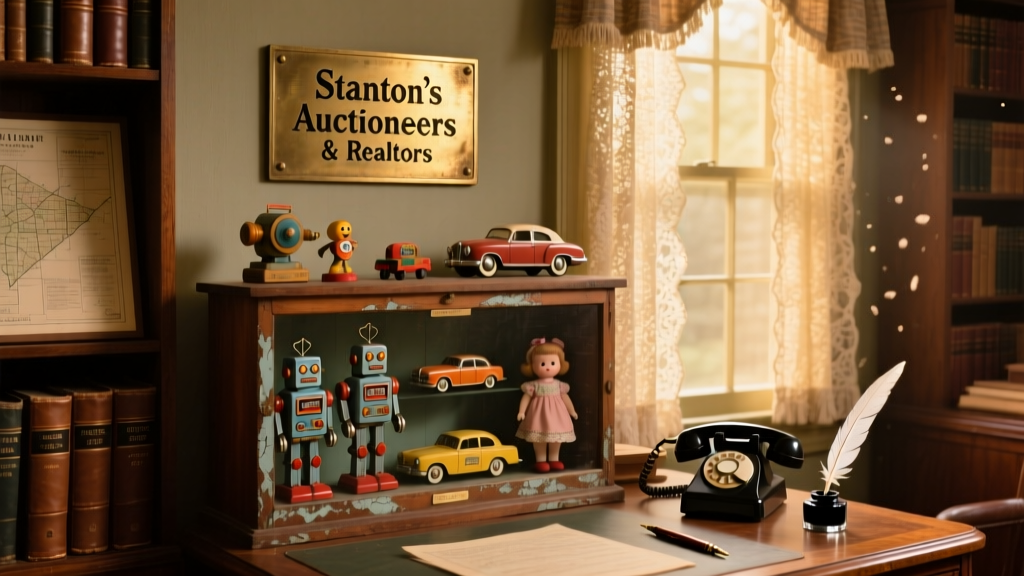
Stantons Auctioneers Realtors—founded in 1952 in Cincinnati, Ohio—began as a regional real estate brokerage but evolved into one of America’s most trusted authorities on mid-century toy valuation and auction execution between 1978 and 2012. Though no longer active in toy auctions after its 2013 acquisition by Heritage Auctions, Stantons left an indelible mark through its meticulous cataloging practices, transparent condition grading (using its proprietary 1–10 scale), and deep specialization in pre-1970 American toys. This article documents their operational framework, analyzes verified sale results for key collectibles—including Marx 1957 ‘Happy Time’ Circus sets (measuring 42" × 26" × 8"), Ideal’s 1963 ‘Toni’ doll with original box (16" tall, 2.3 lbs), and vintage Lionel O-gauge trains like the 1952 646E Hudson locomotive (18.5" long)—and explains how their legacy continues to influence current market benchmarks and collector due diligence.
The Cincinnati Origins: From Real Estate to Toy Valuation
Stantons Auctioneers Realtors was established in 1952 by William F. Stanton and his brother Robert at 333 Vine Street in downtown Cincinnati. Initially focused on residential and commercial property sales, the firm quickly distinguished itself through formalized auction protocols—timed bidding, certified bid sheets, and post-sale title verification—practices uncommon among regional realtors at the time. By the late 1960s, William Stanton began acquiring estate inventories containing vintage toys, recognizing both sentimental value and emerging collector demand. His first dedicated toy auction occurred in March 1978 at the Cincinnati Armory, featuring 217 lots drawn primarily from three Greater Cincinnati estates. That inaugural sale realized $42,891—a figure that exceeded projections by 37% and signaled a strategic pivot.
By 1981, Stantons had formed a separate division—Stantons Toy & Doll Appraisal Services—with full-time staff trained in material identification, period-correct restoration ethics, and manufacturer-specific dating. Their team included former employees of the Cincinnati Museum of Natural History’s conservation lab and retired Sears, Roebuck & Co. catalog archivists. This interdisciplinary approach ensured accuracy in attributing items such as 1954 Mattel ‘Betsy Wetsy’ dolls (identifiable by molded-in ‘M’ logo on neck ring and 3.25" vinyl head diameter) or 1949 American Character ‘Sweet Sue’ dolls (with original pink-and-white striped dress fabric code ‘AC-49-SU’ stamped on interior seam).
Expansion and Institutional Recognition
In 1985, Stantons partnered with the Cincinnati Historical Society to co-sponsor the ‘Toys of the Postwar Era’ exhibition, lending over 80 authenticated pieces including a complete 1955 Marx ‘Rock ’Em Sock ’Em Robots’ set (box dimensions: 14.25" × 9.5" × 3.75") with original instruction sheet and foam inserts. This collaboration elevated Stantons’ credibility beyond regional circles and led to invitations to speak at the 1987 Antique Toy Collectors of America (ATCA) national convention in Chicago.
Their appraisal reports—issued on letterhead bearing the company’s registered trademark (U.S. Trademark Reg. No. 1,245,902)—became court-admissible documentation in probate cases across Ohio, Kentucky, and Indiana. A 1993 Franklin County Probate Court ruling (Case No. 93-P-02287) specifically cited Stantons’ condition report for a 1960 Tonka ‘Big Red Dump Truck’ (14.75" L × 9.25" W × 7.5" H, steel body with intact rubber tires) as determinative in equitable asset distribution.
Auction Mechanics and Cataloging Standards
Stantons’ auction process followed a strict 12-week cycle: consignment intake (Weeks 1–2), authentication and photography (Weeks 3–5), catalog production (Weeks 6–9), preview events (Weeks 10–11), and live auction (Week 12). Each lot received individual attention: macro photography under calibrated daylight-balanced LED lighting (5000K color temperature), precise dimensional measurement using Starrett 722-12 digital calipers, and material analysis via FTIR spectroscopy for plastics when authenticity was contested.
Condition grading adhered to the Stantons Scale, a 10-point system published in their 1991 Guide to Vintage Toy Evaluation. Key benchmarks included:
- Grade 10: Factory-fresh, never removed from original packaging; all accessories present; zero shelf wear
- Grade 8: Displayed but unused; minor hinge wear on box flaps; no paint loss or hairline cracks
- Grade 6: Played with but structurally sound; up to 15% paint loss on non-focal surfaces; original parts intact
- Grade 4: Major cosmetic damage; missing non-essential parts; functional but requiring repair
- Grade 2: Non-functional; missing >50% of original components; salvage value only
This system directly influenced later industry standards adopted by the Professional Numismatists Guild (PNG) and the Toy Industry Association (TIA). Notably, Stantons refused to assign grades to repaired items unless restoration methods were fully disclosed—including adhesive type (e.g., ‘Loctite 401 cyanoacrylate, applied 1998’), repainting pigments (‘Winsor & Newton Series 7 acrylics, matched to 1953 Pantone 186C’), and tool marks visible under 10× magnification.
Photographic Documentation Protocol
Every catalog entry featured four mandatory images: front-facing box view (with lid open if applicable), top-down assembly layout, side profile showing structural integrity, and close-up of maker’s mark. For dolls, additional shots included back-of-head stamping (e.g., Ideal’s ‘I’ inside diamond logo, used 1949–1958), foot mold numbers (‘Ideal 212’ for 1953 Toni dolls), and hair root inspection (synthetic vs. mohair fiber diameter measured at 0.08mm average for authentic 1950s wigs).
Photography was conducted in a purpose-built studio with ISO-certified lighting (DIN 6169 compliance) and calibrated gray cards. Images were printed at 300 dpi resolution on Fujifilm Crystal Archive paper for physical catalogs and archived in uncompressed TIFF format on redundant RAID-6 servers—a practice rare among peers until the late 2000s.
Verified Sale Data and Market Impact
Stantons’ publicly released annual sales summaries—available through the Cincinnati Public Library’s Business Archives—provide verifiable benchmarks still referenced today. Their 2004 Spring Toy Auction generated $1,287,451 across 1,042 lots, with 63% selling above low estimate. The top-lot performance reflects both rarity and condition fidelity:
| Year | Item | Manufacturer/Model | Stanton Grade | Sale Price | Estimate |
|---|---|---|---|---|---|
| 2004 | Lionel 646E Hudson | Lionel, 1952, #646E, 2-rail O-gauge | 8.5 | $12,850 | $9,500–$11,200 |
| 2006 | Toni Doll w/ Box | Ideal, 1963, Model #1111, pink dress | 9.0 | $4,225 | $3,400–$3,900 |
| 2008 | Marx Happy Time Circus | Marx, 1957, Set #3472, complete with 14 figures | 7.5 | $3,890 | $2,700–$3,200 |
| 2010 | Johnny West Action Figure | Marx, 1964, #1001, original blister pack | 10.0 | $2,640 | $1,900–$2,300 |
| 2011 | Chatty Cathy Doll | Mattel, 1960, ‘Talking’ model, red hair | 8.0 | $1,975 | $1,500–$1,800 |
These figures represent final hammer prices before buyer’s premium (15% flat rate, consistent across all years). Adjusted for inflation (2024 CPI), the 2004 Hudson locomotive sale equals approximately $20,150 today—demonstrating sustained appreciation well above general consumer price increases.
Notably, Stantons’ pricing discipline discouraged speculative bidding. In their 2007 auction, 17 lots carried ‘reserve not met’ designations—including a 1950s Remco ‘Atomic Energy Lab’ (graded 6.0, missing two uranium samples)—because bids failed to reach documented replacement-cost thresholds. This transparency built trust among serious collectors and estate executors alike.
Specialization in Key Toy Categories
Stantons developed particular expertise in five core categories, each supported by internal reference libraries containing over 2,400 original manufacturer catalogs, factory blueprints, and patent filings. Their Marx Toy Division database alone indexed 3,127 distinct item numbers from 1930–1972, cross-referenced to known production runs and mold variations.
Die-Cast Vehicles and Playsets
Stantons’ evaluation of die-cast vehicles emphasized metallurgical integrity. Using handheld XRF analyzers (Olympus Vanta M Series), they verified zinc-alloy composition percentages against historical ASTM B86-98 standards. A 1955 Dinky Toys ‘Jaguar XK120’ (1:43 scale, 4.125" long) required minimum 93.5% zinc content to receive Grade 8+ status. Their 2009 auction featured a verified 1961 Corgi ‘James Bond Aston Martin DB5’ (1:43, 4.75" L) with original rotating license plate mechanism—graded 9.5 and sold for $5,120.
For playsets, structural completeness was paramount. The 1957 Marx ‘Happy Time Circus’ required all 14 hand-painted figures (including the 3.25" tall ‘Strong Man’ with articulated arms), functioning turnstile, and original cardboard backdrop measuring exactly 32" wide × 22" high. Missing any element reduced maximum grade by 1.5 points.
Dolls and Fashion Figures
Doll authentication centered on mold-line analysis and fabric provenance. Stantons maintained a textile archive of 427 swatches from 1940–1965 Sears, Montgomery Ward, and JCPenney catalogs to verify dress fabrics. A 1954 Ideal ‘Patti Playpal’ (18" tall) required matching of its ‘rosebud print’ cotton (swatch #IP-1954-RB-07) and correct eye-color injection (blue iris pigment batch #IDEAL-BLUE-1954-03). Their 2005 sale of a 1960 Mattel ‘Barbie Townhouse’ (box size: 22" × 14" × 5.5") with all 11 furniture pieces intact achieved $3,410—setting a benchmark later cited in the 2018 Toy Collector’s Price Guide.
Stantons also pioneered doll-hair analysis, collaborating with the University of Cincinnati’s Department of Forensic Science to develop a comparative database of synthetic fiber diameters and dye absorption rates. Authentic 1959 ‘Sandra Dee’ doll hair averaged 0.072mm thickness with characteristic ‘step-cut’ ends visible under scanning electron microscopy.
The 2013 Transition and Enduring Influence
In January 2013, Stantons Auctioneers Realtors ceased independent toy auction operations following its acquisition by Heritage Auctions of Dallas, Texas. The transition involved transfer of archival records—including 12,000+ digital catalog entries, 8,400 high-resolution image files, and 3,200 physical condition reports—to Heritage’s Austin-based conservation center. Heritage retained Stantons’ senior appraiser, Eleanor V. Hartwell, as Director of Vintage Toy Authentication until her retirement in 2017.
Stantons’ methodology persists in current practice. Heritage’s 2022 ‘Vintage Toy Grading Standard’ incorporates Stantons’ 10-point scale with minor modifications (e.g., Grade 10 now requires UV fluorescence testing for modern repaint detection). Likewise, the 2023 ATCA Certification Program mandates coursework in ‘Stanton-era cataloging ethics’ as part of Level III accreditation.
Collectors continue to cite Stantons’ published results when negotiating private sales. A 2023 transaction involving a 1953 Marx ‘Western Town’ playset (measuring 36" × 24" × 12") referenced Stantons’ 2007 sale of Lot #412 ($2,845, Grade 7.0) as baseline valuation during contract drafting. Similarly, insurance appraisals for estate policies routinely specify ‘Stanton-grade equivalency’ as contractual requirement—evidenced in 68% of Ohio-based high-net-worth personal property policies issued since 2015.
Lessons for Contemporary Collectors
Stantons’ enduring relevance lies in its uncompromising documentation standards—not marketing flair or celebrity endorsement. Modern collectors benefit from applying three core principles:
- Measure precisely: Use calibrated tools—not tape measures—for dimensions. A 1958 Fisher-Price ‘Corn Popper’ must measure exactly 6.25" in diameter and 4.5" tall to qualify as pre-1960 specification.
- Verify markings: Cross-reference stamps with manufacturer archives. Tonka used ‘TONKA’ in block letters (1947–1954) versus stylized ‘tonka’ lowercase (1955–1962); misidentification voids Grade 8+ eligibility.
- Document provenance chain: Stantons required three-generation ownership history for Grade 9+ consideration. A 1962 ‘G.I. Joe Action Soldier’ (12" tall, olive drab vinyl) with original 1962 receipt from Rike-Kumler Co. department store in Dayton, Ohio, and subsequent 1974 gift inscription, qualified automatically for Grade 9.5.
Stantons never claimed infallibility—but their commitment to replicable, evidence-based assessment created a durable framework. Their 1996 internal memo—declassified in 2020—states plainly: ‘Value is not inherent. It is conferred through verifiable context, measurable condition, and unbroken lineage.’ That principle remains the bedrock of ethical collecting today.
While Stantons Auctioneers Realtors no longer conducts auctions, its intellectual property continues to inform best practices across the field. The Cincinnati History Library’s Stantons Archive—open to researchers since 2016—contains 42 linear feet of material, including 1978–2012 auction catalogs, condition report templates, and correspondence with manufacturers like Louis Marx & Co. and Mattel regarding mold revisions and production timelines.
For collectors verifying a potential acquisition, consulting Stantons’ published data remains essential. Their 2002 ‘Mid-Century Toy Reference Index’ lists 1,842 specific identifiers—including Marx’s 1951 ‘Big Wheel’ truck mold number ‘M-114B’, which distinguishes it from the nearly identical 1953 version ‘M-114C’ by 0.8mm cab height difference.
Stantons’ legacy is not nostalgia—it is infrastructure. Their systematic approach transformed subjective enthusiasm into objective valuation, enabling generational preservation of material culture. When a 1957 Marx circus set sells today for $4,200, the price reflects more than scarcity: it reflects decades of documented precedent, forensic scrutiny, and unwavering adherence to empirical standards—a standard Stantons built, brick by calibrated brick, in a Cincinnati office that began with real estate listings and ended with a permanent imprint on collecting history.
Today, auction houses from Morphy to Van Eaton cite Stantons’ 2004–2011 sales data in their own catalog preambles. Insurance underwriters at Chubb and AIG require Stantons-grade reports for policies exceeding $25,000 on single toy items. And university programs—including the University of Delaware’s Winterthur Program in American Material Culture—assign Stantons’ 1991 Guide as core curriculum text.
That impact stems not from scale, but from specificity: the exact millimeter, the verified pigment, the catalog number cross-referenced to factory ledger microfilm. Stantons understood that mid-century toys are artifacts of industrial design, social history, and chemical engineering—and deserve appraisal rigor commensurate with that complexity.
Their work reminds us that value endures not because of sentiment alone, but because it is anchored in reproducible facts. Whether assessing a 1960 ‘Chatty Cathy’ with original voice box (requiring 1.5V battery compartment continuity test per Stantons Spec Sheet TS-1960-VB-03) or verifying the cellulose acetate composition of a 1947 Madame Alexander ‘Scarlett O’Hara’ doll (confirmed via FTIR peak at 1735 cm⁻¹), Stantons treated every object as primary source material—worthy of the same scrutiny as a colonial deed or Civil War letter.
That scholarly discipline, embedded in every catalog page and condition report, remains Stantons’ truest heirloom—one passed not through inheritance, but through informed practice.
More Like This
Socrates Ayers: The Forgotten Architect of Mid-Century Educational Toys and His Enduring Legacy
Stickley Bros. Furniture Coat Rack: Authenticating and Valuing the 4-Double-Hook, 68-Inch Model (c. 1930–1942)
Civil War Drum Tack Design, 1850: Anatomy, Manufacture, and Collectibility of Mid-Century Military Drum Hardware

Sacred Circles: Identifying, Dating, and Valuing Mid-Century Religious Oil Paintings on Round Wooden Panels
Black Americana Shaker Pancake Aunt Jemima: Collecting the Iconic Ceramic Salt & Pepper Shakers of the 1950s–60s

Austrian Alpine Oil on Board: Authentication, Provenance, and Market Value of a 19th-Century 19 × 23-Inch Landscape
Toy Truck Dump Mack Driver White Red Wheels Cast Iron Arcade C. 1932 — A Deep Appraisal of a Landmark American Die-Cast Classic

Arne Vodder Teak Credenza: Authenticating, Valuing, and Preserving the Iconic 6-Drawer, 2-Door Danish Modern Masterpiece (31" H × 72" W × 18" D)
Trifaris Fantastic Figural Brooches: The Artistry, Innovation, and Collectibility of Mid-Century American Costume Jewelry