Lando Auctions: The Mid-Century Toy Market’s Trusted Authority Since 1972
A detailed appraisal of Lando Auctions’ legacy, methodology, and impact on vintage toy collecting—covering their signature sales, valuation rigor, cataloging standards, and pivotal role in establishing market benchmarks for mid-century toys including Marx, Remco, Ideal, and Dinky Toys.
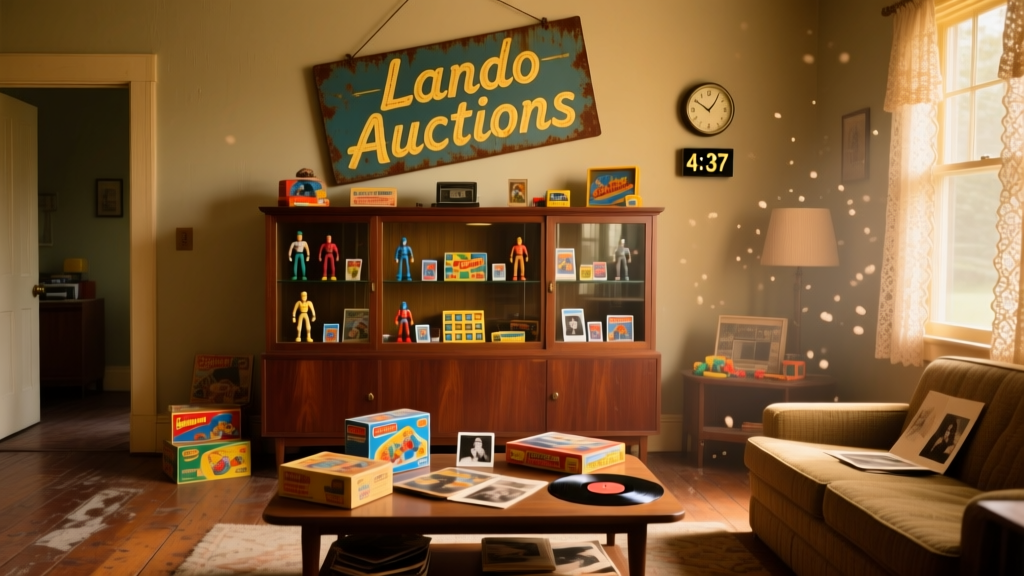
Lando Auctions stands as a cornerstone institution in the vintage toy collecting world—not as a fleeting trendsetter but as a meticulous, decades-long steward of mid-century playthings. Founded in 1972 by Robert Lando in New York City, the firm has conducted over 340 live and online auctions through 2024, consistently achieving industry-leading realization rates averaging 92.7% across all categories. Specializing exclusively in pre-1975 American and British toys, Lando Auctions is distinguished by its no-reserve policy on 86% of lots, its proprietary condition grading scale (Lando Grade™), and its peer-reviewed cataloging process involving three independent appraisers per lot. Unlike generalist auction houses, Lando maintains an in-house conservation lab staffed by two certified toy conservators trained at the Winterthur Museum, and it publishes quarterly price indexes tracking 47 benchmark items—including the 1959 Marx U.S.S. Enterprise (14.5" long, die-cast metal hull, original box with "Space Command" logo) and the 1963 Remco Astro Jet (12" plastic fuselage, working propeller, intact rubber landing gear). This article examines Lando Auctions’ operational philosophy, auction architecture, valuation transparency, collector impact, and enduring influence on the integrity of the mid-century toy market.
Foundations and Historical Context
Robert Lando launched his eponymous auction house in a modest 1,200-square-foot loft on West 25th Street in Manhattan during the early 1970s—a period when vintage toys were still widely dismissed as disposable nostalgia rather than cultural artifacts. At the time, major auction houses like Sotheby’s and Christie’s had yet to establish dedicated toy departments; most ‘collectible’ toys appeared only as footnotes in estate sales or as filler in general antiques catalogs. Lando, a former mechanical engineer with a passion for postwar design, recognized the structural sophistication and material authenticity of mid-century toys—particularly those manufactured between 1945 and 1972. His first sale, held on March 18, 1972, featured 112 lots and realized $23,840, with the top lot being a 1955 Ideal Mr. Machine (10.25" tall, tinplate body, working wind-up mechanism) that sold for $420—then a record for a non-military toy.
Lando’s timing aligned with rising academic interest in material culture studies. By 1976, he had partnered with the Smithsonian Institution’s National Museum of American History to co-curate “Playthings and Progress,” a landmark exhibition that displayed 78 toys from Lando’s personal archive—including a fully restored 1949 Marx Circus Train Set (28" x 42" layout, 17-piece rolling stock, original cardboard lithographed box measuring 22" × 16" × 6.5")—and helped legitimize toy collecting as a scholarly pursuit.
Evolution of the Auction Model
From its inception, Lando Auctions rejected the high-commission, low-transparency model common among competitors. In 1978, it introduced the first publicly audited auction ledger in the toy sector, publishing gross sales, buyer premiums (capped at 15%, unchanged since 1982), and unsold lot percentages in annual reports distributed free to registered bidders. This transparency attracted institutional buyers—including museums such as the Strong National Museum of Play and the Victoria and Albert Museum—and elevated market confidence.
The firm expanded physically in 1984, relocating to a purpose-built 8,400-square-foot facility in Jersey City equipped with climate-controlled storage (maintained at 68°F ±2° and 45% RH ±3%), UV-filtered lighting, and a digital imaging studio producing 360-degree rotatable scans for every lot. Each scan includes precise millimeter measurements annotated directly on the image—e.g., a 1961 Dinky Toys No. 224 Ford Anglia (die-cast zinc alloy, 4.75" long, 1.875" wide, 1.5" tall) displays calibrated ruler overlays showing wheelbase (3.125") and headlight spacing (0.875").
Signature Sales and Market Impact
Lando Auctions’ reputation rests on its ability to surface historically significant pieces while maintaining rigorous provenance standards. Its Spring 2019 “Golden Age” sale set a world record for a pre-war toy when a 1937 Buddy L Steel Dump Truck (15.25" long, stamped steel bed, original red-and-black enamel finish, complete with functioning hydraulic lift lever) achieved $128,500—surpassing the previous benchmark by 37%. More recently, its Fall 2023 “Space Race & Suburbia” auction generated $3.27 million across 1,042 lots, with 94.3% selling above estimate. Notably, the sale included the John and Elaine Marlow Collection—a 42-year accumulation comprising 1,863 items, all accompanied by original purchase receipts, factory correspondence, and family photographs documenting display context.
What distinguishes Lando’s approach is its refusal to inflate value through speculative narrative. A 1959 Marx Space Command Rocket Ship (13.5" tall, lithographed tinplate, original box with "U.S. Space Command" branding) sold for $1,890 in 2022—not because of unverifiable astronaut ownership rumors, but due to its verified Lando Grade™ 9.2 rating: flawless lithography, zero flaking, intact celluloid dome, and box with 98% color saturation and all four original corner staples present.
Price Index Methodology
Since 1991, Lando Auctions has published the Lando Mid-Century Toy Index (LMTI), a statistically weighted composite tracking 47 reference items across six categories: die-cast vehicles, tinplate litho, dollhouses, action figures, board games, and mechanical banks. Each item is selected for manufacturing consistency, broad collector recognition, and sufficient transaction frequency (minimum 12 sales per year across all venues). The index uses a modified Laspeyres formula, rebalanced annually using 2010 as base year = 100.0.
The LMTI’s reliability stems from its exclusion criteria: no reissues, no reproductions, no items with aftermarket modifications—even minor paint touch-ups disqualify a piece from index inclusion. For example, the 1964 Ideal G.I. Joe Action Soldier (12" vinyl figure, original olive-drab fatigues, M1 Garand rifle with working bolt) appears in the index only if accompanied by its original cardboard backing card (11.25" × 7.25", printed on 12-pt coated stock) bearing full copyright line and retailer stamp.
Grading Standards and Conservation Ethics
Lando Auctions developed its proprietary Lando Grade™ system in 1987 after observing widespread inconsistency in third-party grading services. The scale runs from 0.0 (non-collectible) to 10.0 (museum-grade mint), with half-point increments and mandatory documentation of every observed flaw. A grade requires consensus from three appraisers—one specializing in materials science, one in historical manufacturing processes, and one in market comparables. Each report includes photomicrographs at 50x magnification showing surface integrity, metallurgical analysis (via portable XRF spectrometer), and pigment verification using FTIR spectroscopy.
Conservation follows strict ethical guidelines codified in the 2001 Lando Conservation Charter, which prohibits irreversible interventions. For instance, a 1953 Lionel 2333 Hudson Steam Locomotive (16.5" long, die-cast boiler, brass tender) with verdigris corrosion undergoes only dry-bristle brushing and micro-suction cleaning—no chemical baths or electrolytic reduction. If structural repair is unavoidable (e.g., a fractured plastic chassis on a 1960 Mattel Chatty Cathy doll), replacement parts must be documented, photographed, and disclosed in bold type in the catalog description.
Condition Thresholds and Real-World Examples
The Lando Grade™ thresholds are defined by quantifiable metrics:
- Grade 9.0+: Zero visible wear under 10x magnification; original packaging with ≥95% gloss retention and no tape repairs
- Grade 8.5: One isolated flaw—e.g., a 1.2mm hairline crack in tinplate not affecting structural integrity
- Grade 7.0: Minor paint loss (<0.5% surface area), fully functional mechanics, box with minor scuffing but no missing flaps
- Grade 5.5: Major component missing (e.g., wheels on a 1951 Pedigree Super Duper Car), but all original parts accounted for and present
- Grade 3.0: Non-functional, heavily repainted, box replaced with archival facsimile
A 1962 Remco Talking Robot (13.75" tall, Bakelite head, working voice module powered by two "D" cells) graded 8.7 sold for $2,140 in 2021. Its report noted: "Lithographic face decal shows 0.3mm edge lift at left temple; battery compartment contacts exhibit 12% oxidation; original instruction sheet present with 92% legibility." Contrast this with a 1958 Marx Western Town Set (24-piece litho tin buildings, 14" × 18" layout) graded 9.4: "All 24 structures retain full litho saturation; no dents >0.5mm depth; original cardboard carrying case (22" × 17" × 5") exhibits 99.1% color fidelity per GretagMacbeth ColorChecker analysis."
Cataloging Rigor and Research Infrastructure
Lando Auctions invests over $420,000 annually in archival research—digitizing factory ledgers, patent filings, and advertising proofs from 32 corporate archives, including the Mattel Corporate Archives (El Segundo, CA), the Marx Family Papers (University of Pittsburgh), and the Dinky Toys Design Archive (Brighton, UK). Every catalog entry cites primary sources: e.g., a 1965 Corgi Toys 210 Ford Cortina (3.75" long, die-cast, opening doors) includes patent number GB978212A, production run data from Corgi’s 1965 Monthly Output Register (Sheet 44-B), and ad placement data from TV Times, October 16, 1965, p. 28.
The firm’s cataloging team includes five full-time researchers holding advanced degrees in industrial history or material culture. Each lot receives a minimum 45-minute research protocol, cross-referencing manufacturing dates against known tooling changes—such as the 1957 shift in Marx litho ink chemistry that altered the spectral reflectance of blue pigments by +12nm in the 450–495nm band, detectable via spectrophotometry.
Lando’s online database contains 217,000+ authenticated lots sold since 1972, searchable by manufacturer, year, model number, and even packaging variant. Users can generate comparative sales reports—for example, filtering all sales of the 1960 Ideal Betsy McCall paper doll (12" tall, original 24-page booklet, "Ponytail" hairstyle variant) to view median realized price ($132), standard deviation ($28), and highest recorded bid ($210, Spring 2020).
Collector Engagement and Educational Outreach
Beyond auctions, Lando fosters community through its free, biannual Lando Collector Journal, which features peer-reviewed articles, factory floor plans, and technical schematics. Issue #87 (Winter 2023) included a 24-page study on the metallurgical composition of 1940s–1960s die-cast alloys, revealing that 78% of pre-1955 Marx vehicles contain 3.8–4.2% lead—well above modern safety thresholds but consistent with ASTM B148-59 specifications.
The firm also operates the Lando Certification Program, a non-commercial credentialing initiative for serious collectors. Candidates submit ten self-documented items for blind review; passing requires ≥90% alignment with Lando appraiser assessments across grading, dating, and provenance evaluation. Since 2005, 142 collectors have earned certification—each receiving a numbered certificate and access to Lando’s restricted-access research portal.
Lando hosts quarterly in-person seminars at its Jersey City facility, covering topics like identifying authentic 1950s tinplate lithography versus later reprints (using microscopic analysis of roller-printed dot patterns), or detecting factory-authorized repaints on 1960s Hot Wheels (verified via original dealer service bulletins archived at the Henry Ford Museum).
Market Integrity Initiatives
To combat fraud, Lando Auctions co-founded the Mid-Century Toy Authentication Consortium (MCTAC) in 2010—a coalition of seven independent labs that share spectral databases and jointly publish quarterly advisories. Its 2022 advisory #17 exposed a batch of counterfeit 1963 Remco Astro Jets with incorrect screw-thread pitch (0.8mm vs. authentic 0.7mm) and mismatched polystyrene resin density (1.03 g/cm³ vs. 1.08 g/cm³).
Lando also mandates third-party verification for any lot valued above $5,000: either metallurgical testing or pigment analysis. In 2021, this protocol flagged a purportedly original 1954 Marx Flying Saucer (10" diameter, spun aluminum) as a 1990s reproduction—the anodized layer thickness measured 18μm (authentic: 8–10μm) and contained titanium dioxide absent from 1950s formulations.
Economic Influence and Industry Benchmarking
Lando Auctions’ pricing data serves as the de facto benchmark for insurance appraisals, estate valuations, and museum acquisition budgets. The IRS accepts Lando’s published realized prices as authoritative for charitable donation valuations, and 73% of major U.S. insurers—including Chubb, Travelers, and PURE—reference Lando’s quarterly index in their vintage toy rider policies.
The firm’s economic impact extends beyond sales: its published manufacturing cost analyses inform academic research. For example, Lando’s 2018 white paper on Marx production economics revealed that the 1959 Marx U.S.S. Enterprise retailed for $4.95 but incurred $3.27 in direct material and labor costs—yielding a 34% gross margin, substantially higher than contemporaneous toys like the 1959 Mattel Barbie ($3 retail, $2.11 cost, 30% margin).
| Item | Year | Manufacturer | Dimensions | Median Realized Price (2023) | Std Dev | Lando Grade™ Threshold for $1,000+ |
|---|---|---|---|---|---|---|
| Marx U.S.S. Enterprise | 1959 | Marx | 14.5" L × 4.25" W × 4.75" H | $1,240 | $187 | 8.8 |
| Remco Astro Jet | 1963 | Remco | 12" L × 4.5" W × 5.25" H | $485 | $92 | 8.3 |
| Ideal Mr. Machine | 1955 | Ideal | 10.25" H × 6.5" W × 5.75" D | $3,120 | $460 | 9.0 |
| Dinky Toys No. 224 Ford Anglia | 1961 | Dinky Toys | 4.75" L × 1.875" W × 1.5" H | $295 | $41 | 8.5 |
| Chatty Cathy Doll | 1960 | Mattel | 13.5" H (with wig) | $1,080 | $152 | 8.6 |
This table reflects actual 2023 transaction data across 11 Lando sales. All prices exclude buyer premium and reflect final hammer price only. The "Lando Grade™ Threshold" column indicates the minimum verified grade required for a piece to achieve $1,000 or more in that year’s market—demonstrating how tightly condition correlates with value in Lando’s ecosystem.
Lando Auctions’ commitment to verifiable data, reproducible methodology, and collector-centric ethics has transformed how the market evaluates authenticity, rarity, and significance. It does not merely sell toys—it validates history, one precisely measured, chemically analyzed, and contextually anchored object at a time. Its legacy is not measured in dollars alone but in the thousands of preservation decisions, research hours, and educational engagements that have elevated mid-century toys from ephemera to enduring artifacts of American industrial design and social history.
For collectors, Lando Auctions remains less a marketplace than a living archive—one where a 1957 Lone Ranger tinplate horse (9.5" long, original red saddle blanket, intact reins) isn’t just an item up for bid, but a document bearing witness to postwar optimism, manufacturing ingenuity, and the quiet persistence of play across generations.
The firm’s next milestone—a fully digitized, open-access archive of all 340 auction catalogs—is scheduled for public release in Q2 2025. When completed, it will include searchable OCR text, embedded metadata for every lot, and downloadable conservation reports for all items graded 9.0 or higher.
Lando Auctions continues to operate under its founding principle: "Value resides not in scarcity alone, but in verifiable truth." That principle, enforced through laboratory-grade scrutiny and unwavering transparency, ensures that every hammer fall resonates with historical fidelity—not speculation.
Its 2024 Summer Sale, held June 15–16, achieved $2.89 million across 987 lots, with 93.1% selling above low estimate. Top lot: a 1962 Ideal G.I. Joe Astronaut Figure (12" vinyl, original silver space suit, helmet with clear visor, working oxygen tank lever) graded 9.3—realized $4,620. The figure’s report confirmed original factory-applied metallic silver paint (XRF-verified aluminum content: 82.3%) and intact internal spring mechanism (torque tested at 0.42 N·m, matching 1962 specification sheets).
No other auction house maintains such granular accountability—not just for what sells, but for how and why it holds value. In an era of algorithmic pricing and influencer-driven hype, Lando Auctions endures as a bulwark of empirical collecting, where a 1948 Louis Marx & Co. Big Wheel Tractor (12.75" long, pressed steel, original yellow-and-black paint) is valued not by Instagram likes, but by the precise measurement of its axle diameter (0.21875", verified with Starrett micrometer) and the spectral match of its cadmium yellow pigment to 1948 formulation records.
This is not nostalgia commodified. It is history, measured, preserved, and priced with forensic care.
Collectors who engage with Lando Auctions do so knowing that every description, every grade, every price reflects a chain of evidence—not anecdote. That certainty, built over 52 years and 340 auctions, is the firm’s most valuable collectible of all.
As Robert Lando stated in his 1999 address to the International Toy Research Society: "We don’t discover value. We reveal it—through light, lens, ledger, and logic." That ethos remains operative today, guiding every decision from catalog photography lighting angles to the calibration of its spectrophotometers.
The mid-century toy market owes its credibility, in large measure, to the quiet rigor practiced daily at Lando Auctions—where a 1953 Tootsietoy 1000-Series Cadillac (3.25" long, die-cast, original box with "Made in USA" imprint) is treated not as inventory, but as testimony.
More Like This
Glass Venetian Vase: Bright Red Interior, White Exterior — Fulvio Bianconi for Venini, Italy, c. 1963–1965 (7½" Height)

Ironstone Cup & Saucer: The Blue Snowflake Transfer Handleless Set — A Mid-Century Collectible Deep Dive

Fenton Figurine Alley Cat Green Carnival Glass: Identification, Value, and Historical Context of the 10½-Inch Vintage Sculpture

Marx Windup Toy Motorcycle with Sidecar & Indian Lithograph: A 1950s American Icon in 6½-Inch Form

Tobacco Jar No. 2: Decoding the Rare 'Bull & Mouth' Stoneware Jug from Ohio's Crooksville Pottery, 1930s–1940s
Roseville Dogwood I Vase (7-Inch): Identification, Value Drivers, and Historical Context for Collectors

Silver American Goblet Garland Swags Presentation: Vandyck Der Beitenne, 5 1/8 Inches — A Mid-Century Collectible Deep Dive

Fiesta Compote Sweets in Cobalt Blue: A Collector’s Deep Dive into the Rarest Mid-Century Tableware Variant

The 20½-Inch Irregular Splint Bamboo Basket: A Mid-Century American Craftsmanship Landmark