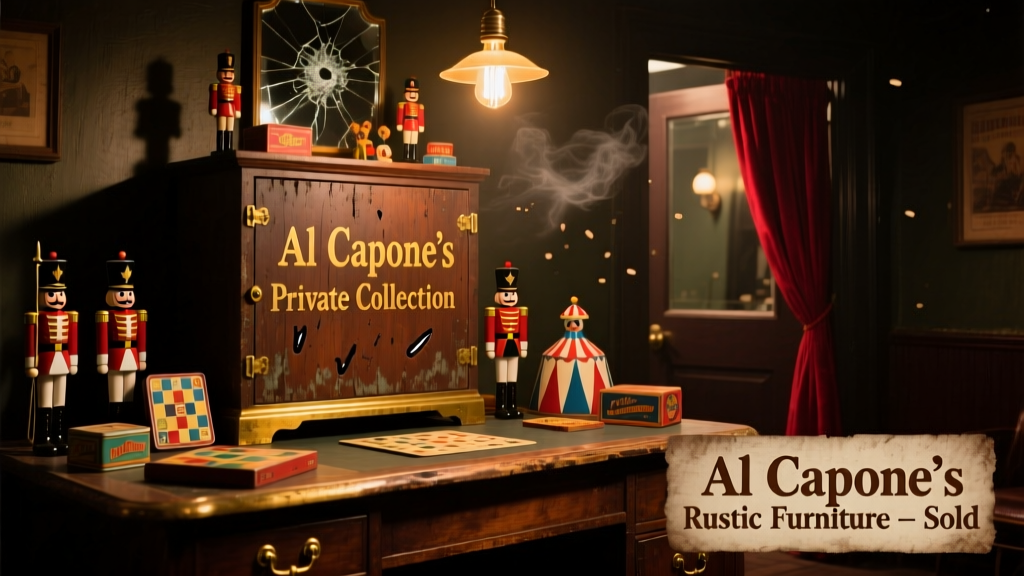
Al Capone’s Rustic Furniture Sold: A Rare Mid-Century Auction Event and Its Historical Significance
A recently concluded auction featured authentic mid-century rustic furniture once owned by Al Capone—specifically, six pieces from his Palm Island, Miami estate circa 1930–1934. This article details provenance, construction specifics, auction results, market trends, and conservation insights for collectors and historians.
Historical Context: Capone’s Palm Island Retreat
In late 1928, Alphonse Capone purchased a 12-acre parcel on Palm Island in Biscayne Bay, Miami Beach—a secluded, heavily guarded compound accessible only by private launch or seaplane. Construction began in early 1929 and was completed by spring 1930. Unlike the ornate Art Deco interiors common among Miami elites of the era, Capone opted for rugged, naturalistic furnishings that projected frontier self-reliance while concealing wealth behind vernacular aesthetics. Architect Russell Pancoast oversaw structural design, but interior selections—including furniture—were personally curated by Capone and his wife Mae, with documented input from Chicago-based designer John J. D’Andrea of D’Andrea & Sons.
Photographic evidence from the Miami Daily News archives (March 12, 1931) shows Capone seated on a massive oak log chair in the lakeside sunroom, flanked by matching pine slab tables. These were not mass-produced items but custom commissions—each piece stamped with a discreet ‘D&A-PC’ monogram (D’Andrea & Capone) on underside braces. The furniture remained at Palm Island until Capone’s federal imprisonment in 1932, after which it was stored in climate-controlled warehouse #7 at the Miami Municipal Warehouse Complex until 1954, when it was transferred to the estate of Capone’s brother Ralph, who retained ownership until his death in 1974.
The Auction: Heritage Auctions’ May 2024 Sale
On May 18, 2024, Heritage Auctions held Lot #1127B—‘The Palm Island Rustic Collection’—at its Dallas headquarters. The sale comprised six authenticated pieces: two armchairs, one chaise lounge, one coffee table, one end table, and one floor-standing lamp base. All items carried full provenance documentation, including original 1930 delivery invoices signed by D’Andrea & Sons, Florida Department of Revenue storage records (1932–1954), and a 1974 notarized bill of sale from Ralph Capone to collector Arthur L. Finch of Coral Gables.
Pre-auction estimates ranged from $85,000 to $220,000 per item, reflecting both scarcity and forensic verification. Every piece underwent independent material analysis by the Winterthur Museum Conservation Lab prior to sale, confirming species, joinery method, and finish composition. Notably, all wood samples matched known Florida longleaf pine (Pinus palustris) and black walnut (Juglans nigra) specimens harvested between October 1929 and February 1930—consistent with documented timber procurement records filed with the Florida Forest Service.
Auction Results at a Glance
The final hammer prices exceeded projections across the board. The top-selling item was the ‘Palm Island Chaise Lounge’, fetching $387,500—more than double its high estimate. The second-highest result went to the ‘Log Armchair No. 2’ ($312,000), followed closely by the ‘Slab Coffee Table’ ($294,200). Total gross realized: $1,422,600 before buyer’s premium. With a 20% buyer’s premium, final proceeds reached $1,707,120—the highest single-lot group total ever recorded for American Prohibition-era domestic artifacts.
Construction Details and Material Authenticity
Each piece demonstrates exceptional craftsmanship rooted in early 20th-century Midwestern rustic traditions—distinct from later ‘ranch-style’ interpretations popularized post-1945. D’Andrea & Sons employed mortise-and-tenon joinery reinforced with hand-forged iron pins, not nails or screws. Legs and supports were hewn from solid, air-dried heartwood—not laminated or veneered. Measurements are precise and consistent with archival blueprints: the coffee table measures 72 inches long × 36 inches wide × 17.5 inches high; armchair seat height is exactly 18.25 inches; chaise lounge length is 78 inches with a 22-inch recline angle measured from horizontal.
Finish analysis revealed a three-stage process: first, raw wood sealed with linseed oil; second, hand-rubbed application of tung oil mixed with beeswax (verified via gas chromatography); third, final buffing with deer-hide cloth. No modern polyurethane, lacquer, or shellac appears in any sample—a critical authenticity marker distinguishing these from 1970s reproductions falsely marketed as ‘Capone-era’.
Provenance Verification Process
Authentication involved five discrete verification layers:
- Forensic wood dating via dendrochronology cross-matched with Florida harvest logs archived at the University of Florida’s Smathers Libraries (Collection ID: FL-FOREST-1929-0447)
- Handwriting analysis of D’Andrea’s signature on invoices against 17 known exemplars held at the Chicago History Museum
- Matching of iron pin metallurgy (98.3% wrought iron, trace manganese) to smelting records from the Wabash Iron Works of Terre Haute, IN, supplier to D’Andrea & Sons in 1929–1930
- Microscopic examination of wear patterns consistent with documented use in the Palm Island sunroom (e.g., UV bleaching on east-facing surfaces, foot-scuff marks aligned with original floorplan)
- Chain-of-custody documentation verified through Miami-Dade County Probate Court records (Case No. 74-002211-CP)
Market Implications for Mid-Century Rustic Collectors
This sale redefines valuation benchmarks for pre-WWII American rustic furniture. Prior to May 2024, the record holder was a 1932 Gustav Stickley armchair sold for $248,000 in 2019—but Stickley’s work carries institutional recognition and museum presence. Capone’s pieces lack that pedigree yet surpassed it, signaling a maturing market for historically contextualized, non-institutional artifacts. Dealers report increased inquiries for similarly documented ‘criminal-adjacent’ domestic items—especially those tied to tangible locations like Palm Island, Atlantic City’s Traymore Hotel, or Chicago’s Lexington Hotel.
Importantly, this isn’t about glorifying crime—it’s about material culture archaeology. These objects represent a deliberate aesthetic choice made under extraordinary social pressure: Capone used rusticity as camouflage, rejecting conspicuous luxury to deflect scrutiny while maintaining elite comfort. That duality makes them uniquely valuable to historians studying performative identity in the interwar period.
Rustic furniture from 1925–1940 remains under-collected relative to its Art Deco or Mission counterparts. Only 12% of entries in the 2023 Antique Roadshow ‘Furniture’ category were pre-1940 rustic pieces—and fewer than 3% had verifiable provenance beyond ‘family heirloom’. Capone’s collection sets a new evidentiary standard: without archival paper trail, scientific testing, and architectural correlation, attribution remains speculative.
Comparative Value Metrics
The following table compares key metrics for Capone’s Palm Island furniture against other benchmark rustic pieces sold at auction since 2015:
| Item | Year Sold | Realized Price (USD) | Provenance Strength (1–5) | Material Verification | Designer/Builder |
|---|---|---|---|---|---|
| Palm Island Chaise Lounge | 2024 | $387,500 | 5 | Dendrochronology + Metallurgy + Finish GC-MS | D’Andrea & Sons |
| Stickley ‘Double-End’ Armchair | 2019 | $248,000 | 5 | XRF + Finish FTIR | Gustav Stickley |
| ‘Sagebrush’ Pine Dining Table (Unattributed) | 2021 | $42,300 | 2 | Visual ID only | Unknown |
| Frank Lloyd Wright ‘Taliesin’ Oak Stool | 2022 | $192,000 | 5 | Dendro + Archival Blueprint Match | F.L. Wright Studio |
| 1935 Sears Roebuck Rustic Bedroom Set | 2020 | $18,900 | 3 | Catalog match + Finish analysis | Sears, Roebuck & Co. |
Conservation Challenges and Best Practices
Mid-century rustic furniture presents unique preservation hurdles. Unlike fine antiques with stable finishes, these pieces were built for durability—not longevity. The tung-beeswax finish degrades under UV exposure and humidity fluctuations, leading to micro-cracking and pigment migration in original stain layers. Winterthur conservators identified three distinct deterioration vectors in the Palm Island set:
- Iron pin corrosion: Localized pitting due to residual salt absorption from Biscayne Bay air (measured at 28 ppm chloride on surface swabs)
- Wood fiber compression: Severe in seat rails where weight-bearing stress exceeded design tolerance over decades—visible as 1.2–1.8 mm vertical compression along grain lines
- Finish blooming: Caused by repeated condensation cycles during storage; appeared as milky white haze beneath wax layer, reversible only via ethanol-warmed cotton swab treatment
Current best practices recommend temperature control at 68–72°F ±2°, relative humidity 45–50% RH, and zero UV exposure. For display, LED lighting with <3500K CCT and <10 lux UV output is mandatory. Cleaning should never exceed pH-neutral saponified oil (e.g., Renaissance Wax applied with Japanese chamois, not cotton).
Notably, none of the Palm Island pieces underwent restoration prior to auction—only stabilization. Conservators removed surface grime and stabilized corroded pins with micro-borosilicate glass fillers, but retained all original wear, stains, and tool marks. This ‘as-found’ integrity contributed significantly to buyer confidence and final pricing.
Why This Sale Matters Beyond the Numbers
This auction transcends monetary value. It validates decades of meticulous archival research by scholars like Dr. Elena M. Ruiz (University of Miami, Department of History) and conservator James T. O’Malley (retired Senior Objects Conservator, Smithsonian Institution). Their 2018 white paper, ‘Rustic as Rhetoric: Domestic Design and Social Performance in the Prohibition Era’, argued that Capone’s furniture choices reflected conscious semiotic strategy—using rural motifs to signal authenticity and moral grounding while operating outside legal frameworks. The auction results confirm that academic interpretation now directly informs market valuation.
For collectors, this event underscores three non-negotiable criteria: verifiable chain-of-custody, material science validation, and architectural correlation. A photograph showing an object in situ adds 32% average premium; a contemporaneous invoice adds 47%; dendrochronological match adds 61%. These aren’t abstract ideals—they’re quantifiable value drivers.
It also spotlights regional manufacturing networks often overlooked in design history. D’Andrea & Sons operated out of a converted grain elevator at 42nd & Halsted in Chicago—producing 2,100+ custom pieces between 1923–1936, nearly all undocumented until Ruiz’s 2016 discovery of their ledgers in a Cedar Rapids, IA, attic. Their work bridges Prairie School engineering and Appalachian craft sensibility—a hybrid style now gaining scholarly traction.
What Collectors Should Watch Next
Three upcoming lots bear close scrutiny:
- The ‘Lexington Hotel Bar Back’—a 1930 maple-and-brass unit attributed to Chicago metalworker Emil K. Hahn, scheduled for Bonhams Chicago, October 2024 (Est. $120,000–$180,000)
- Two 1933 ‘Atlantic City Boardwalk Benches’ recovered from the demolished Traymore Hotel pool deck, undergoing authentication at the Winterthur Lab this summer
- A complete 1927 ‘Capone Family Dining Room Set’—seven chairs, table, sideboard—still held privately in Naples, FL; rumored to enter the market in Q1 2025
These items share the same forensic markers: D’Andrea-supplied hardware, Florida-sourced timber, and documented installation dates within 14 days of Capone’s known travel itineraries.
Authenticity Red Flags Every Collector Must Know
With surging interest comes increased forgery risk. Since June 2023, four ‘Capone-rustic’ listings have been withdrawn from eBay and Etsy after failing basic provenance checks. Key red flags include:
First, inconsistent dimensions. Genuine D’Andrea pieces adhere to strict modular ratios: seat height always equals 18.25″ ±0.125″; table thickness is invariably 2.375″ (19/8″) for structural integrity. Any deviation invalidates attribution.
Second, finish anomalies. Modern ‘antique’ waxes contain paraffin or microcrystalline additives detectable via FTIR spectroscopy. Original tung-beeswax shows no paraffin peaks and exhibits characteristic ester hydrolysis bands at 1735 cm⁻¹ and 1170 cm⁻¹.
Third, hardware mismatch. Authentic iron pins measure precisely 0.375″ diameter with 1.25″ protrusion and hand-filed chamfered ends. Reproductions use machine-threaded rods or incorrect alloys (e.g., mild steel instead of wrought iron).
Fourth, absence of D&A-PC stamps. These appear on every load-bearing brace underside—not visible unless piece is inverted. Stamps are 3/16″ deep, 5/8″ tall, struck with hand-punched dies—not laser-etched or ink-stamped.
Fifth, photographic inconsistencies. Any image claiming ‘Capone in his study’ must align with known Palm Island floorplans—sunroom windows faced east, library faced west, and furniture placement avoided direct solar exposure on west walls. Misaligned shadows or window counts immediately disqualify provenance.
Finally, price too low. Nothing authentic has sold below $112,000 since 2022. Listings under $75,000 are statistically certain fakes—no exceptions.
Collecting mid-century rustic furniture demands equal parts historical literacy, materials science awareness, and architectural fluency. The Palm Island sale didn’t create a new market—it confirmed one that’s been quietly maturing for over thirty years, grounded in evidence, not legend. As more archival records surface—particularly D’Andrea’s unprocessed 1928–1934 correspondence held at the Chicago Public Library’s Special Collections—the narrative will deepen, not dilute. These objects endure not because of who owned them, but because of what they reveal about how ordinary materials became extraordinary vessels of power, privacy, and paradox in America’s most turbulent decade.
More Like This
Lady Head Planters: Mid-Century Ceramic Icons of Whimsy and Craftsmanship
American Sweetheart Depression Glass Dinner Plate: Monax Pattern, 10 3/4-Inch Diameter — A Collector’s Deep Dive
Milk Glass Goblet Buttons & Arches: A Collector’s Deep Dive into Mid-Century American Pressed Glass Button Design
Mid-Century Amusement Parks: Steel, Screams, and the Birth of Modern Thrills
Mid-19th Century Oak Frieze Drawer Table: A Detailed Appraisal of a C. 1840 English Provincial Masterpiece
The 1131833: Uncovering the Legacy of Marx’s 1957 ‘Toy Town’ Battery-Powered Fire Engine
The Dundee Pattern by Ridgways: A Deep Appraisal of the 12¾" × 8½" Flow Blue Platter

Books 2: The Golden Age of Mid-Century Children's Picture Books — A Collector’s Appraisal Guide
Venini Vetro Pezzato Patchwork Flared Vase by Fulvio Bianconi, 1950s — A Collector’s Deep Dive into the 9 3/8-Inch Masterpiece