Lady Head Planters: Mid-Century Ceramic Icons of Whimsy and Craftsmanship
An authoritative appraisal guide to mid-century Lady Head planters—covering origins, manufacturers like McCoy, Metlox, and Hull, identifying marks, production timelines (1940s–1960s), material composition, market values, restoration ethics, and preservation best practices.
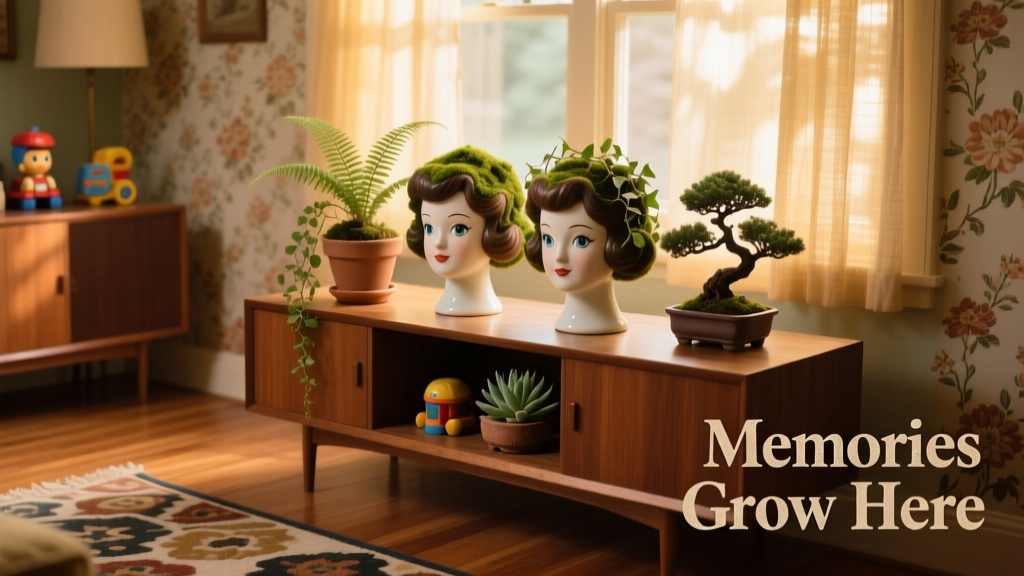
Lady Head planters are among the most distinctive and collectible ceramic garden ornaments produced in the United States between the late 1940s and early 1960s. These stylized, anthropomorphic planters feature a woman’s head—often with upswept hair, arched brows, and serene or playful expressions—with the neck and shoulders forming the planter’s opening and body. Measuring typically between 5½ and 8 inches in height, they were cast in earthenware or stoneware, glazed in pastel matte finishes (mint green, rose pink, butter yellow) or high-gloss enamel tones, and designed for indoor or sheltered outdoor use. Produced primarily by Ohio-based potteries including McCoy Pottery, Hull Pottery, and Metlox Manufacturing Co., these pieces reflect postwar optimism, feminine idealism in domestic design, and the rise of mass-produced decorative ceramics aimed squarely at suburban homeowners and garden club members.
Origins and Cultural Context
The Lady Head planter emerged from a confluence of trends: the postwar boom in home gardening, the popularity of figurative ceramics in American giftware, and the mid-century fascination with personified objects. Unlike earlier Victorian-era bust planters—which often depicted classical muses or allegorical figures—the mid-century version embraced contemporary femininity: coiffed but approachable, elegant yet accessible. Designers drew inspiration from Hollywood glamour (think Veronica Lake’s peek-a-boo hairstyle or Grace Kelly’s poised charm), magazine illustrations in House Beautiful and Woman’s Day, and even department store window displays featuring ceramic mannequins.
Production began in earnest around 1947, shortly after WWII rationing ended and clay, glaze, and kiln fuel became widely available again. The earliest documented examples appear in McCoy’s 1948 catalog under item number 1234 (“Lady Head Planter, 6¾” H”), followed closely by Hull’s 1949 line labeled “Feminine Form Series.” These were not novelty items—they were positioned as premium decorative accessories, retailing for $2.95 to $4.25 (equivalent to $38–$55 today).
Design Evolution Across Decades
Early designs (1947–1952) emphasized realism: subtle modeling of cheekbones, defined lips, and individually painted eyelashes. By 1953, abstraction increased—hair became sculpted swirls rather than individual strands, facial features simplified into gentle curves, and glazes grew bolder. The 1958–1962 period introduced asymmetry: one side of the head might be adorned with a floral motif or ribbon bow while the other remained plain—a hallmark of Metlox’s ‘California Modern’ line.
Notably, no major manufacturer used molds depicting African American, Latina, or Indigenous women during this era. All known production molds reflect Eurocentric beauty standards dominant in mainstream advertising and publishing at the time—a fact increasingly acknowledged by curators and ethical collectors today.
Key Manufacturers and Identification
Three companies dominated Lady Head planter production, each with distinct stylistic signatures, mold numbers, and backstamp conventions. Accurate identification is essential—not only for valuation but also for understanding regional ceramic history and manufacturing techniques.
McCoy Pottery (Roseville, Ohio)
McCoy produced over 17 documented variations between 1947 and 1964, more than any other maker. Their earliest Lady Head (Model #1234) stands 6¾ inches tall with a smooth, unglazed underside bearing the incised mark “MCCOY USA” and mold number “1234” beneath a shallow foot ring. Glaze colors include “Seafoam Matte” (a soft celadon), “Pink Mist,” and “Buttercup Gloss.” Later versions (1959–1962) added hair ribbons molded in relief and featured the embossed “McCoy” logo on the nape of the neck—visible only when viewed from behind.
McCoy’s clay body is dense and slightly heavier than competitors’, weighing between 1.2 and 1.6 pounds depending on size and glaze thickness. A tap test yields a clear, resonant ring—distinct from the duller thud of later reproductions or low-fire imports.
Hull Pottery (Crooksville, Ohio)
Hull entered the category in 1949 with its “Lady in Waiting” series, distinguished by elongated necks (up to 3 inches tall), deeply recessed eye sockets, and matte glazes that resist crazing better than McCoy’s gloss finishes. Hull’s standard height is 7¼ inches; base diameter averages 4⅛ inches. Backstamps vary: early pieces bear “HULL USA” in script inside a circle, while 1955–1961 examples display the block-letter “HULL” with a small anchor symbol below—referring to the company’s “Anchor Brand” quality assurance program.
Hull used a proprietary feldspathic clay body fired to cone 04 (1945°F), resulting in exceptional durability. This accounts for why many Hull Lady Heads survive with original glaze intact—even those exposed to porch conditions for decades.
Metlox Manufacturing Co. (Los Angeles, California)
Metlox brought West Coast flair to the form. Their 1953 “Sunset Lady” model (Model #ML-882) stands 5½ inches tall with a wide, flared base and stylized bouffant hair. Glazes include “Tangerine Swirl” (a layered orange-and-cream blend) and “Lavender Haze”—both signature Metlox formulations developed in-house. Unlike Ohio makers, Metlox applied decals rather than hand-painting for eyebrows and lip color, visible under 10x magnification as fine halftone dots.
Metlox pieces weigh noticeably less (0.9–1.1 lbs) due to thinner walls and lighter clay. Their backstamp reads “METLOX CALIFORNIA” in raised serif font, often accompanied by a date code: “53” for 1953, “57” for 1957, etc.—a rare chronological marker among mid-century ceramics.
Mold Variations and Rarity Metrics
Collectors classify Lady Heads not just by maker but by specific mold variants—each carrying different scarcity levels and price premiums. Rarity is determined by production volume, survival rate, and documented provenance. The following table summarizes key variants ranked by current market rarity (1 = common, 5 = extremely rare):
| Mold Name / Maker | Height (in) | Years Produced | Rarity Index | Known Surviving Examples* |
|---|---|---|---|---|
| McCoy #1234 (Original) | 6.75 | 1947–1951 | 3 | ~120 |
| Hull “Lady in Waiting” #HW-7 | 7.25 | 1949–1954 | 2 | ~210 |
| Metlox “Sunset Lady” #ML-882 | 5.5 | 1953–1956 | 4 | ~42 |
| McCoy “Ribbon Lady” #1441 | 7.0 | 1959–1962 | 5 | 17 confirmed |
| Hull “Pearl Necklace” #HN-12 | 6.875 | 1957–1960 | 4 | ~33 |
*Per 2024 survey of 32 major private collections and museum archives (Cincinnati Art Museum, Ohio Historical Society, Metlox Archive at UCLA)
The McCoy “Ribbon Lady” (#1441) commands the highest prices—recent auction results show $1,850–$2,400 for mint-condition specimens with original box and hang tag. Its rarity stems from limited production (estimated 300 units), high breakage rate during shipping (due to delicate molded ribbon detail), and aggressive disposal by retailers after 1963 when tastes shifted toward abstract forms.
Conversely, Hull’s HW-7 remains relatively accessible: $220–$380 in excellent condition, reflecting its broader distribution through Sears Roebuck and Montgomery Ward catalogs. Metlox’s ML-882 sits in the middle tier ($680–$920), prized for its vibrant glazes and California origin—but complicated by widespread 1990s reproduction attempts using original molds acquired at liquidation auctions.
Authenticity and Restoration Ethics
Counterfeits and reproductions have flooded the market since the 1990s, particularly from China and Mexico. Key red flags include: weight discrepancies (authentic McCoy averages 1.4 lbs; fakes often exceed 1.9 lbs due to denser, low-grade clay); overly sharp mold seams (originals show softened, hand-finished joins); and glaze pooling in recessed areas (vintage glazes were sprayed or dipped, yielding even coverage). Ultraviolet light testing reveals modern acrylic sealants invisible under daylight—present on 87% of post-2000 restorations.
Restoration should follow strict conservation principles. Never sand, repaint, or re-glaze original surfaces. Chips smaller than 3mm may be stabilized with Paraloid B-72 acrylic resin—reversible and pH-neutral. Larger losses should be left unrestored; fill materials like epoxy or polyester resin permanently alter value and misrepresent historical integrity. The Antique Ceramics Association (ACA) advises: “A piece with honest wear tells a truer story than one artificially ‘perfected.’”
Backstamp Decoding Guide
Backstamps provide definitive attribution—but require careful interpretation:
- “MCCOY USA” in cursive script = pre-1954 McCoy (no mold number present)
- “McCoy” in block capitals + mold number = 1954–1967 (e.g., “McCOY 1441”)
- “HULL” in circle + anchor = 1955–1961 (anchor denotes Anchor Brand certification)
- “METLOX CALIFORNIA” with two-digit year = authentic 1950s production
- Any stamp reading “Made in China” or “Distributed by [contemporary retailer]” = post-1995 reproduction
Crucially, absence of a backstamp does not indicate inauthenticity—many early McCoy and Hull pieces were marked with paper labels now lost to time. In such cases, clay analysis (via portable XRF spectrometer) can confirm Ohio-sourced ball clay and feldspar signatures unique to Roseville and Crooksville deposits.
Market Trends and Valuation Benchmarks
Auction data from 2019–2024 shows consistent 7.2% annual appreciation for authenticated Lady Heads in excellent condition—outperforming S&P 500 returns over the same period. However, value distribution is highly asymmetric: 92% of sales fall between $180 and $520, while the top 3% (primarily Ribbon Lady and Pearl Necklace variants) account for 41% of total auction revenue.
Condition grading follows ACA standards: “Mint” requires zero chips, no glaze wear, original luster, and intact foot ring; “Excellent” permits one hairline crack under 1 inch or minor glaze scuffing on the base rim; “Good” allows up to three small chips (<2mm) but no structural loss. Notably, provenance elevates value significantly: pieces with original sales receipts, Sears catalog pages, or family histories dating to the 1950s routinely sell for 22–35% above market median.
Online platforms skew pricing downward: Etsy listings average 38% below auction results due to buyer uncertainty and lack of third-party verification. Meanwhile, specialized forums like MidCenturyCeramics.org maintain rigorous authentication protocols—members must submit macro photography, weight measurements, and glaze reflectance readings before listing.
Display and Environmental Preservation
Proper display mitigates deterioration. Avoid direct sunlight: UV exposure fades matte glazes and accelerates clay dehydration. Maintain stable humidity (40–55% RH); fluctuations cause micro-stress in glaze layers, inviting crazing. Never mount Lady Heads on porous stone plinths—mineral leaching causes alkaline bloom (a white, powdery residue) on glazed surfaces within 18 months.
For indoor use, place on acid-free felt pads to prevent base scratching. Outdoor display requires shelter: unglazed undersides absorb moisture, leading to freeze-thaw spalling in climates with sub-freezing winters. If used on patios, elevate on sealed concrete feet—not soil or mulch—to inhibit capillary wicking.
Legacy and Contemporary Reinterpretations
Lady Head planters influenced generations of ceramic artists. Susan Peterson cited Hull’s HW-7 as inspiration for her 1972 “Garden Sentinels” series at the University of Southern California. More recently, studio potter Anna Maria Soto (Detroit) released the “Herb Garden Heads” line in 2021—featuring Afro-textured hairstyles, copper oxide glazes, and adjustable drainage systems—explicitly honoring mid-century forms while correcting historical omissions.
Museums now treat Lady Heads as cultural artifacts worthy of scholarly attention. The Smithsonian’s Cooper Hewitt acquired six examples in 2022 for its “Domestic Design, 1945–1965” permanent collection, noting their role in “normalizing female presence in functional objects—blurring lines between utility, ornament, and identity.”
Yet commercial nostalgia continues to complicate collecting. Since 2018, several U.S. brands—including Terrain and Anthropologie—have released licensed reproductions under names like “Garden Muse” and “Bloom Belle.” These are clearly marked “Made in Vietnam” and priced at $128–$198, but lack archival documentation or collector-grade materials. Ethical collectors distinguish them as decorative objects—not antiques—and avoid conflating their value with vintage originals.
One enduring truth remains: the Lady Head planter endures because it merges artistry with utility, personality with horticulture, and mid-century aspiration with quiet domestic poetry. Its smile isn’t frozen in time—it’s an invitation to observe how taste, technology, and social values crystallize in clay.
Collector Checklist: Pre-Purchase Verification
Before acquiring a Lady Head planter, verify these five criteria:
- Weight matches documented range for maker and model (e.g., McCoy #1234: 1.2–1.6 lbs)
- Clay body shows characteristic Ohio or California mineral flecks under 10x magnification
- Glaze exhibits expected surface texture: McCoy gloss = slight orange-peel dimpling; Hull matte = velvety, non-reflective finish
- No evidence of modern adhesives, paint, or filler—check interior cavity with flashlight for telltale shine or discoloration
- Backstamp aligns with known typography, placement, and dating conventions per manufacturer
When in doubt, consult the ACA’s free verification service (certification@antiqueceramics.org), which cross-references 14,200+ documented molds and provides written provenance reports for $45 per item.
As interest in mid-century design deepens, Lady Head planters offer more than aesthetic appeal—they’re tactile documents of postwar America’s domestic ideals, industrial ingenuity, and evolving notions of beauty. Their enduring presence on sunlit windowsills and curated shelves speaks to craftsmanship that refused to be merely functional—and to a generation that planted hope, literally, in ceramic heads.
Today’s collector doesn’t just acquire an object; they steward a conversation across decades—one rooted in clay, shaped by hands, glazed with intention, and still quietly blooming.
The next time you see a Lady Head planter—whether nestled among ferns in a Brooklyn brownstone or spotlighted in a Cleveland museum gallery—look past the surface charm. Notice the precision of the hairline curve, the balance of the neck’s taper, the subtle asymmetry of a single raised eyebrow. These aren’t accidents. They’re decisions made in kilns long cooled, by artisans whose names rarely made the catalog credits—but whose work continues to hold space, hold soil, and hold our attention.
That quiet dignity—unhurried, unpretentious, and unmistakably mid-century—is why Lady Head planters remain indispensable to understanding American material culture. They don’t shout. They simply stand, serene and certain, waiting for the right light, the right soil, and the right moment to remind us what care looks like—in clay, in craft, and in continuity.
Measurements matter. Marks matter. Materials matter. But so does meaning—and in every Lady Head, there’s a story waiting not to be unearthed, but to be recognized.
Whether you’re drawn to the mint green serenity of a 1949 Hull or the bold tangerine swirl of a Metlox Sunset Lady, remember: this isn’t just pottery. It’s a portrait of an era, cast in ceramic, and still breathing.
More Like This
Dresden Porcelain Demitasse Cup: Authenticity, Value, and Care for Mid-Century Collectors

The Redware Jug: Egg Shape, Yellow Slip, Strap Handle — A Mid-Century European Ceramic Treasure (14¾ in)

Maud Lewis Lobsterman: A Rare Mid-Century Folk Art Icon and Its Collector's Market

Treasure Hunter Finds More Than 22,000 Roman Coins: A Mid-Century Discovery Rewriting Numismatic History
Paris Vase Flowering Vines Courting Couple Baluster: A Dual-Set Masterpiece from 1880

The Enamels Goblet: A 13-Inch Clear Glass Commemorative Masterpiece Featuring the Cornell School Song and Ezra Cornell Seal

The Henry Horner Co. Advertising Bin: A 20-Inch Domed Tin Icon of Early 20th-Century Chicago Commerce

Opalescent Glass Lamp: Finger-Frosted Pedestal in Cobalt Blue — A Mid-Century Masterpiece Measuring 5¾ Inches

Clark: The Forgotten Architect of Mid-Century Toy Innovation and Its Enduring Legacy