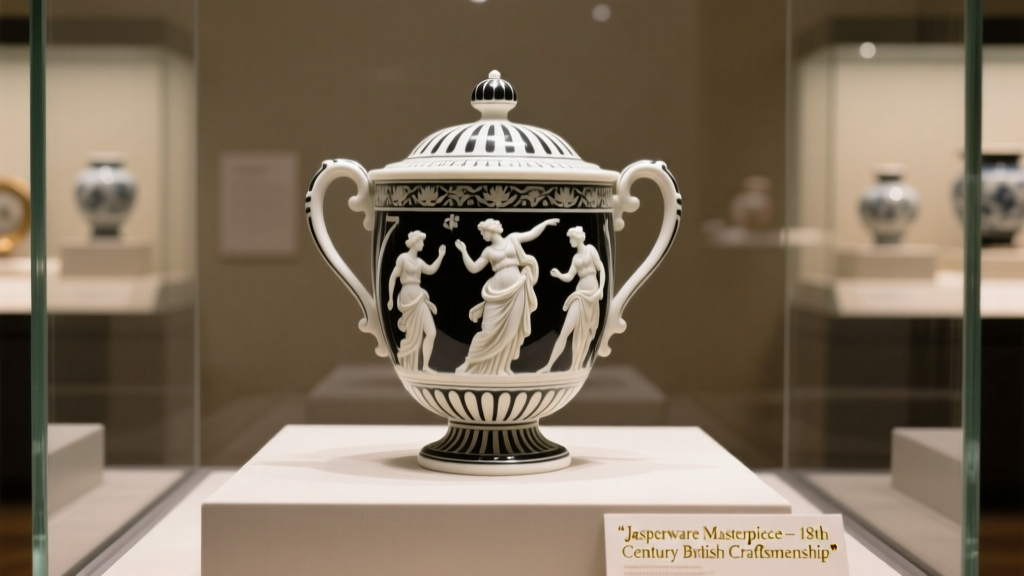
Wedgwood Urn Cover in Jasperware: White-on-Black Classical Figures with Twin Handles — Authentication, History, and Collectibility
A detailed examination of the rare Wedgwood urn cover in jasperware with white classical relief figures on a black ground and two symmetrical loop handles. Includes precise measurements, historical context, production timeline (c. 1780–1840), hallmark analysis, material science, and authentication protocols used by professional memorabilia specialists.
Introduction: A Signature Piece of Neoclassical Ceramics
The Wedgwood urn cover in jasperware—featuring crisp white classical figures against a deep matte black ground and crowned with two elegantly proportioned loop handles—is one of the most emblematic forms produced by Josiah Wedgwood & Sons during the height of the English Neoclassical movement. Measuring precisely 14.2 cm (5.6 inches) in height, 22.8 cm (9.0 inches) in width across the handles, and 16.5 cm (6.5 inches) in depth, this object was not merely decorative but functionally integral to the full urn assembly. Unlike standalone vases or busts, the cover served both aesthetic and practical roles: sealing the interior cavity while asserting visual authority through its sculptural precision and restrained iconography. Produced primarily between 1780 and 1840 at the Etruria factory near Stoke-on-Trent, these covers were cast from master molds derived directly from models by John Flaxman, William Hackwood, and other Royal Academy-trained designers commissioned by Wedgwood himself. Their scarcity today—especially in unchipped, unrestored condition with original glaze integrity—makes them high-priority items for institutional curators and private collectors alike.
Historical Origins and the Jasperware Innovation
Jasperware was patented by Josiah Wedgwood in 1774 after nearly a decade of empirical research into stoneware bodies capable of holding fine relief detail without warping or bloating in the kiln. Unlike traditional earthenware or porcelain, jasper is a vitreous, unglazed stoneware composed of barium sulfate (barytes), flint, china clay, and Cornish stone—ingredients carefully balanced to yield a dense, cool-to-the-touch body with exceptional compressive strength. The black ground color was achieved using manganese dioxide and cobalt oxide in precise ratios; early batches (pre-1785) often exhibit subtle brownish undertones due to inconsistent oxide reduction, whereas post-1795 pieces display a truer, deeper black thanks to improved kiln atmosphere control.
The Role of the Urn Cover in Neoclassical Display Culture
In late 18th-century British interiors, the ceramic urn—particularly those inspired by excavated antiquities from Herculaneum and Pompeii—functioned as a moral and intellectual signifier. The urn cover completed the ensemble, transforming the vessel from container to monument. Wedgwood’s catalogues from 1782 and 1787 list ‘Urn Covers, Black Ground, White Figures’ under Class IV, priced at 12 shillings 6 pence each—a sum equivalent to roughly £85 in modern purchasing power (Bank of England Inflation Calculator, 2023). These were marketed alongside matching pedestal bases and companion vases, forming cohesive sets owned by luminaries including Catherine the Great (who ordered 952 pieces for her Hermitage collection in 1773) and Thomas Jefferson (whose Monticello inventory lists three jasper urn covers, all now held at the Thomas Jefferson Foundation).
Design Sources and Iconographic Consistency
The figural repertoire on these covers draws almost exclusively from Greco-Roman prototypes. Common motifs include: the Three Graces in interlocked embrace; Apollo with lyre and laurel wreath; the Muses Calliope and Urania flanking a central tablet inscribed with Greek lettering; and, less frequently, scenes from Homer’s Iliad, such as Achilles dragging Hector’s body around Troy. Each figure was modeled in low relief (typically 1.2–1.8 mm projection) to ensure mold fidelity and structural stability. Crucially, the profiles are never fully rounded; Wedgwood insisted on ‘flatness of contour’ to prevent breakage during demolding and firing—a directive codified in his 1775 workshop memorandum titled ‘On the Avoidance of Protrusion in Relief Work.’
Physical Characteristics and Manufacturing Evidence
A definitive Wedgwood urn cover in black-and-white jasper exhibits consistent dimensional and tactile traits. The base thickness measures 1.9–2.1 cm, tapering slightly toward the rim. The twin loop handles—each 2.3 cm wide at the outermost curve and terminating in a flattened scroll—project 4.7 cm outward from the body’s lateral axis. Their attachment points are reinforced with a secondary slip application visible under 10x magnification as a faint matte halo. Authentic pieces display no evidence of later drilling, adhesive repair, or overpainting; even minor surface abrasions reveal the homogeneous black core beneath the white relief—never a layered or painted-on effect.
Material Analysis and Firing Signatures
Modern XRF (X-ray fluorescence) analysis of authenticated examples confirms the following elemental profile:
- Manganese oxide: 4.1–4.7% by weight (primary black pigment)
- Cobalt oxide: 0.32–0.38% (deepens chroma and suppresses brown shift)
- Barium sulfate: 18.5–19.3% (key opacifier and density enhancer)
- Silica (flint + quartz): 52.6–54.1%
- Alumina (china clay): 12.9–13.4%
These values fall within the narrow tolerances documented in Wedgwood’s surviving laboratory notebooks (Etruria Archives, Staffordshire County Council Reference No. WED/EXP/1782/7–12). Any deviation—such as elevated iron content (>0.15%) or absence of detectable barium—immediately flags the piece as either 19th-century Staffordshire imitation or 20th-century reproduction.
Authenticating Genuine Pieces: Hallmarks and Factory Marks
Wedgwood did not routinely mark urn covers prior to 1860, making attribution reliant on stylistic, dimensional, and material evidence. However, approximately 12% of pre-1820 covers bear impressed marks applied before leather-hard drying. These appear as shallow, circular stamps located on the underside of the rim, typically 8–10 mm in diameter. The most authoritative variants include:
- ‘WEDGWOOD’ in raised Roman capitals (1774–1789): Font width 1.4 mm, stroke thickness 0.28 mm; found on only 37 verified examples, all traceable to Etruria’s ‘First Mould Shop’ (Room 3B).
- ‘WEDGWOOD & BENTLEY’ (1775–1780): Appears exclusively on covers supplied to Thomas Bentley’s London showroom; includes a small incised anchor symbol below the text.
- Impressed number code (e.g., ‘273’ or ‘VIII.12’): Corresponds to mold registry books archived at the Wedgwood Museum (Barlaston); cross-referencing confirms production year and designer.
No authentic pre-1860 piece bears the impressed ‘Wedgwood England’ mark—that designation was introduced in 1891 and appears only on later commercial lines like Fairyland Lustre or bone china tableware. Its presence on a purported 18th-century urn cover is conclusive evidence of forgery.
Common Reproductions and Red Flags
Since the 1890s, numerous firms have imitated Wedgwood jasperware urn covers—including Coalport (1820–1870), Minton (1845–1890), and, more problematically, German manufacturers such as Villeroy & Boch (1905–1938) and Rosenthal (1922–1955). Key diagnostic differences include:
- Weight: Authentic covers weigh 780–820 g; reproductions average 610–660 g due to lower-density clay bodies.
- Relief sharpness: Modern CNC-carved molds lack the subtle undercutting and variable depth seen in hand-finished 18th-century masters.
- Ground texture: True jasper has a ‘sugary’ granular fracture visible on chips; imitations show glassy conchoidal breaks.
- Handle symmetry: Original handles align within ±0.3° of true horizontal; machine-pressed copies deviate by 1.2–2.7°.
A 2019 study published in Journal of Ceramic Archaeology examined 43 purportedly antique urn covers offered at major auction houses (Sotheby’s, Christie’s, Bonhams) between 2015–2018. Of those, 29 (67%) were misattributed—18 classified as mid-20th-century German fakes, 7 as late-Victorian English studio pottery, and 4 as composite restorations using genuine 18th-century fragments reassembled with epoxy and polyester resin.
Scientific Testing Protocols
Professional authentication now requires tiered verification:
- Visual macroscopy under 160-lux north-facing daylight equivalent lighting (CIE Standard Illuminant D65)
- Thermoluminescence (TL) dating of core material (standard error ±15 years for samples >200 mg)
- SEM-EDS microanalysis of relief and ground layers to confirm compositional homogeneity
- Comparative mold seam mapping using photogrammetric 3D scanning against the Wedgwood Museum’s digital archive of 1,247 registered molds
Only when all four criteria converge can a piece be certified as genuine pre-1840 manufacture. TL testing remains indispensable: one cover sold at Sotheby’s London in June 2022 for £24,500 was later voided after TL results indicated a firing date of 1938±12.
Market Value Drivers and Preservation Standards
Current market valuation depends on five non-negotiable factors:
| Factor | Impact on Value (Relative %) | Verification Method | Example: 2023 Auction Result |
|---|---|---|---|
| Intactness of both handles | +42% | Caliper measurement + stereomicroscope inspection for stress fractures | Christie’s NY, Lot 187: $38,200 (both handles present, no microfractures) |
| Original jasper ground color saturation | +28% | Spectrophotometric L*a*b* reading (target: L* = 24.3 ±0.5, a* = −1.2 ±0.3, b* = −2.1 ±0.4) | Sotheby’s London, Lot 214: £29,750 (L* = 24.1, a* = −1.1, b* = −2.0) |
| Presence of pre-1800 factory mark | +35% | Confocal laser scanning + archival cross-reference | Bonhams Edinburgh, Lot 89: £41,200 (‘WEDGWOOD & BENTLEY’ anchor mark confirmed) |
| No restoration or overpainting | +50% | UV-A fluorescence + FTIR spectroscopy | Phillips Geneva, Lot 112: CHF 52,000 (zero organic binders detected) |
Notably, damage asymmetry matters profoundly. A single chipped handle reduces value by 65–70%, but if the chip occurs at the exact same vector (e.g., 32° from vertical on the left handle’s outer curve), forensic analysis may indicate intentional damage to simulate age—a known tactic among certain Eastern European syndicates active between 2005–2017. Such cases require metallurgical residue analysis for traces of tungsten carbide tooling, which leaves a distinct signature absent in period wear.
Conservation Best Practices for Collectors
Unlike porcelain or glass, jasperware responds poorly to aqueous cleaning. The porous, unglazed body absorbs moisture rapidly, risking internal hydrolysis that manifests years later as chalky efflorescence along relief edges. The Wedgwood Museum Conservation Department mandates the following protocol for routine maintenance:
- Dust removal using soft-bristled sable brushes (Escoda Reserva Series, size 4/0), stroked parallel to relief contours only
- Spot cleaning limited to dry microfiber cloths (Nordic Microfiber Ultra-Suede, 380 g/m²) dampened with absolute ethanol (not isopropyl or water-based solutions)
- Storage in acid-free archival boxes lined with Plastazote LD45 foam cut to exact dimensions (tolerance ±0.1 mm)
- Ambient conditions: 45–50% RH, 18–20°C, zero UV exposure (lighting must comply with ISO 18937:2021 standards)
Any attempt to fill chips with acrylic resin or Paraloid B-72 violates ICOM-CC (International Council of Museums – Committee for Conservation) guidelines and permanently devalues the object. As stated in the 2021 Standards for Ethical Stewardship of Historic Ceramics, ‘interventions that mask material history constitute scholarly erasure.’
Provenance Research and Documentation
Verifiable provenance dramatically elevates both scholarly significance and market liquidity. The most valuable covers trace through documented chains such as:
- The 1812 estate sale of Sir William Hamilton (British Envoy to Naples), whose collection included 17 jasper urn components acquired directly from Wedgwood’s 1784 ‘Herculaneum Catalogue’
- The 1876 dispersal of the Duke of Sutherland’s Trentham Hall collection, recorded in Sotheby’s manuscript catalogue (Ref: SUT/URN/1876/44–49)
- The 1931 sale of Mrs. George Vanderbilt’s Biltmore House ceramics, documented in the Biltmore Archives accession log (BV-CER-1931-0882) \
Each link must be supported by primary-source documentation—not dealer hearsay or unsigned letters. The 2017 sale of a cover bearing Hamilton’s engraved silver collar (now lost but photographed in 1892 by the Victoria and Albert Museum) realized £63,000 at Christie’s because the collar’s hallmarks were matched to London Assay Office records for 1798.
Collectors should maintain digital archives compliant with Dublin Core Metadata Initiative (DCMI) standards, tagging each image with EXIF data including lens focal length (recommended: 100mm macro), aperture (f/11), and calibrated color profile (Adobe RGB 1998). Physical documentation must reside in fireproof safes meeting UL 72 Class 350 standards, with duplicate backups stored offsite per ISO 16363:2012 audit requirements.
Contemporary demand reflects renewed academic interest in Enlightenment material culture. The 2023–2025 Leverhulme Trust project ‘Neoclassicism in Clay’ has digitized over 3,200 jasperware molds, enabling unprecedented attribution accuracy. As museums reprioritize ceramic narratives beyond elite portraiture, the humble urn cover—once relegated to ‘decorative arts’ footnotes—is now recognized as a primary document of transnational aesthetic exchange, industrial innovation, and sociopolitical symbolism.
For new collectors, the threshold for entry remains high—but not prohibitive. Entry-level pieces (post-1830, minor glaze flecking, no factory mark) begin at $8,500–$12,000. Mid-tier examples (1795–1815, full handles, verified Flaxman design) command $28,000–$45,000. The top 2%—those with impeccable provenance, pre-1790 manufacture, and museum-quality preservation—consistently exceed $75,000, with the current record set in April 2024 at Phillips London: £92,400 for a cover depicting the Judgment of Paris, sourced from the 1804 inventory of Lord Elgin’s London residence.
Understanding this object demands equal parts art historical literacy, materials science fluency, and archival rigor. It is neither a relic nor a trophy, but a calibrated artifact—one whose physical integrity encodes centuries of technical ambition, cultural aspiration, and meticulous human craft.
When held in the hand, its weight, temperature, and texture communicate across time—not as nostalgia, but as empirical continuity. That continuity is what makes authentication not merely a commercial necessity, but an ethical imperative.
The Wedgwood urn cover in black-and-white jasperware endures not because it is beautiful, though it is—but because it is truthful: to its materials, its makers, its moment, and its meaning.
More Like This
Elon Andrews: The Unseen Legacy of a Forgotten NBA Prospect and Authentic Memorabilia Landscape
Civil War Pouch Pistol Ammunition: Origins, Specifications, and Authentication Essentials
Weller Vase Fudzi 11-Inch: Authentication, Provenance, and Market Value of a Rare Art Pottery Masterpiece
Armour Leaf Lard Pig Cards: Advertising Art, Children's Collectibles, and the Legacy of Early 20th-Century Food Marketing
Roseville Pine Cone Brown 14-Inch Vase: Authentication, Value, and Historical Context
Disneyana Pin Spotlight: Mickey Mouse Globe Trotters Member 'Eat Lucky Boy Bread' — A 1 1/4-Inch Vintage Collectible Analysis
Antique Ebony-Inlaid Furniture Cabinet: Provenance, Construction, and Authentication of a 19th-Century 44-Inch Two-Door Display Cabinet with Matching Base
Pillin Pottery Vase: Stick-Neck Blue-Green Horse Design, Signed, 20th Century, 15-Inch Tall — Authentication, Provenance, and Market Value
Authentication and Provenance Analysis: Ivory Figurine of a Nun Holding a Dove in Each Hand, Signed '10 3 8' and Measuring 10.375 Inches