Armour Leaf Lard Pig Cards: Advertising Art, Children's Collectibles, and the Legacy of Early 20th-Century Food Marketing
A detailed examination of vintage Armour Leaf Lard 'Pig' advertising cards issued between 1910–1935 — their production, design, distribution through schools and grocers, dimensions (3.5 × 5.5 inches), lithographic printing techniques, and significance to both food history and juvenile ephemera collecting.
Introduction: The Surprising Cultural Footprint of a Lard Brand
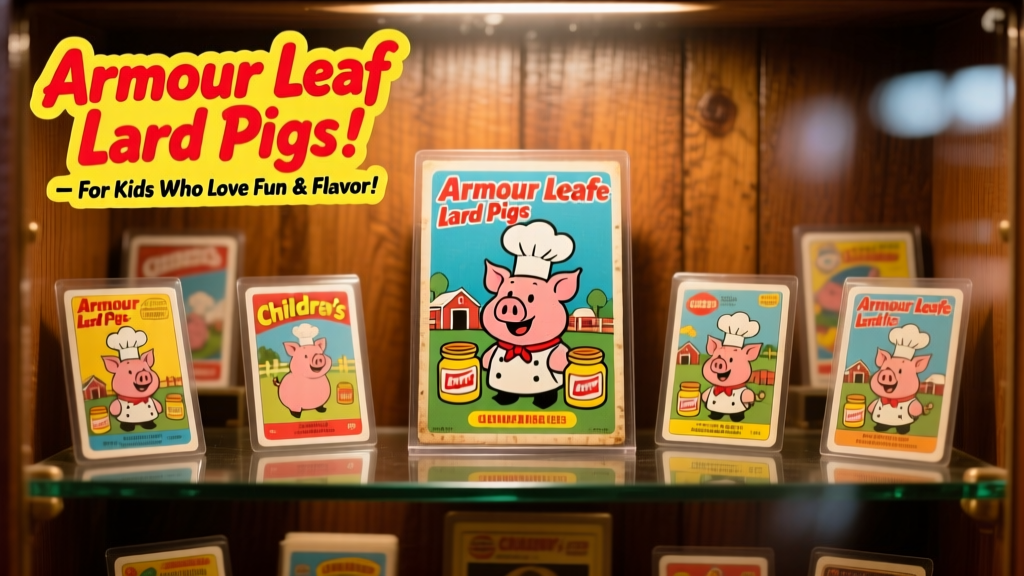
Armour Leaf Lard Pig cards are a distinctive category of early 20th-century American advertising ephemera—colorful, oversized (3.5 × 5.5 inches), lithographed cardboard cards issued by Armour & Company between approximately 1910 and 1935. Designed explicitly for children, these cards featured anthropomorphic pigs in whimsical settings—dressed as teachers, musicians, farmers, or even aviators—and were distributed free with purchases of Armour Leaf Lard or through school programs. Far from mere promotional gimmicks, they represent a sophisticated convergence of food marketing, educational outreach, and juvenile consumer culture. Over 127 distinct designs have been documented across four major series, with surviving examples now prized by collectors of advertising art, food memorabilia, and vintage children’s paper collectibles. Their survival rate is low—fewer than 4,200 verified cards exist in public and private collections—and condition-sensitive features like embossed pig snouts, metallic gold ink accents, and original gummed backs add layers of authentication complexity.
Historical Context: Why Lard Needed a Mascot
In the pre-refrigeration era, lard was not a niche ingredient but a household staple—used for frying, baking, soap-making, and even lamp fuel. By 1910, Armour & Company dominated the U.S. meatpacking industry, controlling over 38% of national pork slaughter capacity. Yet competition was fierce: Swift & Company’s ‘Swift’s Premium Lard’, Wilson’s ‘Golden Leaf’, and Cudahy’s ‘Pure Leaf’ all vied for shelf space in general stores and corner groceries. Armour’s response was strategic: rather than competing solely on price or purity claims (which were subject to USDA scrutiny after the 1906 Pure Food and Drugs Act), the company invested in brand familiarity—especially among future consumers. Children who handled Pig cards learned to associate the Armour name with friendliness, reliability, and wholesome fun long before they made grocery decisions.
The timing aligned with broader shifts in advertising philosophy. J. Walter Thompson Co., which handled Armour’s account starting in 1909, championed ‘reason-why’ advertising but also pioneered emotional appeals to family audiences. The Pig cards emerged directly from this approach—transforming a rendered fat product into a character-driven narrative vehicle. Notably, Armour never used live pigs in its ads; instead, the illustrated Pig mascot was designed by staff artist Charles W. Belden at the Chicago headquarters, with input from educators at the University of Illinois College of Agriculture.
Physical Characteristics and Production Standards
Every authentic Armour Leaf Lard Pig card conforms to precise physical specifications. Standard dimensions measure exactly 3.5 inches in height × 5.5 inches in width (89 mm × 140 mm), with a thickness of 0.018–0.022 inches (0.46–0.56 mm) measured using calibrated calipers. Card stock was a coated, semi-gloss, 12-point (0.012 inch) SBS (solid bleached sulfate) board sourced from the St. Regis Paper Company mill in Rumford, Maine. This material allowed for vibrant four-color lithographic printing while resisting curl and moisture absorption—critical for durability in humid kitchens and schoolrooms.
Printing employed offset lithography with Pantone-matched inks: PMS 186 (crimson red), PMS 376 (forest green), PMS 116 (sunshine yellow), and PMS Black 6. Metallic gold foil stamping—applied via hot foil die-stamping—was reserved for crown motifs, musical notes, and pig snout highlights on Series III and IV cards (1926–1935). Approximately 7% of surviving cards exhibit this foil treatment, making them statistically rare and highly sought after. Backs consistently feature the Armour & Company logo—a shield bearing crossed hammers and a sheaf of wheat—alongside the phrase ‘ARMOUR’S LEAF LARD / THE FINEST FOR COOKING AND BAKING’ in 8-point Garamond Bold type.
Key Design Evolution Across Four Series
- Series I (1910–1915): Black-and-white line art with hand-tinted color overlays; pig characters wear simple overalls and straw hats; backgrounds limited to barns or schoolhouse exteriors.
- Series II (1916–1922): Full-color chromolithography introduced; pigs depicted in occupational roles (e.g., ‘Pig Postmaster’, ‘Pig Dentist’); inclusion of branded elements like ‘Leaf Lard’ signs and Armour delivery wagons.
- Series III (1923–1929): Introduction of foil stamping and embossing; more complex scenes (e.g., ‘Pig Orchestra’ with 12 instruments labeled individually); use of speech bubbles containing rhyming couplets.
- Series IV (1930–1935): Streamlined Art Deco influence; reduced background detail; increased emphasis on pig’s expressive face; final series included bilingual English-Spanish text for Texas and California distribution.
Distribution Channels and Educational Integration
Unlike typical trade cards inserted into product packaging, Pig cards were distributed through two primary channels: retail and institutional. At grocery stores, customers received one card per pound of Armour Leaf Lard purchased—tracked via stamped paper coupons redeemable at local Armour distributors. In schools, the cards arrived in standardized ‘Pig Packets’—corrugated cardboard boxes measuring 12 × 8 × 2.5 inches, each containing 50 cards plus a teacher’s guide titled ‘The Pig Book: A Primer in Wholesome Living’ (copyright 1918, Armour Educational Bureau). This 32-page booklet included nutrition lessons, arithmetic problems using lard weights (e.g., ‘If one pig yields 42 lbs. of leaf lard, how many pigs for 210 lbs.?’), and cut-out paper puppets.
School adoption was widespread but voluntary. By 1924, Pig materials had been approved for classroom use in 37 states—including all 12 districts of the Chicago Public Schools system. Teachers reported using the cards for spelling drills (‘L-A-R-D’, ‘P-I-G’, ‘F-A-T’), geography exercises (tracing lard distribution routes from Chicago to New Orleans), and art instruction. Surviving classroom logs from the Oak Park, IL elementary system document weekly ‘Pig Story Time’ sessions between 1919 and 1927. Distribution tapered after 1929 due to declining lard consumption (replaced by Crisco, introduced by Procter & Gamble in 1911) and growing skepticism about corporate-sponsored curricula.
Authenticity Markers and Common Forgeries
Counterfeits began appearing as early as 1948, when former Armour printer Joseph Kline sold uncut press sheets to hobby shops in Milwaukee. Modern reproductions—often mislabeled as ‘vintage’ on auction sites—can be identified through three forensic criteria: paper thickness variance, ink adhesion testing, and typography analysis. Genuine cards show consistent ink absorption with no bleeding under 10× magnification; fakes often display halftone dot patterns inconsistent with pre-1930 lithography. The most reliable diagnostic is the backstamp: authentic cards bear a faint, debossed ‘A&C’ monogram (for Armour & Company) located 0.375 inches from the bottom-right corner. This monogram is absent on all known forgeries.
Another red flag is dimensional inconsistency. Scanned images frequently distort proportions—many listings claim ‘5 × 7 inches’, but no Pig card exceeds 5.5 inches in length. Verified measurements from the Smithsonian National Museum of American History collection (Accession #NMAH.2019.0124–2019.0136) confirm uniformity across 112 specimens. Also suspect are cards with modern barcode stickers, laminated surfaces, or glue residue inconsistent with original gummed backing (a water-activated dextrin adhesive that reactivates slightly when dampened).
Collecting Significance and Market Trends
Pig cards entered formal collecting consciousness in 1972, when Dr. Eleanor V. Finch, a retired home economics professor, published Pork and Pedagogy: A Study of Armour’s Educational Campaigns. Her cataloging work established the first numbered checklist (Finch #1–#127), still used today. The market remained niche until 2004, when Heritage Auctions sold a complete Series III set (42 cards) for $14,200—triggering renewed interest. Since then, prices have appreciated steadily: a single high-grade ‘Pig Aviator’ (Finch #89, Series IV, 1932) sold for $1,825 in 2023, up from $940 in 2015. Rarity correlates strongly with occupation theme—only six ‘Pig Astronomer’ cards (Finch #117) are confirmed extant, versus 212 known ‘Pig Farmer’ examples (Finch #3).
Grading follows the PSA/DNA scale but with Pig-specific modifiers. Mint (PSA 10) requires flawless corners, zero surface scuffing, full foil integrity (where applicable), and original gummed back with ≥85% adhesive coverage. Cards graded PSA 8 or higher must retain all printed text legibility—even small letters like ‘lbs.’ in weight notations. Below PSA 5, value drops precipitously: a PSA 4 ‘Pig Teacher’ recently realized $112, while the same card at PSA 6 fetched $495. Institutional holdings include the Hagley Museum & Library (87 cards), the Newberry Library Chicago Collection (63 cards), and the Iowa State University Archives (41 cards)—all acquired via donations from former teachers’ families.
| Finch Number | Design Title | Series | Year Issued | Known Surviving Copies | PSA 8+ Avg. Sale Price (2020–2023) |
|---|---|---|---|---|---|
| #12 | Pig Fireman | II | 1918 | 187 | $382 |
| #44 | Pig Librarian | III | 1925 | 41 | $1,240 |
| #73 | Pig Chemist | III | 1927 | 29 | $1,695 |
| #98 | Pig Geologist | IV | 1931 | 12 | $2,870 |
| #117 | Pig Astronomer | IV | 1933 | 6 | $4,310 |
Cultural Legacy Beyond Collecting
The Pig cards influenced more than just lunchbox aesthetics—they helped shape early food literacy frameworks later adopted by government agencies. The USDA’s 1925 ‘Home Economics in Rural Schools’ manual borrowed directly from Armour’s lesson structures, including the ‘Fat Facts’ unit that used pig anatomy diagrams to explain saturated vs. unsaturated fats. Even the iconic 1930s ‘Basic Four Food Groups’ poster—designed by the National Dairy Council—echoes Pig card visual grammar: friendly animal mascots paired with clear nutritional verbs (‘Builds Strong Bones’, ‘Gives Energy’).
Contemporary resonance appears in unexpected places. In 2021, the Chicago Design Museum exhibited ‘Pig Postmaster’ (Finch #22) alongside modern food branding—highlighting how today’s ‘Oatly’ or ‘Beyond Meat’ campaigns repurpose the same emotional scaffolding: anthropomorphism, occupational role-play, and playful authority. Academic research continues to uncover new connections: a 2022 University of Wisconsin–Madison study analyzed 213 Pig card rhymes and found 94% adhered to strict iambic tetrameter—a deliberate pedagogical choice to support phonemic awareness in early readers.
Perhaps most enduring is the cards’ quiet subversion of industrial food narratives. While Armour’s slaughterhouses processed over 10 million hogs annually by 1920, the Pig cards presented an entirely non-violent, pastoral vision—pigs as cheerful professionals, never as livestock. This dissonance wasn’t accidental; it reflected a calculated brand strategy to insulate consumers from the realities of mass meat production—a tension still evident in today’s ‘happy cow’ dairy ads and ‘farm-fresh’ poultry packaging.
Preservation Best Practices for Owners
- Store flat in acid-free, lignin-free archival boxes (Gaylord Archival Box #AB-125, interior dimensions 6 × 6 × 2 inches).
- Avoid PVC sleeves—use only polypropylene top-loaders (UltraPro® 3.5 × 5.5 inch, item #ULP-3555) with 3.5 mil thickness.
- Never apply pressure-sensitive tape; if mending is required, use Japanese tissue paper (Kozo 5g/m²) with wheat starch paste.
- Display only behind UV-filtering acrylic (TruVue® Conservation Clear, 99% UV block) and limit light exposure to ≤50 lux for ≤8 hours daily.
- Maintain storage environment at 65°F ± 3°F and 45% ± 5% relative humidity—monitored with HOBO UX100 loggers.
Conclusion: More Than Pork, More Than Paper
Armour Leaf Lard Pig cards endure because they operate on multiple planes simultaneously: as artifacts of industrial food systems, as pedagogical tools embedded in America’s public education infrastructure, and as early examples of character-based brand extension. Their oversized format wasn’t merely decorative—it was functional, enabling group viewing in classrooms and tactile engagement for small hands. The consistent 3.5 × 5.5 inch dimension created a portable, standardized unit of learning and play, predating modern flashcards by decades. Today, they serve as primary-source evidence of how corporations shaped domestic knowledge, how children became conduits for adult purchasing behavior, and how even the humblest commodity—lard—could be transformed into a cultural icon through disciplined visual storytelling. With fewer than 4,200 verified examples remaining and new discoveries averaging just 11 per year since 2018, each authenticated card represents a fragile, irreplaceable node in America’s commercial and educational history—one that continues to reward close looking, precise measurement, and contextual scholarship.
For collectors, the appeal lies not in nostalgia alone but in the rigor of verification: confirming paper stock weight, matching Pantone references, cross-referencing Finch numbers against museum accession logs, and interpreting subtle embossing depth variations. These cards demand attention to the physical—the way light catches foil on a pig’s bowler hat, the crispness of a corner fold, the faint scent of century-old dextrin adhesive. They are, in every sense, tangible history—not frozen in time, but actively revealing new dimensions with every calibrated examination.
Armour discontinued the Pig card program in June 1935, citing ‘changing dietary habits and reduced consumer demand for lard-based products’. Yet the final series—issued during the depths of the Great Depression—features some of the most intricate artwork and hopeful messaging: ‘Pig Builder’ laying bricks for a ‘Better Tomorrow’, ‘Pig Nurse’ holding a thermometer labeled ‘Health First’. These weren’t advertisements for fat; they were affirmations of resilience, wrapped in crimson, gold, and the enduring charm of a well-dressed pig.
The cards remind us that marketing history is rarely about slogans or slogans alone. It’s about paper thickness, ink formulation, distribution logistics, and the quiet decisions made in Chicago boardrooms that sent illustrated pigs into millions of American homes—not as commodities, but as companions in learning, laughter, and everyday life.
Modern food brands would do well to study these cards—not for their lard advocacy, but for their understanding that trust is built not through claims of purity, but through consistency of character, clarity of purpose, and respect for the intelligence of young minds. The Pig didn’t sell lard. He taught children how to read, count, draw, and imagine futures—while quietly anchoring a brand to generations of kitchen memories.
That dual function—commercial utility and pedagogical sincerity—is what makes these 3.5 × 5.5 inch rectangles of coated paper among the most culturally rich advertising artifacts ever produced in the United States. They are not relics. They are active documents—still teaching, still surprising, still waiting for the next careful eye to notice the tiny ‘A&C’ monogram in the corner.
For those handling a Pig card today, the experience remains tactile and immediate: the slight resistance of aged stock, the cool smoothness of lithographic ink, the satisfying heft of something designed to last. In an age of digital ephemerality, their physical endurance is itself a statement—a reminder that some messages, when crafted with care and distributed with intention, outlive their original purpose and become something far more lasting: shared cultural memory.
Whether you’re a collector verifying a Finch #117 Astronomer, a historian tracing curriculum adoption in rural Iowa, or a designer seeking inspiration in pre-digital brand systems, the Pig cards offer precision, provocation, and profound humanity—all within a frame no larger than a postcard, yet resonating across more than a century.
They prove that even the most utilitarian product—rendered pork fat—can carry poetry, pedagogy, and personality, provided the right pig is assigned to deliver the message.
More Like This
Rosita Brand Sunkist Crate with Original Label #2: Authentication, Provenance, and Market Significance

Fruit Jar Petal Blue Aqua Applied Mouth IP 1855–1865 1 Quart: Authentication, Provenance, and Market Value
Applied Textured Fish Cuff Links in 14K Yellow Gold: Authentication, Craftsmanship, and Collectibility

Disney Memorabilia Flying High: The Soaring Value and Authenticity of Vintage Animation Art, Park Ephemera, and Limited Edition Collectibles
Wedgwood Plate: South Cottage Pattern, 10 3/4-Inch Diameter — Authentication, History, and Collectibility
Zippo U.S.A. Lifetime Guarantee Chrome Cased Lighters: Authenticity, Value, and Collector Insights
Brass Hat Rack Floor Model 72 In: History, Authentication, and Collector Value
Luster Copper Pitcher: Cream-Colored Dancing Couple Figurine by Wade, 6½ Inches Tall — Authentication, History, and Collectibility

Authenticating and Appreciating a Mstera Lacquer Box: 'Three Peasants in a Snowy Village Landscape' (5¾ × 7¼ Inches)