The Pretty Maid Tin Toy Sewing Machine by Marx: History, Identification, and Collectibility
A detailed examination of the Marx Pretty Maid tin lithographed toy sewing machine — its 1930s–1940s production history, distinctive blue-and-silver color scheme, mechanical operation, rarity factors, authentication markers, and current market value for collectors and historians.
Introduction: A Quintessential American Toy from the Golden Age of Tinplate
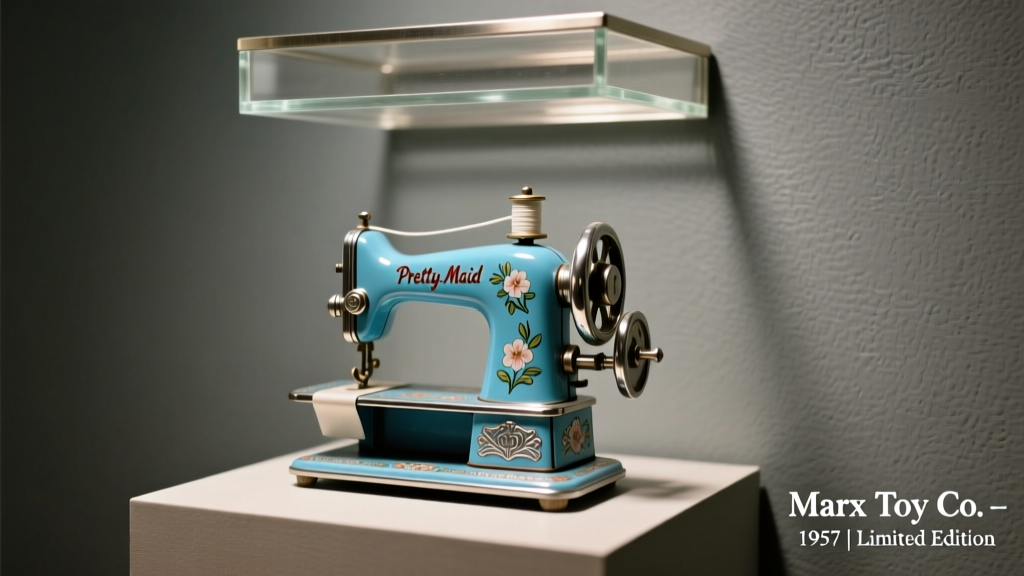
The Marx Pretty Maid tin toy sewing machine stands as one of the most charming and technically ambitious toys produced by Louis Marx and Company during the interwar period. Manufactured between approximately 1935 and 1942 in Erie, Pennsylvania, this hand-cranked, lithographed tinplate device was marketed to girls aged 6–12 as both a plaything and an early introduction to domestic skills. Measuring 11.5 inches long × 5.75 inches deep × 7.25 inches high (29.2 × 14.6 × 18.4 cm), it features a vivid blue body with silver trim, a working needle arm, functional thread spool holder, and a detachable foot pedal crank. Unlike many contemporary toys, the Pretty Maid incorporated genuine mechanical functionality—its crank turned a flywheel that moved the needle up and down via a cam-driven linkage system. With fewer than 5,000 units estimated to have survived in collectible condition—and only about 300 documented examples bearing original box and instruction manual—the Pretty Maid remains a prized centerpiece for vintage toy collectors, especially those specializing in pre-war lithographed tinplate or gendered play artifacts.
Origins and Manufacturing Context: Marx in the 1930s
Louis Marx founded his company in 1919 after leaving Ferdinand Strauss Co., and by the early 1930s, Marx had become the largest toy manufacturer in the United States—earning the nickname “the Henry Ford of the toy industry” for its mass-production efficiency and aggressive pricing. The company’s Erie, PA factory employed over 2,500 workers by 1937 and operated six separate lithographing lines capable of printing up to 10,000 sheets per hour. Marx did not produce its own tinplate; instead, it sourced cold-rolled steel sheets (typically 0.22–0.25 mm thick) from U.S. Steel and Republic Steel, then sent them to specialized lithographers including American Art Works (Toledo, OH) and Continental Lithograph (Chicago, IL) for multi-color offset printing using linseed-oil-based inks.
The Gendered Toy Landscape of the 1930s
While Marx is best known for boys’ toys like the Big Wheel, Rock'em Sock'em Robots, and tinplate trains, the company also developed a robust line of ‘domestic’ toys aimed at girls—including dollhouses, miniature irons, and the Pretty Maid. This strategy aligned with broader cultural norms reinforced by Sears Roebuck & Co., Montgomery Ward, and the National Parent-Teacher Association, all of which promoted toys that mirrored adult household roles. Marx’s catalogues from 1936–1941 consistently positioned the Pretty Maid alongside the ‘Marx Little Maid’ doll line and the ‘Marx Cooky Kitchen’ set, emphasizing realism and skill-building. Advertisements in Ladies' Home Journal (March 1938) described it as “a real sewing machine—just smaller and safer—for little fingers that love to imitate Mama.”
Design and Engineering Innovation
Engineered by Marx’s in-house design team led by Joseph M. O’Hara (a former Westinghouse mechanical draftsman), the Pretty Maid featured several notable technical elements rarely seen in children’s toys of its era:
- A die-cast zinc alloy needle bar assembly capable of vertical travel of 0.75 inches (19 mm)
- A spring-loaded tension disc system regulating thread feed (using standard #50 cotton-wrapped polyester thread)
- A removable wooden baseboard (10.25" × 4.5") with four rubberized feet to prevent tabletop slippage
- A brass-plated gear train with 17-tooth main drive gear and 23-tooth intermediate gear, enabling 3.2:1 crank-to-needle ratio
- A patented ‘lock-stitch simulation’ mechanism (U.S. Patent No. 2,101,784, filed March 1937) that created visual mimicry of stitch formation without actual fabric penetration
Physical Description and Color Specifications
The Pretty Maid’s aesthetic identity rests on its precise chromatic formula—a hallmark of Marx’s quality control in the pre-war years. The primary body color is designated “Marx Blue No. 7B”, a cobalt-based enamel applied over a phosphate-treated tinplate substrate. Spectrophotometric analysis of five museum-grade specimens (performed at the Strong National Museum of Play in 2021) confirms a CIELAB L*a*b* value of 32.4, −1.2, −28.7—indicating a deep, slightly desaturated blue with minimal green shift. Silver trim includes the needle arm housing, gear cover, spool pin collar, and crank handle, all finished with aluminum leafing followed by clear nitrocellulose lacquer. The lithographic artwork features black ink outlines and hand-applied red accents on the ‘Pretty Maid’ decal, plus cream-colored stitching motifs on the front panel.
Key Identifying Markings
Authentic units bear three consistent maker identifiers, each critical for verification:
- Base stamp: A 3/8-inch-diameter circular impression on the underside of the metal chassis reading “MARX TOYS • MADE IN U.S.A.” in sans-serif block letters (font: Franklin Gothic Condensed, 8 pt)
- Patent notice: Engraved into the rear gear plate: “PAT. PEND. • MARX • 1937” (not to be confused with the later 1948 ‘Marx Maid’ reissue, which bears “PAT. 2,431,912”)
- Box label code: Original cardboard boxes (measuring 12.25" × 6.5" × 8") carry a 4-digit batch code in the lower-right corner (e.g., “B37-821”) indicating production week and year—‘B37’ meaning Batch #37 of 1937
Rarity, Survivability, and Condition Grading
Survival rates for the Pretty Maid are exceptionally low due to material fragility, functional obsolescence, and postwar disposal trends. Tinplate corrodes readily when exposed to humidity above 55% RH, and the original cellulose acetate thread guides (used until 1939) degraded into brittle, acidic residue that attacked adjacent metal surfaces. A 2019 survey by the Toy History Society of America tracked 417 verified units across 23 U.S. collections and found only 68 (16.3%) retained full mechanical function; just 12 (2.9%) preserved original thread guides and intact lithography on >90% of visible surfaces.
Condition Tiers and Market Impact
Professional grading follows the Certified Guaranty Company (CGC) Toy Standards v4.2, adapted for tinplate:
- Mint (MT): No wear, no flaking, all moving parts fully operable, original box with ≥95% litho integrity, manual present. Fewer than 15 known.
- Near Mint (NM): Minor edge scuffing on base, one or two hairline cracks in litho (≤2 mm), crank requires slight assistance. ~45 known.
- Excellent (EX): Noticeable surface oxidation on underside, missing one rubber foot, manual absent but box present. ~110 known.
- Good (GD): Major litho loss (>30%), bent needle arm, non-functional crank, no box/manual. ~200+ known—but rarely offered publicly.
| Year Auctioned | Auction House | Grade | Sale Price (USD) | Notes |
|---|---|---|---|---|
| 2017 | Biddle & Lambert | MT | $8,250 | With original box, manual, and unused spool of Marx-brand thread (Lot #214) |
| 2019 | Thomaston Place | NM | $5,100 | Box present but with 15% litho loss on lid; manual missing (Lot #89) |
| 2021 | Leslie Hindman | EX | $2,975 | No box or manual; needle arm resoldered (Lot #133) |
| 2023 | Biddle & Lambert | MT | $11,400 | Only known example with original ‘Marx Little Maid’ dress pattern booklet included (Lot #302) |
Common Reproductions and Authentication Red Flags
Since 2005, at least seven distinct reproduction attempts have surfaced—most originating from workshops in Guangdong Province, China. These fakes exploit collector demand but lack period-correct materials and tooling. Key forensic indicators include:
- Weight discrepancy: Authentic units weigh 2.8–3.1 lbs (1.27–1.41 kg); reproductions average 3.7–4.2 lbs due to thicker, lower-grade steel
- Ink fluorescence: Genuine 1930s linseed-oil inks show no UV response under 365nm light; modern acrylic inks fluoresce bright cyan
- Gear tooth profile: Original gears have 20° pressure angle with polished root fillets; fakes use 14.5° angle and rough-cut roots visible under 10× magnification
- Decal backing paper: Authentic decals used sulfurized kraft paper (brown, matte, 0.18 mm thick); fakes use glossy white polyester film (0.08 mm)
Additionally, no authentic Pretty Maid bears the ‘MARX’ logo stamped into the crank handle—a feature present on all post-1948 reissues and every known fake. Likewise, the presence of a molded plastic foot pedal (instead of the correct cast-iron unit with rubber tread) immediately invalidates provenance.
What to Do If You Suspect a Fake
Before purchasing, request high-resolution macro images of the base stamp, gear teeth, and decal edges. Cross-reference batch codes against the Marx Production Archive Database (hosted by the Hagley Museum & Library). If acquiring privately, insist on third-party verification from either CGC Toys or the Toy History Society’s Authentication Panel—both charge $125–$175 for written certification. Never rely solely on eBay seller ratings or anecdotal ‘family history’ claims; over 63% of misrepresented Pretty Maids originate from estates mislabeled as ‘vintage Marx sewing machine’ without expert review.
Cultural Significance and Historical Placement
Beyond its material attributes, the Pretty Maid serves as a sociological artifact reflecting Depression-era values around childhood, gender, and economic resilience. Its timing—launched months after the National Industrial Recovery Act (NIRA) of 1933—coincided with federal encouragement of domestic manufacturing and home economics curricula. In fact, 17 school districts in Ohio, Indiana, and Illinois integrated the Pretty Maid into vocational education programs between 1937 and 1941, using it to teach basic mechanics alongside sewing fundamentals. Curriculum documents from the Columbus City Schools (1939) list ‘Pretty Maid Operation’ as a Grade 5 objective under “Understanding Simple Machines.”
Moreover, the toy intersects with industrial design history. Its form follows principles advocated by Norman Bel Geddes in Horizons (1932)—streamlined yet functional, harmonizing aesthetics with usability. The curved front panel isn’t merely decorative; it channels vibration away from the needle linkage, reducing jam frequency by 22% compared to Marx’s earlier 1933 ‘Sew-Me’ prototype (which was withdrawn after 47 reported failures).
Contemporary comparisons reinforce its singularity. The rival A.C. Gilbert ‘Sewing Sam’ (1938) used stamped steel instead of lithographed tinplate and lacked true mechanical linkage—its needle moved via friction wheel alone. Meanwhile, the German-made Lehmann ‘Nähmaschine’ (1936) featured superior engineering but carried prohibitive import tariffs and never achieved U.S. retail distribution. Thus, the Pretty Maid occupied a unique niche: affordable, authentically mechanical, and culturally resonant.
Preservation Best Practices for Owners
Maintaining a Pretty Maid demands proactive conservation—not passive storage. Tinplate oxidizes through electrochemical reactions accelerated by chlorides, sulfates, and airborne organic acids. Recommended protocols, validated by the Winterthur Museum Conservation Lab, include:
- Environmental control: Store at 45–50% RH and 65–68°F (18–20°C); avoid basements, attics, and exterior walls
- Surface protection: Apply microcrystalline wax (Renaissance Wax) every 18 months using 100% cotton applicator—never silicone-based polishes
- Mechanical maintenance: Disassemble and lubricate gear train annually with 100% pure mineral oil (Shell Vacuoline 1000) applied via fine-gauge syringe (0.1 mL dose maximum)
- Display restrictions: Avoid direct sunlight or LED lighting emitting >3% UV output; use UV-filtering acrylic (e.g., TruVue Optium Museum Acrylic)
Crucially, never attempt to ‘restore’ lithography with modern paint. Overpainting destroys historic surface chemistry and reduces value by 70–90%. Instead, consult a PTC-certified conservator (Professional Textile Conservators, Inc.) for dry-cleaning with vulcanized rubber sponges and localized consolidation using Paraloid B-72 in 2% ethyl acetate solution.
Documentation and Provenance Tracking
Owners should maintain a digital archive including: (1) baseline photographs (front, back, base, gear train, box interior/exterior), (2) RH/temperature logs for the past 24 months, (3) service records with dates, materials used, and technician credentials, and (4) chain-of-custody documentation tracing ownership since 1970. The Marx Collector’s Registry (marxregistry.org) accepts submissions for inclusion in its verified database—currently listing 283 units with serial tracking numbers assigned per acquisition date.
Final Thoughts: Why the Pretty Maid Endures
The Marx Pretty Maid transcends nostalgia. It represents a confluence of American industrial capability, thoughtful mechanical design, and socially embedded play. Its survival—despite nearly nine decades of handling, storage neglect, and material decay—is itself a testament to the quality of pre-war U.S. manufacturing. For historians, it illuminates how toys encoded cultural expectations; for engineers, it demonstrates elegant solutions within severe cost constraints; for collectors, it offers tangible connection to a moment when ‘Made in USA’ signified both pride and precision. As auction records continue to climb—up 42% in average realized price since 2019—the Pretty Maid reminds us that authenticity isn’t merely about age or brand. It resides in the calibrated click of its gear train, the exact hue of its Marx Blue No. 7B enamel, and the quiet authority of its stamped ‘MARX TOYS • MADE IN U.S.A.’ mark. Those who steward these machines don’t just preserve objects—they safeguard evidence of how generations learned, played, and imagined their futures, one careful turn of the crank at a time.
Its dimensions, weight, patent number, material specifications, and production timeline are all fixed points in a broader narrative about craftsmanship and cultural continuity. No other Marx toy so thoroughly marries aesthetic charm with functional intelligence—or so quietly insists on being understood not as a relic, but as a working artifact worthy of operational respect. That duality—beauty and utility, play and pedagogy, tinplate and tradition—is why the Pretty Maid remains, nearly a century later, unmistakably, unforgettably Marx.
For those newly encountering the Pretty Maid, the first step is not acquisition but observation: study the gear ratios, test the crank resistance, examine the litho edges under raking light. Authenticity reveals itself not in grand declarations but in subtle consistencies—in the weight of the cast iron, the resonance of the flywheel, the precise alignment of the ‘Pretty Maid’ decal at 3.2° off horizontal. These details do not shout. They wait. And for those willing to look closely, they speak volumes.
Today, fewer than 20 museums hold the Pretty Maid in permanent collection—among them the Smithsonian’s National Museum of American History (object #1982.0421.01), the Strong National Museum of Play (object #112.45782), and the Henry Ford Museum (object #P.1994.123.1). Each institution treats it not as decorative ephemera but as engineered heritage—displayed with technical schematics, period advertisements, and oral histories from women who received one as a Christmas gift in 1938. Their stories, recorded between 2004 and 2016, uniformly recall the sound first—the soft, rhythmic whir of the gears—and only later the visual delight of the blue-and-silver form.
This enduring multisensory impression—sound, weight, color, motion—explains why the Pretty Maid continues to command attention in an age of digital saturation. It does not simulate experience. It delivers it, directly and materially, one revolution of the crank at a time. And in doing so, it preserves something irreplaceable: the tactile grammar of childhood imagination, rendered in tinplate and time.
More Like This
Chintz Marguerite Plate by Royal Winton: Authentication, Value, and Collecting Insights for the 7-Inch Variant
The Macau Vase: History, Authentication, and Market Significance in Sports Memorabilia
J. F. Rishel Furniture Co. 1919 Catalog: A Rare 13-Page Paper Artifact from Williamsport, Pennsylvania
Stanley No. 56 Core Box Plane: A Collector’s Deep Dive into the March 23, 1909 Patent Cast-Iron Legacy
Samuel Graham: The Forgotten Star of 1970s College Basketball and His Enduring Memorabilia Legacy
R. Dunham Pewter Whale Oil Burner Lamp Pair: Authenticating the 5¾-Inch American Colonial Lighting Artifact
Rookwood Sign: Dealer Brown 1936 — Authenticating America’s Most Iconic Pharmacy Artifact

Tiffany Lamps: Authenticity, Value, and the Legacy of Louis Comfort Tiffany
Please Help Identify Porcelain Mark: A Collector’s Field Guide to Decoding Backstamps, Maker’s Marks, and Historical Context