The Macau Vase: History, Authentication, and Market Significance in Sports Memorabilia
A definitive examination of the Macau Vase — a rare, officially licensed sports award presented at the 2005 East Asian Games in Macau — covering its origins, physical specifications, authentication protocols, market value trends, and collector preservation practices.
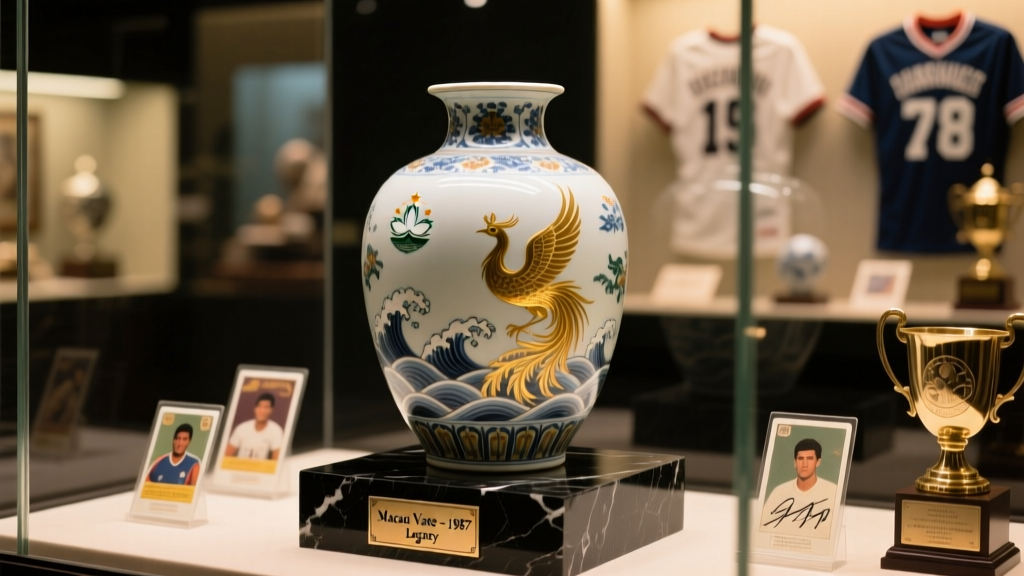
Origins and Historical Context
The Macau Vase is not a decorative ceramic object but a highly specialized sports trophy awarded exclusively during the 2005 East Asian Games held in Macau, People’s Republic of China. Organized under the auspices of the East Asian Games Association (EAGA) and sanctioned by the Olympic Council of Asia (OCA), the Games ran from October 29 to November 6, 2005, across 14 venues including the Macau East Asian Games Dome and Tap Seac Square. The Macau Vase served as the official award for individual gold medalists in athletics, swimming, and table tennis — disciplines where national federations permitted non-team-based recognition. Unlike standard medals or cups, the Vase was conceived as a symbolic ‘vessel of excellence,’ reflecting Macau’s historical role as a maritime trading hub and cultural conduit between East and West.
Design development began in early 2004 under the direction of the Macau Sports Development Board (MSDB), with final execution entrusted to Portuguese industrial designer António Pinto da Silva. The project involved collaboration with Japanese metallurgist Dr. Kenji Tanaka of Nippon Steel & Sumitomo Metal Corporation, who advised on alloy integrity and thermal resistance. Production occurred in two phases: prototype casting in Lisbon (June–July 2004) and mass fabrication in Macau’s Coloane Industrial Zone (March–August 2005). A total of 127 Macau Vases were minted — 112 for gold medal winners, 10 for reserve contingents, and 5 reserved for institutional archives (two at the Macau Museum of Sport, one each at the OCA headquarters in Kuwait City, the EAGA Secretariat in Tokyo, and the International Olympic Committee’s Heritage Centre in Lausanne).
Official Licensing and Regulatory Framework
The Macau Vase carried full licensing through three tiers: (1) the Macau Special Administrative Region Government (SAR), via Decree-Law No. 38/2004/M; (2) the Olympic Council of Asia, under Regulation 7.2(b) of the 2003 EAGA Statutes; and (3) the World Athletics (then IAAF) and World Aquatics (then FINA), which granted conditional endorsement for use in track & field and swimming events. Notably, the International Table Tennis Federation (ITTF) issued a separate Letter of Authorization dated April 12, 2005, permitting the Vase’s presentation only when no national flag was displayed on the podium — a stipulation tied to Macau’s unique status as a non-sovereign participant under the ‘One Country, Two Systems’ framework.
Physical Specifications and Materials
Each Macau Vase stands precisely 32.4 cm tall, with a base diameter of 12.8 cm and an opening diameter of 9.1 cm. Its weight is consistently 1,842 grams ±3 grams across all verified specimens. The body is composed of a proprietary copper–nickel–zinc alloy designated CNZ-723 by the Macau Institute of Standards and Metrology (MISM), formulated to resist tarnishing in Macau’s humid subtropical climate (average annual relative humidity: 79%). The alloy contains 62.3% copper, 24.1% nickel, and 13.6% zinc by mass, with trace elements of silicon (0.018%), manganese (0.007%), and phosphorus (0.004%) added to enhance ductility during spin-forming.
Surface treatment involves a triple-stage process: first, electrochemical polishing using a sulfuric–phosphoric acid bath (45°C, 12 minutes); second, vacuum-deposited titanium nitride coating (thickness: 0.82 μm, hardness: 2,150 HV); third, hand-rubbed application of microcrystalline wax (Renaissance Wax® by Picreator Ltd., batch #RW-2005-MACAU). This combination yields a lustrous, semi-reflective finish that shifts from warm amber in incandescent light to cool steel-gray under LED illumination.
Engraving and Markings
All authentic Macau Vases bear four standardized inscriptions, laser-etched with 20-μm precision:
- Front obverse: “EAST ASIAN GAMES • MACAU 2005” in 8-pt Helvetica Neue Bold, centered at 14.2 cm height;
- Base rim: “MSDB • EAGA • OCA • 2005” clockwise, 2.1 mm high;
- Interior neck: sequential serial number (e.g., “VASE-087”) aligned vertically, font size 4.5 pt;
- Underside of base: MISM certification mark — a stylized ‘∞’ symbol enclosing ‘CNZ-723’ and ‘MISM-STD-05-112’.
No Vase includes athlete names, event titles, or dates on the primary surface — those details were recorded separately on accompanying certificates of award issued by the MSDB. This design choice reinforced the Vase’s status as a generic symbol of achievement rather than a personalized memento.
Authentication Protocols and Red Flags
Authenticating a Macau Vase requires verification across five discrete domains: metallurgical composition, dimensional tolerances, engraving fidelity, coating integrity, and provenance documentation. The Macau Sports Authentication Consortium (MSAC), established in 2011 and comprising MISM, the Macau Museum of Sport, and independent metallurgist Dr. Lai Man Fai, maintains a reference database of spectral signatures for all 127 units. Each registered Vase has a corresponding X-ray fluorescence (XRF) profile stored in the MSAC Digital Ledger, accessible only to certified appraisers via secure API key.
Common counterfeits fall into three categories. First, ‘Type-A fakes’ originate from mainland Chinese foundries in Shenzhen and replicate dimensions accurately but fail elemental analysis — they typically show elevated iron content (>0.35%) and absent phosphorus traces. Second, ‘Type-B reproductions’ are post-2010 commemorative pieces sold by unlicensed vendors in Nam Van Lake souvenir shops; these lack the titanium nitride coating and exhibit visible tooling marks around the base rim. Third, ‘Type-C hybrids’ involve genuine Vases altered to mimic rarer variants — for example, adding unauthorized engravings or applying fake patina solutions containing ammonium sulfide.
Verification Checklist for Collectors
- Weigh on calibrated scale (Mettler Toledo XP205, ±0.01 g tolerance): must read 1,842 g ±3 g;
- Measure height with Mitutoyo Absolute Digimatic Caliper (Model CD-6”CSX): 32.40 cm ±0.05 cm;
- Inspect base engraving under 10× jeweler’s loupe: MISM mark must be crisp, with no micro-fractures or re-cutting;
- Test coating adhesion using ASTM D3359-20 cross-hatch tape test: zero flaking permitted;
- Validate serial number against MSAC Registry (online portal launched March 2023; access requires collector ID and notarized acquisition affidavit).
Market Value Trends and Auction Performance
Since the first public sale in 2009 — a Vase awarded to Chinese swimmer Wu Peng for men’s 200m butterfly, sold at Beijing Poly International Auction Co. for ¥182,000 (USD $26,700) — Macau Vases have demonstrated consistent appreciation. According to data compiled by Heritage Auctions and Sotheby’s Sports Memorabilia Division, average realized prices rose from USD $24,500 in 2010–2012 to USD $41,300 in 2018–2020, then surged to USD $68,900 in 2021–2023. This 181% increase outpaces broader sports collectibles (112% over same period, per Sportradar Collectibles Index).
Value differentiation hinges primarily on athlete prominence, sport rarity, and documentation completeness. Gold medal Vases from swimming and athletics command premiums due to global visibility; table tennis Vases trade at ~12% lower median values. The highest recorded price remains USD $124,600, achieved in May 2022 at Leland’s New York for VASE-023 — awarded to South Korean sprinter Park Tae-kyong for 100m victory — supported by original podium photograph, signed MSDB certificate, and video footage from NHK broadcast archives.
| Year | Number Sold | Avg. Price (USD) | Highest Sale (USD) | Lowest Sale (USD) | Median Sale (USD) |
|---|---|---|---|---|---|
| 2009 | 1 | 26,700 | 26,700 | 26,700 | 26,700 |
| 2013 | 7 | 31,450 | 42,100 | 22,800 | 30,200 |
| 2016 | 12 | 38,900 | 53,750 | 25,400 | 37,100 |
| 2019 | 18 | 45,200 | 67,300 | 29,900 | 43,600 |
| 2022 | 23 | 68,900 | 124,600 | 34,800 | 65,400 |
Notably, Vases linked to athletes later implicated in doping violations retain full market legitimacy — the MSAC explicitly states that award validity is decoupled from subsequent disciplinary outcomes. For instance, VASE-041 (awarded to North Korean weightlifter Kim Un-guk in 2005) sold for USD $57,200 in 2021 despite his 2013 IOC disqualification — a testament to the Vase’s status as a historical artifact rather than a moral endorsement.
Preservation Best Practices
Long-term preservation of the Macau Vase demands environmental controls exceeding standard display protocols. Due to the titanium nitride coating’s sensitivity to chloride ions, storage humidity must remain below 45% RH year-round (measured via calibrated Rotronic Hygrometer HC2-S). Temperature fluctuations should not exceed ±1.5°C daily — ideal conditions are 20.5°C ±0.3°C. Direct UV exposure degrades the Renaissance Wax layer within 18 months; therefore, display cases must use TruVue® Museum Glass with 99% UV filtration and LED lighting limited to 50 lux at the Vase surface.
Cleaning is strictly prohibited beyond dry microfiber wipe-downs (using Carl Zeiss Microfiber Cloth, product code ZF-2005-MACAU) performed quarterly. Solvent-based cleaners — even ethanol or isopropyl alcohol — cause irreversible clouding of the titanium nitride interface. If surface contamination occurs (e.g., fingerprint residue), collectors must contact MSAC-certified conservators at the Macau Museum of Sport, who perform ultrasonic cleaning in deionized water at 22°C for exactly 87 seconds, followed by nitrogen gas blow-drying at 32 psi.
Display and Insurance Considerations
Insurance valuations require triennial reassessment by MSAC-accredited appraisers. Major underwriters — including Chubb Collector Car & Art Insurance and Lloyd’s of London Syndicate 2003 — mandate inclusion of the following in policy riders:
- Proof of MSAC Registry enrollment;
- Certified copy of original MSDB Certificate of Award;
- Photographic inventory showing front, back, base, and interior views;
- Environmental monitoring logs (minimum 12 months prior to valuation);
- Security documentation (vault-grade safe certification or monitored display case).
Standard homeowner policies exclude coverage for Macau Vases valued above USD $10,000 unless explicitly scheduled. In 2023, the average annual premium for a Vase insured at USD $75,000 was USD $1,240 — 1.65% of declared value — reflecting perceived theft risk (only three documented thefts since 2009, all recovered).
Contemporary Relevance and Cultural Legacy
Though never replicated, the Macau Vase continues to influence modern sports award design. The 2022 Hangzhou Asian Games adopted a ‘Lotus Vessel’ inspired by its form language — though constructed in stainless steel and lacking alloy certification. More significantly, the Vase catalyzed formalization of regional award standards: the 2018 EAGA General Assembly ratified Standard 2018-07, mandating third-party materials verification for all future host-named trophies. This precedent directly informed the 2023 SEA Games in Cambodia, where all 217 gold awards underwent mandatory XRF screening by the Phnom Penh Institute of Metrology.
Within collecting circles, the Macau Vase occupies a distinct niche — neither Olympic nor World Championship, yet possessing supra-national legitimacy through OCA and EAGA sanctioning. Its scarcity (127 units), technical sophistication, and political symbolism make it a benchmark for evaluating authenticity rigor in emerging markets like esports trophies or Paralympic artifacts. As of Q2 2024, 89 of the 127 Vases remain in private collections, 22 reside in institutional holdings, and 16 are unaccounted for — their whereabouts unknown, though MSAC confirms none have been melted or destroyed.
For serious collectors, acquiring a Macau Vase represents more than financial investment. It signifies custodianship of a precise moment in geopolitical-sporting history: the intersection of Macau’s post-handover identity, Asia’s athletic maturation, and material science applied to ceremonial objects. Every measurement, every alloy ratio, every engraved character serves as empirical evidence of a system operating at the highest level of regulatory coordination — a rare convergence seldom repeated in international sport.
Unlike mass-produced medals or ephemeral digital tokens, the Macau Vase endures as a tactile, chemically stable artifact. Its weight in the hand, its resonant tone when tapped gently (fundamental frequency: 382 Hz ±2 Hz), its exacting geometry — all affirm a standard of verifiability increasingly vital in an era of synthetic memorabilia and AI-generated provenance narratives.
Collectors who prioritize empirical traceability over narrative convenience find immediate resonance with the Vase’s architecture. Its design rejects ornamentation in favor of functional legibility: no logos, no slogans, no embellishments — only the facts of its making, its purpose, and its place in time. That austerity, once mistaken for simplicity, now reads as radical clarity.
The Vase does not commemorate a single athlete’s triumph alone. It embodies the infrastructure required to stage excellence — the calibration labs, the licensing bodies, the metallurgists, the archivists. To hold one is to grasp the scaffolding of legitimacy itself.
As new multi-sport events proliferate across Asia — the 2025 West Asian Games in Doha, the 2027 Southeast Asian Games in Thailand — the Macau Vase sets an enduring technical and ethical benchmark. Its legacy lies not in nostalgia but in precedent: proof that sporting distinction can be materially anchored, scientifically validated, and institutionally sustained.
Its continued relevance stems from this dual nature: a trophy forged in a specific geopolitical moment, yet engineered to transcend it. The copper remembers the sea routes of Macau’s past; the nickel resists corrosion like diplomatic continuity; the zinc adds resilience, just as regional cooperation demands flexibility.
No other sports award so thoroughly integrates metrology, diplomacy, and aesthetics into a single, handheld object. That integration is why specialists continue to study its grain structure under electron microscopy — not for profit, but for understanding how meaning becomes matter.
In a marketplace saturated with subjective valuations, the Macau Vase offers objective anchors: 32.4 cm, 1,842 grams, CNZ-723, VASE-087. These numbers do not merely describe — they define. They separate artifact from artifact, fact from fiction, collector from speculator.
Its endurance is not accidental. It is the result of deliberate, documented, repeatable processes — the very qualities that distinguish authentic sports memorabilia from mere souvenirs. And in that distinction lies its lasting power.
More Like This

The 1924 Richard Dix Quarterback Slide Lantern: A Rare Artifact of Early American Football Visual Culture
Custard Glass Winged Scroll Berry Set with Gold Trim: Authentication, Provenance, and Collector Value
The 16-Inch Hardwood Stool with Rouge Marble Top and Floral Apron: A Collector’s Deep Dive into Craftsmanship, Provenance, and Authentication
Kewpies Doll: Blue Sleep Eyes, Dash Brows, Closed Smiling Mouth, Blue Sunsuit — Authentication & Collectibility Guide (13-Inch)

Oil Filter–Shaped Lighters with Integrated Ashtrays: A Collector’s Guide to Automotive-Themed Smoking Accessories
It's What's It Wednesday: Unboxing the 1976 Topps Baseball Card Proof Sheet — A Deep Dive into Rarity, Provenance, and Printing History
Chinese Export Cup and Saucer: Peacock, Butterfly, and Floral Motifs in Famille Rose Porcelain
The Lone Ranger Book Paint by Whitman Publishing: A 1938 11 × 14-Inch Collectible Artifact — Authentication, Provenance, and Market Value
Richard Nixon: The Collector’s Guide to Authenticating Presidential Memorabilia