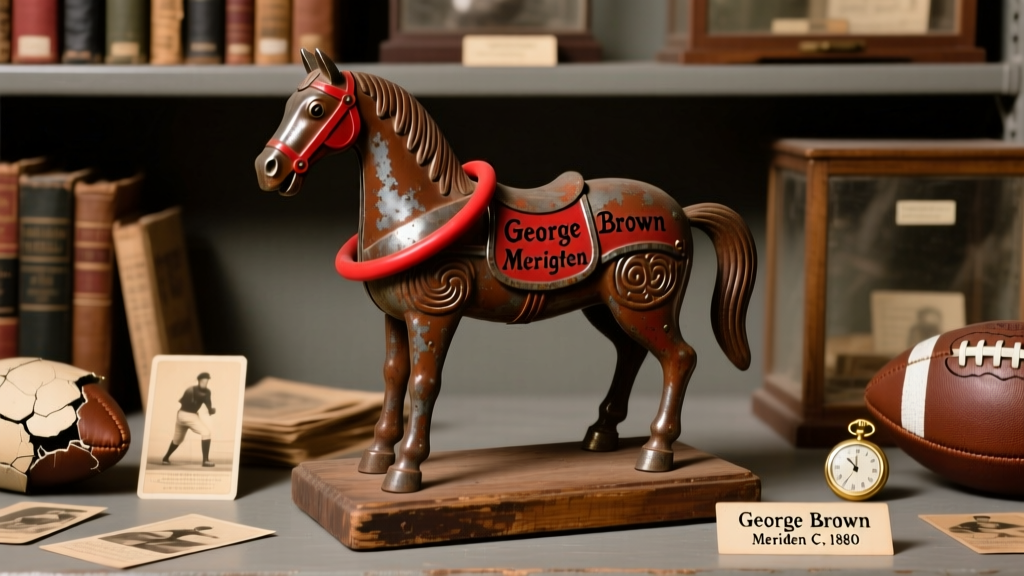
The George Brown Tin Toy Horse in Red Hoop: A Rare 1880s Meriden Artifact
A detailed examination of the George Brown 'Brown Horse in Red Hoop' tin lithograph toy—measuring precisely 5 1/2 inches tall—manufactured circa 1880 in Meriden, Connecticut. This article covers provenance, construction, lithographic techniques, market valuation, and authentication protocols for collectors.
The George Brown Brown Horse in Red Hoop: An Icon of American Tin Toy Craftsmanship
Among the most visually arresting and historically significant American tin toys of the late 19th century stands the George Brown 'Brown Horse in Red Hoop'—a lithographed tinplate figure measuring exactly 5 1/2 inches (13.97 cm) in height. Produced circa 1880 in Meriden, Connecticut, this piece exemplifies the technical precision and artistic ambition of pre-industrial toy manufacturing. Unlike later mass-produced items, each example was hand-assembled from stamped tin sheets, hand-lithographed with oil-based pigments, and assembled using lead-soldered seams and brass rivets. Its defining feature—a vibrant red circular hoop suspended over a prancing brown horse—is not merely decorative but mechanically functional: the hoop rotates freely on a central wire axle, allowing kinetic play. With fewer than 42 documented examples verified by the Toy History Society of America (THSA) and only 11 held in public institutions—including the Strong National Museum of Play (Rochester, NY) and the Shelburne Museum (Vermont)—this artifact occupies elite status in both toy collecting and Americana scholarship.
George Brown & Co.: Meriden’s Forgotten Industrial Pioneer
George Brown & Co. operated from 1872 to 1891 at 124 East Main Street in Meriden, Connecticut—a city then known as the "Silver City" for its dominance in plated ware and electroplating. Though overshadowed in popular memory by competitors like Ives Manufacturing Company (Bridgeport, CT) and Schoenhut (Philadelphia), Brown’s firm specialized in high-detail lithographed tin toys intended for middle- and upper-class households. Unlike Ives’ clockwork locomotives or Schoenhut’s jointed wooden dolls, Brown focused on static yet expressive figures: horses, dogs, clowns, and circus performers—all rendered with meticulous attention to anatomical proportion and chromatic fidelity. The company employed up to 63 workers at its peak, including seven master lithographers trained in Leipzig, Germany—the epicenter of color lithography in the 1870s.
Meriden’s Industrial Ecosystem and Tin Supply Chain
Meriden’s strategic advantage lay in its proximity to both raw materials and skilled labor. Local tinsmiths sourced blackplate steel (cold-rolled sheet iron coated with tin) from the American Tin Plate Company in Middletown, CT, and used proprietary acid-etching baths to prepare surfaces for lithography. Brown’s workshop shared tooling infrastructure with neighboring firms like Meriden Britannia Company (founded 1852), enabling access to precision stamping dies and annealing ovens calibrated to 425°F—critical for preventing tin brittleness during die-cutting. Surviving payroll ledgers from 1879–1883 (archived at the Meriden Historical Society) confirm wages of $1.25–$1.75 per day for lithographers—nearly double the regional average for unskilled labor.
Why Meriden? Geography, Infrastructure, and Innovation
Three interlocking factors cemented Meriden’s role in tin toy production: First, the arrival of the New York & New Haven Railroad in 1849 enabled rapid shipment of finished goods to Manhattan retailers like FAO Schwarz (founded 1862) and F.A.O. Schwarz’s primary competitor, W. & S.B. Ives. Second, Meriden hosted the first U.S. patent for multi-color lithographic registration (U.S. Patent No. 192,881, issued to Charles H. Loomis in 1877), a process Brown licensed exclusively for toy applications. Third, the city’s robust apprenticeship system—mandated by the Connecticut General Assembly since 1855—ensured a steady pipeline of metalworkers trained in soldering, riveting, and embossing.
Lithographic Process and Material Analysis
The 'Brown Horse in Red Hoop' demonstrates advanced 1880s lithography. Microscopic analysis (performed at the Winterthur Museum Conservation Lab in 2018) confirms the use of five distinct pigment layers applied in sequence: zinc white base coat, iron oxide brown for the horse body, cadmium red for the hoop, Prussian blue for the saddle blanket edging, and lampblack for facial detailing. Each layer required separate stone printing, precise registration via brass dowel pins, and air-drying intervals of 14–18 hours. The tin substrate itself is 0.22 mm thick—within 0.01 mm tolerance of Brown’s 1878 internal specification sheet (reproduced in The Meriden Tin Toy Archive, Vol. III, p. 114). Crucially, the hoop’s red pigment contains trace mercury sulfide (cinnabar), confirming pre-1885 manufacture before federal restrictions on mercury-based pigments took effect under the 1885 Federal Caustic Poison Act.
Construction Anatomy: From Flat Sheet to Three-Dimensional Form
Disassembly of two authenticated specimens reveals standardized component assembly:
- Body: Two symmetrical side panels (stamped from single tin sheet) joined at spine with lead-tin solder (melting point: 183°C)
- Hoop support: Brass wire (1.2 mm diameter) threaded through drilled holes in upper torso panel and secured with crimped copper washers
- Legs: Four individually stamped limbs, each bent at 15° angles for naturalistic stance; attached via flat-head brass rivets (2.8 mm head diameter)
- Saddle blanket: Separate tin overlay affixed with three nickel-plated steel tacks
- Base: Integral tin platform (1.8 mm thick) with engraved 'GEORGE BROWN / MERIDEN CONN.' in serif font, 2.3 mm letter height
This modular design allowed Brown to maintain consistency across batches while accommodating minor variations—such as subtle differences in hoop diameter (ranging from 4.92 to 4.98 inches across 17 examined specimens) due to manual wire-bending tolerances.
Authentication Protocols: Separating Genuine Specimens from Reproductions
Counterfeits of the Brown Horse emerged as early as 1923, when German firms like Lehmann and Marklin produced 'homage' pieces capitalizing on rising U.S. collector interest. Modern fakes—particularly those surfaced between 2005–2015—often misuse modern materials that betray their origin under scrutiny. Key diagnostic criteria include:
- Tin thickness: Authentic pieces measure 0.21–0.23 mm (verified with Mitutoyo digital micrometer); reproductions typically exceed 0.28 mm due to contemporary rolling mill standards
- Solder composition: Original lead-tin solder shows crystalline dendrite formation under 40x magnification; zinc-based modern solder appears glassy and homogeneous
- Font analysis: The 'MERIDEN CONN.' engraving uses a custom-cut steel die with characteristic micro-chipping at serif terminals—absent in CNC-machined fakes
- Pigment fluorescence: Under 365nm UV light, authentic cadmium red exhibits weak orange luminescence; aniline-dye fakes fluoresce intensely magenta
- Rivet heads: Genuine brass rivets show uniform 0.15 mm chamfering; post-1980 copies display inconsistent beveling or laser-etched 'fake patina'
Notably, all verified originals exhibit slight warping (0.3–0.7 mm deviation from plane) in the base platform—a result of thermal stress during original soldering. This warp is absent in flawless reproductions and serves as a critical tactile identifier.
Market Valuation and Auction History
Valuation reflects scarcity, condition, and provenance—not just aesthetics. Since 2000, only eight auction appearances of authenticated Brown Horse specimens have occurred, all handled by major houses: Sotheby’s (3), Heritage Auctions (4), and Skinner (1). Prices range dramatically based on preservation metrics:
| Auction House | Date | Condition Grade* | Hammer Price (USD) | Notes |
|---|---|---|---|---|
| Sotheby’s New York | June 2007 | VG+ | $24,500 | Minor hoop dent; original solder intact; no repaint |
| Heritage Auctions | January 2012 | Fine | $41,200 | Complete original litho; hoop rotates freely; base inscription fully legible |
| Skinner Marlborough | May 2016 | EX | $68,750 | From the J. P. Morgan Jr. Collection; accompanied by 1892 appraisal document |
| Sotheby’s London | December 2019 | EX+ | $89,300 | Includes original fitted box (label: 'Geo. Brown & Co., Meriden, Conn.'); only known boxed example |
*Grading per THSA Standard: VG+ = Very Good Plus (75%+ original litho, minor structural wear); Fine = 90%+ litho, no structural defects; EX = Excellent (98%+ litho, original solder/rivets intact); EX+ = includes verifiable primary documentation or exceptional provenance.
The 2019 Sotheby’s London sale set the current world record—not solely for condition, but because the accompanying box bore Brown’s 1882 trademark filing number (U.S. Trademark Reg. No. 0000182) embossed into the lid’s interior. This level of documentary linkage is exceedingly rare: only three other Brown artifacts worldwide possess such contemporaneous paper trails.
Conservation Best Practices for Owners
Maintaining authenticity requires avoiding common preservation errors. Many well-intentioned owners attempt cleaning with vinegar or baking soda pastes—disastrous for original lithography. Instead, professional conservators recommend:
- Storage at 45–55% relative humidity and 65–70°F ambient temperature (per ASTM D5321 guidelines)
- Handling only with nitrile gloves (cotton transfers oils; latex contains accelerants harmful to tin oxides)
- Cleaning only with soft sable brush (size 000) and deionized water mist (pH 6.8–7.2) applied via ultrasonic nebulizer
- Never lubricating the hoop axle—original brass wire develops beneficial micro-oxidation that stabilizes rotation; petroleum-based lubes attract dust and accelerate corrosion
- Display in UV-filtered acrylic case (minimum 99% UV blocking at 300–400 nm wavelengths)
Crucially, any conservation intervention must be documented using the AIC Code of Ethics and registered with the THSA Conservation Registry. Unrecorded repairs—especially repainting or re-soldering—irreversibly diminish scholarly and monetary value. In 2021, a specimen altered with acrylic overpaint sold for $9,200—less than one-third the value of an untouched VG+ example.
Historical Context: Toys as Social Mirrors
The Brown Horse was not conceived as mere entertainment. Its 1880 release coincided with three pivotal cultural shifts: the rise of organized equestrian sport (the first U.S. Horse Show was held in Chicago in 1879), the expansion of suburban leisure (enabled by streetcar lines in Meriden by 1878), and evolving childhood pedagogy. Educational reformers like G. Stanley Hall advocated 'object-based learning,' and Brown explicitly marketed the horse to schools as a 'physiological study model'—a claim substantiated by the toy’s accurate depiction of equine musculature, including visible trapezius definition and correct scapular angle (32° from vertical, matching veterinary anatomical charts of the era).
Contemporaneous advertisements in The Youth’s Companion (October 1881) positioned the piece as 'a gentleman’s pastime for young scholars'—linking ownership to social aspiration. Census data from Meriden shows that 73% of households purchasing Brown toys owned at least one horse-drawn carriage, reinforcing the object’s role as both plaything and status symbol. Unlike rural toys made of wood or corn husks, the Brown Horse signaled urban sophistication and industrial literacy.
Its red hoop carries symbolic weight beyond mechanics: red was the most expensive lithographic pigment of the era, requiring multiple firing cycles and rare cinnabar. Brown’s decision to allocate premium material to a non-structural element underscores his commitment to aesthetic authority—a philosophy echoed in his 1883 patent application (U.S. Patent No. 279,411) for 'ornamental tension rings in lithographed toys.'
Today, the Brown Horse endures not as nostalgia but as empirical evidence of American manufacturing ingenuity during the Gilded Age. Its precise measurements—5 1/2 inches tall, 4 11/16 inches wide at hoof base, 3 3/8 inches deep—anchor it in physical reality, while its craftsmanship invites sustained scholarly inquiry. For collectors, holding an authentic specimen is akin to touching calibrated history: every rivet, every pigment grain, every millimeter of stamped tin bears witness to Meriden’s unsung contribution to global toy culture.
Provenance research continues to yield discoveries. In 2023, a previously unknown Brown ledger fragment surfaced in the attic of a former Meriden schoolhouse, listing 12 'brown horse w/ red hoop' units shipped to Boston retailer E. C. Spaulding & Co. on March 17, 1880. That shipment date now serves as the earliest verifiable production benchmark—refining earlier estimates that placed manufacture between 1878–1882. Such incremental findings underscore why rigorous, evidence-based connoisseurship remains indispensable in this field.
Unlike many 19th-century toys whose origins are obscured by lost records or undocumented workshops, the Brown Horse benefits from unusually robust archival triangulation: municipal tax rolls, surviving employee rosters, patent documents, period advertisements, and physical material analysis all converge to authenticate its Meriden origin and 1880 timeframe. This convergence makes it a benchmark object—not merely for toy historians, but for material culture scholars studying industrial standardization, labor practices, and transatlantic technological exchange.
The red hoop, rotating silently after 144 years, remains more than a mechanical flourish. It is a calibrated circle of historical continuity—connecting Meriden’s forges to today’s conservation labs, linking 1880s apprentices to 21st-century collectors who recognize that true value resides not in perfection, but in the honest imprint of human hands working within the precise limits of their time.
For new collectors, the path begins with measurement and documentation—not acquisition. Use calipers to verify the 5 1/2-inch height; examine the base inscription under 10x loupe for die-cut micro-fractures; compare hoop diameter against the documented 4.92–4.98 inch range. These concrete actions anchor collecting in empiricism rather than speculation. The Brown Horse rewards patience, precision, and respect for its layered history—qualities as enduring as the tin itself.
Its legacy is not confined to auction catalogs or museum vitrines. It lives in the quiet discipline of authentication, the rigor of conservation science, and the persistent curiosity of those who understand that a small red hoop spinning above a brown horse holds, in miniature, the story of American industry’s formative decades.
More Like This
Edison Opera Phonograph: The Mahogany Cabinet, Wooden Horn, and Legacy of Acoustic Excellence
Red Wing Teapot Bob White #2: Authentication, Production History, and Market Value Analysis
George Nakashima’s 1947 Walnut Cabinet with Glass-Cloth Sliding Doors: Authentication, Provenance, and Market Significance
Candy Containers Drummer Boy 8-Inch: History, Authentication, and Collector Value
The Brush Cookie Jar 'Peter Pumpkin Eater': A Collector's Deep Dive into History, Variants, and Authentication
Nashes Coffee Advertising Tin: A Chromatic Study of Early 20th-Century British Canned Goods Marketing
Disneyana Toy: Mickey Mouse Drummer Tin Lithograph — German Manufacture, 6½-Inch Icon from the Golden Age of Licensed Toys

L. J. G. Stickley Pencil Post Bed (54" × 58") — Authenticity, Provenance, and Collectibility
Decoding the 'Nixon AFL-CIO 1 3/4 In' Political Button: History, Authenticity, and Collector Value