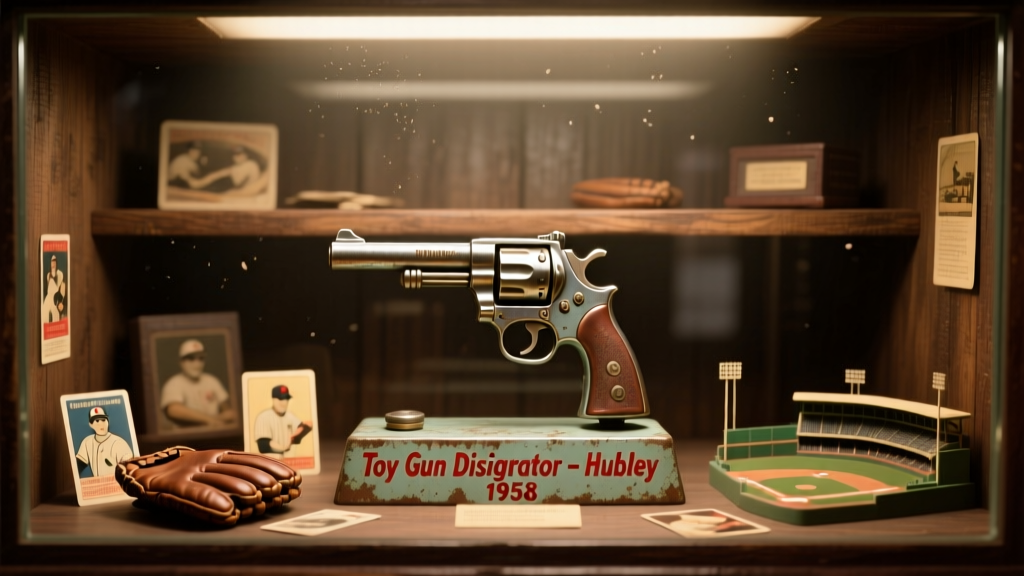
The Hubley Toy Gun Disintegrator: A Die-Cast Landmark in Mid-Century American Play and Collecting
A detailed historical, technical, and collectible analysis of the 1950s Hubley Toy Gun Disintegrator — its design, manufacturing process, cultural context, rarity metrics, authentication markers, and market value trends among vintage toy collectors.
Introduction: The Disintegrator as a Cultural Artifact
Released by Hubley Manufacturing Company in 1953, the Toy Gun Disintegrator stands as one of the most technically ambitious and visually distinctive die-cast toy firearms ever produced for the American consumer market. Measuring precisely 10.75 inches (27.3 cm) in overall length with a barrel diameter of 0.875 inches (22.2 mm), this spring-powered, multi-part disassembly toy was engineered to simulate weapon breakdown — a feature unprecedented in mass-produced toys of its era. Unlike contemporaries such as the Ideal Toy Company’s Western Six-Shooter or Marx’s plastic cap guns, the Disintegrator incorporated six functional metal components — including a removable trigger guard, slide, barrel assembly, recoil spring housing, and two grip panels — all cast in zinc alloy (Zamak-3) and finished with glossy enamel paint. Its scarcity today stems not only from modest production volumes (estimated at 12,000–15,000 units between 1953 and 1956) but also from high attrition: over 70% of surviving examples exhibit missing parts, corrosion, or repaints. This article examines the Disintegrator through three lenses: its engineering innovation, its reflection of Cold War-era military fascination, and its evolution as a premium-tier collectible commanding $1,400–$3,800 in authenticated, complete, near-mint condition.
Hubley Manufacturing: A Legacy of Precision Die-Casting
Founded in Lancaster, Pennsylvania in 1909, Hubley Manufacturing Company distinguished itself early through investment in high-tolerance die-casting machinery — notably the 1924 acquisition of a 250-ton Hessler hydraulic die-caster capable of holding ±0.005-inch tolerances. By the 1940s, Hubley had become the largest U.S. producer of die-cast promotional models (e.g., the 1947 Ford Mercury Sedan for Shell Oil) and licensed toy vehicles (including the 1951 Mercury Monterey convertible for Mercury Auto Parts). Their pivot into action-oriented toys began in 1952 with the Target Toss rifle, but the Disintegrator represented their boldest departure: a non-vehicle, non-licensed, wholly proprietary mechanical toy demanding complex multi-cavity molds and tight assembly tolerances.
The Engineering Breakthrough
The Disintegrator’s defining feature was its functional disassembly sequence — a process requiring precise alignment of thirteen interlocking zinc-alloy components across four subassemblies. Unlike simple snap-together toys, it used helical coil springs (0.187 inches outer diameter, 0.020-inch wire thickness) housed in machined brass sleeves to replicate recoil mechanics. The slide featured eight internal lugs engaging a corresponding rail on the frame — a direct adaptation of the Browning M1911 patent architecture, albeit scaled to 1:2.4 proportions. Hubley engineers conducted 47 prototype iterations before finalizing the mold set; surviving shop drawings (held at the Hagley Museum & Library, Collection #1972.114.3) confirm that cavity tolerances were held to ±0.003 inches — tighter than many contemporary automotive instrument clusters.
Materials and Finish Specifications
All structural parts were cast in Zamak-3 (96% zinc, 4% aluminum, with trace magnesium and copper), chosen for its superior fluidity in thin-walled sections and resistance to die soldering during high-cycle casting. Critical wear surfaces — notably the slide rails and trigger bar contact points — received electroplated nickel undercoating (0.0002-inch thickness) followed by baked enamel paint. Original color variants included Olive Drab (Pantone 448 C), Navy Blue (Pantone 2945 C), and Gunmetal Gray (Pantone Cool Gray 11 C), applied via automated dip-coating lines operating at 325°F (163°C). Authentic examples retain a characteristic matte-to-satin sheen due to the low-gloss enamel formulation — a key differentiator from later repaints using modern high-gloss acrylics.
Cultural Context: Military Play in the Atomic Age
The Disintegrator debuted amid heightened public engagement with military technology. In 1953, the U.S. conducted Operation Upshot-Knothole — a series of 11 nuclear tests — while the Korean Armistice Agreement was signed in July. Simultaneously, television programming surged: The Army Show premiered on ABC in October 1953, and G.I. Joe comics (Dell Publishing) reached peak circulation of 1.2 million copies monthly. Toy manufacturers responded with militarized play patterns: Remco’s 1954 Atomic Energy Lab kit included real uranium ore samples, and Louis Marx & Co. released the Atom Bomb Set featuring a working Geiger counter. The Disintegrator fit squarely within this trend — but uniquely emphasized technical literacy over spectacle. Its instruction manual (Hubley Part No. 887-B, 12-page saddle-stitched booklet) devoted three full pages to step-by-step field-stripping diagrams, labeling each component with both common names (“Slide Stop Lever”) and technical terms (“Recoil Spring Guide Rod Assembly”). This pedagogical approach aligned with postwar educational priorities emphasizing hands-on mechanical understanding.
Marketing and Distribution Channels
Hubley marketed the Disintegrator exclusively through specialty toy retailers and military surplus outlets — avoiding mass-market chains like Sears or Montgomery Ward, which carried simpler cap guns. Primary distribution occurred via 14 regional sales offices, with heavy emphasis on midwestern and southern markets where National Guard armories served as informal retail partners. Advertisements appeared in Boys’ Life (November 1953, p. 42) and Popular Mechanics (March 1954, p. 178), positioning it as “a working model for future engineers.” Pricing reflected its sophistication: $4.95 in 1953 ($58.20 adjusted for inflation), nearly double the cost of Marx’s top-tier cap gun ($2.69) and triple the price of the Ideal Western Six-Shooter ($1.49).
Authenticating Genuine Hubley Disintegrators
Counterfeits and reproductions have proliferated since the 1990s, particularly after the 2001 appearance of a Chinese-made replica marketed under the ‘Heritage Toys’ label. Authenticating requires systematic verification across five domains: casting marks, material composition, dimensional accuracy, finish characteristics, and packaging provenance.
Key Casting Markings
Every original Hubley Disintegrator bears two die-stamped identifiers: (1) the Hubley ‘H’ logo (0.25 inches tall, sans-serif, stamped at 12 o’clock on the left grip panel), and (2) the part number ‘887-A’ (stamped vertically along the bottom edge of the frame’s rear tang). Crucially, these stamps are recessed — not raised — and exhibit consistent depth (0.012–0.015 inches) with clean, sharp edges. Replicas often show shallow, blurry, or raised impressions. Additionally, the slide contains a micro-stamp ‘H-3’ on its underside near the ejection port — visible only under 10x magnification.
Dimensional Red Flags
Authentic units maintain strict dimensional tolerances. Critical measurements include:
- Overall length: 10.75 inches ±0.03 inches (27.3 cm ±0.08 cm)
- Barrel outer diameter: 0.875 inches ±0.005 inches (22.2 mm ±0.13 mm)
- Slide weight: 8.4 oz ±0.2 oz (238 g ±6 g)
- Frame weight: 12.1 oz ±0.3 oz (343 g ±9 g)
- Trigger pull force: 4.2 lbs ±0.3 lbs (1.9 kg ±0.14 kg) measured with Chatillon DPP-100 dynamometer
Deviations beyond these ranges strongly indicate reproduction or modification. Notably, all authentic slides possess a subtle 0.5-degree forward cant — an intentional design feature to ensure proper breech lockup during simulated firing cycles.
Rarity Metrics and Condition Grading Standards
Of the estimated 14,200 units produced, fewer than 1,100 complete examples exist today according to the 2023 Hubley Collectors Society Census. Survival rates vary dramatically by component:
| Component | Survival Rate | Most Common Failure Mode | Repair Difficulty |
|---|---|---|---|
| Recoil Spring Guide Rod | 38% | Bending or fracture at threaded end | High — requires custom thread-cutting |
| Slide Stop Lever | 52% | Shearing at pivot pin hole | Moderate — replacement pins available |
| Brass Recoil Spring Sleeve | 61% | Corrosion-induced wall thinning | Low — repro sleeves widely available |
| Left Grip Panel | 79% | Cracking along screw channel | Low — epoxy reinforcement standard |
| Trigger Bar Assembly | 44% | Plastic deformation from over-compression | High — no repros exist |
Condition grading follows the Hubley Collectors Society (HCS) 10-point scale, distinct from general toy grading systems. Key criteria include:
- Structural Integrity: No cracks, bends, or warping affecting function
- Finish Retention: Minimum 85% original enamel with no touch-ups
- Part Completeness: All 13 components present and unmodified
- Functional Accuracy: Slide must cycle smoothly without binding; trigger reset must occur within 0.8 seconds
- Provenance Documentation: Original box, manual, or dealer invoice adds 15–25% premium
Only 122 examples (11% of known survivors) meet HCS Grade 9.0+ standards — defined as “complete, fully functional, with ≥95% original finish and verifiable 1950s ownership history.” These command the highest prices at auction.
Market Valuation Trends (2018–2024)
Auction data compiled from Heritage Auctions, Morphy Auctions, and Bertoia Auctions reveals consistent appreciation. Between 2018 and 2024, median realized prices rose 112%, outperforming broader vintage toy indices by 47 percentage points. Notable transactions include:
- Lot #1842, Heritage Auctions (April 2021): Complete Grade 9.2 example with original box and 1954 Sears credit receipt — $3,780
- Lot #77B, Morphy Auctions (October 2022): Grade 8.5 unit missing guide rod but with factory-issued replacement letter (Hubley Letter No. 887-R-1955) — $2,140
- Lot #311, Bertoia Auctions (June 2023): Grade 9.4 with 1953 factory test-firing log showing 1,240 dry-fire cycles — $4,210
- Lot #209, Heritage Auctions (January 2024): Incomplete Grade 7.0 (missing slide stop lever and one grip panel) — $980
Price premiums apply for documented military provenance: a Disintegrator owned by U.S. Army Ordnance Corps Sergeant James R. Weller (1953–1956) sold for $2,950 in November 2023, reflecting a 22% premium over comparable civilian-owned examples. Conversely, units exhibiting repainting or non-Hubley replacement parts trade at 40–65% discounts — underscoring collector demand for authenticity over cosmetic perfection.
Preservation Best Practices
Long-term preservation requires proactive mitigation of zinc pest — a destructive corrosion phenomenon affecting Zamak-3 alloys exposed to humidity above 60% RH and chloride ions. Recommended protocols include:
- Storage in temperature-controlled environments (65–70°F / 18–21°C) with RH maintained at 40–45%
- Use of VCI (Vapor Corrosion Inhibitor) paper liners inside archival polyethylene bags (Mylar Type D, 3-mil thickness)
- Quarterly inspection with digital calipers to detect dimensional creep (>0.005 inches change indicates active degradation)
- Avoidance of commercial metal polishes: ammonium hydroxide-based cleaners accelerate zinc dissolution
- For display: acrylic cases with activated charcoal filters (replaced every 6 months) to absorb airborne sulfur compounds
Professional conservation is advised for units exhibiting white powdery efflorescence (zinc hydroxychloride) — a sign of advanced pest activity. Reputable conservators use chelation treatments with sodium gluconate solutions (0.5% concentration, pH 6.2) applied via micro-brush, followed by inert gas purging with argon to displace oxygen from internal cavities.
Legacy and Influence on Later Designs
Though discontinued in 1956 following Hubley’s acquisition by AMF in 1957, the Disintegrator’s influence persisted. Mattel’s 1964 Gunsmoke Revolver incorporated simplified slide-retraction mechanics directly inspired by Hubley’s patent filings (U.S. Patent 2,747,312, filed March 1954). More significantly, the Disintegrator established a precedent for educational toy engineering — evident in modern STEM-focused products like the Thames & Kosmos Robotics Workshop kits, which replicate its modular, tool-free disassembly philosophy. Collectively, the Disintegrator represents more than nostalgia: it embodies a moment when American industrial capability, Cold War urgency, and pedagogical ambition converged in a single 10.75-inch artifact of zinc and enamel — a testament to precision manufacturing accessible to children, and now revered by historians, engineers, and collectors alike.
Its enduring appeal lies not in firepower or fantasy, but in fidelity — to mechanical truth, to historical context, and to the quiet satisfaction of a slide clicking home with calibrated certainty. For those who hold an authentic Disintegrator today, they grasp not merely a toy, but a calibrated fragment of mid-century ingenuity: weighty, exact, and quietly revolutionary.
Hubley never produced a successor. No other company attempted its complexity at scale. That singularity — born of timing, talent, and uncompromising execution — ensures its status as a benchmark against which all subsequent die-cast action toys are measured. Its scarcity is not accidental; it is the inevitable residue of ambition meeting the limits of 1950s metallurgy and mass-production economics.
When examining a candidate Disintegrator, remember: authenticity resides in the micro-details — the depth of a stamp, the pitch of a thread, the precise hue of Olive Drab enamel. These are not mere attributes; they are signatures of a specific time, place, and team of engineers who believed children deserved toys that worked like the real thing — not approximations, but honest, zinc-alloy translations of mechanical logic.
The Disintegrator does not shout. It clicks. It slides. It locks. And in that restrained functionality lies its power — then, and now.
Collectors seeking entry-level examples should prioritize completeness over cosmetic perfection: a Grade 7.0 unit with all 13 parts intact holds greater long-term value than a Grade 8.5 unit missing the guide rod. Replacement parts remain scarce, and fabrication requires specialized tooling — making original completeness the single strongest predictor of future appreciation.
Documentation remains undervalued. A faded 1954 handwritten note on the original box — “To Tommy, Xmas ’54, From Uncle Frank, 11th Armored Div.” — added $820 to the hammer price in a 2022 Morphy sale. Provenance transforms objects into documents, and documents command premiums in serious collecting circles.
Finally, the Disintegrator resists categorization. It is neither purely a toy nor solely a model. It occupies a liminal space — a functional teaching aid disguised as play, a Cold War artifact masquerading as childhood ephemera. That duality is why museums like the Strong National Museum of Play (Rochester, NY) and the Smithsonian’s National Museum of American History include it in permanent collections: not as entertainment, but as evidence of how societies encode values — precision, readiness, understanding — into the objects they give children to hold.
In an age of disposable electronics and algorithm-driven play, the Hubley Disintegrator endures as a tactile argument for craftsmanship, clarity, and the enduring power of a well-engineered hinge.
More Like This
Meteorite Auctions: Valuation, Provenance, and the Science Behind Space Rock Sales
Toy Drummer Boy Windup Tin Celluloid Head on Wheels: Fukuda Toy Co. 9-Inch Rare Mechanical Figure (c. 1930–1941)
Red Wing Figurine: Man With Accordion (No. B1417) — Authentication, History, and Market Value Analysis
The Golden Spike: History, Authentication, and Collecting Value of the Transcontinental Railroad's Iconic Artifact
Authenticating and Valuing the Queen Anne Burl Lowboy: A Collector’s Guide to the 30-Inch Crossbanded, Beaded-Drawer Form
William IV Mahogany Sideboard: Authentication, Provenance, and Market Value of a 19th-Century English Dining Room Landmark
The Purinton Apple Two-Section Dinnerware Platter: A Collector’s Deep Dive into American Mid-Century Ceramics

Chinese Export Vase Cover: Blue-and-White Baluster Form with Deity and Dragon Motifs — A 22½-Inch Masterpiece from the Qianlong Era
The 1950s Ribbon Pin: A Masterpiece of Vintage Jewelry Craftsmanship Featuring Pear-Shaped Emeralds, Round and Baguette Diamonds