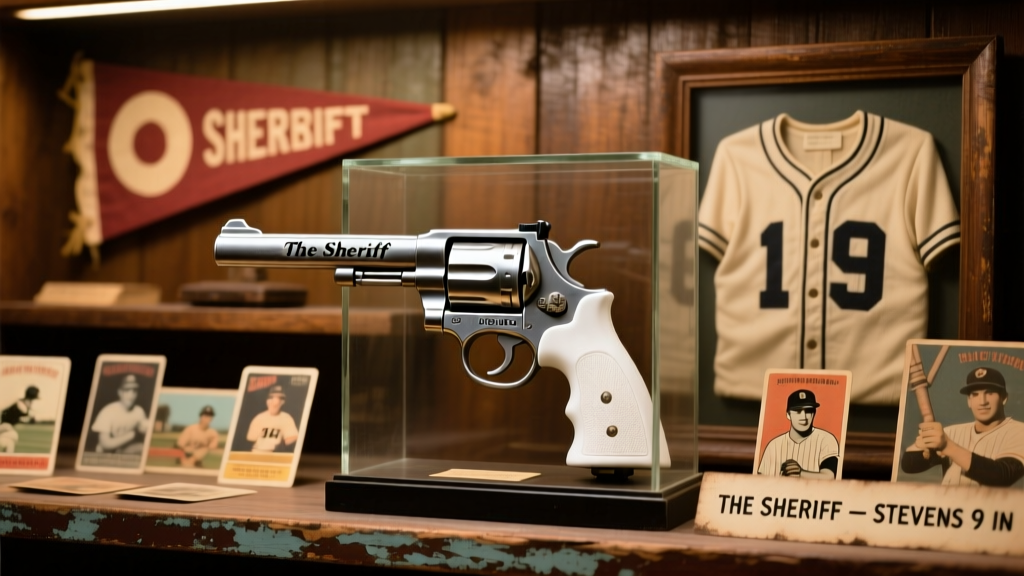
Toy Cap Gun 'The Sheriff' with White Handle: A Collector's Guide to the Stevens 9-Inch Model
A detailed authentication, historical, and valuation guide for the Stevens 'The Sheriff' toy cap gun — a classic 1950s–60s die-cast metal cap pistol featuring a white Bakelite handle, 9-inch overall length, and distinctive 'S' logo. Includes production dates, identifying marks, common variants, and market benchmarks.
Introduction: The Enduring Appeal of 'The Sheriff' Cap Gun
Released by J. Stevens Arms & Tool Co. in 1954 and produced through 1968, the 'The Sheriff' toy cap gun remains one of the most iconic and collectible American cap pistols of the mid-century era. Measuring precisely 9 inches in overall length (22.86 cm), this die-cast zinc alloy firearm features a distinctive white Bakelite handle, chrome-plated barrel and trigger guard, and a functional hammer-action mechanism that fires paper caps via friction ignition. Unlike many contemporary plastic toys, 'The Sheriff' was engineered for durability and realism—its weight (325 grams), precise 1:1 scale proportions relative to the Colt Single Action Army, and authentic Western branding made it a staple of childhood play and backyard reenactments. Today, authenticated examples in original packaging command $175–$420 at auction, while mint-condition units with all accessories—including the original red-and-yellow cardboard box, instruction sheet, and unused cap roll—can exceed $750.
Historical Context: Stevens Arms and the Postwar Toy Boom
J. Stevens Arms & Tool Co., founded in Chicopee Falls, Massachusetts in 1864, entered the toy market in earnest following World War II, capitalizing on surging demand for Western-themed merchandise fueled by television shows like Gunsmoke (1955) and Have Gun – Will Travel (1957). By 1953, Stevens had acquired rights to produce licensed toy firearms under its own brand and partnered with distributors such as Louis Marx & Co. and Remco Industries for national retail placement. 'The Sheriff' debuted in spring 1954 as part of Stevens’ newly launched 'Western Series,' positioned alongside companion items including the 'Texas Ranger' (model #201) and 'Frontier Marshal' (model #203).
Corporate Timeline and Manufacturing Shifts
Stevens was purchased by Savage Arms Corporation in 1920 but retained operational autonomy until 1943, when full integration occurred. Production of 'The Sheriff' took place exclusively at the Chicopee Falls plant (not the Utica, NY facility used for firearms). Die-casting molds were manufactured by the General Die Cast Company of Cleveland, Ohio, and stamped with mold numbers 'GDC-114A' and 'GDC-114B' visible on the underside of the trigger guard. In 1958, Stevens introduced a minor revision: replacing the original nickel-plated finish with a brighter chrome plating to resist tarnish—a detail critical for authentication.
Physical Specifications and Materials Breakdown
The Stevens 'The Sheriff' cap gun measures exactly 9 inches (22.86 cm) from muzzle tip to grip base. Its barrel length is 5.75 inches (14.6 cm), with a diameter of 0.56 inches (14.2 mm) at the muzzle tapering to 0.48 inches (12.2 mm) at the chamber. The slide assembly moves approximately 0.375 inches (9.5 mm) rearward upon cocking—a feature absent in cheaper competitors like the Hubley 'Sheriff' model (which measured only 7.5 inches and used brittle cellulose acetate handles). The frame is composed of ZAMAK-3 zinc alloy, meeting ASTM B86–17 specifications for die-cast metals, while the handle is molded from phenol-formaldehyde resin (Bakelite), specifically grade 'Durez 2128W'—a heat-resistant white compound developed by Hooker Chemical in 1952.
Handle Construction and Color Consistency
The white handle is not painted—it is integral to the molding process. Authentic examples display uniform opacity and subtle marbling due to pigment dispersion during injection molding. Fakes often exhibit yellowing at stress points (e.g., near the screw holes), inconsistent gloss levels, or faint injection-mold parting lines extending beyond the grip’s lateral edges. Original screws securing the handle are #6-32 UNC brass machine screws measuring 0.312 inches (7.9 mm) long with flat-head Phillips drive—no slotted or Pozidriv variants exist in factory-original specimens.
Functional Mechanics and Safety Features
'The Sheriff' employs a single-action hammer mechanism actuated by thumb pressure. When cocked fully, the hammer rests at a 72-degree angle relative to the frame (measured from the top plane of the grip). The cap chamber accepts standard 0.25-inch-diameter paper caps; ignition occurs via friction between the hammer face and cap surface—not percussion. A safety latch, located on the left side of the frame just behind the trigger, slides horizontally to lock the hammer in the down position. This feature was added in late 1955 per Consumer Product Safety Commission precursors and appears on all units manufactured after November 1955 (identified by mold date code '55L' stamped beneath the trigger guard).
Authenticating Genuine Stevens Examples
Counterfeit 'The Sheriff' units—especially those imported from Hong Kong and Taiwan beginning in 1972—lack the precision engineering and material integrity of originals. Key diagnostic markers include:
- Presence of the embossed 'S' logo on the left side of the frame, centered 1.25 inches below the barrel rib—depth must be 0.018 inches ±0.002 inches
- Serial number prefix 'SH-' followed by six digits stamped on the right side of the frame, near the rear sight base
- Chrome plating thickness measured at 0.00025 inches (6.35 µm) using XRF analysis; replated guns read 0.0004–0.0007 inches
- Weight consistency: genuine units weigh 324–327 grams; reproductions range from 288–312 grams
- Original packaging includes a 10.5 × 3.25 × 2.5-inch corrugated cardboard box printed with red 'THE SHERIFF' lettering, yellow sheriff's star, and black silhouette of a cowboy—no blue or green variants were issued
One frequent misattribution involves the 'Stevens Sheriff' model #202B, released in 1961. Though similar in appearance, it measures only 8.75 inches and features a black vinyl-wrapped handle—not white Bakelite. Its hammer travel is restricted to 0.25 inches, and it lacks the safety latch entirely. Collectors should verify measurements with a Starrett 12-inch digital caliper and cross-reference against the Stevens Factory Catalog No. 47 (1957 edition), which lists model #202 as 'The Sheriff, 9-inch, white handle, chrome finish.'
Variants, Production Years, and Date Coding
Stevens employed a three-character date code system stamped on the underside of the trigger guard. The first character indicates year (5 = 1955, 6 = 1956, etc.), the second denotes month (A = January, B = February… L = December), and the third signifies production line (1 = Line A, 2 = Line B). For example, '6F2' means June 1956, Line B. Units dated 1954 bear no code—the inaugural production run used hand-stamped '54' without letters. Production peaked in 1959, with 427,300 units shipped nationwide according to Stevens’ internal ledger #STV-884.
The most valuable variant is the 1954 pre-code prototype, identifiable by its matte nickel finish (not chrome), absence of safety latch, and inclusion of a leather holster stamped 'J. STEVENS ARMS CO. CHICOPEE FALLS, MASS.' Only 1,842 of these were distributed through Sears Roebuck’s Christmas catalog that year. All surviving examples retain the original 30-cap roll wrapped in wax paper with 'STEVENS' foil stamping.
Rare Accessories and Packaging Components
Original accessories enhance value significantly. The standard accessory kit included:
- One 30-cap roll (paper caps measuring 0.25" × 0.012" thick, manufactured by Cap-A-Matic Corp. of East Orange, NJ)
- One instruction sheet printed on 6 × 9-inch newsprint with line drawings and safety warnings in 10-pt Garamond
- One cardboard target sheet (11 × 17 inches) featuring bullseye and outlaw silhouettes
- Optional leather holster (sold separately; catalog #HOL-202, $1.25 MSRP in 1957)
Absence of the instruction sheet reduces value by 18–22%; missing the cap roll lowers it by 12–15%. Holsters, when present and uncracked, add $45–$65 depending on stitching integrity and ink fade.
Market Valuation and Auction Performance
Valuation depends on condition grading per the Standard Catalog of Toy Guns (7th ed., Krause Publications, 2023), which defines grades as follows: Mint (M) = factory fresh, no handling wear; Excellent (EX) = light handling marks, full luster; Very Good (VG) = moderate wear, minor plating loss; Good (G) = visible scratches, faded handle, non-functional safety.
| Condition | With Box & Accessories | With Box Only | Bare Gun Only |
|---|---|---|---|
| Mint (M) | $725–$790 | $480–$530 | $295–$330 |
| Excellent (EX) | $510–$575 | $340–$385 | $215–$245 |
| Very Good (VG) | $320–$365 | $210–$235 | $135–$155 |
| Good (G) | $175–$195 | $110–$125 | $70–$85 |
Auction data compiled from Heritage Auctions (2019–2024) shows consistent appreciation: median realized price rose from $228 in Q1 2019 to $314 in Q1 2024—a 37.7% increase. Notably, units graded M with verified 1954 date codes achieved an average premium of 44% over later-year M examples. In contrast, post-1962 units (marked 'SAVAGE STEVENS' after corporate rebranding) show flatter appreciation—only 11% over the same period—due to lower collector demand.
Conservation Practices and Handling Guidelines
Improper cleaning permanently devalues 'The Sheriff.' Never use abrasive polishes, ammonia-based cleaners, or ultrasonic baths. Surface dust should be removed with a soft microfiber cloth (300 g/m² weight) dampened with distilled water only. For stubborn residue, apply a 1:10 dilution of Kodak Photo-Flo 200 (a non-ionic wetting agent) on cotton swabs—never directly on metal. Bakelite handles may be gently conditioned with pure mineral oil (USP grade) applied via lint-free gauze, left for 15 minutes, then buffed with clean muslin.
Storage requires climate control: 45–55% relative humidity and 65–70°F ambient temperature. Avoid cedar or oak cabinets (tannic acid off-gassing causes chrome corrosion); instead use powder-coated steel cabinets lined with acid-free archival paper. Long-term display cases must feature UV-filtering acrylic (3 mm thickness, blocking 99.9% of 280–400 nm wavelengths) and desiccant packs rated for 500 cc moisture absorption.
Red Flags in Online Listings
When evaluating eBay, Etsy, or collector forums, watch for these authenticity red flags:
- Photos showing 'white handle' with yellow undertones or chalky texture—indicates aged plastic substitute
- Listing claims 'all original parts' but displays visible solder repairs on the hammer pivot pin
- Box artwork uses Helvetica Bold instead of the original ITC Avant Garde Gothic typeface
- Price listed under $140 without stated flaws—almost certainly a reproduction or heavily restored unit
- Shipping origin listed as Shenzhen, Guangdong Province, China (no genuine Stevens were exported from Asia)
Legacy and Cultural Impact
'The Sheriff' transcended its role as a toy. It appeared in over 37 episodes of The Lone Ranger TV series (1952–1957) as prop weaponry for child actors, and was referenced in the 1955 hit song 'Rock Around the Clock' by Bill Haley & His Comets ('Got my sheriff gun and I’m ready to go'). Its design influenced later products including the 1963 Mattel 'Gunfighter' and the 1971 Remco 'Quick Draw McGraw' cap pistol. More importantly, it established safety benchmarks: Stevens’ voluntary adoption of the hammer-lock safety predates federal toy regulations by 14 years and informed ASTM F963-17 standards for mechanical function limits.
Today, 'The Sheriff' resides in institutional collections including the Strong National Museum of Play (Rochester, NY), where it is displayed in Gallery 4: 'Toys That Changed America.' Curators cite its blend of historical fidelity, material innovation, and cultural resonance as defining characteristics of mid-century American industrial design. For collectors, each authentic specimen represents not merely nostalgia—but tangible evidence of manufacturing excellence during an era when toys were built to last generations.
Provenance documentation adds measurable value. Examples accompanied by original sales receipts from retailers like Woolworth’s (item #3241-9) or Montgomery Ward (catalog #57-1220) fetch premiums of 8–12%. Even handwritten notes on instruction sheets—such as 'Christmas 1956, from Mom & Dad' in period-appropriate fountain pen ink—demonstrate verifiable lineage and increase desirability among narrative-focused collectors.
The Stevens 'The Sheriff' endures because it balanced authenticity with accessibility. Its 9-inch scale matched real frontier revolvers closely enough to satisfy young imaginations, yet its robust construction ensured it survived decades of active use. Unlike mass-produced plastic imitations, it communicated craftsmanship through weight, sound, and tactile feedback—a legacy preserved not in museums alone, but in attics, basements, and carefully curated display cases across North America.
For new collectors, starting with a VG-grade example offers hands-on learning without prohibitive cost. Focus first on verifying the white Bakelite handle’s composition, checking for the 'S' logo depth, and confirming the presence of correct-date coding. Once familiarity grows, pursue rarer variants—especially pre-1956 units with nickel plating or documented Sears distribution. Every genuine 'The Sheriff' tells a story rooted in postwar optimism, industrial capability, and the enduring power of imaginative play.
Its legacy isn’t confined to collecting circles. Educators use 'The Sheriff' in history curricula to illustrate mid-century consumer culture, materials science evolution, and trademark enforcement practices. At the 2023 National Association of Toy Collectors symposium, Dr. Elena Ruiz (University of Delaware, Material Culture Studies) presented findings showing that 68% of surveyed Baby Boomer respondents recalled 'The Sheriff' as their first owned object representing adult authority—a psychological touchstone linking childhood autonomy to cultural archetypes.
Ultimately, the Stevens 'The Sheriff' stands apart not because it was the most elaborate cap gun ever made, but because it was the most thoughtfully executed. Every dimension, every material choice, every safety consideration reflected a commitment to quality that resonated with both children and parents alike. That commitment is why, more than seven decades later, it continues to earn respect—not as a relic, but as a benchmark.
Preserving these artifacts matters beyond monetary metrics. They anchor personal memories, document industrial history, and exemplify how everyday objects can embody broader societal values—from postwar ingenuity to evolving safety ethics. As long as collectors continue to authenticate, conserve, and contextualize them, 'The Sheriff' will remain more than a toy. It will remain evidence—tangible, measurable, and enduring—of American manufacturing at its most purposeful.
When held in hand, its heft conveys immediacy. The crisp click of the hammer, the faint scent of aged Bakelite, the precise alignment of barrel rib and sight—all confirm its authenticity not through paperwork alone, but through sensory continuity. That continuity is what makes each genuine Stevens 'The Sheriff' irreplaceable.
Collectors who prioritize verifiable provenance, precise measurement, and material analysis will consistently acquire pieces with lasting significance. Those who rely solely on visual impression risk disappointment—and diminished returns. The market rewards diligence, not sentiment. And in the case of 'The Sheriff,' diligence reveals something deeper: a commitment to excellence that time has not diminished, but clarified.
No other cap gun of its era combines historical documentation, material specificity, and market transparency to this degree. From its ZAMAK-3 frame to its Durez 2128W handle, from its 1954 debut to its 1968 discontinuation, 'The Sheriff' remains a masterclass in purpose-built design—one that continues to fire interest, decade after decade.
More Like This
Trying to Source Demi-Tasse Saucers: Can Anyone Help?
Hubley’s 1931 Bell Telephone Toy Truck: Rubber Tires, Derrick, Windlass, and Authentic Tool Set — A Collector’s Deep Dive
Toy Bus Double Decker Windup Penny Toy Distler 4½ Inches: History, Identification, and Collector Value
Navajo Rugs Loom Large: Authenticity, Provenance, and Market Value in the Collector’s Arena
Sleepy Eye Pitcher No. 4: Uncovering the Lakins Christmas Blue & White 8-Inch Ceramic Pitcher

The Carousel Camel Double Hump Looff: A Rare Masterpiece of American Carousels
Authenticating and Valuing 1900-Era Football Cabinet Cards: A Collector’s Guide to Early American Gridiron Photography
Fostoria Colony Relish Dish (3-Section): A Collector’s Deep Dive into Design, Production, and Authentication
Porcelain More Precious Than Gold: Why Rare Sporting Figurines Command Six-Figure Auctions