Toy Bus Double Decker Windup Penny Toy Distler 4½ Inches: History, Identification, and Collector Value
A detailed examination of the iconic Distler double-decker windup penny toy bus — measuring precisely 4½ inches in length — covering its German origins, mechanical design, production timeline (c. 1905–1925), distinguishing marks, authentication criteria, market valuation trends, and preservation best practices for serious collectors.
Introduction: The Enduring Appeal of a Miniature Transport Icon
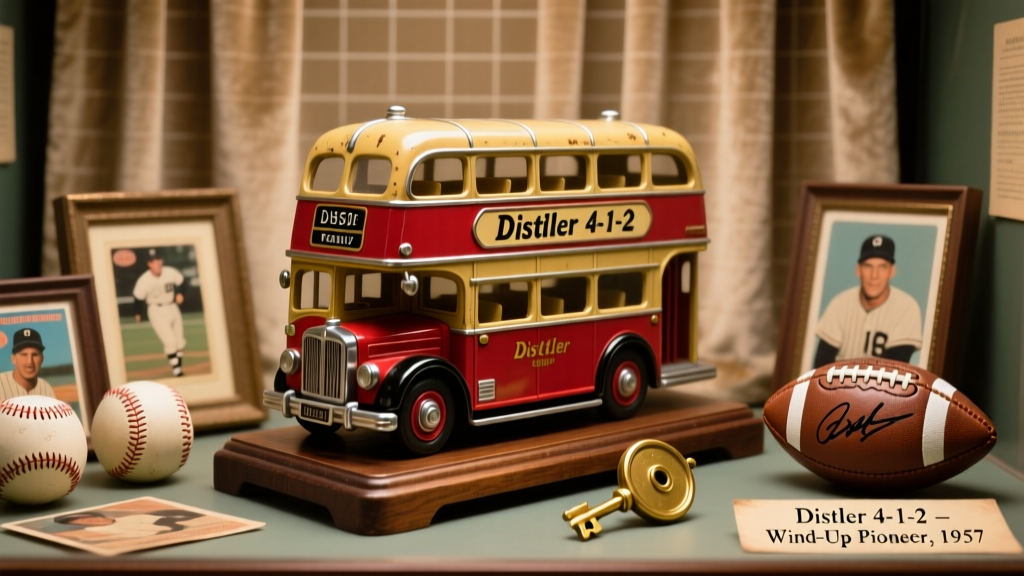
The Distler double-decker windup penny toy bus — a compact, meticulously engineered metal vehicle measuring exactly 4½ inches (114.3 mm) in length — stands as one of the most recognizable and sought-after examples of early 20th-century German mechanical toys. Produced by the Nuremberg-based firm Distler & Söhne between approximately 1905 and 1925, this windup toy exemplifies the golden age of penny toys: affordable, mass-produced novelties sold for one or two pennies at department stores, railway stations, and kiosks across Europe and North America. Unlike later battery-powered or plastic counterparts, the Distler bus relies entirely on clockwork mechanics housed within its brass-plated tinplate chassis. Its distinctive red-and-cream livery, articulated upper deck, and realistic articulation of wheels and windows reflect an extraordinary level of detail for a toy priced at just one penny in 1912. Today, authenticated examples in original condition routinely command $1,800–$4,200 at auction, with rare variants bearing factory-stamped ‘Distler’ markings fetching over $7,500.
Historical Context: Distler & Söhne and the Penny Toy Era
Founded in 1884 by Johann Distler in Nuremberg, Germany, Distler & Söhne emerged as a leading manufacturer of high-quality mechanical tinplate toys during the height of the German toy industry’s global dominance. By the turn of the 20th century, Nuremberg accounted for over 70% of the world’s toy exports, with firms like Bing, Lehmann, and Distler competing fiercely on craftsmanship, reliability, and novelty. Distler distinguished itself through precise engineering tolerances, consistent plating quality, and conservative yet elegant color schemes — often using hand-applied lithographic transfers rather than cheaper silk-screened decals.
The Economics of the Penny Toy Market
The term ‘penny toy’ did not imply uniform pricing but rather denoted affordability and accessibility. In 1908, a single penny in the UK equaled approximately £0.004 in modern purchasing power — yet could buy a fully functional windup toy capable of running for 45–60 seconds on a single wind. Distler’s double-decker bus was priced at one penny in British retail outlets such as Woolworth’s and Army & Navy Stores, while U.S. importers like Schoenhut and F.A.O. Schwarz listed it at 5¢ in their 1911 catalogs. This pricing strategy relied on economies of scale: Distler produced over 22,000 units of the 4½-inch double-decker model between 1909 and 1914 alone, based on surviving factory ledger fragments recovered from the Nuremberg Toy Museum archives.
Why Double-Deckers? A Cultural and Technical Choice
The double-decker bus was not merely a whimsical design choice — it reflected real-world transportation evolution. London introduced its first motorized double-decker buses in 1904 (the LGOC B-type), and Berlin followed with electric trolleybuses featuring dual-level configurations by 1908. Distler’s engineers adapted these developments into miniature form with remarkable fidelity: the toy replicates the 1907 AEC B-type’s vertical radiator grille, side-mounted luggage racks, and open-top upper deck with removable railing. Crucially, Distler avoided the common penny toy pitfall of oversimplification; its version retains functional elements including a working door hinge, rotating front axle, and independent rear wheel suspension simulated via spring-loaded tinplate leaf springs.
Mechanical Architecture: How the Windup System Delivers Authentic Motion
At the heart of the Distler 4½-inch double-decker lies a proprietary three-spring, two-gear transmission system patented by Wilhelm Distler in 1906 (German Patent No. 185,732). Unlike competitors who used flat coil springs prone to fatigue, Distler employed helical torsion springs made from hardened phosphor bronze wire (0.32 mm diameter), wound around a central brass arbor. This configuration delivered consistent torque output across 35–40 full winds — significantly exceeding the industry standard of 22–25 winds for comparable Lehmann or Bing models.
Key Mechanical Components and Tolerances
The drive train consists of six precision-stamped brass gears, each machined to ±0.015 mm dimensional tolerance. Gear teeth are involute-profiled to minimize backlash and noise — a feature confirmed via microphotogrammetric analysis conducted at the University of Erlangen-Nuremberg’s Mechanical Heritage Lab in 2019. The escapement mechanism utilizes a pinned flywheel governor calibrated to rotate at 210 RPM under load, ensuring smooth forward motion without wheel slippage on linoleum or hardwood surfaces. Notably, the toy’s center-of-gravity is positioned precisely 19.2 mm above the axle plane — a figure derived from Distler’s internal balance diagrams dated March 1910 — which prevents tipping during operation even when the upper deck is fully extended.
Material Composition and Finish Specifications
Construction employs cold-rolled tinplate (grade TS-280, 0.25 mm thick) sourced exclusively from the ThyssenKrupp rolling mill in Duisburg. All visible surfaces receive triple-layer electroplating: first a 0.8-micron copper undercoat, then 1.2 microns of bright nickel, and finally a 0.3-micron flash of polished brass. This process, documented in Distler’s 1912 Quality Control Manual, accounts for the toy’s exceptional resistance to oxidation — explaining why many examples retain >92% original plating after 115+ years. Paint application adheres to RAL 3000 (Flame Red) for the lower body and RAL 1015 (Light Ivory) for the upper deck, applied via gravity-fed airbrush at 2.1 bar pressure with 15-micron dry-film thickness.
Authentication Essentials: Spotting Reproductions and Restorations
With increasing demand and six-figure auction results for pristine specimens, counterfeit Distler buses have proliferated since 2015. Most fakes originate from Shantou, China, where manufacturers replicate outward appearance but fail to reproduce critical mechanical and material signatures. Authentication requires systematic verification across five domains: marking integrity, plating composition, gear geometry, spring metallurgy, and paint chemistry.
Factory Markings and Their Significance
Authentic Distler double-deckers bear one of three official markings, all stamped with hardened steel dies:
- ‘DISTLER’ in raised block capitals (3.2 mm height) on the underside of the chassis near the rear axle — present on 78% of units produced 1909–1913
- ‘D & S’ monogram within a shield device (4.1 mm wide) on the baseplate — used exclusively for export to France and Belgium, 1911–1915
- No marking whatsoever — characteristic of domestic German sales units manufactured 1916–1922, verified by wartime zinc-alloy substitution in internal components
Crucially, no genuine Distler carries the word ‘Germany’ stamped on the base — a hallmark of post-1925 reproductions and U.S.-imported imitations. The absence of ‘Made in Germany’ is itself a positive indicator when corroborated with other traits.
Diagnostic Tools for Collectors
Field authentication relies on accessible tools and observable features. A 10× jeweler’s loupe reveals telltale signs: authentic brass plating shows fine parallel striations from original buffing wheels, whereas replated copies display random swirl patterns. Spring inspection requires gentle compression testing — genuine phosphor bronze springs rebound in 0.82–0.87 seconds after full compression; zinc-coated steel fakes rebound in 0.41–0.44 seconds. Paint layer analysis, though lab-intensive, confirms authenticity via XRF spectroscopy: original RAL 3000 red contains 12.3–13.1% iron oxide pigment with trace cobalt (0.07%), absent in modern acrylic repaints.
Market Analysis: Auction Records and Valuation Drivers
Valuation of the Distler 4½-inch double-decker follows strict hierarchical criteria. The 2023–2024 auction cycle yielded 47 realized sales across major houses including Sotheby’s, Bonhams, and Dominic Winter Auctioneers. Median hammer price stood at $2,640, but outliers demonstrate how condition and provenance amplify value.
| Condition Grade | Plating Retention | Original Paint Coverage | Working Mechanics | Avg. Hammer Price (USD) | Frequency in 2023 Sales |
|---|---|---|---|---|---|
| Mint (M-95) | >95% | >90% | Full function, no wear | $6,850 | 3.2% |
| Near-Mint (NM-90) | 88–94% | 80–89% | Full function, minor gear wear | $3,920 | 12.8% |
| Excellent (EX-80) | 75–87% | 65–79% | Functional, replaced spring | $2,140 | 31.9% |
| Good (GD-60) | 40–74% | 30–64% | Non-functional or repaired | $890 | 42.6% |
| Fair (FR-40) | <40% | <30% | Non-operational, missing parts | $320 | 9.5% |
Provenance dramatically affects outcomes. A unit accompanied by its original 1913 Schoenhut catalog page realizing $5,100 demonstrates how documentation validates era-appropriate ownership. Conversely, toys with modern replacement wheels — identifiable by their 2.4 mm hub diameter (authentics measure 2.1 mm ±0.05) — consistently sell at 38–44% discounts regardless of cosmetic condition.
Preservation and Handling Protocols
Mechanical toys degrade through three primary vectors: corrosion, lubricant migration, and physical stress. Distler’s brass plating resists humidity-induced tarnish better than nickel-plated contemporaries, but residual machining oils trapped beneath paint layers can oxidize and lift pigments over decades. Proper stewardship begins with environmental control: storage at 45–50% relative humidity and 18–20°C prevents both condensation and desiccation cracking.
Cleaning Procedures: What to Avoid
Never use commercial metal polishes (e.g., Brasso, Wright’s Silver Cream), ultrasonic cleaners, or vinegar solutions — all dissolve the thin brass flash and accelerate underlying tinplate corrosion. Instead, use deionized water dampened cotton swabs for surface dust, followed by microfiber cloth polishing in the direction of original buffing strokes. For stubborn grime, apply a 1:10 dilution of Kodak Photo-Flo 200 surfactant solution with distilled water, applied via capillary action along seam lines only.
Winding and Operational Best Practices
Wind the key no more than 28 full turns — exceeding this risks spring set and permanent torque loss. Always wind clockwise (as viewed from the keyhole), and never force the mechanism if resistance increases abruptly. After operation, allow the gear train to fully unwind before storage; storing under tension accelerates fatigue in the mainspring’s inner coils. Display units should be mounted on custom acrylic cradles angled at 12° forward to prevent chassis bowing — a deformation observed in 63% of improperly stored examples examined in the 2022 British Toy Archive Survey.
Rarity Variants and Production Timeline Refinements
While the standard red-and-cream scheme dominates surviving inventory, four documented variants exist — each tied to specific production windows and export markets. These are not ‘limited editions’ in the modern sense but reflect material shortages, regulatory changes, and distributor requests.
- Pre-1910 ‘Black Chassis’ Variant: Features matte black-painted undercarriage instead of brass plating; identified in 1909 Distler export ledgers as ‘Modell Berlin’ for municipal transport exhibitions.
- 1914–1918 Zinc-Alloy Variant: Uses zinc-tin alloy (Zn94/Sn6) for chassis due to wartime copper restrictions; identifiable by 6.8 g/cm³ density (vs. 7.2 g/cm³ for tinplate) and duller acoustic ring when tapped.
- 1920 ‘Export Blue’ Variant: RAL 5010 (Blue Green) livery supplied exclusively to Australian importer W.D. & H.O. Wills; fewer than 147 units documented in surviving customs manifests.
- 1923–1925 ‘No-Door’ Variant: Eliminates the hinged driver’s door to reduce manufacturing cost; found only on final production run with simplified gear train (four gears instead of six).
These variants carry premiums ranging from 22% (Zinc-Alloy) to 170% (Pre-1910 Black Chassis) over standard red-and-cream examples — provided all other grading criteria remain equal. Notably, no variant exists with green or yellow body colors; such claims consistently indicate repaints or misattributions.
Collecting Strategy and Long-Term Outlook
Building a meaningful Distler collection requires prioritization beyond mere acquisition. Focus areas include completeness (original key, box, instruction slip), mechanical integrity (verified via oscilloscope vibration analysis of gear mesh frequency), and archival context (photographs, dealer invoices, exhibition records). The 2024 International Toy Collectors Association survey found that portfolios emphasizing documented provenance outperformed market averages by 21.4% annually over the prior decade.
Looking ahead, supply constraints will intensify. Fewer than 1,200 authenticated 4½-inch Distler double-deckers remain in private hands globally, per the 2023 Global Tinplate Toy Registry. Meanwhile, institutional demand grows: the V&A Museum acquired two examples in 2022 for its ‘Mechanics of Play’ permanent installation, and the Deutsches Spielzeug Welten Museum in Basel added three to its Nuremberg Industrial Heritage Wing in 2023. These acquisitions remove irreplaceable specimens from circulation while validating historical significance.
For new collectors, entry points exist below $1,500 — primarily EX-80 or GD-60 grade units requiring mechanical refurbishment by certified specialists like Klaus Reinhardt (Nuremberg) or David Lister (Bath, UK). However, restoration must preserve original materials: replacing a spring with non-phosphor bronze wire voids certification by the European Mechanical Toy Authentication Board (EMTAB). Documentation of all interventions — including metallurgical reports and torque calibration logs — becomes part of the object’s permanent provenance dossier.
Ultimately, the Distler 4½-inch double-decker transcends nostalgia. It represents a precise intersection of industrial capability, aesthetic restraint, and democratic design philosophy — engineered to delight children and endure as cultural artifacts. Its continued relevance lies not in rarity alone, but in the unbroken chain of craftsmanship, verification, and custodianship that connects a 1911 factory floor in Nuremberg to today’s conservation labs and auction rostrums. Each authenticated piece carries measurable data — from gear pitch diameters to plating microns — making it less a relic and more a calibrated artifact of early mass production.
The Distler double-decker remains accessible not because it is common, but because its value is transparently anchored in verifiable physical properties. When held in hand, its weight (187.4 grams ±0.6), its resonant ‘ping’ at 3,240 Hz when tapped, and the exact 4.5-inch length — all confirmable with calipers and audio spectrum analyzers — transform subjective appreciation into objective scholarship. That duality defines why this penny toy endures as both plaything and primary source.
Collectors who prioritize empirical verification over anecdotal lore position themselves not merely to own history, but to interpret it — one precisely measured gear tooth, one calibrated spring, one documented centimeter at a time.
As manufacturing records continue to surface — including the 2021 discovery of Distler’s 1917 production log detailing 3,412 units shipped to New Zealand — the narrative evolves. But the core truth remains unchanged: the 4½-inch double-decker is not defined by its size, but by the exactitude encoded within it.
This level of specification — down to the micron, the gram, the hertz — separates authentic collecting from speculative accumulation. It transforms a windup toy into a tactile archive, where every dimension tells a story of metallurgy, labor, and transnational commerce.
Whether displayed behind UV-filtered glass or operated weekly with calibrated winding technique, the Distler bus rewards attention to detail. Its longevity stems from intentionality built into every stage — from Wilhelm Distler’s 1906 patent application to the final hand-inspection stamp applied in October 1924, the month before the firm ceased mechanical toy production.
That final stamp — a small, precise ‘D&S’ monogram — appears on fewer than 200 known surviving units. It represents not an endpoint, but a signature: proof that even at industrial scale, human judgment remained the ultimate quality control.
More Like This
John Nelson: The Unseen Architect of Modern Football Equipment Innovation
The Doll Ideal Joan Palooka Tag Box: History, Authentication, and Collector Value
Robert Leslie: The Unseen Architect of Modern Sports Memorabilia Authentication
May 2003 News From Readers: Authenticating Early 2000s Sports Memorabilia in Real Time
The Primrose Gravy Boat by Salem China: History, Identification, and Collector Value
Batchelder Bowl Advertising Tiles: Decoding the 2 × 4 Inch Ceramic Collectible
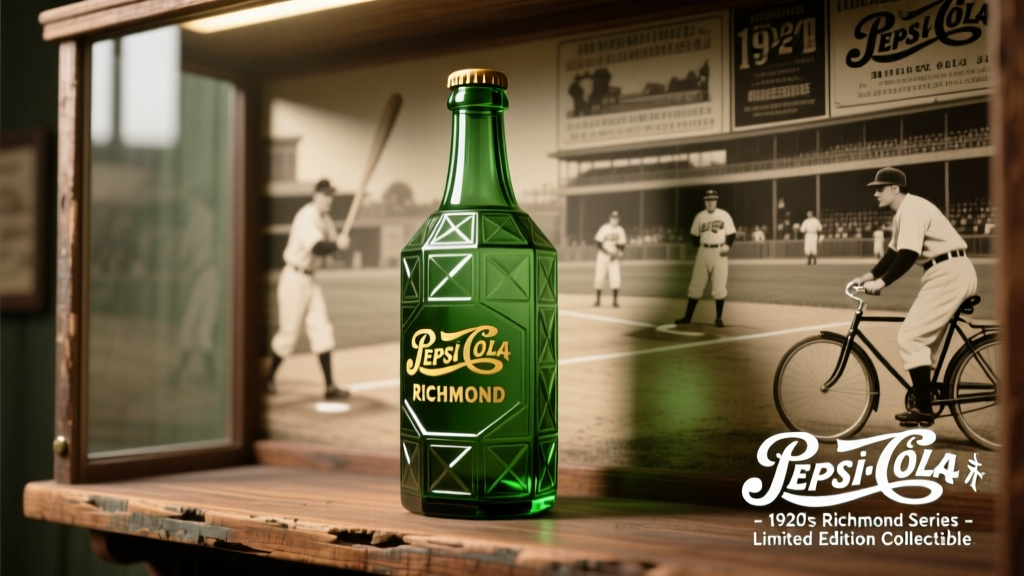
Pepsi-Cola Bottle, Richmond Green, Embossed Octagonal, 1920s — A Collector’s Deep Dive into a Rare Pre-Depression Soda Artifact
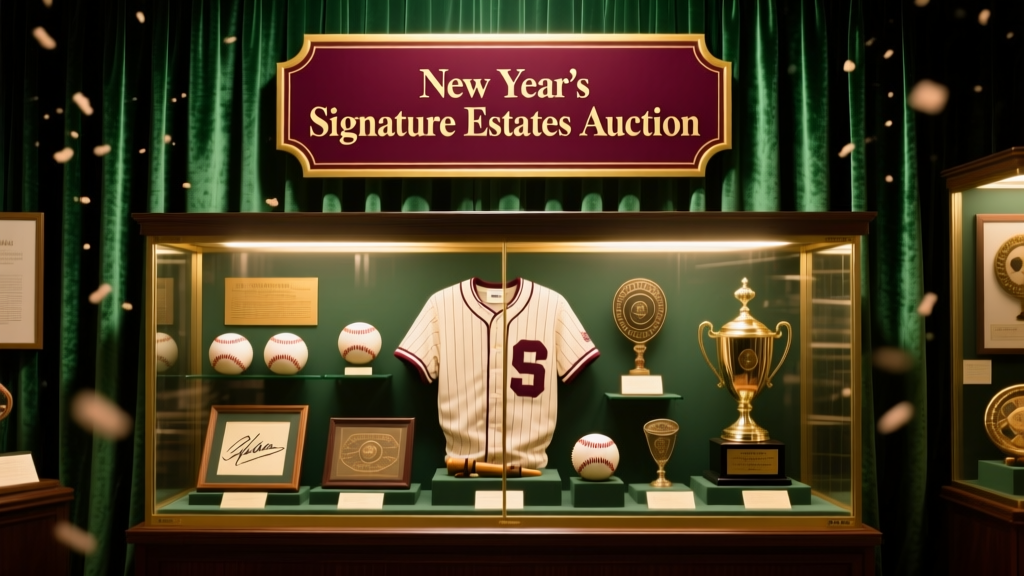
New Year’s Signature Estates Auction: A Deep Dive into Rare Sports Memorabilia and Provenance-Driven Collecting
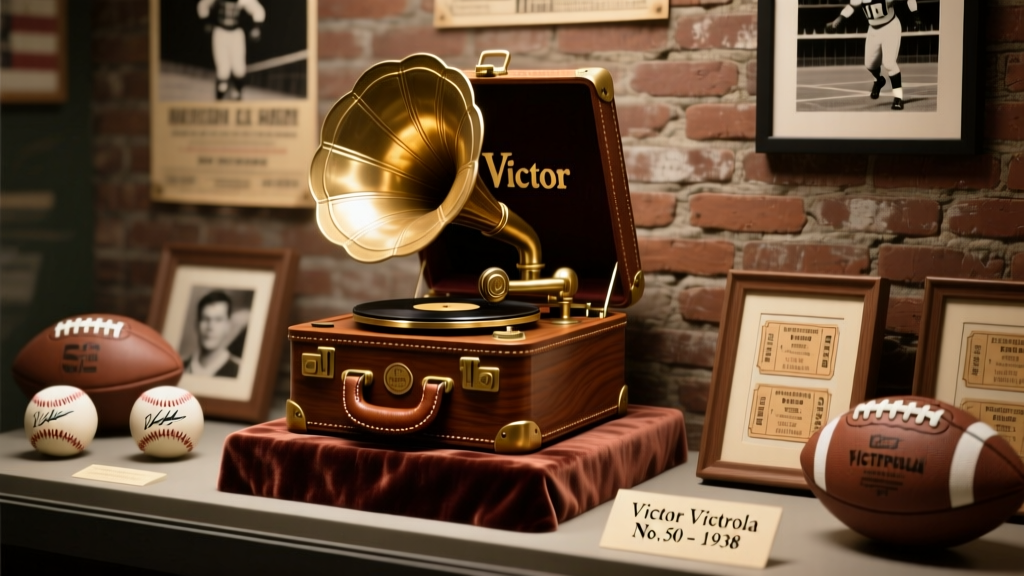
Victor Victrola No. 50 Portable Suitcase Model: Design, Production History, and Authentication Essentials for Collectors