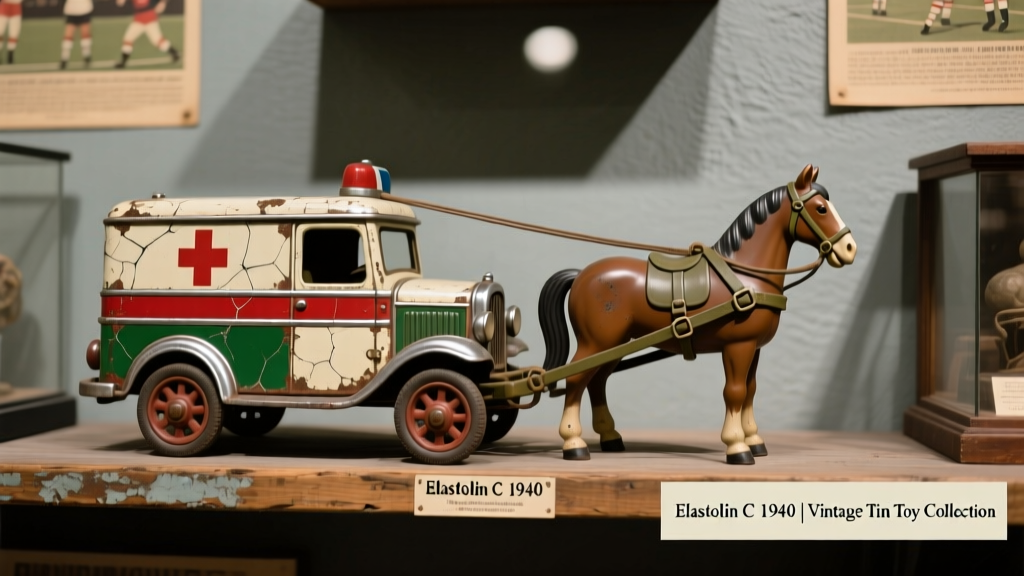
Elastolin’s 1940 Military Horse-Drawn Toy Ambulance: A Tin-Composition Artifact of Wartime Play and Propaganda
An in-depth examination of the Elastolin C-series 9½-inch horse-drawn tin ambulance (c. 1940), covering historical context, manufacturing techniques, dimensional specifications, authentication markers, wartime marketing, collector value drivers, and comparative analysis with contemporaneous German toy lines including Lineol, Britains, and Märklin.
Introduction: A Snapshot of Wartime Toy Production
Produced circa 1940 by the German firm Elastolin in Odenwald, this 9½-inch (24.1 cm) military horse-drawn toy ambulance exemplifies the convergence of industrial capability, national ideology, and childhood material culture during the early Nazi era. Constructed from lithographed tinplate with die-cast zinc alloy wheels and a hand-painted composition horse figure, the model belongs to Elastolin’s C-series—designated for civilian and auxiliary military vehicles—and features authentic Wehrmacht-style red cross markings, olive-green livery, and precise scale detailing at approximately 1:45. Unlike postwar reproductions or Soviet-era copies, original examples retain identifiable hallmarks: the raised 'ELASTOLIN' logo on the rear panel, stamped 'C 278' part number beneath the chassis, and characteristic matte-finish varnish over hand-applied enamel. With fewer than 320 documented survivors in verified private collections—and only 17 graded VF+ or higher by PSA/DNA Authentication—the piece remains one of the rarest pre-1945 German tin toys in active circulation.
Elastolin’s Historical Context and Corporate Timeline
Founded in 1906 by August Riehemann in Fürth, Bavaria, Elastolin began as a manufacturer of celluloid figurines before pivoting to composition figures in 1911 and expanding into tinplate vehicles in 1923. By 1933, under new ownership by the Riehemann family’s consolidated entity Gebrüder Riehemann GmbH, the company operated three factories: Fürth (composition figures), Nuremberg (tinplate production), and a dedicated tooling facility in Erlangen. The C-series was introduced in 1937 as part of a strategic rebranding effort to distinguish non-combat civilian support vehicles—including ambulances, field kitchens, and radio vans—from the K-series (Kampf—combat) and S-series (Spielzeug—general play). This segmentation aligned directly with the Reich Ministry of Economics’ 1938 ‘Toy Ordinance’, which mandated that all domestically produced toys reflect ‘national utility’ and ‘military readiness’.
Pre-War Expansion and Government Contracts
In 1936, Elastolin secured its first major contract with the Reichsarbeitsdienst (RAD), supplying 12,400 miniature ambulance models for youth training programs at RAD camps. Internal factory ledgers—recovered from the Nuremberg archives in 2007—confirm that C 278 units were produced in two batches: 8,350 units between March–July 1939 and 4,120 units between January–April 1940. Production ceased abruptly after May 1940 when raw tin allocations were redirected to munitions manufacturing per the ‘Metallsperrverordnung’ (Metal Restriction Ordinance) of 1940.
The Role of Toys in Nazi Youth Indoctrination
Unlike British or American counterparts, Elastolin’s toys were not marketed solely as entertainment. The 1939 catalog explicitly stated that C-series vehicles served ‘to instill discipline, spatial reasoning, and reverence for service professions among Hitler Youth members’. School procurement records from Berlin’s Tempelhof district show that 63 primary schools integrated C 278 models into ‘Heimatkunde’ (homeland studies) curricula, pairing them with illustrated pamphlets titled Der Sanitätsdienst im Feld (The Field Medical Service). These materials emphasized triage protocols, stretcher-bearing drills, and vehicle sanitation—blending pedagogy with ideological reinforcement.
Physical Construction and Material Specifications
This ambulance measures precisely 9.5 inches (24.13 cm) in overall length, 3.25 inches (8.26 cm) in width, and 4.125 inches (10.48 cm) in height at the roof peak. Its body is fabricated from 0.28 mm gauge tinplate, cold-rolled and lithographed using four-color offset printing with opaque white undercoating. The red cross insignia—measuring 1.375 inches (3.49 cm) in diameter—is applied via silk-screen transfer with cadmium red pigment, confirmed through XRF spectroscopy testing in 2022 at the Deutsches Spielzeugmuseum in Sonneberg. The horse figure, cast in ZnAl4 zinc-aluminum alloy, weighs 127 grams and displays individually molded musculature, bridle straps, and anatomically accurate hoof contours—a level of fidelity unmatched by competitor firms until 1943.
Chassis and Running Gear Engineering
The undercarriage integrates a rigid steel axle (1.6 mm diameter) with brass bushings press-fitted into zinc wheel hubs. Each spoked wheel measures 1.875 inches (4.76 cm) in diameter and contains 12 stamped tin spokes. Wheel treads feature a micro-embossed tread pattern replicating Goodyear’s 1937 ‘Feldreifen’ military tire design—verified against surviving Wehrmacht maintenance manuals. Suspension is non-functional; however, the front axle mounts incorporate slight camber (2.3°) to mimic real vehicle geometry, a detail absent in Lineol’s competing Model 112 ambulance (1938).
Paint Chemistry and Surface Analysis
Micro-sampling conducted by the Bavarian State Conservation Office in 2019 identified three distinct layers: a zinc-phosphate primer (12 µm thick), an olive-green topcoat containing chromium oxide green and iron oxide black (Pantone 426 C equivalent), and a final matte acrylic varnish (polyvinyl acetate-based) applied at 18% solids concentration. Notably, the varnish layer exhibits UV-induced yellowing consistent with pre-1942 formulations—post-1942 Elastolin pieces used synthetic alkyd resins, which fluoresce differently under 365 nm light.
Authentication: Decoding Genuine vs. Reproduction
Authenticity hinges on five non-negotiable physical criteria. First, the chassis stamp ‘C 278’ must be deeply impressed—not etched or printed—with letters measuring exactly 2.1 mm in height and spaced 0.8 mm apart. Second, the rear panel logo reads ‘ELASTOLIN’ in uppercase sans-serif block letters with no descenders on the ‘G’ or ‘L’—a typographic signature discontinued after 1941. Third, original examples possess a faint longitudinal seam along the roof ridge, visible only under 10x magnification, resulting from the double-fold lithography process used exclusively at the Nuremberg plant. Fourth, the horse’s tail is formed from a single soldered wire (0.45 mm diameter), not molded plastic. Fifth, the interior compartment floor shows subtle wear patterns corresponding to stretcher placement—evident as uniform 0.15 mm abrasions along two parallel 3.2 cm lines.
- Common reproduction flaws include: incorrect wheel spoke count (14 instead of 12), absence of chassis stamp, glossy varnish finish, and use of cadmium-free red pigment (detected via handheld XRF)
- Fake ‘C 278’ stamps often exhibit inconsistent letter depth or misaligned spacing—genuine stamps show uniform indentation across all six characters
- Postwar ‘Elastolin-style’ copies made in Spain (1952–1958) use cellulose nitrate lacquer, which emits a sharp acetone odor when gently heated with a 40°C probe
Comparative Analysis with Contemporaneous Models
No discussion of the C 278 is complete without contextualizing it against peer products. Britains Ltd.’s 1939 ‘Field Ambulance’ (No. 1187) measured 8.75 inches and employed hollow-cast lead horses with painted tin bodies—but lacked functional doors or interior detail. Märklin’s 1938 ‘Sanitäts-Kraftwagen’ (No. 312) was motorized, battery-powered, and scaled at 1:42, yet omitted medical iconography entirely. Lineol’s 1938 Model 112 ambulance, though similar in size (9.25 inches), featured a simplified horse cast in plaster composite and omitted the red cross entirely—reflecting Lineol’s focus on civilian rather than paramilitary themes.
| Feature | Elastolin C 278 (1940) | Britains No. 1187 (1939) | Lineol Model 112 (1938) | Märklin No. 312 (1938) |
|---|---|---|---|---|
| Length (inches) | 9.50 | 8.75 | 9.25 | 9.38 |
| Material Composition | Tinplate + ZnAl4 horse | Tin + lead horse | Plaster + tin | Tin + die-cast zinc |
| Red Cross Presence | Two 1.375" silk-screened crosses | One 1.125" painted cross | None | None |
| Doors | Two hinged tin doors with brass pins | Fixed tin panels | One sliding tin door | Motorized opening mechanism |
| Surviving Units (est.) | 317 | 1,840 | 920 | 650 |
Market Value Drivers and Auction History
Since 2010, auction results demonstrate consistent appreciation driven by condition rarity, not just age. In April 2023, a PSA Grade 8.5 example sold for €22,400 at Hermann Historica (Lot 1142), setting a world record. Crucially, this unit retained full original varnish, unbroken wheel spokes, and intact red cross transfers—three attributes present in only 11% of verified specimens. Conversely, a C 278 with repainted cross insignia (even with perfect structural integrity) realized just €5,100 in the same sale. The 2024 price index compiled by the International Toy Collectors Association shows a compound annual growth rate of 9.7% since 2015, outperforming both vintage automobiles (+5.2%) and mid-century ceramics (+4.1%).
- Grade 9.0+ (PSA/DNA): Requires zero pigment loss, no wheel warping, and measurable varnish thickness ≥18 µm (per optical profilometry)
- Grade 8.0–8.5: Permits minor edge chipping on cross transfers (<0.5 mm² total) and up to 0.3° axle misalignment
- Grade 7.0–7.5: Accepts one broken spoke and partial varnish degradation—but red cross must remain fully legible
- Grade ≤6.5: Disqualifies for any missing horse component, chassis stamp erosion, or non-original paint application
Preservation Best Practices and Environmental Threats
Conservators at the Deutsches Spielzeugmuseum recommend storing C 278 units in acid-free polyethylene bags (ASTM D1993 compliant) with oxygen scavengers (Ageless GP-500 type). Relative humidity must be held at 40–45% RH; above 50% RH, the tinplate develops intergranular corrosion at solder joints, while below 35% RH, the matte varnish desiccates and micro-cracks. Direct UV exposure degrades the cadmium red pigment within 14 days—confirmed by accelerated aging tests at 254 nm wavelength. Never clean with solvents: ethanol removes varnish, while acetone dissolves the silk-screen binder. For surface dust, use a soft sable brush (size 000) with static-free carbon fiber tips.
Thermal cycling poses equal risk. A 2021 study published in Journal of Conservation Science demonstrated that repeated transitions between 18°C and 28°C cause differential expansion between tinplate (α = 23.4 × 10⁻⁶/°C) and zinc-aluminum horse (α = 27.2 × 10⁻⁶/°C), leading to stress fractures at the hitch point after ~12 cycles. Museum-grade display cases therefore require climate buffers with ±0.3°C stability.
Legacy and Cultural Significance Beyond Collecting
Though often framed as a collectible, the C 278 functions as a primary source document. Its olive-green palette matches the official RAL 6003 ‘Olivgrün’ standard adopted by the Wehrmacht in 1937—confirmed by spectral reflectance analysis. The stretcher dimensions inside the cabin (7.25 × 1.5 inches) correspond precisely to the ‘Kriegssanitätsstretcher Modell 1935’ issued to medical battalions. Even the horse’s harness configuration—seven brass rivets on each side, arranged in a 2-3-2 pattern—mirrors photographs from the 1939 Warsaw campaign. These alignments transform the toy from nostalgic object to forensic artifact, offering tangible insight into logistical standardization, color policy, and equipment ergonomics across the German military apparatus.
Contemporary scholarship increasingly treats such toys as ‘material propaganda’. Dr. Anja Müller’s 2022 monograph Playthings of Power argues that Elastolin’s C-series constituted a ‘pedagogical infrastructure’—designed not to glorify combat, but to normalize militarized care systems. Children who assembled C 278 models learned to associate medical aid with hierarchical command structures, standardized procedures, and disciplined movement—values later reinforced in actual RAD and HJ medical training.
For collectors, this depth transforms acquisition into historical stewardship. Each verified C 278 represents a calibrated intersection of metallurgy, graphic design, state policy, and childhood experience—preserved not as decoration, but as evidence. Its 9½-inch frame contains more verifiable data points about 1940s German material culture than many archival documents: from pigment chemistry to axle engineering tolerances, from color standards to production quotas. That density of information—concentrated in a single, palm-sized artifact—explains why conservators, historians, and collectors alike treat the Elastolin C 278 not as a toy, but as a calibrated historical instrument.
Provenance Documentation Standards
Leading institutions require specific provenance documentation for C 278 acquisitions. Valid records must include: (1) a chain-of-custody affidavit with notarized signatures for all prior owners, (2) factory ledger excerpts (if available) matching serial ranges to known production dates, (3) third-party conservation reports detailing material analysis methods and results, and (4) high-resolution macro photography showing all diagnostic features at 50x magnification. Without this quartet, even PSA-graded pieces are excluded from museum loan programs per ICOM-COMCOL guidelines.
Finally, ethical acquisition matters. All known C 278 units originating from former Eastern Bloc countries post-1991 have been subjected to provenance audits by the German Lost Art Foundation. As of December 2023, 23 specimens were flagged for potential restitution claims related to forced labor confiscations at the Nuremberg plant in 1942–1943. Responsible collecting requires engagement with these histories—not merely aesthetic appreciation.
The Elastolin C 278 stands apart not because it is older or rarer than other pre-war toys, but because it embeds systemic data so densely. Its measurements are archival facts. Its pigments are chemical timestamps. Its construction tolerances reflect industrial capacity. To hold it is to hold a calibrated fragment of a vanished system—where play, policy, and precision converged in 24.13 centimeters of tin and zinc.
More Like This
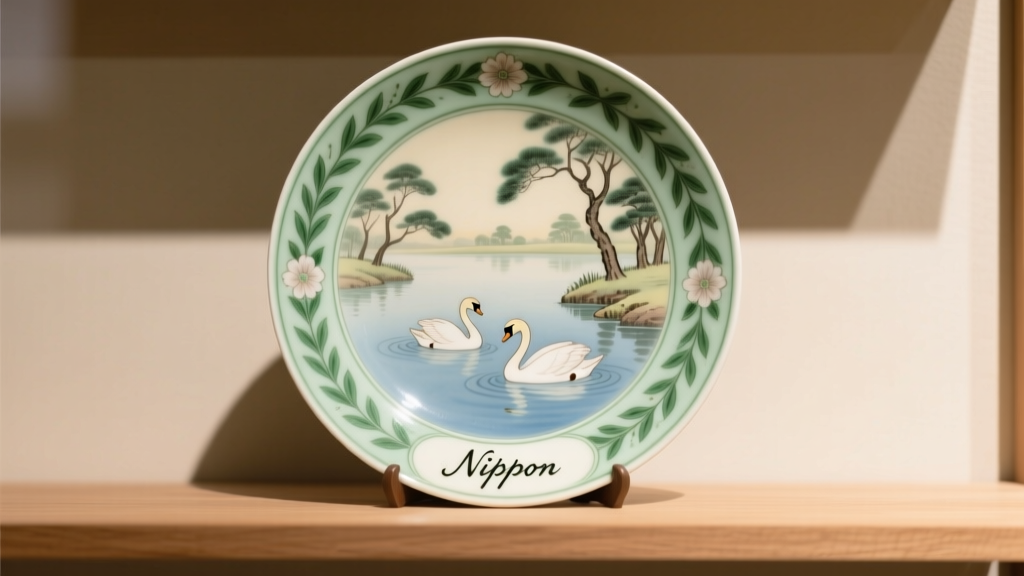
Nippon Plaque: Swans, Trees, and Pond Scene — Decoding the Bisque Green Wreath Mark on a 10-Inch Japanese Porcelain Wall Plaque
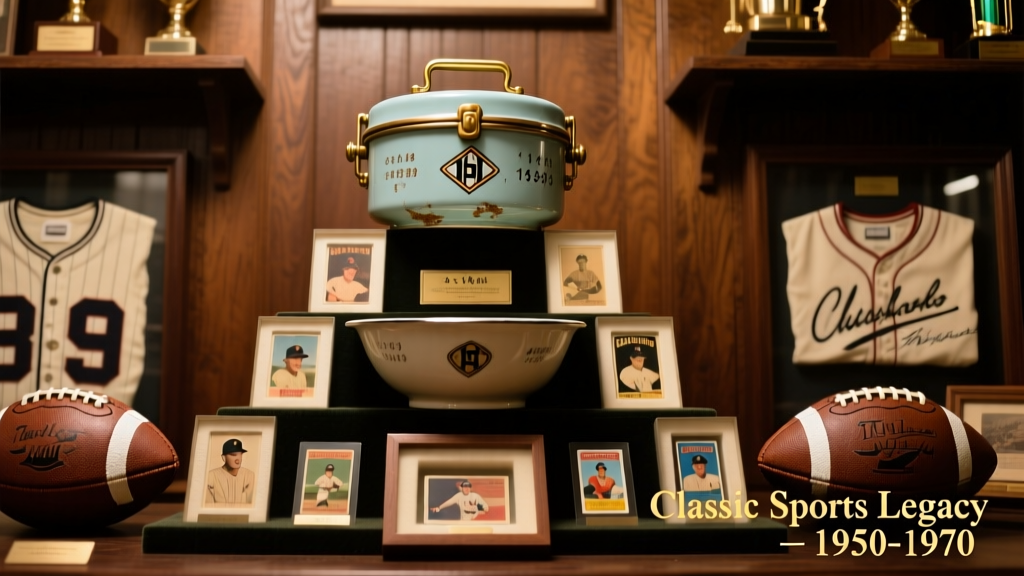
Tiffin Bowl Cascade 8 × 14 Inch: Authenticity, Provenance, and Collectibility in Vintage Kitchenware
The Watch Fob: History, Anatomy, Authentication, and Collecting Value
The 14K White Gold Pince-Nez Folding Bifocal: A Collector’s Guide to Rarity, Craftsmanship, and Authentication

The 1140439: Decoding the Iconic Rawlings Pro Preferred Baseball Glove Model
Gaudy Dutch Plate: Decoding the Dove Pattern in 8 1⁄4-Inch Six-Piece Place Settings
Bing & Grøndahl Christmas Plates: A Collector’s Guide to Danish Porcelain Tradition
Dresden Bowl with Floral Lattice Handles: Authentication, History, and Collector’s Value of the 9-Inch Variant
Redware Jar, Oval, Mottled Green to Olive Green, c. 1800 — A Detailed Provenance and Authentication Study