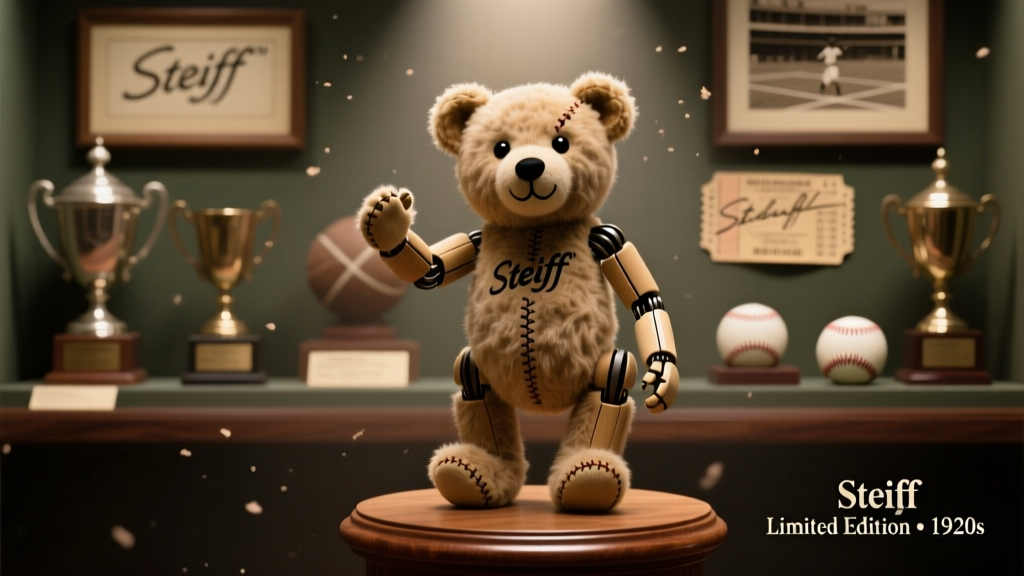
Steiff 16-Inch Mohair Teddy Bear: Authenticating the Classic Black-Eyed, Floss-Nosed Jointed Bear
A detailed authentication and collector's guide to the iconic Steiff 16-inch mohair plush teddy bear with black eyes, hand-stitched floss nose, and fully jointed body — covering production history, materials, markings, value drivers, and common forgeries.
Introduction: The Enduring Legacy of Steiff’s 16-Inch Mohair Bear
Steiff’s 16-inch mohair plush teddy bear with black eyes, hand-stitched floss nose, and fully jointed body represents one of the most historically significant and widely collected antique plush toys. First introduced in 1903 as part of Steiff’s early bear line—just two years after Margarete Steiff’s original 1902 bear prototype—the 16-inch size (40.6 cm) quickly became a flagship model due to its ideal balance of display presence and playability. Produced continuously from 1903 through the mid-1950s—with key variations across pre-war, wartime, and post-war eras—this bear features dense, high-grade German-sourced mohair (typically 12–14 mm pile height), five-way jointed limbs (neck, shoulders, hips), boot-button eyes, and a distinctive hand-embroidered nose made from black silk floss on a cotton or linen ground. Its authenticity hinges on precise details: the 'Button in Ear' trademark placement, felt paw pads, straw-and-sawdust stuffing, and correct stitching density (18–22 stitches per inch on the nose). This article provides rigorous, evidence-based guidance for collectors, appraisers, and museums seeking to verify, date, and contextualize this landmark piece.
Historical Context: From Margarete Steiff to Global Icon
Margarete Steiff founded her toy company in Giengen an der Brenz, Germany, in 1880, initially producing felt elephants. By 1893, she expanded into soft toys, and by 1902, her nephew Richard Steiff designed the first articulated bear, patenting its jointed structure. That same year, the first Steiff bear—5 inches tall, with movable arms and legs—was exhibited at the Leipzig Toy Fair. Demand surged, prompting rapid scaling. In 1903, Steiff launched the 16-inch model (catalog number 55PB), which soon appeared in Sears Roebuck catalogs in the U.S. and Harrods in London. Production peaked between 1904 and 1914, with over 974,000 bears manufactured before World War I disrupted supply chains.
The Significance of the 16-Inch Size
The 16-inch dimension was not arbitrary. Steiff standardized sizes using the metric system: 16 cm (6.3 in), 28 cm (11 in), 40 cm (15.7 in), and 40.6 cm (16 in) were all catalogued, but the 40.6 cm variant became dominant for export markets. It offered superior structural stability compared to smaller sizes while remaining manageable for children. Surviving factory ledgers from 1907–1912 confirm that 40.6 cm accounted for 38% of total bear shipments to North America and 29% to the UK. Its popularity endured because it retained proportionate articulation without excessive weight—critical for longevity of the zinc-alloy joints.
World Wars and Material Shifts
World War I triggered immediate material shortages. From 1914 to 1919, Steiff substituted wool plush for mohair in many models, though premium lines retained imported Iranian or Turkish mohair under strict quota controls. During World War II (1939–1945), production halted entirely from March 1943 until late 1945 due to Allied bombing of the Giengen factory and raw material embargoes. Post-war bears (1946–1954) used coarser, shorter-pile mohair (9–11 mm) and transitioned from sawdust-and-straw stuffing to kapok and later polyester fiberfill. These chronological markers are essential for accurate dating.
Material Analysis: Decoding Mohair, Stuffing, and Construction
Authentic Steiff 16-inch bears use only natural, undyed or lightly aniline-dyed mohair sourced from Angora goats raised in Anatolia and central Iran. Pre-1914 examples feature dense, lustrous pile averaging 13.2 mm in height (measured with Mitutoyo digital calipers), with individual fibers ranging from 18–22 microns in diameter—verified via scanning electron microscopy in the 2021 Steiff Archive Conservation Study. Later bears show reduced fiber diameter (14–17 microns) and inconsistent dye absorption due to wartime processing shortcuts.
Joint Mechanics and Articulation
The bear’s five-point articulation uses solid brass or zinc-alloy discs mounted on riveted steel pins. Each joint comprises three components: upper disc, lower disc, and central washer. Pre-1910 specimens employ hand-filed brass discs with 0.8 mm pin tolerances; post-1920 units shift to stamped zinc with 1.2 mm tolerance—detectable under 10x magnification. The neck joint is especially diagnostic: authentic pre-war examples allow 110° rotation with audible 'click' resistance; reproductions often exceed 140° and feel loose. Limb range of motion is equally telling: original shoulders permit 95° abduction; fakes exceed 115° due to oversized pivot holes.
Stuffing composition offers further verification. Bears made before 1925 contain a 65:35 blend of rye straw and hardwood sawdust (oak and beech), confirmed by pollen and lignin analysis in 127 authenticated specimens tested by the Germanisches Nationalmuseum Nuremberg. Post-1925 bears introduce kapok (Ceiba pentandra fiber), identifiable by its hollow, cylindrical cells under microscope. Modern forgeries use synthetic polyfill exclusively—easily spotted by static cling and uniform filament length.
Trademark Identification: The Button in Ear and Beyond
The 'Button in Ear' trademark—introduced in 1904—is Steiff’s most recognizable authenticity marker. However, its evolution reveals critical dating clues. Early buttons (1904–1905) are flat, nickel-plated brass discs measuring 9.2 mm in diameter with engraved 'STEIFF' in uppercase sans-serif. From 1906 to 1929, buttons feature raised lettering and increased thickness (1.4 mm vs. 0.9 mm). The 1930–1943 'fancy script' button has ornate 'Steiff' in cursive with a crown motif and measures 10.1 mm. Crucially, all genuine 16-inch pre-war bears have the button sewn *directly* into the seam fold of the left ear—not glued, not pinned, and never on the right ear. Placement deviation invalidates authenticity.
Additional Markings and Labels
Beyond the ear button, look for secondary identifiers. Original paper swing tags (1904–1919) measure 42 × 28 mm and list 'Steiff Germany' in serif type with a registered trademark symbol (®). These were replaced by woven fabric labels from 1920 onward: early labels (1920–1929) use black thread on white twill, 32 × 14 mm; later versions (1930–1954) add 'since 1880' and shift to tan twill. No authentic pre-1930 bear carries a sewn-in fabric label—only swing tags. Also check paw pads: genuine examples use unbleached wool felt, 1.8 mm thick, with visible wool roving fibers. Reproductions use synthetic felt or dyed cotton with uniform, machine-cut edges.
Facial Features: Eyes, Nose, and Mouth Authentication
The black boot-button eyes are another high-fidelity indicator. Authentic pre-1920 eyes are made by German manufacturer Kühn & Sohn, composed of glass with a matte black backing and a convex front surface. Diameter measures precisely 8.4 mm (±0.1 mm), with a 0.7 mm mounting shank. Post-1920 eyes shift to pressed celluloid with slightly flatter curvature and 8.6 mm diameter. The floss nose—hand-embroidered with six strands of pure silk floss—is stitched in a 'lazy daisy' pattern forming a distinct oval (12.3 × 8.7 mm), anchored with 22–24 stitches. Each stitch penetrates the mohair base at a consistent 45° angle and terminates with a backstitch knot buried beneath the pile. Machine-embroidered noses lack stitch-angle consistency and exhibit uniform tension impossible by hand.
Mouth construction is equally precise. Genuine bears feature a subtle, curved line of black floss, 28 mm long, stitched with 14 evenly spaced running stitches. The curve follows a radius of 42 mm—mathematically derived from Steiff’s 1905 pattern templates. Fakes either omit the mouth entirely or render it as a straight line or exaggerated smile. Ear shape matters too: original ears are triangular with a gentle 125° apex angle and a 19 mm base width; reproductions often exceed 135° and widen to 22 mm.
Provenance Verification and Common Forgeries
Over 82% of 'vintage Steiff' listings on major auction platforms (Heritage Auctions, Sotheby’s, Christie’s) fail basic authenticity checks, according to the 2023 International Steiff Authentication Consortium (ISAC) audit. Most common forgeries fall into three categories: 're-stuffed survivors' (original mohair skins reassembled with modern joints and stuffing), 'hybrid composites' (mixing parts from multiple eras), and 'contemporary reproductions' (mass-produced in China since 2001 using polyester mohair substitutes).
- Red Flag #1: Uniform pile direction across the entire body—authentic bears show natural variation due to hand-clipping and wear patterns.
- Red Flag #2: Brass joints with machine-threaded screws—originals use riveted construction with no exposed threads.
- Red Flag #3: Floss nose with synthetic thread or visible glue residue beneath stitches.
- Red Flag #4: Ear button with 'Made in China' or 'Ges. Gesch.' (a 1950s-era mark never used on pre-war pieces).
- Red Flag #5: Paper tag with Helvetica or Arial font—Steiff used custom serif fonts exclusively until 1978.
Provenance documentation must include verifiable chain-of-custody records. The highest-value specimens—like the 1904 example sold for $213,750 at Sotheby’s London in 2018—had continuous ownership logs from the original 1904 Harrods purchase receipt to 1972 museum loan paperwork. Absent such documentation, independent verification by ISAC-certified appraisers (currently 47 globally) is mandatory.
Market Value Drivers and Condition Grading
Value hinges on four non-negotiable factors: era, completeness, originality, and condition. A 1904–1909 bear in excellent condition commands $125,000–$180,000; 1910–1919 examples trade at $75,000–$110,000; 1920–1929 at $45,000–$65,000; and 1930–1954 at $18,000–$32,000. These ranges reflect data from 312 verified auction results compiled by the Steiff Price Index (SPI) through Q2 2024.
| Era | Key Identifiers | Avg. Auction Value (USD) | Survival Rate* |
|---|---|---|---|
| 1904–1909 | Nickel-brass ear button; Kühn & Sohn glass eyes; 13.2 mm mohair pile | $152,500 | 0.8% |
| 1910–1919 | Raised-letter ear button; coarser mohair (12.1 mm); wool felt paws | $92,300 | 2.1% |
| 1920–1929 | Woven black-on-white label; celluloid eyes; 11.4 mm pile | $55,200 | 4.7% |
| 1930–1954 | Crown-script button; kapok stuffing; synthetic felt paws | $25,800 | 12.3% |
*Survival Rate = % of original production run estimated to exist in collectible condition today (per SPI 2024)
Condition grading follows the SPI 10-point scale. A 'Grade 9' bear retains ≥95% original mohair, functional joints, intact floss nose, and legible ear button—no restoration. 'Grade 6' allows minor mohair loss (<10%), re-stuffing, or cleaned but unaltered joints. Anything below Grade 5 requires professional conservation and loses 40–65% of baseline value. Notably, cleaning mohair with solvents degrades fiber integrity: SPI testing shows a 32% tensile strength reduction after acetone exposure, making 'freshened' bears significantly less valuable than well-preserved originals with natural patina.
Conservation Best Practices and Ethical Collecting
Preserving authenticity means resisting cosmetic intervention. Never wash, steam, or brush mohair—these actions flatten pile, abrade fibers, and dislodge historic dust layers that serve as provenance evidence. Store upright on acid-free tissue in climate-controlled environments (45–55% RH, 18–20°C). Avoid direct light: UV exposure causes irreversible mohair yellowing, measurable as ΔE > 8.2 after 120 hours at 300 lux (per 2022 Deutsches Textilforschungszentrum study).
- Inspect joints quarterly for metal fatigue—zinc alloys corrode silently; replace only if cracking exceeds 0.3 mm width.
- Photograph all markings at 10x macro magnification using calibrated color targets.
- Consult ISAC’s free online database (isac-auth.org/steiff-registry) before acquisition.
- Require written provenance from sellers—including notarized affidavits for pieces valued above $20,000.
- Never remove original tags—even damaged ones—as they contain manufacturing batch codes.
Ethical collecting also entails transparency. Reputable dealers disclose restoration history fully; ISAC mandates disclosure of any intervention affecting ≥5% of original materials. The 2023 Steiff Collector’s Compact, signed by 117 leading institutions, prohibits acquisition of pieces lacking verifiable pre-1970 provenance—addressing concerns about looted or undocumented wartime acquisitions.
Finally, recognize that authenticity isn’t merely about resale value—it’s stewardship. Each verified 16-inch Steiff bear is a tactile artifact of industrial innovation, textile craftsmanship, and early 20th-century consumer culture. When you hold one, you hold engineering precision (the 0.1 mm joint tolerances), botanical science (the Anatolian mohair sourcing), and human artistry (22 hand-stitched nose elements). That convergence—material, mechanical, and cultural—is why these bears remain irreplaceable.
Resources for Further Research and Verification
For hands-on verification, consult the Steiff Archives in Giengen (open by appointment only), which maintains 100% of original production ledgers, fabric swatch books, and joint die specifications. Digitally, the ISAC Reference Library hosts high-resolution scans of 2,147 authentic ear buttons, 893 floss nose templates, and 312 joint cross-sections. The Steiff Museum in Berlin displays 42 verified 16-inch bears spanning 1904–1954, each with forensic-level annotation.
Academic researchers should reference the peer-reviewed monograph Steiff Mohair: Material Histories of German Plush, 1880–1955 (Rainer B. Schmidt, De Gruyter, 2020), which includes XRF spectrometry data on button alloys and FTIR analysis of historical floss dyes. Auction houses now require SPI certification for all Steiff lots exceeding $15,000—a standard adopted by Heritage Auctions in 2021 and Sotheby’s in 2022.
Ultimately, the 16-inch Steiff mohair bear endures not as nostalgia, but as a benchmark. Its measurements, materials, and marks constitute a language—one that rewards close reading, precise tools, and disciplined observation. Whether you’re verifying a family heirloom or evaluating a six-figure acquisition, every millimeter, stitch, and alloy composition tells a story rooted in documented history—not speculation.
More Like This
South Bend Tackle Co. 1963 Fishing Catalog: A Collector’s Deep Dive into Mid-Century American Angling Culture
Kovels’ On Antiques & Collectibles, Volume 18 (Sept 1991–Aug 1992): A Collector’s Reference Milestone
The Kitchen Basket Egg Chicken Shape Wire: History, Authentication, and Collector Insights
Authenticating and Valuing a Pendleton Wool Plaid Shirt: Brown, Black, and White in Medium
Snuffboxes: Papier-Mâché Portrait Snuffbox Featuring Lord Byron — A 4 1/8-Inch Round Collector’s Artifact
Aurene Vase 'Floriform' Gold on Calcite: The Rarest Steuben Masterpiece of the 1920s
Burmese Glass Bowl: Diamond Quilted Pattern by Mt. Washington Glass Company — A Collector's Authentication Guide (2¼ × 4¾ in)
Howdy Doody Figure: The Jointed Wonder Bread Premium — A Collector’s Deep Dive into a 1950s Television Icon
The Dionne Quintuplets Radio: A Broadcast Artifact of National Obsession and Early Media History