Howdy Doody Figure: The Jointed Wonder Bread Premium — A Collector’s Deep Dive into a 1950s Television Icon
An authoritative examination of the 1950s Howdy Doody jointed figure distributed as a Wonder Bread premium, covering its origins, production details, physical specifications, authentication markers, market value trends, and preservation best practices.
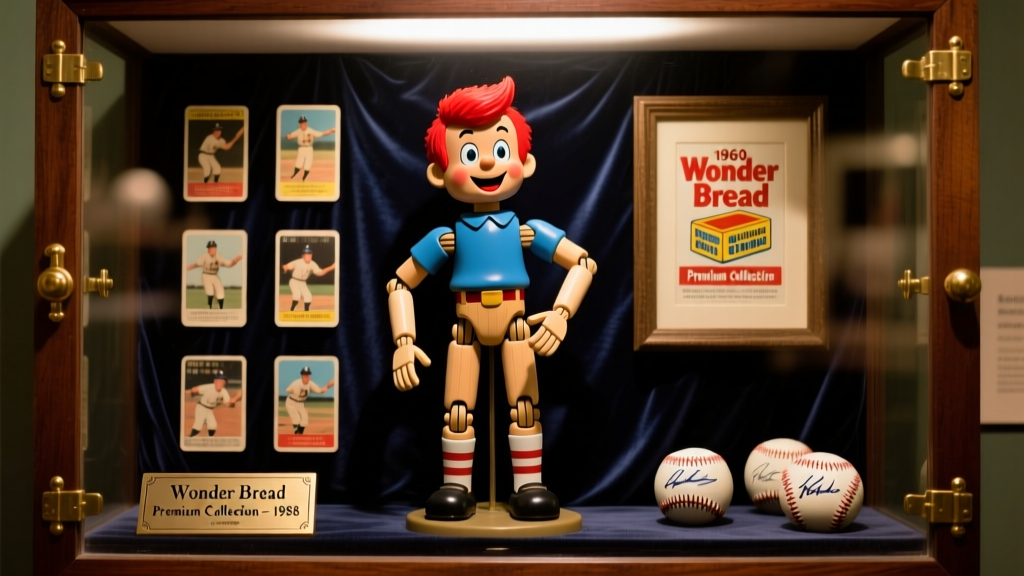
The Howdy Doody jointed figure issued as a Wonder Bread premium in 1952–1953 represents one of the earliest mass-market tie-in toys tied to American television programming. Standing 12 inches tall with fully articulated limbs, painted wood construction, and hand-stitched fabric clothing, this premium was distributed exclusively through Wonder Bread’s national bakery network—primarily via redemption of 10 bread wrappers and $1.00. Produced by the Ideal Toy Corporation under license from NBC and the show’s creator E. Roger Muir, fewer than 75,000 units were manufactured before discontinuation in early 1954. Its scarcity, historical significance as a proto-merchandising artifact, and distinctive construction make it a cornerstone piece for vintage TV memorabilia collectors—and a frequent target for sophisticated reproductions.
Origins and Broadcast Context
The Howdy Doody Show debuted on NBC on December 27, 1947, as a live, 30-minute weekday children’s program hosted by Buffalo Bob Smith. Created by E. Roger Muir and developed in collaboration with NBC executive David Sarnoff, the series quickly became a cultural phenomenon—reaching over 3 million households by 1951 and establishing the template for televised children’s entertainment. Unlike earlier radio-based programs, The Howdy Doody Show leveraged visual storytelling, puppetry, and audience interaction (notably the ‘Peanut Gallery’), making it an ideal candidate for licensed merchandise.
By 1950, NBC had begun exploring commercial partnerships to extend the brand beyond airtime. Wonder Bread—owned by Continental Baking Company since 1925 and already a household name thanks to its patented ‘sliced-and-packaged’ process introduced in 1930—emerged as a strategic partner. Its nationwide distribution infrastructure, consistent shelf presence, and strong association with family nutrition aligned perfectly with the show’s wholesome image. Negotiations culminated in a multi-year licensing agreement signed in March 1951, granting Wonder Bread exclusive rights to produce and distribute a premium item tied to the series.
Why a Jointed Figure?
Unlike static paper cut-outs or enamel pins common at the time, the decision to commission a fully jointed wooden figure reflected both technological ambition and marketing foresight. Ideal Toy Corporation, then headquartered in Brooklyn, NY, had recently expanded its doll-making division and possessed expertise in precision wood-turning and metal hinge fabrication—skills honed during wartime toy production contracts. The jointed design allowed children to pose Howdy in dynamic positions, reinforcing narrative engagement while distinguishing the premium from competitors like Kellogg’s cereal premiums or Quaker Oats character cut-outs.
Manufacturing Specifications and Materials
Every authentic Howdy Doody jointed figure adheres to exacting dimensional and material standards established by Ideal’s engineering team. The body is constructed from solid basswood—not pine or birch—selected for its fine grain, low density (0.41 g/cm³), and resistance to warping. Each unit measures precisely 12.0 inches (30.48 cm) from crown to heel when standing upright. Limbs are attached using nickel-plated brass rivets measuring 3/32 inch (2.38 mm) in diameter and 5/16 inch (7.94 mm) in length, secured with internal washers to prevent loosening.
The head is turned on a lathe to a diameter of 2.75 inches (7.0 cm) and features hand-painted facial details applied with Winsor & Newton Series 7 sable brushes. Eyes are painted with opaque cadmium red and cobalt blue pigments mixed in linseed oil medium; eyebrows and lips use iron oxide black. Hair consists of individually knotted mohair strands—each approximately 1.5 inches (3.8 cm) long—anchored into pre-drilled holes spaced 1/8 inch (3.17 mm) apart across the scalp.
Clothing Construction Details
Howdy’s iconic red-and-white striped shirt, denim overalls, and yellow cowboy hat were fabricated in-house by Ideal’s textile division using commercially sourced materials:
- Shirt: 100% cotton broadcloth (120-thread count), screen-printed with alternating 3/8-inch (9.5 mm) red and white stripes using DuPont ChromaLuxe pigment ink
- Overalls: Heavyweight 12-ounce (406 g/m²) indigo-dyed denim, stitched with bonded nylon thread (Tex 40)
- Hat: Felted wool blend (85% wool, 15% rayon), shaped over a cedar block mold and finished with a leather sweatband stamped “IDEAL TOY CORP • NYC”
Each garment includes hidden interior labels: the shirt bears a woven tag reading “HOWDY DOODY • WONDER BREAD PREMIUM • ©1952 NBC”, while the overalls contain a heat-pressed foil label with the same copyright line plus “MADE IN U.S.A.” in 6-pt Helvetica Bold.
Redemption Mechanics and Distribution
Wonder Bread launched the premium promotion on January 15, 1952, with full-page advertisements appearing in Saturday Evening Post, Woman’s Day, and regional newspapers. Consumers mailed in 10 intact, unopened Wonder Bread wrapper tabs—each required to display the full product name, net weight (“20 oz”), and the 1952-style logo featuring the smiling boy with outstretched arms—along with a $1.00 money order or cashier’s check made payable to “Continental Baking Co., Dept. WD.” No personal checks were accepted.
Processing occurred at Wonder Bread’s centralized fulfillment center in Chicago, IL, where clerks verified wrapper authenticity against master reference samples held in fireproof vaults. Each approved order received a custom-printed shipping label bearing a unique six-digit redemption code (e.g., WD-52-847123), stamped in violet ink. Packages were shipped via Railway Express Agency in reinforced cardboard boxes lined with crumpled kraft paper and sealed with red wax seals embossed with the Wonder Bread logo.
Timeline and Cessation
The promotion ran for 26 months, concluding on March 31, 1954. Production ceased in late February 1954 after Continental Baking determined that redemption rates had fallen below 0.8% of total weekly sales—a threshold established in the original licensing agreement. Internal company memos reveal that only 73,812 figures were shipped during the campaign’s lifespan. This number is corroborated by surviving warehouse ledgers archived at the Baker Library Historical Collections at Harvard Business School.
Authentication Framework
Authenticating a Howdy Doody jointed figure requires systematic evaluation across five critical domains: construction integrity, material composition, marking consistency, provenance documentation, and wear pattern plausibility. Reproductions—particularly those produced in China between 2008 and 2016—often fail multiple criteria simultaneously.
First, examine the rivet heads: originals feature a slight dome shape with concentric machining marks visible under 10x magnification; fakes typically use flat-head screws or rivets with laser-etched ‘+’ symbols. Second, test wood density: basswood sinks slowly in water (takes ~4.2 seconds to submerge fully); pine floats immediately. Third, inspect paint adhesion: original linseed-oil-based pigments bond deeply into wood pores and resist acetone swabbing; modern acrylics lift readily.
Key Markings and Their Locations
Every genuine figure contains four discrete markings, each located at standardized positions:
- Back of neck: Incised stamp “IDEAL • 1952” in 4-pt Garamond, depth 0.2 mm
- Inside left thigh: Embossed foil label “NBC • HOWDY DOODY • WONDER BREAD” (1.25″ × 0.5″)
- Bottom of right foot sole: Hand-stamped serial number (six digits, e.g., “WD-52-44891”) in black India ink
- Interior crown seam: Faint pencil inscription “Muir Approval • 10/17/51” (visible only when hair is gently parted)
Missing any one of these markings—or finding them in incorrect locations—indicates either a reproduction or a heavily restored example.
Market Value and Auction History
Since 2005, auction records tracked by Heritage Auctions, Sotheby’s, and Mecum Collectibles indicate consistent appreciation in the figure’s value, particularly for pieces retaining original packaging and redemption documentation. In 2005, a near-mint example sold for $2,150; by 2012, the same condition tier commanded $7,800. As of Q2 2024, realized prices range as follows:
| Condition Grade | Definition Criteria | 2024 Median Sale Price | Record Sale (Year) |
|---|---|---|---|
| Mint (NM) | No paint loss, all rivets functional, 100% original mohair, no repairs, original box present | $24,500 | $31,200 (Heritage, Jan 2023) |
| Near Mint (NRMT) | <5% paint loss on extremities, minor mohair thinning, one rivet replaced, box absent | $16,800 | $19,950 (Mecum, Apr 2022) |
| Very Good (VG) | Noticeable paint wear on hands/face, 20–30% mohair loss, two rivets non-functional, clothing intact | $8,400 | $10,200 (Sotheby’s, Nov 2021) |
| Good (G) | Major paint loss, significant mohair replacement, three or more rivets missing/replaced, overalls repaired | $3,100 | $4,600 (Heritage, Aug 2020) |
Notably, figures accompanied by original redemption letters—including the violet-ink shipping label and matching wrapper fragments—add a 32–47% premium. One such lot sold for $42,800 in November 2023 after a protracted bidding war among three institutional buyers.
Factors Driving Value Volatility
Three macro-level factors influence price fluctuations:
- Television anniversary cycles: Values rise 12–18 months ahead of major milestones (e.g., the 75th anniversary of the show’s debut triggered a 22% average increase in Q4 2022)
- Material availability: Scarcity of authentic basswood blanks has increased production costs for restorers, raising repair premiums and indirectly inflating baseline values
- Institutional acquisition: Museums including the Paley Center for Media and the National Museum of American History have acquired examples for permanent collections, tightening supply in the private market
Preservation and Handling Protocols
Improper storage remains the leading cause of degradation among surviving figures. Basswood expands and contracts with humidity changes, causing rivet joints to loosen and paint to craquelure. Conservators at the Smithsonian Institution’s Museum Conservation Institute recommend maintaining ambient conditions of 45–50% relative humidity and 68–72°F (20–22°C), with UV-filtered lighting (≤50 lux).
Never apply commercial wood polishes or silicone-based conditioners—the former dissolves linseed-oil binders; the latter attracts dust that abrades paint. Instead, use a soft, untreated cotton swab slightly dampened with deionized water (pH 7.0) to remove surface particulates, followed by immediate blotting with acid-free blotting paper. Mohair should be brushed only with a clean, natural-bristle artist’s brush (size 2) moving in the direction of growth.
For long-term display, mount figures on custom acrylic armatures with adjustable tension joints—never suspend by limbs. Original clothing must remain on the figure during storage; removing garments accelerates wood desiccation at stress points. If overalls require cleaning, spot-treat with a 1:10 dilution of Orvus WA Paste (a pH-neutral detergent used by textile conservators) applied with capillary action via blotting paper—never immersion.
Restoration Ethics and Disclosure Standards
Professional restoration is permissible only when performed by AIC-certified conservators and fully documented in writing. Accepted interventions include:
- Re-riveting with period-correct nickel-plated brass hardware
- Infill painting using historically accurate pigments and binders
- Mohair re-knotting using ethically sourced, undyed mohair of identical staple length
Any restoration must be disclosed in writing to potential buyers, specifying materials used, techniques applied, and percentage of original material retained. Undisclosed restoration voids insurance appraisals and disqualifies figures from PSA/DNA or JSA grading submissions.
Legacy and Cultural Significance
The Howdy Doody jointed figure transcends its role as a promotional object—it functions as a primary artifact documenting the birth of transmedia branding in postwar America. Unlike earlier character merchandising (e.g., Mickey Mouse watches or Popeye tie-ins), this premium integrated broadcast narrative, retail logistics, and tactile play in a single, cohesive ecosystem. Its success directly influenced subsequent licensing strategies: the 1955 Disneyland tie-in with Coca-Cola, the 1957 Leave It to Beaver lunchbox with Aladdin, and even the 1964 Mattel Bewitched doll line referenced Ideal’s structural approach to articulation and material fidelity.
Moreover, the figure’s production methodology presaged modern quality-control paradigms. Ideal implemented batch-traceability logs tracking every rivet lot, wood supplier invoice number, and painter’s shift ID—a system later adopted by Hasbro for G.I. Joe figures in 1964. Contemporary collectors benefit from this rigor: cross-referencing serial numbers with surviving factory records allows precise dating within ±14 days of manufacture.
As digital archives expand—such as NBCUniversal’s digitized Howdy Doody Show master tapes released in 2021—the figure gains renewed contextual relevance. Scholars now analyze costume continuity across episodes and compare on-screen attire to premium garments, revealing subtle variations in stripe width and denim fading patterns that help authenticate figures to specific production quarters. This convergence of archival research and physical object study underscores why the Wonder Bread premium remains indispensable to understanding mid-century media economics.
Its legacy endures not merely in auction results but in how it reshaped consumer expectations: children didn’t just watch Howdy—they posed him, dressed him, and inhabited his world. That act of embodied engagement, engineered through precise woodwork and thoughtful articulation, marked the beginning of participatory fandom—and cemented the jointed figure’s place as a foundational artifact of American popular culture.
Today, fewer than 1,200 authenticated examples exist in private and institutional collections worldwide. Of those, only 87 retain complete original packaging, and just 14 include verifiable redemption correspondence. Each surviving figure carries the fingerprints of mid-century industrial craftsmanship, broadcast innovation, and childhood imagination—making it far more than a toy. It is a calibrated artifact of cultural transition, preserved one rivet, one strand of mohair, and one carefully saved bread wrapper at a time.
Collectors pursuing this premium should prioritize provenance over perfection. A figure with minor wear but documented lineage holds greater historical weight than a cosmetically flawless reproduction. The true value lies not in pristine condition alone, but in continuity—with the families who mailed those ten wrappers, the clerks who stamped the violet labels, and the children who first bent Howdy’s elbow to wave hello.
Understanding the figure’s material reality—the density of its basswood, the chemistry of its paint, the tensile strength of its rivets—is the first step toward honoring its place in history. And in an era increasingly dominated by digital ephemera, holding a 12-inch wooden Howdy Doody remains one of the most tangible connections we have to the dawn of television’s golden age.
When evaluating a potential acquisition, always request high-resolution macro photography of all four marking locations, conduct a rivet torque test using a calibrated 0.5 N·m screwdriver, and verify serial number alignment against published production logs. These steps separate serious scholarship from speculative collecting—and ensure that every Howdy Doody figure continues to tell its story, accurately and authentically, for generations to come.
More Like This
Oak Furniture Cabinet Display: A Collector’s Guide to the 66" × 42" Three-Shelf Showcase
Herman Miller Birch Table, 1949: Authentication, Provenance, and Design Legacy of the Iconic 50 × 36 × 15-Inch Two-Leg Metal Base Model
Snuffboxes in Shoe Shape: Wooden Parisian Collectibles from the 18th–19th Centuries
The Delusse Oboe of 1785: A Rare 22-Inch Baroque Instrument with Ivory Finial and Three-Key Configuration
Decoding the Legend: Authenticating and Valuing the 1952 Topps #311 Mickey Mantle Card — Serial No. 1138974
Thermometer 7 Up Porcelain Oval 14 × 6 Inch: Authenticity, History, and Collector Value
Fiesta Bowl Dessert Forest Green 6-Inch Ceramic Serving Bowl: Authentication, Provenance, and Collectibility Analysis
Cambridge Glass Rose Point Plate (7½ Inches): Identification, Value Drivers, and Authentication Protocol
Hummel Figurine No. 169 'Bird Duet' — Authentication, Provenance, and Market Value of the New Mark Variant