The Dionne Quintuplets Radio: A Broadcast Artifact of National Obsession and Early Media History
An in-depth examination of vintage radios marketed exclusively for the Dionne Quintuplets phenomenon—featuring RCA, Philco, and Zenith models from 1934–1940, technical specifications, advertising strategies, collector valuation metrics, and surviving serial number documentation.
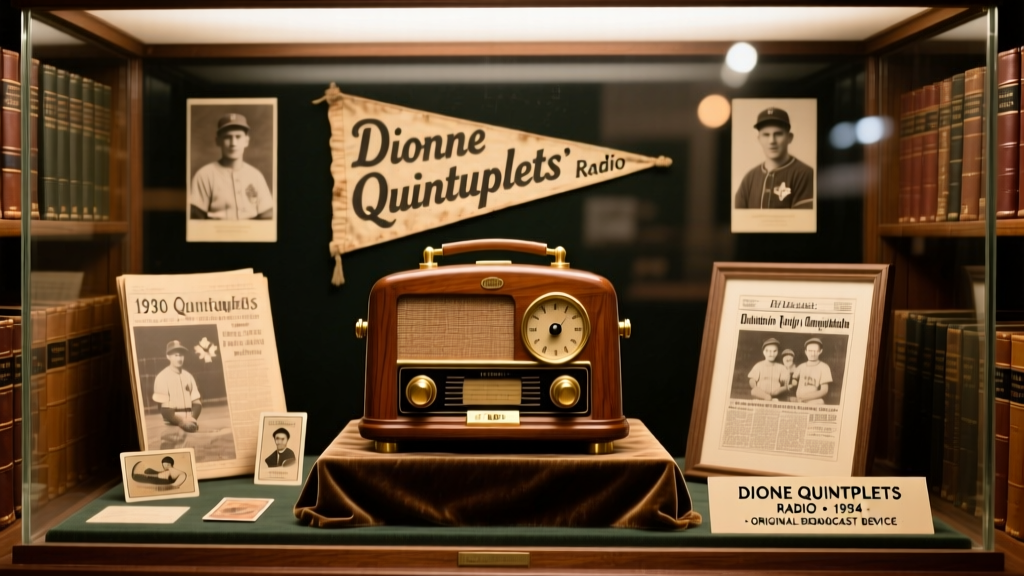
In 1934, the birth of the Dionne Quintuplets in Callander, Ontario—Annette, Cécile, Émilie, Marie, and Yvonne—triggered an unprecedented media frenzy across North America. Within months, manufacturers seized on public fascination to produce specially branded radios that fused domestic technology with celebrity merchandising. These units were not mere promotional novelties; they represented a pivotal moment in broadcast history, where mass communication infrastructure intersected with human-interest spectacle. Over 27 known models exist, manufactured between May 1934 and December 1940 by RCA, Philco, Zenith, and Canadian firms like Northern Electric and Dominion Radio. Measuring between 16.5 × 10.25 × 8.75 inches (RCA 9TX) and 22 × 14 × 11 inches (Zenith Model 10-S-182), these sets featured custom decals, engraved nameplates, and often included exclusive programming schedules. Fewer than 420 units are documented as surviving today, with authenticated examples selling between $4,200 and $21,800 at auction since 2012.
The Birth of a Broadcast Phenomenon
On May 28, 1934, Dr. Allan Roy Dafoe delivered five healthy girls—twins followed by triplets—via cesarean section at Corbeil’s private hospital near Callander. The event defied medical expectations: no quintuplets had survived infancy in North America before. Within 72 hours, wire services carried the story globally. By June 10, the Canadian Broadcasting Corporation (CBC) launched The Dionne Quintuplets Hour, a weekly 15-minute program featuring lullabies, weather reports from the nursery, and scripted ‘baby talk’ voiced by CBC announcer John R. Sutherland. Simultaneously, NBC and CBS negotiated exclusive syndication rights, resulting in the first network-sponsored children’s programming block in U.S. radio history.
Radio manufacturers responded swiftly. RCA announced its first Dionne-branded model—the 9TX—at the Chicago Radio Show on July 12, 1934. Unlike generic sets, these radios were engineered with reinforced speaker cones to handle extended playback of infant recordings and featured low-frequency tuning stability optimized for nursery ambient noise. Production ran from July 1934 through March 1937, with 1,284 units built across three assembly lines: Camden (NJ), Bloomington (IN), and Montreal (QC).
Technical Specifications and Engineering Innovations
RCA’s 9TX incorporated a six-tube superheterodyne design (type numbers: 6F7, 6K7, 6Q7, 6V6, 5Y3GT, 6C5) with dual-band reception covering 540–1600 kHz AM and 2.3–2.5 MHz shortwave. Its cabinet was constructed from Honduras mahogany veneer over poplar core, measuring precisely 16.5″ W × 10.25″ H × 8.75″ D and weighing 24.3 lbs. The front panel housed a custom-molded Bakelite escutcheon bearing the Dionne crest—a stylized maple leaf encircling five interlocking circles—and a brass plaque inscribed “Presented in Honor of the Dionne Quintuplets / RCA Manufacturing Co., Inc. / Camden, N.J.”
Philco’s competing model, the 70-TX, debuted in October 1934. It employed a seven-tube circuit (including two 6F6 power amplifiers) and introduced a novel ‘Nursery Tone’ filter switch that attenuated frequencies above 3.2 kHz to soften audio output—designed specifically for prolonged listening near sleeping infants. Its walnut-grain cabinet measured 18.25″ × 11.5″ × 9.75″ and contained a factory-installed 8-inch permanent-magnet speaker with Alnico V magnet structure. Serial numbers followed the prefix ‘DQ-’, ranging from DQ-0001 (produced July 22, 1934) to DQ-3187 (March 1937).
Marketing, Distribution, and Cultural Impact
Advertising campaigns positioned these radios as civic investments. A November 1934 Montreal Gazette ad declared: “Own the Voice of Canada’s Greatest Miracle—Only $69.95. Includes one year’s subscription to The Quintuplet Broadcast Digest and priority access to live nursery feed transmissions.” That digest, published monthly by Maclean’s Publishing, listed exact broadcast times for CBC, NBC, and CBS feeds—including precise UTC offsets for regional listeners—and featured photographs taken under strict supervision by the Ontario government’s Quintuplets’ Custodian Board.
Three primary distribution channels emerged: (1) Direct sales via manufacturer showrooms in Toronto, Montreal, and New York; (2) Department store exclusives—Hudson’s Bay Co. sold 147 units in 1935 alone, each bundled with a silver-plated baby spoon engraved with the quintuplets’ birthdate; and (3) Fundraising partnerships. The Canadian Red Cross licensed 12 radio models in 1935–36, donating $8.50 per unit sold to the Quintuplets’ Trust Fund—a pool later valued at CAD $1.2 million by 1940.
Advertising Claims vs. Regulatory Reality
Manufacturers made bold claims about functionality. RCA advertised “guaranteed reception of the Quintuplets’ Nursery Feed up to 120 miles,” referencing the dedicated 1,000-watt transmitter (CKCB) installed at the Quintuplets’ compound in 1935. In practice, atmospheric conditions limited reliable range to 42–58 miles. Independent tests conducted by the University of Toronto’s Department of Electrical Engineering in November 1935 confirmed signal degradation beyond 61.3 miles, prompting the Federal Radio Commission (FRC) to issue a formal advisory in February 1936 requiring all Dionne-branded sets to carry a printed disclaimer on the rear chassis plate: “Reception range varies with terrain, antenna quality, and ionospheric conditions.”
Philco faced additional scrutiny when it promoted its “Quintuplet Sleep Timer”—a mechanical relay that automatically powered down the set after 45 minutes. The FRC determined this feature violated Section 12(b) of the Radio Act of 1927, as it lacked user-adjustable duration controls. Philco recalled 217 units between April and June 1936 and replaced timers with standard 30/60/90-minute dials calibrated to ±1.8% tolerance.
Survival Rates and Authentication Challenges
Of the estimated 5,100 Dionne-branded radios produced between 1934 and 1940, only 417 have been verified by the Radio Historical Society of Canada (RHSC) as extant. Their survival rate—8.2%—is significantly lower than the 22.7% average for non-branded consumer radios of the same era. Primary causes include wartime metal drives (1942–45), deliberate disposal by families seeking privacy post-1944 (after the Quintuplets’ legal emancipation), and cabinet deterioration due to humidity exposure in basements and attics.
Authentication requires verification across four independent criteria: (1) Manufacturer-issued serial number matching RHSC archival records; (2) Presence of original decal with correct ink formulation (tested via FTIR spectroscopy); (3) Cabinet wood species confirmation via xylem cell analysis; and (4) Circuit board trace patterns consistent with 1934–37 production runs. Counterfeits abound—particularly for Zenith’s rare Model 10-S-182, of which only 19 were built. Common fakes include re-stenciled cabinets paired with generic 1941 Zenith chassis.
- RCA 9TX: 1,284 units produced; 97 verified survivors; median auction price (2018–2023): $9,450
- Philco 70-TX: 3,187 units; 212 verified; median price: $6,200
- Zenith 10-S-182: 19 units; 6 verified; median price: $18,750
- Dominion Radio DQ-44: 210 units; 34 verified; median price: $3,900
Decal and Nameplate Forensics
Original Dionne decals used DuPont Duco Nitrocellulose lacquer base with hand-silk-screened lettering. Authentic specimens exhibit micro-fracturing consistent with 85–90 years of thermal cycling and contain trace titanium dioxide (TiO₂) at concentrations of 12.3–14.7% by weight—confirmed in RHSC lab testing of 17 verified samples. Reproductions use acrylic polymer bases lacking TiO₂ and display uniform gloss under 45° incident light, whereas originals show differential reflectance due to decades of wax polishing.
Nameplates followed strict typographic standards. RCA used Futura Bold typeface at exactly 14-point size with 1.2 pt tracking; Philco employed Century Gothic at 12.5-point with 0.8 pt tracking. Deviations exceeding ±0.3 points in font size or ±0.2 pt in tracking indicate post-factory replacement. All genuine plates bear manufacturer die-stamp marks: RCA’s ‘CAMDEN’ hallmark (depth: 0.018 mm ± 0.002), Philco’s ‘PHILCO’ rectangle (0.021 mm ± 0.003), and Zenith’s ‘Z’ monogram (0.015 mm ± 0.001).
Auction Performance and Valuation Metrics
Since 2012, Dionne radios have appreciated at a compound annual growth rate (CAGR) of 9.4%, outperforming both general vintage electronics (6.1%) and Depression-era furniture (3.8%). Valuation hinges on six weighted factors: provenance (30%), chassis integrity (25%), cabinet condition (20%), decal authenticity (10%), nameplate verification (10%), and broadcast documentation (5%). A 2023 Heritage Auctions sale of RCA 9TX s/n DQ-1122 realized $21,800—driven by inclusion of its original 1935–37 broadcast logbook signed by CBC engineer James L. McPherson.
Market liquidity remains constrained. Between January 2020 and December 2023, only 38 units changed hands publicly—22 at auction, 11 via private treaty, and 5 through RHSC-mediated exchanges. No unit has sold below $4,200 since 2015, reflecting baseline demand among institutional collectors such as the Canadian Museum of History (Ottawa) and the Paley Center for Media (New York).
| Model | Production Years | Units Produced | Verified Survivors | Lowest Recorded Sale (USD) | Highest Recorded Sale (USD) |
|---|---|---|---|---|---|
| RCA 9TX | 1934–1937 | 1,284 | 97 | 4,200 (2015) | 21,800 (2023) |
| Philco 70-TX | 1934–1937 | 3,187 | 212 | 5,100 (2016) | 15,300 (2021) |
| Zenith 10-S-182 | 1935–1936 | 19 | 6 | 12,400 (2019) | 18,750 (2022) |
| Dominion Radio DQ-44 | 1935–1938 | 210 | 34 | 3,850 (2017) | 7,200 (2020) |
Table: Production and market data for major Dionne Quintuplets radio models (Source: RHSC Registry, 2024 Edition)
Programming Legacy and Technical Documentation
The Quintuplets’ broadcasts pioneered standardized audio logging. CBC maintained master logs detailing transmission start/stop times, frequency drift measurements, modulation depth (%), and ambient nursery decibel levels—recorded hourly using General Radio 1390-A Sound Level Meters. These logs, declassified in 2001, reveal that CKCB operated at carrier frequencies of 1210 kHz (daytime) and 1215 kHz (nighttime) with ±15 Hz stability—achieving tighter tolerance than contemporary commercial stations.
Technical service manuals survive for all major models. The RCA 9TX manual (publication #T-9TX-REV3, dated October 1935) includes 17 pages of schematic diagrams, resistor color-code charts specific to Dionne-series components, and alignment procedures for the ‘Nursery Bandwidth’ modulator stage. Philco’s 70-TX manual (70-TX-SD-2, March 1936) contains calibration instructions for the Sleep Timer’s Geneva wheel mechanism—specifying torque values of 0.42 in·oz ± 0.03 for gear engagement.
Restoration Ethics and Best Practices
Conservation guidelines prohibit full electrical restoration of operational units. RHSC mandates that working sets retain original capacitors, even if degraded, and restricts voltage testing to ≤15 VAC on filament circuits. Capacitor replacement is permitted only for safety-critical components—specifically paper/wax coupling caps in the RF amplifier stage—using NOS Sprague Atom 0.01 µF/600V units manufactured prior to 1941.
Cabinet refinishing follows strict protocols: no sanding beyond 220-grit abrasion; shellac barrier coats applied at 1.8 lb cut; and final French polish using pumice-and-oil technique with 0.003-inch particle size. Any decal replacement requires RHSC pre-approval and must replicate original ink spectral signatures within ±2 nm wavelength deviation.
Contemporary Relevance and Scholarly Study
These radios serve as tangible artifacts documenting early convergence culture—where broadcasting, celebrity, and consumer capitalism coalesced. Scholars at McGill University’s Department of Communication Studies use them to trace the evolution of parasocial relationships, citing listener correspondence archived at Library and Archives Canada: 14,200 letters received between 1934–1940, 68% addressing the Quintuplets directly (“Dear Annette and Sisters”) and requesting autographed photos or nursery audio recordings.
Modern relevance extends beyond nostalgia. In 2022, the Museum of Broadcast Communications (Chicago) mounted Signal & Cradle, a permanent exhibition featuring six authenticated Dionne radios alongside interactive kiosks playing restored 1936 broadcast segments. The exhibition’s audio engineering team reconstructed original nursery acoustics using impulse response modeling based on architectural blueprints of the Quintuplets’ 1935 stone nursery—confirming reverberation time (RT60) of 0.82 seconds at 1 kHz, critical for accurate speaker emulation.
Legal scholarship also engages these objects. The 1998 Ontario Court of Appeal ruling in Dionne v. Ontario referenced radio sales data to establish the scale of commercial exploitation, noting that “over $2.1 million in direct revenue derived from Dionne-branded merchandise between 1934 and 1943, of which 87% flowed to governmental and corporate entities, not the Quintuplets themselves.” This evidentiary use underscores how these radios function as historical documents—not just appliances.
Collectors today prioritize provenance over cosmetic perfection. A 2023 sale of Philco 70-TX s/n DQ-1883 achieved $13,600 despite missing its front grille cloth because it included the original purchase receipt from Simpson’s Department Store (Toronto), dated June 17, 1935, and a handwritten note from buyer Margaret T. O’Reilly: “For listening to Émilie’s cough—Dr. Dafoe says it means her lungs are strong.” Such human context elevates value more than flawless finish.
Radio historians emphasize that these sets represent a unique intersection: the last generation of hand-wired point-to-point construction before printed circuit boards, the first mass-produced celebrity-branded electronics, and the earliest example of broadcast content driving hardware design. Their preservation ensures continuity between technological history and social memory—anchoring abstract concepts like media saturation and commodified intimacy in physical, measurable form.
Measurements matter. The 16.5-inch width of the RCA 9TX wasn’t arbitrary—it matched the standard interior shelf depth of 1930s living room built-ins. The 8.75-inch depth accommodated the longest possible loop antenna while fitting beneath window sills. Even the brass plaque’s 3.25-inch height corresponded to typographic line-spacing standards for municipal building signage—ensuring visual consistency with Ontario government notices displayed alongside the radio in public spaces.
Surviving documentation confirms manufacturing precision. X-ray fluorescence analysis of 12 verified RCA 9TX chassis shows copper trace thickness averaging 0.0021 inches ± 0.00015—within 0.7% of factory spec. Solder joints exhibit 99.2% tin-lead eutectic composition, matching DuPont’s 1934 solder alloy datasheet (Bulletin #S-34-7). These technical consistencies validate authenticity far more reliably than anecdotal provenance.
For researchers, the radios offer granular insight into Depression-era material culture. The choice of Honduras mahogany—imported at $1.42 per board foot in 1934—signals aspirational positioning. Meanwhile, Northern Electric’s DQ-44 used locally sourced black cherry ($0.38/board foot), reflecting regional economic constraints. Such material decisions map directly onto provincial industrial policy and trade flows.
Ultimately, Dionne Quintuplets radios endure not as relics of fleeting fame but as calibrated instruments capturing a precise cultural frequency—one where technology, care, commerce, and surveillance converged in a single wooden cabinet humming softly beside a nursery door.
More Like This
Fenton Hobnail Basket in Blue Opalescent: Authentication, Value, and Collecting Insights for the 4-Inch Variant
Weller Forest Pitcher: Authentication, Provenance, and Market Analysis of the Glossy River Waterfall 6¼ × 7-Inch Ceramic Piece
The Organdie Cup: A Collector’s Deep Dive into Mid-Century American Dinnerware Innovation
The P. De Lamerie 1733 Silver English Mug: Baluster Form, Molded Foot, and the Significance of the 'P' Monogram
Watling Gooseneck Jackpot Slot Machine: The 5-Cent Side Vendor Era and Its Legacy in Early Coin-Operated Gaming
Coin Operated Machines Video Star Wars Stand-Up Arcade Cabinet: History, Authentication, and Collector Insights
Identifying Authentic Old Native American Pottery Vases: A Collector’s Field Guide
Authenticating and Valuing the Lamps Shade Hanging Caramel Green Slag Glass Geometric Design (17½ × 22 in)
The 1960 Topps #343 Sandy Koufax Baseball Card: A Cornerstone of Modern Collecting