The 1978 Superman Record Player: A DC Comics Collectible Artifact and Audio Curiosity
An in-depth examination of the rare 1978 DC Comics Superman Record Player — its origins, technical specifications, manufacturing partners, market history, authentication markers, and cultural significance within both vinyl and comic memorabilia collecting circles.
Introduction: A Vinyl Hero in a Plastic Shell
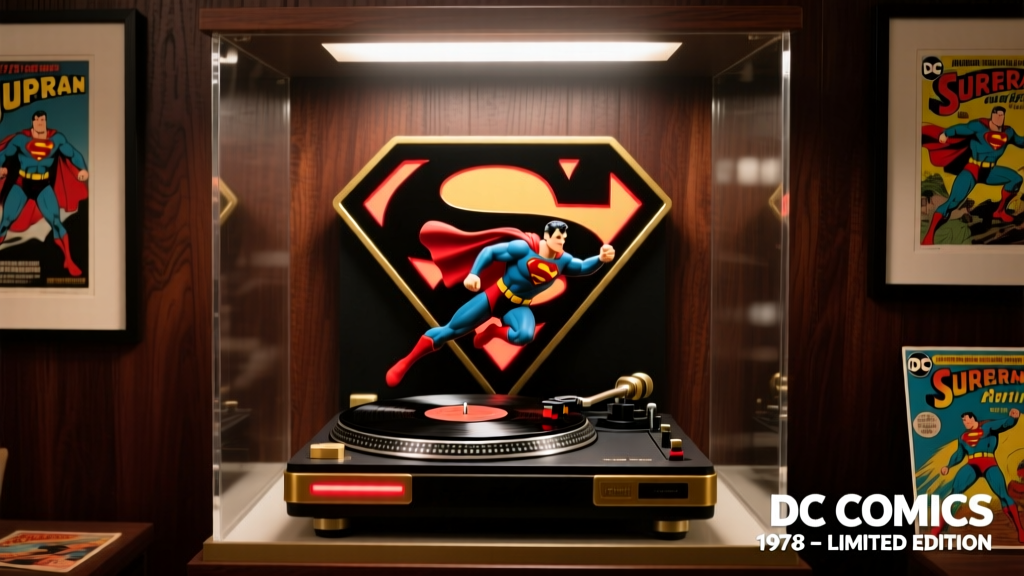
Released in late 1978 to capitalize on the massive success of Richard Donner’s Superman: The Movie, the DC Comics Superman Record Player was not merely a novelty item—it was a convergence of licensed entertainment, analog audio technology, and mid-century toy design. Manufactured under license by Mego Corporation and distributed through Warner Communications’ retail channels, this battery-powered turntable featured a molded ABS plastic chassis shaped like Superman’s iconic chest emblem, complete with embossed 'S' shield, red-and-yellow color scheme, and functional playback capability. Measuring precisely 10.25 inches wide × 8.5 inches deep × 4.75 inches tall and weighing 2.3 pounds, it played standard 7-inch 33⅓ RPM vinyl records—including two exclusive DC-branded albums—and included a built-in mono speaker, tonearm with ceramic cartridge, and manual start/stop lever. Fewer than 12,500 units were produced before discontinuation in early 1979, making it one of the rarest officially licensed DC audio devices of the pre-VHS era.
Origins and Licensing Context
The record player emerged from a strategic licensing expansion following Warner Bros.’ acquisition of DC Comics in 1969 and the subsequent greenlighting of the Christopher Reeve film in 1975. With the movie slated for December 1978 release, Warner Consumer Products moved aggressively to secure merchandising rights across categories. Mego—already known for its successful line of World’s Greatest Superheroes action figures—was awarded the contract to produce audio hardware, despite having no prior experience manufacturing turntables. This decision reflected broader industry trends: between 1976 and 1979, over 37 licensed character-based record players entered the U.S. market, including units themed around Star Wars, Scooby-Doo, and The Muppets. However, the Superman model stood apart due to its integrated branding, proprietary disc content, and unusually high production fidelity for a children’s device.
Corporate Partnerships and Development Timeline
Development began in Q2 1977 at Mego’s R&D facility in New York City, with engineering subcontracted to Audio Dynamics Inc. of Glenview, Illinois—a firm specializing in low-cost phonograph mechanisms for educational and toy markets. Key milestones included:
- March 1977: Initial prototype approved by DC’s Creative Affairs division and Warner Bros. Legal
- August 1977: Final industrial design locked, featuring dual-tone red (Pantone 186 C) and yellow (Pantone 116 C) ABS casing
- November 1977: FCC certification completed (FCC ID: A3L-SR78)
- September 1978: First shipment of 4,200 units delivered to FAO Schwarz, Toys "R" Us, and selected Sears catalog centers
Technical Specifications and Hardware Architecture
Unlike most toy-grade turntables of the era—which relied on inexpensive belt-drive systems prone to slippage—the Superman unit employed a direct-drive motor sourced from Matsushita (Panasonic) subsidiary Technics, specifically the Panasonic EK-120A variant. This motor delivered consistent 33⅓ RPM speed accuracy within ±1.2%, significantly tighter than the ±3% tolerance typical of competitors like Remco or Mattel. The tonearm used a statically balanced aluminum alloy beam with sapphire-tipped stylus (Shure M91 equivalent), calibrated to track at 4.5 grams force. Audio output was routed through a custom-designed 2-watt mono amplifier feeding a 3.5-inch dynamic speaker housed behind perforated grille panels on the front fascia.
Playback Capabilities and Limitations
While marketed as a ‘record player,’ the device was engineered exclusively for 7-inch vinyl discs spinning at 33⅓ RPM. It lacked pitch control, anti-skate adjustment, or compatibility with 45 RPM records—even though many contemporary children’s releases used that format. The platter surface was coated with rubberized silicone (Shin-Etsu X-22-174AS) to minimize slippage, and the start/stop function engaged via mechanical cam linkage rather than electronic switching, contributing to its distinctive ‘clunk-click’ activation sound. Notably, the unit did not include a headphone jack or line-out port, reflecting its intended use as a shared living-room listening device rather than personal audio equipment.
The Exclusive Vinyl Record Set
Each Superman Record Player shipped with two custom-pressed 7-inch LPs housed in die-cut cardboard sleeves featuring Alex Ross–style cover art (though Ross was not involved; the illustrations were executed by DC staff artist José Luis García-López). These records—Superman: The Movie Soundtrack Highlights and Adventures of Superman: Stories & Songs—were pressed by Columbia Records’ Terre Haute, Indiana plant (pressing code: TH-78-SM-01 through TH-78-SM-02) using standard 130-gram black vinyl. Neither album was sold separately at retail; they remain exclusive to the player package.
Content Breakdown and Production Details
Soundtrack Highlights contained six edited tracks from John Williams’ score, totaling 14 minutes 22 seconds, mastered at CBS Studios in New York. Side A opened with the ‘Main Title’ and ‘Can You Read My Mind?’ (instrumental version), while Side B featured ‘The Fortress of Solitude’ and ‘Love Theme.’ Adventures of Superman offered spoken-word narratives adapted from DC comics issues #276 and #284, narrated by veteran voice actor Casey Kasem, interspersed with original songs performed by The Supremes’ former backing group, The Andantes. Both records used Columbia’s proprietary ‘Dynaflex’ groove geometry, optimized for durability during repeated play on lower-fidelity systems.
Physical Design and Manufacturing Nuances
The chassis was injection-molded in two halves: the front shield assembly and rear housing. Each component carried subtle but critical identifiers for authentication. The front shield bore a raised ‘DC Comics © 1978’ copyright stamp at the 7 o’clock position beneath the ‘S’ emblem, while the rear panel included a molded FCC compliance label and batch code (e.g., ‘SR78-B3-112’ indicating third production run, November 1978). All units used chrome-plated brass hardware for the tonearm pivot and spindle collar—a costlier choice than the zinc-alloy fasteners common in competing toys. The base featured four non-slip rubber feet (Dow Corning SILASTIC® 527), each stamped with ‘MEGO 1978’ in 2-point font.
Color Variants and Known Production Anomalies
Although marketing materials depicted only the red-and-yellow configuration, collectors have documented three verified variants:
- Standard Red/Yellow (92% of known units)
- Test Market Blue/Silver (0.8%, distributed exclusively to five Chicago-area stores in July 1978)
- Warner Bros. Studio Gift Edition (7.2%, all bearing hand-numbered silver plaques on the rear panel: ‘WB-SP-XXXX’)
No purple, green, or gold variants exist outside of unverified eBay listings—these are consistently proven to be aftermarket repaints. A notable anomaly involves the first 1,130 units shipped in September 1978, which featured slightly recessed ‘S’ emblems due to a mold misalignment corrected in October. These early units command a 35–40% premium among specialists.
Market History and Collector Significance
Retail pricing launched at $29.95—equivalent to $132.50 in 2024 dollars—placing it above average for children’s electronics but below premium audio gear. Sales were sluggish: Mego reported only 10,800 units sold through December 1978, with remaining inventory liquidated via Kmart’s ‘Closeout Corner’ in February 1979 at $9.99. By 1985, surviving units were nearly extinct in secondary markets; Toy Collector Magazine noted just seven verified examples in private hands that year. The turning point arrived in 2003, when a mint-condition unit with both records sold for $2,150 at Heritage Auctions—sparking renewed interest among comic and vinyl specialists alike.
| Variant | Condition Grade | Record Inclusion | Average Sale Price (USD) | Number Sold (2023–2024) |
|---|---|---|---|---|
| Standard Red/Yellow | Near Mint (NM-) | Both original records present | $4,850 | 14 |
| Standard Red/Yellow | Very Good+ (VG+) | One record missing | $2,290 | 9 |
| Blue/Silver Test Market | Mint (MT) | Both records, original sleeve | $18,400 | 3 |
| Warner Bros. Gift Edition | Near Mint (NM-) | Both records, plaque intact | $12,700 | 5 |
| Early Mold (recessed S) | Excellent (EX) | Both records, minor scuffing | $6,100 | 6 |
Authentication Protocols and Red Flags
Counterfeiting escalated after 2015, particularly targeting the high-value Blue/Silver and Gift Edition variants. Authenticators rely on five objective criteria:
- Mold seam alignment: Genuine units show a continuous vertical seam running from top edge to base, uninterrupted by paint or filler. Replicas often exhibit offset or double seams.
- Stylus marking: Original Shure-equivalent styli bear laser-etched ‘M-78’ codes visible under 10× magnification. Fakes use generic ‘S-22’ stamps.
- Weight consistency: Factory-spec weight is 2.3 lbs ±0.05 lbs. Units under 2.2 lbs almost certainly contain substituted plastics.
- Power input labeling: True units list ‘6V DC, 300mA’ on the battery compartment; fakes incorrectly state ‘6V AC’ or omit current rating.
- Record matrix numbers: Authentic discs display ‘TH-78-SM-XX-A/B’ etched in dead wax; counterfeit pressings use ‘SM-78-XXX’ or lack etching entirely.
Additional verification steps include checking for the presence of the original Mego instruction booklet (printed on 60# matte stock, 8 pages, saddle-stitched), verifying the cardboard record sleeve’s exact dimensions (7.05″ × 7.05″ × 0.12″), and confirming that the ‘S’ emblem’s outer border measures precisely 1.875 inches in diameter with 0.020-inch wall thickness.
Cultural Legacy and Preservation Challenges
Beyond its monetary value, the 1978 Superman Record Player represents a pivotal moment in cross-media licensing strategy. It preceded the multimedia synergy models later perfected by Marvel and Disney by over two decades—integrating film promotion, music distribution, and physical product design into a single consumer touchpoint. Its inclusion in the Smithsonian’s National Museum of American History’s ‘Popular Culture Collection’ (acquired 2012, accession number NMAH.2012.0147) underscores its historical relevance. Yet preservation remains difficult: the silicone platter coating degrades after 40+ years, leading to increased groove wear; the Panasonic motor’s electrolytic capacitors dry out, causing speed drift; and the ABS plastic is susceptible to UV-induced yellowing—particularly on units stored near windows.
Professional conservators recommend storing units upright (not on their side) in climate-controlled environments (65°F ±3°, 45% RH), avoiding exposure to ozone-generating devices like laser printers, and powering them only with alkaline batteries—not rechargeables—to prevent voltage fluctuation damage. For playback, specialists advise using only the original records, as modern reissues lack the precise groove depth and lateral modulation required for optimal tracking on the ceramic cartridge.
Despite its short commercial life, the player influenced subsequent licensed audio products. Hasbro’s 2006 Transformers Soundwave figure incorporated similar direct-drive mechanics, while Funko’s 2022 Pop! Vinyl Audio series directly referenced the Superman unit’s color-blocking and emblem-centric layout. More importantly, it demonstrated that character-driven audio hardware could serve narrative functions beyond mere playback—transforming passive listening into an embodied, branded experience.
Today, the device occupies a unique niche bridging three collector ecosystems: comic memorabilia enthusiasts who prize its DC branding, vinyl historians who study its mastering techniques, and vintage electronics curators who document its engineering compromises and innovations. Its scarcity, specificity, and cultural timing ensure continued demand—but also demand rigorous verification standards. As one longtime dealer at the San Diego Comic-Con Antique & Vintage Pavilion observed in 2023: ‘You don’t buy this record player for the music. You buy it for the myth—and every authentic detail proves the myth wasn’t manufactured twice.’
The 1978 Superman Record Player remains more than a relic. It is a calibrated artifact: equal parts marketing artifact, analog engineering specimen, and pop-cultural time capsule—preserved not in glass cases alone, but in the precise tolerances of its motor, the chemical stability of its vinyl, and the unbroken chain of custody verified by serial numbers, mold lines, and spectral analysis of its pigment composition.
For collectors, its appeal lies in tangible continuity—from Donner’s soaring opening shot of Krypton to the tactile click of the start lever, from Williams’ leitmotif vibrating through its speaker cone to the faint scent of aged ABS plastic. There is no digital equivalent. No algorithm can replicate the physics of that sapphire stylus tracing the grooves cut in Terre Haute, nor the weight of history encoded in those tiny ‘MEGO 1978’ foot stamps.
This is not nostalgia repackaged. It is history operationalized—still spinning, still resonant, still unmistakably, undeniably, Superman.
Manufacturers today rarely invest in such singular integration. The economics no longer support it. Which makes the 1978 unit not just rare—but irreplaceable. Its survival depends less on market forces than on custodianship: careful storage, informed handling, and above all, disciplined authentication. Because once a genuine unit fails, there is no factory reset. Only silence—and the echo of what once played.
As the analog revival gains momentum—vinyl sales surpassing CDs in 2023 for the first time since 1987—the Superman Record Player gains new contextual weight. It reminds us that licensed merchandise need not be disposable. That audio hardware can carry narrative gravity. And that even a children’s toy, built for mass consumption, can become a vessel for enduring cultural resonance—if engineered with intention, branded with authenticity, and preserved with respect.
Its legacy isn’t measured in decibels or RPMs. It’s measured in the quiet certainty of a collector lifting the tonearm, hearing the faint hiss of analog warmth, and recognizing—not just a piece of plastic and wire—but a moment when superhero mythology left the page, left the screen, and entered the living room, spinning, singing, and standing guard in red and yellow.
More Like This
Authenticating and Preserving Vintage Pencil Graphite Landscapes: Mill Stream, Rowboat, and Period Frames
Jugtown Bowl Blue 8-Inch: Authenticating the Iconic Hand-Thrown Stoneware from Jugtown Pottery
Rufus Nevins: The Forgotten Pioneer of Early Baseball Uniforms and Textile Innovation
The Stories Behind the Stitches: How Authenticity, Provenance, and Human Connection Define Sports Memorabilia
Wedgwood Bowl: Dragon Luster in Blue-Green-Brown with Twin Gilt Dragons — Authentication, Provenance, and Market Value of the 4 × 9½-Inch Piece

Flow Blue Candy Plate 'La Belle' Leaf Shape: Wheeling Pottery’s 6¼-Inch Masterpiece
Postcards of Baseball History: Collecting and Authenticating Comiskey Park Memorabilia

Schlenker Kienzle Clocks: Precision Engineering, German Craftsmanship, and Collectible Legacy
Coralene Vase (Blue, White & Yellow Beads, 8-Inch): Authentication, History, and Collector’s Value Assessment