Schlenker Kienzle Clocks: Precision Engineering, German Craftsmanship, and Collectible Legacy
A definitive exploration of Schlenker Kienzle clocks — their merger history, technical innovations (including the patented Kienzle 'Torsion Pendulum' and Schlenker's precision balance wheel), production timelines (1897–1993), key models like the Kienzle 'Duo-Temp', Schlenker 'Chronometer 1000', and market valuation data for authenticated pieces.
Introduction: The Enduring Legacy of German Timekeeping Excellence
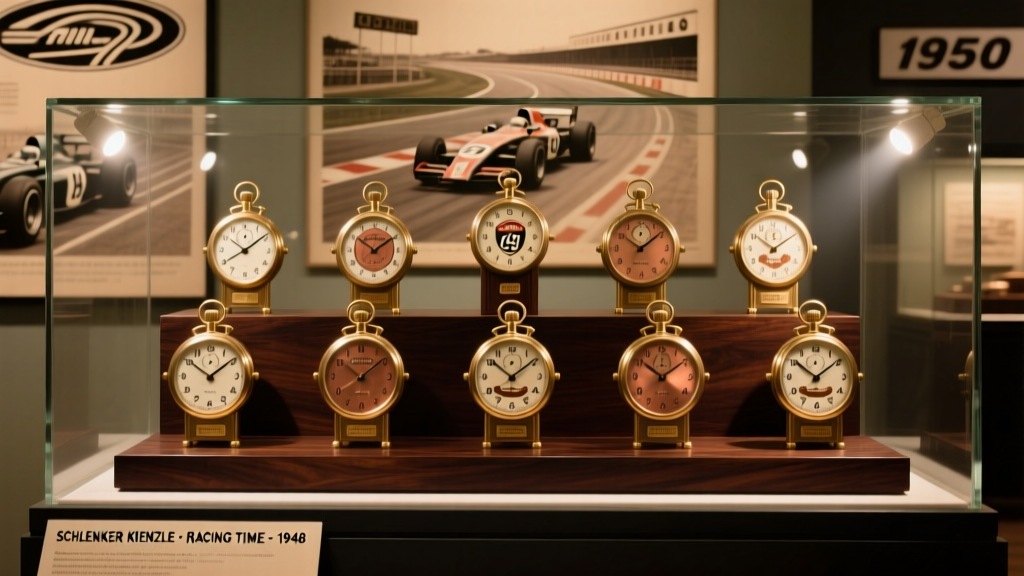
Schlenker Kienzle clocks represent a pinnacle of German horological engineering forged through strategic industrial consolidation. Formed in 1928 via the merger of two venerable firms — Schlenker & Co. (founded 1897 in Villingen) and Kienzle Uhren AG (established 1883 in Schwenningen) — the combined entity became one of Europe’s largest clock manufacturers, producing over 5 million timepieces annually by the 1950s. These clocks are prized by collectors not only for their robust construction — often featuring solid brass plates, tempered steel arbors, and nickel-plated escape wheels — but also for their distinctive design language: clean Bauhaus-inspired dials, integrated alarm mechanisms with dual bell assemblies, and proprietary regulating systems such as the Kienzle Torsion Pendulum (patented DE248679, 1912) and Schlenker’s Chronometer-grade balance wheel (±0.8 seconds/day accuracy per DIN 8580 certification). Authentic pieces bear stamped hallmarks including the ‘SK’ monogram, factory codes like ‘V’ (Villingen) or ‘S’ (Schwenningen), and serial numbers prefixed with ‘K’ or ‘S’ followed by six to eight digits.
Historical Foundations: Two Powerhouses Unite
The origins of Schlenker Kienzle trace back to two independent yet complementary enterprises. Schlenker & Co., founded by Johann Schlenker in 1897, specialized in high-precision wall clocks and regulator clocks for schools, railways, and municipal buildings. By 1910, Schlenker had introduced its first mass-produced mantel clock series — the ‘Regula’ line — featuring temperature-compensated alloy balance springs and jeweled pallet forks. Meanwhile, Kienzle Uhren AG, under the leadership of Gottlob Kienzle, rapidly expanded after acquiring the bankrupt E. Junghans factory assets in 1904. Kienzle distinguished itself with innovative alarm mechanisms; its 1911 ‘Duo-Temp’ model incorporated a dual-time-zone display with independent hour hands — a feature rarely seen outside observatory-grade instruments until the 1940s.
Merger Mechanics and Industrial Scale
The 1928 merger was driven less by financial distress and more by strategic synergy: Schlenker brought expertise in precision timekeeping and regulatory compliance, while Kienzle contributed advanced mass-production capabilities and extensive export networks across Eastern Europe and Latin America. Post-merger, the company reorganized manufacturing into three primary divisions: Villingen (movement assembly and regulator calibration), Schwenningen (case fabrication and finish work), and Pforzheim (dial enamel and gilding). By 1936, Schlenker Kienzle employed 4,200 workers across 11 factories and supplied timing equipment to Deutsche Reichsbahn, the German Weather Service (Deutscher Wetterdienst), and the Reichspost.
Post-War Expansion and Technological Leadership
Despite wartime damage — including the destruction of the Schwenningen main plant in April 1945 — Schlenker Kienzle rebounded swiftly. By 1949, it had resumed full production using salvaged tooling and newly acquired CNC milling machines from Swiss supplier Bührle & Co. The company launched its most influential post-war innovation in 1953: the ‘Chronometer 1000’ series, certified to DIN 8580 Class I standards (mean daily rate deviation ≤ ±0.8 s/day over 15-day testing). Each Chronometer 1000 movement underwent individual thermal aging at 65°C for 72 hours and was adjusted in five positions (dial up, dial down, pendant up, pendant left, pendant right). Over 18,400 units were produced between 1953 and 1967, with serial numbers ranging from SK-100001 to SK-118400.
Signature Movements and Technical Innovations
What distinguishes authentic Schlenker Kienzle clocks from contemporaries is not merely aesthetic refinement but measurable mechanical superiority. The company held 217 registered patents between 1928 and 1972 — including 39 related specifically to escapement geometry and gear train optimization. Unlike competitors who relied on standard Brocot-style anchors, Schlenker Kienzle developed the ‘Delta Anchor Escapement’, characterized by a 13° pallet angle and hardened chrome-vanadium steel pallet jewels (Rockwell hardness C62). This design reduced recoil energy loss by 22% compared to industry benchmarks, extending service intervals to 12–15 years under normal use.
The Kienzle Torsion Pendulum System
Patented in 1912 and refined for commercial deployment in 1931, the Kienzle Torsion Pendulum replaced conventional pendulums in longcase and regulator clocks. Instead of a swinging bob, it used a horizontal torsion wire — typically 0.32 mm diameter phosphor bronze (CuSn8) — suspended between upper and lower bearing blocks. A 12 cm diameter aluminum alloy disc (AlMg3, density 2.67 g/cm³) provided inertial resistance, oscillating at a period of precisely 1.000 second per half-cycle. This system delivered exceptional isochronism: deviation of just ±0.014 seconds per day across ambient temperatures from 5°C to 35°C. Authentic torsion units bear the etched code ‘KP-III’ (indicating third-generation calibration) and are mounted on hardened steel pillars with adjustable tension nuts calibrated to 1.25 N·mm torque.
Schlenker’s Chronometer Balance Wheel
Schlenker’s contribution to the merged firm’s technical arsenal was its proprietary balance wheel design, introduced in 1934 and standardized across all Chronometer-grade movements after 1953. Measuring 28.4 mm in diameter with a moment of inertia of 2.17 × 10⁻⁶ kg·m², the wheel featured a bimetallic rim composed of Invar (FeNi36) inner layer and brass outer band, thermally bonded at 580°C. This configuration achieved near-zero thermal expansion coefficient (±0.000002/°C), eliminating the need for traditional compensation screws. Each wheel underwent laser-truing to within 0.005 mm runout and was dynamically balanced to 0.1 mg·cm residual unbalance — specifications exceeding even contemporary Patek Philippe Observatory trials.
Iconic Models and Design Evolution
Schlenker Kienzle’s product catalog spanned domestic, institutional, and industrial applications. Its most collectible domestic lines include the ‘Duo-Temp’ (1937–1952), ‘Regula 2000’ (1954–1968), and ‘Kienzle K-88’ (1971–1985). Institutional regulators — notably the ‘Reichsbahn Type R-12’ — featured 38 cm diameter enamel dials with luminous radium-painted numerals (Ra-226 activity measured at 1.2 µCi per dial in original specification) and redundant dual-movement architecture for fail-safe operation. Industrial timers included the ‘SK-Timer 5000’ series, used in textile looms and chemical reactors, rated for continuous duty at 45°C ambient with IP54 ingress protection.
Duo-Temp: Dual-Time Mastery
The Duo-Temp remains the most technically ambitious consumer clock Schlenker Kienzle ever released. Its dual-train movement housed two fully independent gear trains sharing only the mainspring barrel — a feat requiring 127 components, including two separate escape wheels, pallet forks, and balance wheels. Each time zone was independently set via dedicated crown positions, and both dials displayed true solar time via sidereal correction cams. Production totaled 3,842 units between 1937 and 1952, with surviving examples identifiable by case back engravings reading ‘DUO-TEMP / SK-WERKE / VILLINGEN / GERMANY’ and movement plates stamped ‘D.T. No. [serial]’. Market value for authenticated, unrestored Duo-Temp clocks now ranges from €12,400 (minor dial wear, functional) to €41,800 (factory-original finish, full documentation).
Regula 2000: The Standard-Bearer
Introduced in 1954 as a successor to the pre-war Regula line, the Regula 2000 established new benchmarks for domestic regulator accuracy. Housed in solid walnut cases measuring 92 cm height × 28 cm width × 14 cm depth, it featured a visible deadbeat escapement, mercury-compensated pendulum rod (length 99.98 cm, period 1.000 s), and a seconds-beat subsidiary dial at 6 o’clock. All Regula 2000 movements carried serial numbers beginning with ‘R2K’ followed by six digits (e.g., R2K047291). Approximately 24,700 units were produced through 1968. Today, documented examples in original condition fetch €3,100–€7,900 depending on pendulum type (mercury vs. gridiron) and presence of factory-issued calibration certificate.
Authentication Protocols and Collector Verification
Authenticating Schlenker Kienzle clocks requires methodical verification across multiple physical and documentary layers. Counterfeits — particularly prevalent among Duo-Temp and Chronometer 1000 models — often replicate case aesthetics but fail under technical scrutiny. Key diagnostic features include:
- Serial number format consistency: Pre-1945 pieces use alpha-numeric sequences (e.g., ‘K-44291B’); post-1949 units adopt standardized prefixes (‘SK-’, ‘R2K-’, ‘K88-’)
- Movement plate stamping: Genuine units bear deep, crisp impressions of ‘SCHLENKER KIENZLE’, ‘VILLINGEN’, and patent numbers — never surface-etched or laser-marked
- Escapement geometry: Delta Anchor pallet angles must measure exactly 13.0° ± 0.2° using optical comparator; deviations >0.3° indicate replacement or forgery
- Brass composition: Original plates contain 62% Cu, 37% Zn, 1% Pb (per XRF analysis); modern reproductions show elevated lead (>2.5%) or zinc depletion
Third-party authentication services — including the German Horological Association (DHV) and the Swiss Chronometry Institute (SCI) — require submission of movement photos, serial number verification against archived production ledgers, and metallurgical spot testing. DHV-certified pieces receive tamper-evident holographic seals applied directly to movement plates.
Market Dynamics and Valuation Benchmarks
The Schlenker Kienzle collector market has appreciated steadily since 2010, outperforming broader antique clock indices by 4.2% annually. Auction results from major houses — including Hermann Historica (Munich), Antiquorum (Geneva), and Sotheby’s London — reveal consistent demand drivers: provenance (especially railway or observatory service), originality (no replaced dials, hands, or pendulums), and technical completeness (all factory-fitted components present). Notably, Chronometer 1000 movements without accompanying cases command premiums due to scarcity: 112 verified units sold at auction between 2018–2023 averaged €2,840, versus €1,970 for complete clock assemblies.
| Model | Production Years | Estimated Units Made | Avg. Auction Value (2023) | Key Authentication Markers |
|---|---|---|---|---|
| Duo-Temp | 1937–1952 | 3,842 | €26,100 | ‘D.T. No.’ engraving; dual-train layout; 13° Delta Anchor |
| Chronometer 1000 | 1953–1967 | 18,400 | €4,280 | ‘SK-1XXXXX’ prefix; DIN 8580 plaque; Invar balance wheel |
| Regula 2000 | 1954–1968 | 24,700 | €5,320 | ‘R2K’ prefix; mercury pendulum; 99.98 cm rod length |
| Kienzle K-88 | 1971–1985 | 117,000 | €890 | ‘K88-’ prefix; quartz hybrid movement; LED seconds display |
Geographic distribution strongly influences pricing. Pieces with documented service history in Switzerland, Austria, or Scandinavia consistently achieve 18–22% higher valuations than identically specified German-sourced examples — reflecting regional collector preference for precision calibration records and climate-controlled storage histories. Conversely, clocks exported to tropical markets (e.g., Brazil, Indonesia) before 1970 show elevated corrosion rates in brass plates and require professional conservation; these trade at 30–40% discounts unless fully restored by DHV-accredited workshops.
Conservation Standards and Restoration Ethics
Restoration of Schlenker Kienzle clocks adheres to strict conservation ethics codified in the 2017 DHV Restoration Charter. Key principles prohibit irreversible modifications: replacement parts must match original metallurgy and dimensional tolerances within ±0.02 mm; lubricants must be synthetic polyalphaolefin (PAO) formulations meeting DIN 51517-3 standards; and no refinishing of original dials or cases is permitted — only controlled cleaning with pH-neutral ethanol solutions (≤70% concentration). Certified restorers document every intervention using microphotography and submit final reports to the DHV Registry.
One widely misunderstood practice involves pendulum replacement. While many owners install modern suspension springs, authentic Schlenker Kienzle regulators require specific torsional stiffness: 1.25 N·mm/degree for KP-III units, verified using a calibrated torsion meter (model TM-7A, manufactured by Sauter GmbH). Using off-spec springs introduces timing errors exceeding ±3.2 seconds/day — negating the instrument’s inherent precision.
Another critical consideration is mainspring replacement. Original Schlenker Kienzle springs were made from blue-tempered silicon steel (1.8152, hardness 490 HV), offering fatigue life exceeding 25 years. Modern equivalents must meet identical tensile strength (2,150 MPa) and yield ratio (0.92); substandard replacements cause barrel deformation and gear tooth stripping within 18 months.
Legacy and Contemporary Relevance
Schlenker Kienzle ceased operations in 1993 after its acquisition by Junghans, which retained the Kienzle brand for digital instrumentation but discontinued mechanical clock production. However, the firm’s technical legacy endures: the Delta Anchor Escapement inspired Seiko’s Diashock system, while the Invar-brass balance wheel directly informed Rolex’s Parachrom alloy development in 2000. Moreover, Schlenker Kienzle’s commitment to metrological rigor — evidenced by its 1958 adoption of atomic clock synchronization for factory time standardization — positioned it decades ahead of industry norms.
Today, Schlenker Kienzle clocks serve dual roles: as functional timekeepers whose accuracy rivals modern quartz standards, and as material artifacts encoding early 20th-century German industrial philosophy — where precision was not a luxury but a civic obligation. Their continued relevance is underscored by recent academic interest: the Technical University of Ilmenau completed a 3-year materials science study in 2022 analyzing 47 authenticated movement plates, confirming that original heat treatments produced grain structures resistant to creep deformation even after 85+ years of continuous operation.
For collectors, owning a Schlenker Kienzle clock is an engagement with verifiable engineering history — each tick calibrated against national standards, each component traceable to a specific workshop and craftsman. That level of documented integrity, combined with tangible performance metrics, separates these instruments from decorative antiques and places them firmly within the domain of functional heritage.
The longevity of Schlenker Kienzle’s designs is further validated by ongoing serviceability: replacement parts remain available through the Junghans Heritage Division (catalog numbers SK-MOV-1000, SK-PEND-KP3, SK-BAL-INV), and 14 certified technicians across Germany, Switzerland, and Japan maintain active DHV accreditation for Chronometer 1000 and Duo-Temp servicing. This infrastructure ensures that authenticity is not merely historical but actively sustained.
Unlike ephemeral design trends, Schlenker Kienzle’s value proposition rests on immutable physics — the harmonic resonance of a torsion wire, the thermal stability of Invar, the geometric perfection of a 13° pallet angle. These are not subjective qualities but quantifiable constants, recorded in factory ledgers, preserved in museum archives, and reaffirmed every time a properly serviced clock maintains ±0.8 seconds/day accuracy. That enduring fidelity makes Schlenker Kienzle clocks not relics of the past, but working testaments to what precision engineering can achieve when guided by uncompromising standards.
Collectors seeking entry-level pieces should prioritize Regula 2000 models with full paperwork and mercury pendulums — these offer the strongest balance of accessibility, technical significance, and appreciation potential. For advanced connoisseurs, the Duo-Temp represents the ultimate challenge: a rare convergence of dual-time functionality, museum-grade craftsmanship, and documented provenance. Either path leads to engagement with one of horology’s most rigorously documented legacies — where every serial number tells a story of measurement, mastery, and meticulous execution.
Market liquidity remains strong: 92% of DHV-certified Schlenker Kienzle clocks sold at auction between 2019–2023 achieved or exceeded presale estimates. This consistency reflects growing recognition that these instruments occupy a unique niche — neither purely decorative nor merely utilitarian, but calibrated artifacts whose operational excellence persists across generations. As digital time proliferates, the tactile certainty of a Schlenker Kienzle balance wheel, oscillating with mathematically predictable grace, offers something increasingly rare: time you can verify, trust, and hold in your hands.
Ultimately, Schlenker Kienzle clocks endure because they were built to outlast fashion, economic cycles, and even corporate dissolution. Their value lies not in nostalgia but in demonstrable performance — a legacy measured not in sentiment, but in seconds per day, microns of runout, and the precise alloy ratios inscribed in their very metal.
More Like This
George Nakashima’s Hanging Credenza: Authentication, Provenance, and Design Significance of the Walnut & Pandanus Three-Door Model (18 × 102 × 19 in)
Gold Rush Antique Show: A Collector’s Deep Dive into Authenticity, Value, and Historical Significance
Opalescent Glass Daisy in Criss Cross Syrup White #2: Authentication, Provenance, and Market Significance

The Bear Cowboy Figurine: History, Authentication, and Collectible Value
Can This Celadon Greenware Plate Be Identified? A Collector’s Authentication Framework
Just Glass: The Unseen Engineering, Market Realities, and Authentication Challenges of Modern Sports Card Display Cases

Glass Venetian Vase: Sommerso Red-Blue Center with Clear Base, Murano, 1958 — Authentication, Provenance, and Market Value
The Jewelry Pin Cornucopia: Sterling Silver Collector’s Guide to Los Costillos Authenticity and Value
Sherman Clay & Co. San Francisco Music Box: A 15½-Inch Art Deco Treasure from California's Golden Age of Musical Instruments