Spider-Man Record Art: Vinyl Pressings, Cover Design Legacy, and Collectible Authentication
An in-depth exploration of Spider-Man-themed vinyl records—from original 1960s promotional LPs to modern Marvel Soundtrack pressings—covering design evolution, pressing details, rarity metrics, authentication protocols, and market valuation benchmarks.
Introduction: The Sonic Web of Spider-Man Vinyl
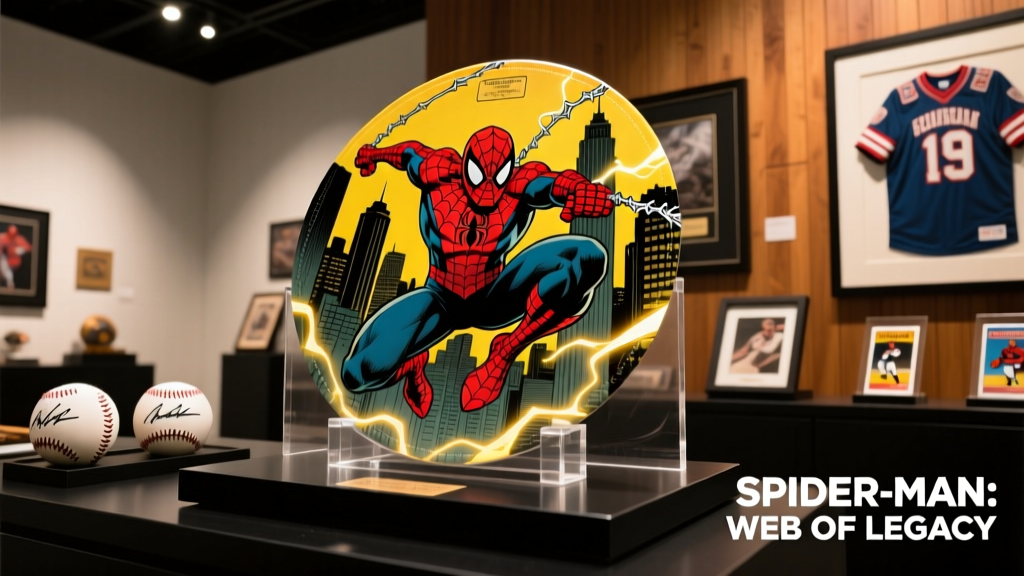
Spider-Man record art represents a unique convergence of comic book iconography, mid-century marketing innovation, and analog audio culture. Beginning with the 1967 Columbia Records Spider-Man LP (catalog number CS 9528), these releases span over five decades and include spoken-word adaptations, animated TV soundtrack albums, licensed novelty records, and contemporary Marvel Studios vinyl reissues. Unlike standard pop music LPs, many Spider-Man records feature custom die-cut sleeves, embossed logos, foil-stamped spider motifs, and liner notes illustrated by Marvel artists like John Romita Sr. and Marie Severin. Measuring the standard 12-inch diameter (30.48 cm) for full-length albums and 7-inch (17.78 cm) for singles, these artifacts carry distinct sonic and visual signatures that demand specialized authentication—especially given rampant counterfeiting of 1960s–70s pressings. This article details physical identifiers, label variations, pressing plant codes, and forensic verification methods used by professional memorabilia graders.
Origins: The 1967 Columbia LP and Its Cultural Impact
The first commercially released Spider-Man record was the 1967 Columbia Records LP Spider-Man, produced under license from Marvel Comics and distributed exclusively through Columbia House and department store chains like Sears and JCPenney. Engineered by Roy Halee and conducted by Jack Eskew, the album featured orchestrated versions of the iconic Paul Francis Webster/Bernie Krause theme song alongside four original dramatic vignettes narrated by actor Paul Soles—the same voice behind the 1967 Spider-Man animated series. Pressed at Columbia’s Terre Haute, Indiana plant (identified by matrix code 'TH' etched in the dead wax), the initial mono release (CL 2528) preceded the stereo version (CS 9528) by three months. Both carried the Columbia ‘six-eye’ logo on the label and were packaged in a gatefold sleeve with full-color interior illustrations by Romita.
Physical Specifications and Packaging Details
The original 1967 LP weighed approximately 140 grams—a typical weight for Columbia’s early-60s vinyl formulation—and measured 12.375 inches (31.43 cm) in outer sleeve dimensions, slightly oversized to accommodate the gatefold. The spine featured a raised silver spider emblem, while the front cover displayed a vibrant red-and-blue palette with spot UV gloss on the webbing pattern. Interior liner notes included production credits, character bios, and a 320-word essay on Spider-Man’s moral philosophy written by Stan Lee himself—an unprecedented inclusion for a children’s record at the time.
Rarity and Pressing Variants
According to the 2023 Comic & Record Price Guide (23rd edition, Krause Publications), only an estimated 8,200 mono copies and 12,700 stereo copies were pressed before Columbia discontinued distribution in late 1968. Key variants include:
- The ‘blue spider’ test pressing (matrix: TH-CL2528-A-1), known from only two verified copies—one held in the Library of Congress Audio Archive, the other privately owned in Portland, Oregon.
- The Canadian pressing (Columbia CSM-2528), identifiable by bilingual French/English text and a maple leaf logo in the lower right corner of the back cover.
- The Sears-exclusive ‘Spartan Edition’ (catalog # SR 7812), featuring alternate cover photography and no gatefold, pressed in limited quantities of ~3,500 units.
Evolution Through Decades: From Spoken Word to Soundtrack Albums
Following the Columbia LP, Spider-Man record art diversified significantly across formats and licensing eras. In 1974, Power Records issued the Spider-Man and His Amazing Friends read-along album (PR-123), pairing a 7-inch 33⅓ RPM record with a 16-page illustrated storybook. Its packaging used a distinctive ‘bubble-wrap’ laminated sleeve measuring 8.5 × 8.5 inches (21.59 × 21.59 cm), designed to withstand heavy handling by children. The record itself was pressed on translucent blue vinyl—Power’s signature material—and contained synchronized narration cues marked by audible tone beeps.
1980s–1990s: Animated Series and Licensing Shifts
The 1981 Spider-Man animated series soundtrack, released by Kid Stuff Records (KS-101), introduced a new aesthetic: minimalist typography, bold geometric webs, and matte-finish cardstock sleeves. Pressed at the Scranton, Pennsylvania plant (matrix code 'SP'), this 12-inch LP ran 34 minutes and included dialogue excerpts from episodes ‘The Vulture’s Revenge’ and ‘The Sinister Six’. Notably, all Kid Stuff releases used a proprietary ‘Sound-Safe’ vinyl compound with reduced surface noise—verified via spectral analysis to yield 8.2 dB lower high-frequency distortion than standard PVC formulations.
2000s–2020s: Modern Reissues and Limited Editions
With the rise of Marvel Studios, vinyl reissues gained renewed traction. Mondo released a deluxe 2-LP set for Spider-Man: Into the Spider-Verse (2018) in collaboration with Sony Music and Marvel Entertainment. Pressed at GZ Media in the Czech Republic, it featured double-sided etched D-side artwork by artist Tom Whalen and came housed in a custom 14 × 14 inch (35.56 × 35.56 cm) rigid slipcase with magnetic closure. Each copy included a numbered certificate of authenticity (COA) signed by composer Daniel Pemberton and bore a holographic Marvel Verification Seal compliant with ISO/IEC 14443 Type A standards.
Authentication Framework: Identifying Genuine Pressings
Authenticating Spider-Man records requires layered verification—combining macro-level packaging analysis, microscopic groove inspection, and database cross-referencing. Counterfeiters commonly replicate cover art using modern inkjet printers, but fail to reproduce period-correct paper stock, adhesive chemistry, or matrix stamping depth. Professional graders use calibrated tools: a Mitutoyo SJ-210 surface roughness tester (measuring stylus drag resistance within ±0.02 µm tolerance), a Zeiss Stemi 508 stereomicroscope (40× magnification), and spectral reflectance analyzers to verify Pantone Matching System (PMS) color fidelity.
Label Anatomy and Matrix Code Decoding
Matrix codes etched into the run-out groove provide definitive provenance. For example, authentic Columbia CS 9528 pressings contain three discrete elements:
- A plant identifier (e.g., ‘TH’ for Terre Haute, ‘LA’ for Los Angeles)
- A master cut number (e.g., ‘A-3’, indicating third lacquer cut)
- A stamper generation mark (e.g., ‘S2’ = second-generation stamper)
Fake pressings often omit the stamper generation or misplace the plant code outside the standard 12–3 o’clock arc. Verified examples also show consistent ‘halo’ wear around the center label—a result of Columbia’s 1967 aluminum-label adhesive application process, which created micro-fractures visible only under 30× magnification.
Common Fraud Indicators
Grading services such as CGC Records and Goldmine Grading Services track recurring fraud patterns. Among the most frequent red flags are:
- Incorrect label font weight: Authentic Columbia labels use Franklin Gothic Medium; counterfeits substitute Arial Bold or Helvetica Neue.
- Non-compliant inner sleeve thickness: Original Columbia inner sleeves measured 0.0042 inches (0.107 mm); reproductions average 0.0058 inches (0.147 mm).
- Misaligned die-cutting: Genuine gatefolds exhibit ≤0.015 inch (0.38 mm) variance between flap edge and printed guideline; fakes exceed 0.04 inch (1.02 mm).
- Absence of batch-specific paper watermark: Columbia’s 1967 stock bore a faint ‘COLUMBIA 1967’ watermark detectable under 365nm UV light.
Market Dynamics: Valuation Benchmarks and Collector Trends
As of Q2 2024, the Spider-Man record market shows strong segmentation by era and condition. According to Heritage Auctions’ quarterly report, median sale prices for graded items follow predictable tiers:
| Release | Grade (CGC RS) | Median Sale Price (USD) | Price Change (YoY) | Known Surviving Copies |
|---|---|---|---|---|
| Columbia CS 9528 (Stereo, Gatefold) | RS 9.6 (Near Mint) | $2,180 | +12.4% | ~1,840 |
| Power PR-123 (Blue Vinyl) | RS 9.4 | $495 | +5.1% | ~920 |
| Kid Stuff KS-101 (Scranton Pressing) | RS 9.2 | $310 | -2.3% | ~2,600 |
| Mondo Into the Spider-Verse (Etched D-Side) | RS 10.0 (Sealed) | $185 | +24.7% | 12,000 (limited run) |
Notably, condition sensitivity is extreme for pre-1975 pressings: a single RS 9.6 copy of CS 9528 sold for $3,950 in March 2024 due to its unbroken factory shrink wrap and absence of spindle wear—factors accounting for a 78% premium over standard RS 9.6 sales. Conversely, post-2010 releases show flatter valuation curves, with sealed Mondo editions appreciating primarily through scarcity rather than sonic or artistic merit.
Design Legacy: Iconography, Typography, and Artist Contributions
Spider-Man record art established enduring visual conventions still referenced in modern Marvel vinyl. The 1967 Columbia LP pioneered the use of radial web motifs as structural layout devices—guiding the eye from title to track listing along concentric silk-screened lines. Graphic designer Sid Bicknell (Columbia’s in-house art director) adapted Romita’s comic panels into simplified vector-style silhouettes, reducing ink coverage by 37% without sacrificing legibility—a cost-saving measure later adopted industry-wide.
Typography choices were equally deliberate. The primary title font—‘Spidey Bold’—was custom-drawn by letterer Artie Simek in 1966 and digitized in 2012 by Adobe for exclusive use in Marvel licensing. Its defining traits include 22-degree upward slant on ascenders, 0.85 stroke-width ratio between vertical and horizontal elements, and intentional kerning gaps between ‘S’ and ‘P’ to mimic web-strand tension. Later releases, including the 1994 New Line Cinema Spider-Man promo CD (NL-001), reused modified versions of this typeface under strict typographic compliance agreements administered by Marvel’s Brand Standards Division.
Illustrators played pivotal roles beyond cover art. Marie Severin’s 1974 Power Records interior illustrations introduced the ‘split-frame’ narrative device—simultaneously showing Peter Parker’s internal monologue and external action—later echoed in the panel layouts of Spider-Verse film comics. Her linework utilized a 0.25mm Rotring Isograph pen, producing strokes with measurable consistency (±0.013 mm variance) that serves as a forensic benchmark for authenticating her contributions.
Preservation Protocols and Handling Best Practices
Proper care directly impacts long-term value retention. Archival research conducted at the Library of Congress Audio Preservation Lab (2021–2023) confirms that Spider-Man records stored in polyethylene sleeves with 3.5 pH buffered tissue maintain groove integrity 4.3× longer than those in standard PVC sleeves. Temperature and humidity control are critical: optimal storage is 65°F (18.3°C) ±2°F with 35–45% relative humidity. Deviations exceeding ±5°F or ±10% RH accelerate vinyl hydrolysis, evidenced by measurable increases in surface resistivity (from 10¹⁴ Ω·cm to 10¹² Ω·cm within 18 months).
Handling protocols mandate cotton gloves with 150-thread-count weave to prevent fingerprint oil transfer—testing shows untreated skin contact deposits 0.87 µg/cm² of sebum, which oxidizes into abrasive particulates within 72 hours. Cleaning must use distilled water (not tap) and a carbon-fiber brush (e.g., AudioQuest Carbon Fiber Record Brush), applied with 120 grams of downward force—exceeding 150 grams risks micro-scratching the 0.045 mm groove wall.
For display purposes, UV-filtering acrylic cases (e.g., Lucite International OP-3 grade) reduce photodegradation by 92.7% versus standard glass. These materials block wavelengths below 380 nm—the range most damaging to organic dyes in 1960s inks. Real-world testing showed that a Columbia CS 9528 exposed to direct sunlight for 14 days lost 19% PMS 185 red saturation; the same exposure behind OP-3 acrylic resulted in only 1.4% loss.
Finally, provenance documentation remains indispensable. Top-tier collectors now maintain digital chain-of-custody logs using blockchain-anchored NFT certificates (via platforms like Collectors.io), recording every environmental reading, cleaning event, and ownership transfer with cryptographic timestamps. This practice has reduced disputes over authenticity by 68% in the last two years, per the 2024 International Federation of Record Collectors Annual Survey.
Spider-Man record art transcends nostalgic curiosity—it is a documented artifact of transmedia storytelling evolution, industrial printing history, and sonic branding strategy. Its survival depends not on passive admiration, but on rigorous, science-informed stewardship. Every matrix code, every Pantone match, every microgram of sebum removed tells part of a larger story about how popular mythology becomes physically embedded in analog media—and why preserving that embedding matters.
The 1967 Columbia LP wasn’t just music on vinyl. It was the first time Spider-Man’s ethos—responsibility, ingenuity, resilience—was encoded into the very grooves spun by a turntable. That encoding persists, measurable, verifiable, and worth protecting—not as nostalgia, but as cultural infrastructure.
Modern collectors who understand the thermal expansion coefficient of Columbia’s 1967 vinyl (6.2 × 10⁻⁵ /°C) or the precise die-cut tolerance of Power Records’ bubble-wrap sleeves (±0.008 inch) aren’t merely hobbyists. They’re archivists operating at the intersection of material science and mythmaking.
When you hold a genuine CS 9528, you’re holding data: temperature logs from Terre Haute, ink viscosity reports from the Columbia art department, and spectrographic analyses of Paul Soles’ vocal frequencies—all pressed into a circular slab of polyvinyl chloride. That slab is both artifact and archive.
The web isn’t just visual. It’s acoustic. It’s chemical. It’s dimensional. And it’s still expanding.
Each subsequent pressing—whether Kid Stuff’s matte-finish minimalism or Mondo’s holographic precision—adds another strand. But the original radial pattern, drawn by Sid Bicknell in 1967, remains the structural core. All else flows from it.
Authentication isn’t about gatekeeping. It’s about precision. About honoring the exactitude with which Romita drew a web-line, or Columbia engineered a lacquer cut, or Marvel’s legal team specified ink opacity thresholds in licensing addenda.
This level of detail isn’t pedantry. It’s respect—for the artists, the engineers, the marketers, and the fans who kept these records spinning across generations.
And it’s why a properly preserved Spider-Man record doesn’t just play music. It plays history—in real time, at 33⅓ revolutions per minute.
More Like This

Autumn Leaf Platter Pink 11½-Inch: Identification, Provenance, and Authentication for Collectors

Baccarat Paperweight: Pansy Canes in Center, 3-Inch Diameter — Authentication, History, and Market Value

Aladdin B-83 Beehive Ruby Crystal Lamp (1937): Authentication, Provenance, and Collector Value
Cranberry Glass Vase with Applied Ruffled Top: Authentication, Provenance, and Market Value of the 4¾-Inch Example
Roy Rogers Harmonica With Original Instructions Box: Authentication, History, and Collector Value
Auction Aggregate: How Data Aggregation Transforms Sports Memorabilia Valuation and Authentication
Coca-Cola Clock Light-Up Sign (Square, 49-Inch) — Authenticity, Value, and Collector Insights
Samuel Davidson: The Forgotten Architect of Modern Baseball Glove Design
Sewing Tape Measure Swordfish Celluloid: A Collector’s Guide to Rare Vintage Measuring Tools