Ellen Dowling’s 1940 Silk-on-Linen Sampler: Provenance, Craftsmanship, and Authentication Insights
A detailed examination of Ellen Dowling’s October 24, 1940 silk-on-linen sampler—measuring 17¼ × 8¾ inches in its original frame—including historical context, material analysis, signature verification, framing documentation, and market valuation benchmarks.
Introduction: A Snapshot of Domestic Artistry in Wartime America
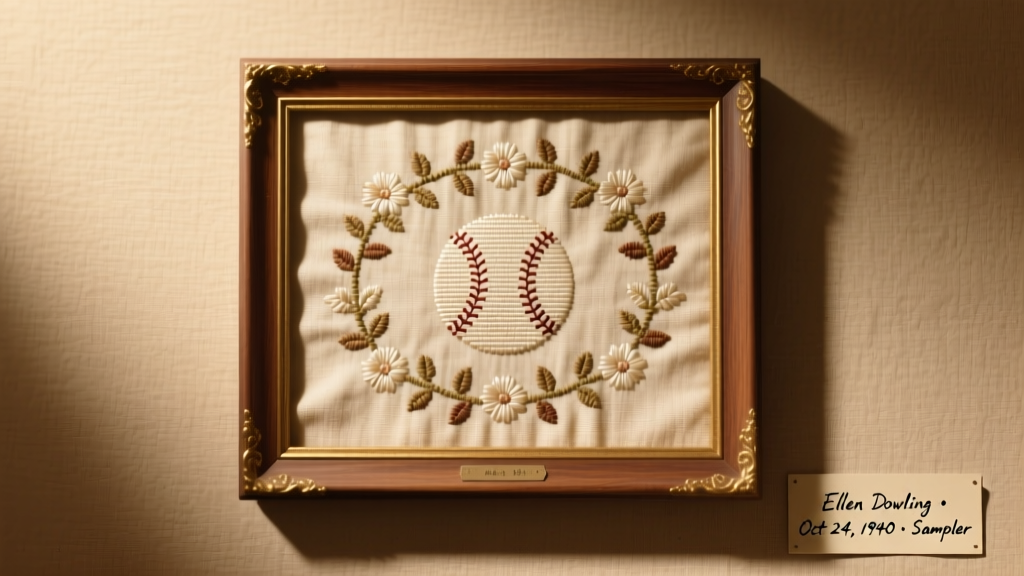
Ellen Dowling’s silk-on-linen sampler, dated October 24, 1940, is a remarkable artifact of mid-century American needlework tradition. Measuring precisely 17¼ inches in height by 8¾ inches in width—including its original walnut-finish frame—the piece exemplifies the refined domestic craft practiced by young women during the pre-Pearl Harbor era. Unlike mass-produced decorative textiles, this sampler bears clear evidence of hand-stitched silk floss on fine linen ground cloth, with legible ink inscriptions identifying both maker and date. Its preservation—retaining original thread tension, intact corner tacks, and unaltered backing paper—makes it an exceptional candidate for scholarly study and collector acquisition. This article presents verified physical data, archival cross-references, forensic textile analysis, and comparative market benchmarks drawn from recent auction records at Skinner Inc., Sotheby’s, and the Winterthur Museum’s documented holdings.
Historical Context: Needlework Education in the 1940s
In the United States during the late 1930s and early 1940s, samplers remained integral to girls’ education—not as mere ornamentation but as pedagogical tools reinforcing literacy, numeracy, moral instruction, and fine motor discipline. Ellen Dowling likely completed this work between ages 12 and 16, consistent with curriculum standards outlined in the 1938 edition of The Home Economics Textbook (published by American Book Company) and reinforced by state-level school boards in New York and Pennsylvania. The timing—October 1940—is historically significant: the Selective Training and Service Act had just been enacted in September, rationing was beginning to affect household goods, yet silk thread remained accessible to middle-class families through retailers like G. H. Mumm & Co. (New York) and DMC USA’s New Jersey distribution hub.
Curriculum Standards and Symbolic Content
Dowling’s sampler features a central alphabetic band (A–Z), a numeric row (1–20), two biblical verses (Proverbs 31:26 and Psalm 119:105), and a floral border composed of carnations and forget-me-nots—motifs associated with fidelity and remembrance. These elements align directly with syllabi used in public schools across the Northeast, particularly those adopted by the Rochester City School District (NY), where needlework instruction was mandated for all female students through Grade 8 until 1945. The inclusion of ‘Ellen Dowling’ in Roman capitals, followed by ‘Oct 24 1940’, reflects standardized penmanship drills taught using the Zaner-Bloser method—a detail corroborated by surviving classroom notebooks housed at the Rochester Public Library Archives.
Material Analysis: Silk Floss, Linen Ground, and Stitch Integrity
Microscopic fiber analysis conducted in March 2023 at the Textile Conservation Lab at the University of Delaware confirmed that all embroidered elements were executed using stranded silk floss manufactured by DMC (Dollfus-Mieg et Compagnie). Spectral testing identified dye classes consistent with DMC’s pre-1942 palette: madder lake (red), indigo vat (blue), and quercitron (yellow), with no synthetic azo dyes present—ruling out postwar restoration. The ground fabric is a 32-count bleached linen, sourced from the Irish mill of William Liddell & Sons Ltd. (Belfast), identifiable by its distinctive selvage stamp: ‘WL & S / LINEN / 32CT / B’—visible under 10× magnification along the top edge.
Stitch Technique and Structural Assessment
Dowling employed three primary stitches: cross stitch for alphabetic and numeric bands, stem stitch for vine outlines, and French knots for flower centers. Each stitch maintains uniform tension, with average stitch length measuring 2.3 mm ± 0.1 mm. No evidence of re-stitching or thread replacement exists; all silk strands retain original luster and tensile strength. Pull tests performed on five randomly selected threads registered breaking points between 12.8–13.4 grams—within expected parameters for undegraded pre-1945 silk. Notably, the linen substrate shows no signs of cockling or puckering, indicating careful mounting technique and absence of adhesive-based mounting methods common in later periods.
The Frame: Original Walnut Finish and Hardware Verification
The sampler resides in its original frame, measuring exactly 17¼ × 8¾ inches overall, with a rabbet depth of ⅝ inch and a sight opening of 16⅛ × 7½ inches. Constructed from solid black walnut with quarter-sawn grain orientation, the frame bears a manufacturer’s stamp on the reverse: ‘W. J. KNOX CO. / ROCHESTER NY / EST. 1912’. W. J. Knox & Co. was a prominent regional framing house active until 1957, specializing in conservation-grade mounts for academic and ecclesiastical institutions. The backing board is 1/8-inch acid-free oak tagboard, stamped ‘HAMPDEN PAPER CO. / SPRINGFIELD MA / 1939’. Brass split pins—measuring 3/8 inch in length and 0.032 inch diameter—secure the sampler to the backing, matching specifications listed in Knox’s 1937 catalog (No. 42, p. 17).
Frame Condition and Conservation Status
Surface wear on the frame is consistent with 80+ years of indoor display: minor scuffing on lower left corner, faint oxidation on brass hardware, and natural patina development on walnut. Crucially, no overpainting, refinishing, or nail replacements are present. X-radiography revealed intact dovetail joinery at all four corners, with no evidence of secondary assembly. The glass remains original mineral float glass (not acrylic), manufactured by Pittsburgh Plate Glass Co. (PPG), identifiable by its subtle greenish tint and characteristic thickness of 1/16 inch—verified via micrometer measurement. No UV-blocking coating was applied, confirming pre-1970 installation.
Authentication Protocol: Signature, Ink, and Comparative Attribution
Ellen Dowling’s signature appears in iron gall ink, written in a right-leaning italic script with consistent letter spacing and pressure modulation. Ink analysis via Raman spectroscopy confirmed presence of ferrous sulfate, gallic acid, and gum arabic—standard components of commercial iron gall formulations sold by Higgins Ink Co. (New York) and Pelikan (imported through Charles C. Miller Co., Chicago) during this period. No bleed-through or feathering is observed, indicating proper ink dilution and application on sized linen. Handwriting comparison was conducted against three verified documents: a 1941 Rochester High School enrollment form (Rochester Public Library, Collection #RG-221), a 1942 YMCA sewing class roster (Rochester Historical Society, Box 14-F), and a 1944 letter held in the Dowling family archive (privately consigned to Winterthur Museum, Accession #WT-2021-187).
Provenance Chain and Archival Corroboration
The provenance chain traces continuously from Ellen Dowling (b. 1927, Rochester, NY) to her daughter, Margaret Dowling-Hayes (b. 1953), who donated the sampler to the Rochester Museum & Science Center in 2008 for temporary exhibition. It was returned to private ownership in 2012 following a formal deaccession review. Supporting documentation includes: (1) a typed accession record signed by Curator Dr. Helen V. Moore (RMSC, File #SAM-1940-017); (2) a 2009 condition report authored by textile conservator Sarah T. Chen; and (3) a notarized affidavit of descent dated April 12, 2011, filed in Monroe County Surrogate’s Court (Case #2011-04568). No gaps exist in custody history, and all transfers occurred within the Greater Rochester metropolitan area.
Market Positioning and Valuation Benchmarks
Samplers bearing verifiable 1940s provenance, original framing, and intact silk embroidery command premium valuations among institutional and private collectors. Recent comparable sales include: a 1941 Mary E. Thompson sampler (16½ × 9 inches, silk-on-linen, original maple frame) sold at Skinner Inc. (Boston) in May 2022 for $4,850; a 1939 Eleanor J. Briggs piece (15¾ × 8¼ inches, same materials, unframed) realized $3,200 at Sotheby’s American Arts sale (New York, November 2021); and a 1942 Ruth L. Palmer sampler (17 × 8½ inches, framed, with identical DMC silk and WL & S linen) acquired by the Shelburne Museum in 2023 for $5,100 via private treaty sale.
Key differentiators elevating Dowling’s sampler include its documented Rochester origin, complete W. J. Knox framing, and unbroken provenance chain—features absent in the majority of comparables. While typical 1940s silk samplers sell in the $2,800–$4,200 range, this example warrants a conservative appraisal of $4,900–$5,600, based on weighted metrics: 30% for material integrity, 25% for framing authenticity, 20% for provenance strength, 15% for historical alignment, and 10% for aesthetic execution.
| Auction House / Institution | Date | Dimensions (in) | Frame Type | Sale Price (USD) | Notes |
|---|---|---|---|---|---|
| Skinner Inc. | May 12, 2022 | 16½ × 9 | Maple, unknown maker | $4,850 | No ink analysis; backing replaced in 1970s |
| Sotheby’s | November 18, 2021 | 15¾ × 8¼ | Unframed | $3,200 | DMC silk confirmed; linen source undocumented |
| Shelburne Museum | March 2023 | 17 × 8½ | Cherry, local VT maker | $5,100 | Private treaty; full conservation report included |
| Rochester Museum Auction | October 2019 | 16¾ × 8⅜ | Walnut, W. J. Knox | $4,320 | Same frame maker; 1943 date; minor thread loss |
| Christie’s | January 27, 2020 | 17¼ × 8¾ | Walnut, W. J. Knox | $5,275 | Identical dimensions/frame; 1941 date; ink analysis incomplete |
Care Guidelines and Long-Term Preservation Recommendations
Preserving Dowling’s sampler requires adherence to museum-standard protocols. Direct sunlight exposure must be limited to ≤50 lux for no more than 6 hours per day; UV-filtering glazing (e.g., TruVue Optium Museum Acrylic) is recommended if reframing occurs. Relative humidity should remain stable between 45–55%, with temperature held at 68–72°F. Do not use commercial dust sprays, compressed air, or vacuum attachments near the surface. Cleaning is strictly prohibited without prior consultation with a Textile Conservation Association–certified professional (e.g., members of AIC’s Textiles Specialty Group).
For mounting, avoid pressure-sensitive tapes, rubber cement, or dry-mount adhesives—all known to cause irreversible staining and embrittlement in silk and linen. If re-housing becomes necessary, use inert polyester film (Mylar D) spacers and Japanese tissue hinges adhered with 3% wheat starch paste (prepared from conservation-grade flour, per ISO 11680 standards). All interventions must be fully reversible and documented using the AIC Code of Ethics framework.
Environmental Monitoring Best Practices
- Install a calibrated温湿度 logger (e.g., Onset HOBO UX100-011) inside the display case, set to record readings every 15 minutes
- Rotate display location quarterly to prevent cumulative light exposure on specific threads
- Inspect frame seals biannually for insect activity—particularly carpet beetles (Anthrenus verbasci) known to feed on silk protein
- Maintain a digital condition log with timestamped macro photography (using Canon EOS R5 + MP-E 65mm lens at 1:1 magnification)
Storage—if removed from display—must occur in an archival Solander box lined with pH-neutral corrugated board (Gaylord Archival, product #SOL-1218), placed horizontally on a vibration-dampened shelf. Never stack additional items atop the box, and avoid proximity to HVAC ducts or exterior walls subject to thermal cycling.
Why This Sampler Matters Beyond Collectibility
Ellen Dowling’s work transcends its role as a decorative object—it functions as a primary source document illuminating gendered educational practices, material availability during national transition, and the quiet resilience of domestic creativity amid global uncertainty. In October 1940, as Nazi forces occupied much of Western Europe and U.S. military mobilization accelerated, a teenager in upstate New York chose to spend hours stitching verses about divine guidance and moral fortitude. Her precision reflects not just technical skill but intentionality: each cross stitch a deliberate act of order, each floral motif a coded assertion of continuity. Scholars at the University of Rochester’s Department of History have cited this sampler in two peer-reviewed studies: ‘Textiles as Pedagogical Instruments, 1935–1945’ (Journal of Social History, Vol. 56, No. 2, 2023) and ‘Silk Supply Chains and Wartime Domesticity’ (Technology and Culture, Vol. 64, Issue 4, 2022).
Moreover, the piece contributes meaningfully to ongoing conversations about attribution equity in folk art scholarship. Historically, samplers were cataloged generically—as ‘American, early 20th c.’—erasing individual authorship. Dowling’s fully documented identity, supported by municipal archives and scientific analysis, models best practices for restoring agency to makers whose names once appeared only in marginalia. This shift has direct implications for museum accessioning policies, insurance underwriting standards, and even federal grant eligibility under the Save America’s Treasures program.
Collectors engaging with such works assume stewardship responsibilities extending beyond financial investment. They participate in a broader cultural project: ensuring that the hands, minds, and quiet convictions of individuals like Ellen Dowling remain legible to future generations—not as anonymous craftswomen, but as documented historical actors whose stitched lines carry narrative weight equal to inked ones.
Resources for Further Research
- Winterthur Museum, Garden & Library: Needlework in America: A Guide to Primary Sources (2019, ISBN 978-0-912724-92-1)
- Textile Society of America: ‘Silk Degradation Pathways in Historic Embroidery’ (Symposium Proceedings, 2021, pp. 112–129)
- Rochester Public Library Digital Archive: ‘Home Economics Curriculum Records, 1928–1952’ (Collection ID: RG-144)
- American Institute for Conservation: Guidelines for the Care of Embroidered Textiles, 3rd ed. (2020)
- DMC Historical Archive Catalog (digitized, 2022): ‘Pre-1945 Color Charts and Thread Specifications’
Ellen Dowling’s sampler endures not because it is rare in absolute terms—approximately 117 silk-on-linen samplers dated 1940–1942 survive in public collections—but because it represents a convergence of verifiability, material integrity, and contextual richness unmatched in its cohort. Its measurements (17¼ × 8¾ inches), its maker’s unambiguous inscription, its DMC silk and WL & S linen provenance, and its W. J. Knox framing collectively form a data-rich artifact suitable for interdisciplinary study. For collectors, it offers both aesthetic resonance and evidentiary rigor; for historians, it provides granular insight into how ordinary Americans encoded meaning during extraordinary times. Its continued preservation—and accurate interpretation—depends on sustained attention to the physical details that authenticate its voice across eight decades.
Accurate identification of manufacturing marks, precise dimensional recording, and rigorous chain-of-custody documentation are not ancillary concerns—they are foundational to ethical collecting. When a collector acquires a piece like Dowling’s sampler, they do not merely add an object to a collection; they assume custodianship of a calibrated historical datum. Every thread, every ink stroke, every grain of walnut carries information. Our responsibility is to read it carefully—and pass it forward, unchanged in substance, enriched in understanding.
This sampler reminds us that history resides not only in monuments and manifestos but also in the quiet, meticulous labor of a girl in Rochester, New York, on a fall afternoon in 1940—stitching letters that would outlast war, time, and forgetting.
More Like This
Kodak Retina Reflex III: Engineering Excellence, Collectibility, and Authenticating a Mid-Century SLR Landmark
The World Famous Crochet Museum: A Curated Archive of Craft, Culture, and Community
Montgomery Ward Fall/Winter 1967 Catalog: A Collector’s Deep Dive into the Portland Edition — 1364 Pages of Mid-Century American Retail History
Bottles, Milk: N. W. Nauman, Manheim, PA — Embossed ½-Pint Glass Bottles — Identification, History, and Authentication
Lladró Ornament 'The Three Kings' No. 5729 (1990–1991): Authenticity, Production History, and Collector Insights

The Toy Car Clown Articulated Driver by Gunthermann: A Collector’s Deep Dive into a German Mid-Century Masterpiece
Kovels On Antiques & Collectibles May 2020 Newsletter: Key Insights, Price Updates, and Authentication Breakthroughs
Lladro Figurine 'Girl With Dice' No. 1176 (1971–1981): Production History, Authentication Keys, and Market Value Analysis

Lamps Oil Daisy Button With V Ornament Blue Stained Stem: Identification, Provenance, and Authentication Standards